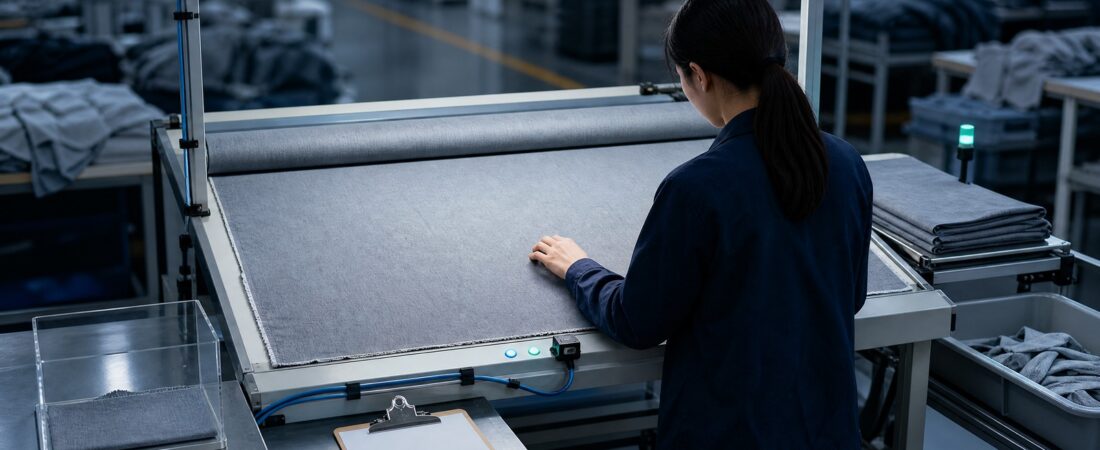
A quality camera finds no visible defect. An AI assistant reads the result. It calls a tool and changes the QC status. The system returns success.
Has the factory proved that the lot can move?
Not yet.
The camera may have seen the wrong style or revision. The tool may have changed a draft record while the live MES record stayed on hold. A network delay may have returned an old result. The AI may have checked one image when the rule required three views. A supervisor may still need to review an exception.
A correct answer is not the same as a controlled action. A successful tool call is not the same as a verified final state.
This is why factories need an action assurance case for important AI-assisted work.
An action assurance case is a connected record for one action. It shows the evidence, scope, constraints, tool path, execution signals, final state, reviewer, and rollback option. It is not an FAA certification, a safety guarantee, or a replacement for the factory’s quality and authorization procedures.
Start by defining one use case and its operating conditions in the Factory AI Readiness Hub. Action assurance begins after that scope is clear.
Why “tool success” is not release evidence
Digital systems produce many receipts. An API can return HTTP 200. An agent can report that a task is complete. A robot controller can accept a command. A dashboard can turn green.
These receipts only prove that one step responded. They do not prove that the intended factory result happened.
A factory action often crosses several layers:
- A source claim or sensor reading starts the task.
- An AI system interprets it.
- A tool sends a command.
- A server accepts or rejects the command.
- A machine, QC record, WIP state, or shipment status changes.
- A responsible person checks the result and releases or holds the work.
A weak control system records only step 3. A stronger system connects the whole path.
Recent AI evaluation work supports this separation. A large Hugging Face reproduction project treated an agent’s own verification result as untrusted and kept claim-level code, artifacts, and traces for separate review. Cloudflare’s MCP security work separates tool activity across the client, network, and server because no single control point sees every path. NVIDIA’s observability guidance shows how a visible failure in one layer can begin in another layer.
Factories should not copy these systems directly. The useful lesson is simpler: a result needs connected evidence across the path that produced it.
The seven parts of a factory AI action assurance case
1. Claim evidence
Write down exactly what the AI is claiming.
Inspection complete is too broad. A better claim is:
Three required images for style A, color navy, lot 24 were checked against defect rule revision 6. No open-seam indication above the review threshold was found.
Then connect the claim to its source evidence: image IDs, sensor records, document revision, lot, style, timestamp, and sample scope.
The AI’s explanation is not the evidence. It is only a description of the evidence.
2. Task scope and pre-state
Record the state before the action.
For a garment QC use case, this may include:
- style, PO, color, size, and lot;
- inspection stage and sampling rule;
- current QC status;
- open hold or rework status;
- machine, line, or work area;
- the document and rule revision in use.
This prevents a technically correct result from being applied to the wrong work.
3. Constraints and permission
List what the system is allowed to do.
A first pilot may allow the AI to read records and prepare a draft. It may not allow the AI to release a shipment, close a CAPA, change a safety setting, or overwrite a buyer-approved specification.
Useful permission stages are:
- read-only;
- draft-only;
- approval required;
- limited execution;
- blocked action.
The permission should be visible in the action record. It should not depend on the AI remembering a sentence in a prompt.
4. Tool path
Record how the action moved through the system.
Which client requested the action? Which tool was called? What arguments were sent? Did the request pass through the approved broker or portal? Which server handler executed it? Did a local script or direct API bypass the normal route?
This matters because an approved server does not prove that every path to it was approved. Local tools and off-network paths can create blind spots.
5. Execution telemetry
Keep the small set of signals needed to understand the action.
For vision QC, the useful chain may be:
- Camera
- Image transfer
- Edge device
- Model
- Queue
- QC application
- Record system
A defect miss may begin with poor exposure, a stale camera configuration, network loss, thermal throttling, an old model version, or a delayed queue. More dashboards will not help if nobody knows which signal leads to which action.
Track only signals with an owner and a response. A green average can hide one failed camera or one slow link.
6. Final state and contradiction check
After the tool reports success, read the real final state again.
Did the correct QC record change? Is the lot still on hold elsewhere? Did the robot finish the physical move? Did the WIP count change once, not twice? Does the final state match the intended state?
Also check for contradictions. A QC draft that says pass must not override an open needle-control incident, missing inspection image, or unreleased specification revision.
The final-state readback is stronger evidence than the tool’s success message.
When records cross machines, PLCs, edge systems, MES, and ERP, first check the data-layer path from PLC to ERP.
7. Human review and rollback
Name the person or role responsible for the final decision.
The reviewer should see the claim, supporting evidence, exceptions, permission level, final state, and unresolved contradictions. The decision can then be recorded as release, hold, rework, or rollback according to the factory’s own procedure.
High-impact actions should remain with responsible people. This includes shipment release, quality disposition, buyer communication, safety settings, and irreversible writes to production systems.
Field reference: fabric inspection and verification questions
A garment QC example
Consider a vision assistant checking an open seam near a cuff.
The camera captures three views. The model marks the defect probability below its review threshold. The assistant prepares a QC status update.
The example assumes that the team has already defined real-defect evidence for factory-line inspection.
A weak record says:
AI inspection passed. Tool call successful.
A useful assurance record says:
- Claim: no open-seam indication above the review threshold;
- Scope: style A, navy, size M, lot 24, cuff operation, rule revision 6;
- Evidence: three image IDs and camera configuration;
- Pre-state: QC hold remains open pending supervisor review;
- Permission: draft-only;
- Tool path: approved QC assistant → broker → QC draft endpoint;
- Telemetry: camera, edge device, model version, queue, and endpoint healthy;
- Receipt: draft record created;
- Final state: live lot remains on hold; draft exists in the correct record;
- Contradiction: one required trim check is still missing;
- Reviewer: line QC supervisor;
- Decision: hold until the trim check is attached.
The AI result did not fail. The factory control worked because the missing evidence stopped release.
Factory AI Action Assurance Record
Use one record for one important action. Keep it short enough for a pilot team to complete.
What is being claimed? Which images, records, sensors, or documents support it?
Which style, lot, machine, revision, WIP state, and hold status apply?
What is allowed, approval-required, or blocked?
Which client, broker, network route, server, and arguments were used?
Which execution signals and intermediate receipts were recorded?
What changed in the real system or physical process?
Which missing evidence, open hold, or conflicting status remains?
Who decides, and how can the action be rolled back or corrected?
This record can begin as a spreadsheet, form, or structured log. A large platform is not required for the first test. The important point is that the fields share one action ID and can be reviewed together.
Three mistakes factories should avoid
Mistake 1: treating the AI report as proof
A fluent report can hide a missing image, wrong revision, narrow sample, or stale state. Keep the source evidence separate and accessible.
Mistake 2: watching only the application layer
The application may look healthy while the camera, network, edge device, queue, or record system is failing. Map the minimum end-to-end chain.
Mistake 3: automating the final release too early
Begin with read-only comparison and draft preparation. Add limited execution only after the team can explain errors, verify final state, and recover safely.
A practical first pilot
Choose one repeated, reversible action. Do not start with shipment release or machine safety control.
Use the Factory AI Readiness Scorecard to check whether safety, ownership, data access, and action control are ready for that narrow pilot.
A good first pilot could be an AI assistant that compares inspection evidence and prepares a QC draft. Run it beside the existing process. For each draft, save the eight record fields above. Review false alarms, missed evidence, tool-path gaps, final-state mismatches, and time saved.
The pilot question is not only, Was the AI answer correct?
Ask:
- Did it use the correct evidence and revision?
- Did it stay inside its permission?
- Can we see the full tool path?
- Can we explain a failure across the chain?
- Did we verify the real final state?
- Did a responsible person review the exceptions?
- Can we recover without losing the original record?
If these questions cannot be answered, the action is not ready for wider execution. That does not mean the technology has no value. It means the factory still needs a clearer evidence and control path.
Sources checked and claim boundary
This article translates several public architecture and evaluation signals into a factory review pattern:
- Hugging Face: ICML 2026 Open Reproductions — claim-level artifacts, traces, and independent review. Its statistics belong to that challenge and should not be generalized to all AI research or factory systems.
- Cloudflare: MCP security updates — client, network, and server visibility. This is first-party architecture guidance, not proof that one product sees every tool path.
- NVIDIA: Full-stack observability for AI factories — failure domains and actionable telemetry. AI data-center architecture should not be copied directly into a factory edge environment.
- NIST AI Risk Management Framework — a broader reference for governing, mapping, measuring, and managing AI risk.
The Factory AI Action Assurance Record is an FAA editorial framework. It has not been validated as a universal industrial standard, safety case, audit method, or compliance requirement. Each factory must adapt it to its own process, legal duties, quality system, buyer requirements, and responsible approval roles.
Final factory check
Before factory AI changes a record or releases work, connect the evidence to the action and the action to the real final state.
Do not ask only whether the model was right.
Ask whether the factory can prove what the system saw, what it was allowed to do, which path it used, what actually changed, what remains uncertain, and who accepted responsibility for the result.
That is the difference between an AI answer and a controlled factory action.