Local-AI architecture decision note
Local AI hardware should be approved only after the factory knows which information is too sensitive, too slow, or too operationally important to send outside the site. AMD, NVIDIA, and AI PC announcements are useful signals, but the factory decision is architecture first, device second.
Hardware is compared before workflow risk
The common mistake is to compare chips, GPUs, or workstations before mapping the workflow. A powerful local box still fails if buyer manuals, defect images, SOPs, maintenance logs, and production rules are scattered or not permission-controlled.
Checks before buying local AI hardware
- Which workflows require local inference because of buyer confidentiality, image data, response time, or internet reliability?
- Can the factory maintain the device, model, storage, security patching, and user permissions without depending on one technical person?
- Is the first use case small enough to prove value before buying a wider hardware fleet?
Proof requests for local-AI architecture vendors
- Run a demo using factory-style documents, defect photos, and SOP fragments rather than generic benchmark prompts.
- Show memory, storage, update, backup, and access-control requirements for a one-year operating period.
- Compare the local architecture with a cloud or hybrid alternative using cost, risk, response time, and evidence control.
Protected-workflow architecture gate
GO if local AI improves a protected workflow with clear support ownership. HOLD if the workflow is valid but data preparation is incomplete. REDESIGN if the purchase is driven by hardware excitement rather than factory operating risk.
Local AI for factories is no longer just a cloud-computing discussion. It is becoming a practical question about where factory intelligence should run: in a remote data center, inside the enterprise network, or directly beside the production process.
The buying gate should therefore separate device excitement from architecture discipline: what stays local, who can access it, how updates are controlled, and which factory workflows justify on-site inference.
A recent short video of AMD CEO Lisa Su showing a hand-sized AI computer is a useful signal, but the story should not be limited to that clip. AMD’s own Ryzen AI Max materials and NVIDIA’s DGX Spark product materials point in the same direction: high-memory, desktop-class AI systems are being positioned for local model development, local inference, and on-device agent workflows. In practical terms, local AI for factories is moving from an abstract future concept into a realistic architecture discussion.
For a general technology audience, this looks like another hardware race. For factory leaders, it raises a more important question: what changes when useful AI can operate close to production data, quality evidence, SOPs, and daily operational decisions?
This article uses AMD and NVIDIA as signals, not as a buying recommendation. The real lesson is bigger than any single device: local AI for factories could become an operating layer for secure, on-site manufacturing intelligence.
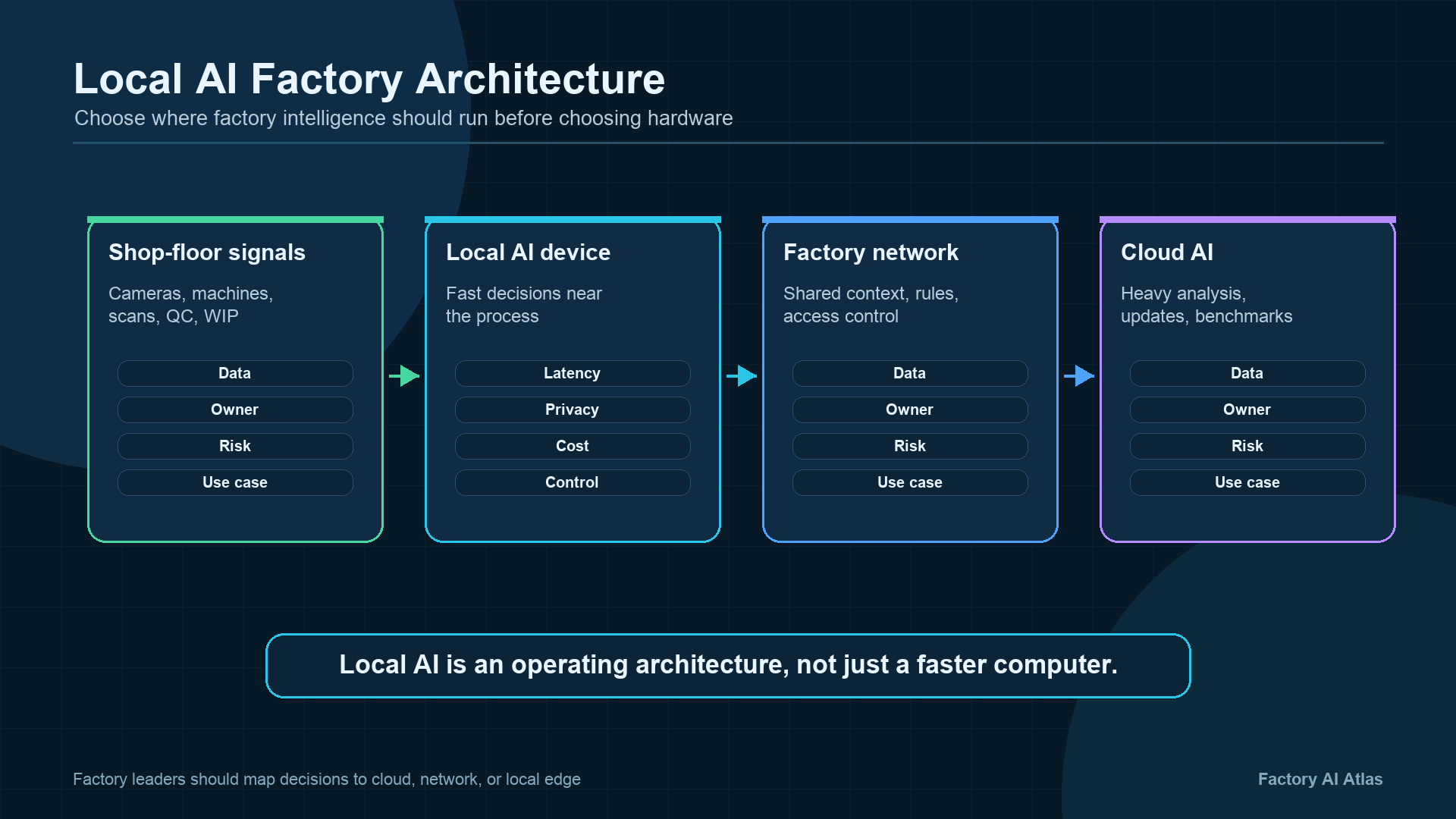
The real shift is not the device. It is the architecture.
Most teams still think of AI as a remote service. A user enters a prompt, data travels to a cloud server, the model processes it remotely, and the answer returns. That architecture works for many office tasks.
Manufacturing is different. Factory data is sensitive, messy, time-critical, and physically connected to real production events. Defect images, buyer manuals, line output reports, costing sheets, and shipment-risk notes may reveal operational weaknesses or customer information that should not casually leave the factory environment.
That is why the important shift is not “a smaller computer.” The important shift is the possibility of running more AI workloads on local hardware, closer to the factory floor. For manufacturers, local AI for factories means intelligence can sit nearer to production evidence, not only inside a remote cloud account.
AMD is one signal: large local models on high-memory AI PCs
The YouTube Short that triggered this article shows Lisa Su presenting a compact AI development system and describing local model execution, Ryzen AI Max processing, and high-speed unified memory. That clip is useful as a visual signal, but it should not be the only source.
AMD’s public developer and blog materials provide a broader foundation. AMD describes Ryzen AI Max+ systems with 128GB unified memory, Variable Graphics Memory, local LLM workflows, and local model execution using tools such as LM Studio and llama.cpp. AMD materials also discuss local execution of large models, including up to 128-billion-parameter workflows on Windows with LM Studio and larger model experimentation depending on model, quantization, drivers, and system configuration.
For factories, the technical details matter less than the direction. AMD is positioning AI PC-class systems as machines that can run meaningful AI workloads locally, not only as thin clients for cloud AI. This strengthens the case for local AI for factories where data privacy, speed, and operational context matter.
NVIDIA is another signal: desktop AI systems for local agents
NVIDIA’s DGX Spark points to the same market direction from a different ecosystem. NVIDIA describes DGX Spark as a personal AI supercomputer and desktop agent computer powered by the GB10 Grace Blackwell Superchip. Its product page states that the system provides 128GB of coherent unified system memory and can run AI development and testing workloads with models up to 200 billion parameters at the desktop. NVIDIA also notes that two systems can be connected for workloads with models up to 405 billion parameters.
The manufacturing implication is clear: major chip companies are not only competing in cloud data centers. They are also building a category of local AI machines for developers, agents, and high-memory workloads.
That is why local AI for factories should be treated as a strategic architecture trend, not a one-off viral hardware demo.
7 critical lessons for factory leaders
1. Do not start with hardware. Start with factory data risk.
A defect photo is not just an image. It may reveal a buyer, product category, process weakness, or shipment risk. A production report may reveal capacity, efficiency, or internal bottlenecks. A costing file may reveal supplier strategy.
Local AI does not eliminate every security issue, but it changes the risk model. A local AI for factories approach can reduce the need to send sensitive operational data to public AI tools or external cloud systems for routine analysis.
2. Use local AI where delay is expensive.
A factory problem often loses value if the answer arrives too late. If a sewing line is falling behind, the factory does not need a beautiful report next week. It needs a useful explanation now.
- Which operation is slowing the line?
- Is the bottleneck caused by skill, method, machine, material, or feeding?
- Which defect type is increasing today?
- Which order is most likely to miss shipment?
The purpose is not to replace managers. It is to help managers see earlier and decide faster.
3. Treat buyer manuals as a local knowledge base.
Garment factories manage large volumes of buyer documents: quality manuals, packing standards, measurement tolerances, labeling rules, compliance requirements, testing protocols, and defect classification guides.
A local AI system could allow QA, merchandising, and production teams to query these documents without uploading confidential buyer files to public AI tools. This is one of the clearest near-term use cases for local AI for factories.
4. Turn defect images into quality learning.
Visual quality data is one of the most underused assets in apparel factories. Factories often collect defect photos, but the information is rarely structured into a learning system.
Local AI could help classify and summarize defect patterns such as broken stitch, puckering, open seam, uneven topstitch, oil stain, shade mismatch, measurement issue, labeling error, and packing defect.
Example insight: “Most rework today is concentrated in side-seam puckering on Line 4. The issue appears after operation 7 and increased after the fabric lot change.”
That kind of explanation is more useful than another dashboard with red numbers.
5. Support IE and line balancing with operational explanations.
Industrial Engineering teams already work with SMV, SAM, GSD, layout planning, WIP flow, and operator allocation. But in many factories, the gap between standard time and actual performance is still reviewed manually.
Local AI can help compare standard time against actual output, planned layout against real bottlenecks, skill matrix against assigned operation, WIP movement against line balance, and defect rate against operation sequence.
Example insight: “The line is not behind because total manpower is insufficient. The delay is concentrated at collar attachment, where two operators are running below planned efficiency and WIP is accumulating before final assembly.”
6. Build factory training assistants from internal SOPs.
Training is another practical opportunity. A local AI system could answer factory-specific questions from new supervisors, QA inspectors, line leaders, mechanics, production clerks, and merchandising assistants.
- How do we check SPI for this product?
- What should a line leader do when hourly output drops below plan?
- What is the escalation process for repeated measurement defects?
- How should we explain this defect to the buyer?
For apparel factories, this could become a practical training layer built on existing SOPs, manuals, defect libraries, and production reports. This is where local AI for factories becomes more than infrastructure: it becomes a daily supervisor-support tool.
7. Prepare the operating system before buying the AI box.
The factories that benefit most will not be the ones that simply buy the newest local AI machine. They will be the ones that prepare the knowledge base the machine needs.
- Organized SOPs
- Structured buyer manuals
- Defect taxonomies
- Standardized production reports
- Digital QC records
- Skill matrices
- IE standard time data
- Clear escalation rules
A local AI machine is only useful if the factory has knowledge worth running through it. The real preparation is not hardware purchasing. The real preparation is turning factory experience into structured operational intelligence.
Cloud AI and local AI will both matter
This does not mean cloud AI disappears. Cloud AI will still matter for large-scale training, enterprise integration, benchmarking, and advanced analytics.
But local AI will matter where factories need security, speed, control, offline capability, internal knowledge access, and real-time operational support. The strongest local AI for factories use cases will be the ones tied to real factory decisions, not generic chatbot demonstrations.
The future factory will likely use both: cloud AI for scale, local AI for factories where control is critical, and human managers for judgment.
For related FAA frameworks, see the Factory AI Readiness guide and the Factory AI checklists.
Final factory takeaway
The future of factory AI is not just about bigger models. It is about putting the right intelligence in the right place.
AMD and NVIDIA are showing that powerful local AI systems are becoming a serious category. The factory question is not “Which box is best?” The factory question is “Which operational problems should stay close to the shop floor, the data, and the people who make daily decisions?”
That is the real opportunity behind local AI for factories.
Source notes for local-AI architecture
- AMD developer article: AMD Ryzen AI Max+395: A Leap Forward in Generative AI Performance with Consumer PC.
- AMD blog: AMD Ryzen AI Max+ Upgraded: Run up to 128 Billion parameter LLMs on Windows with LM Studio.
- AMD blog: AI Unleashed: How Ryzen AI Max+ Makes Supercomputing Personal.
- NVIDIA product page: NVIDIA DGX Spark personal AI supercomputer.
- Original discovery video: YouTube Short showing Lisa Su presenting the compact AMD AI system. This article uses the clip as a starting signal, not as the only evidence source.
Editorial note: hardware specifications, supported model sizes, and local inference performance depend on model architecture, quantization, memory allocation, driver version, software stack, and workload. This article focuses on manufacturing implications, not product benchmarking or purchase advice.
External validation anchors for local AI architecture
- NIST AI Risk Management Framework — useful for local AI governance, accountability, and risk boundaries.
- NIST Cybersecurity Framework — relevant when local AI hardware stores sensitive factory, buyer, worker, or product information.