Choose the next operating layer—not the most advanced tool
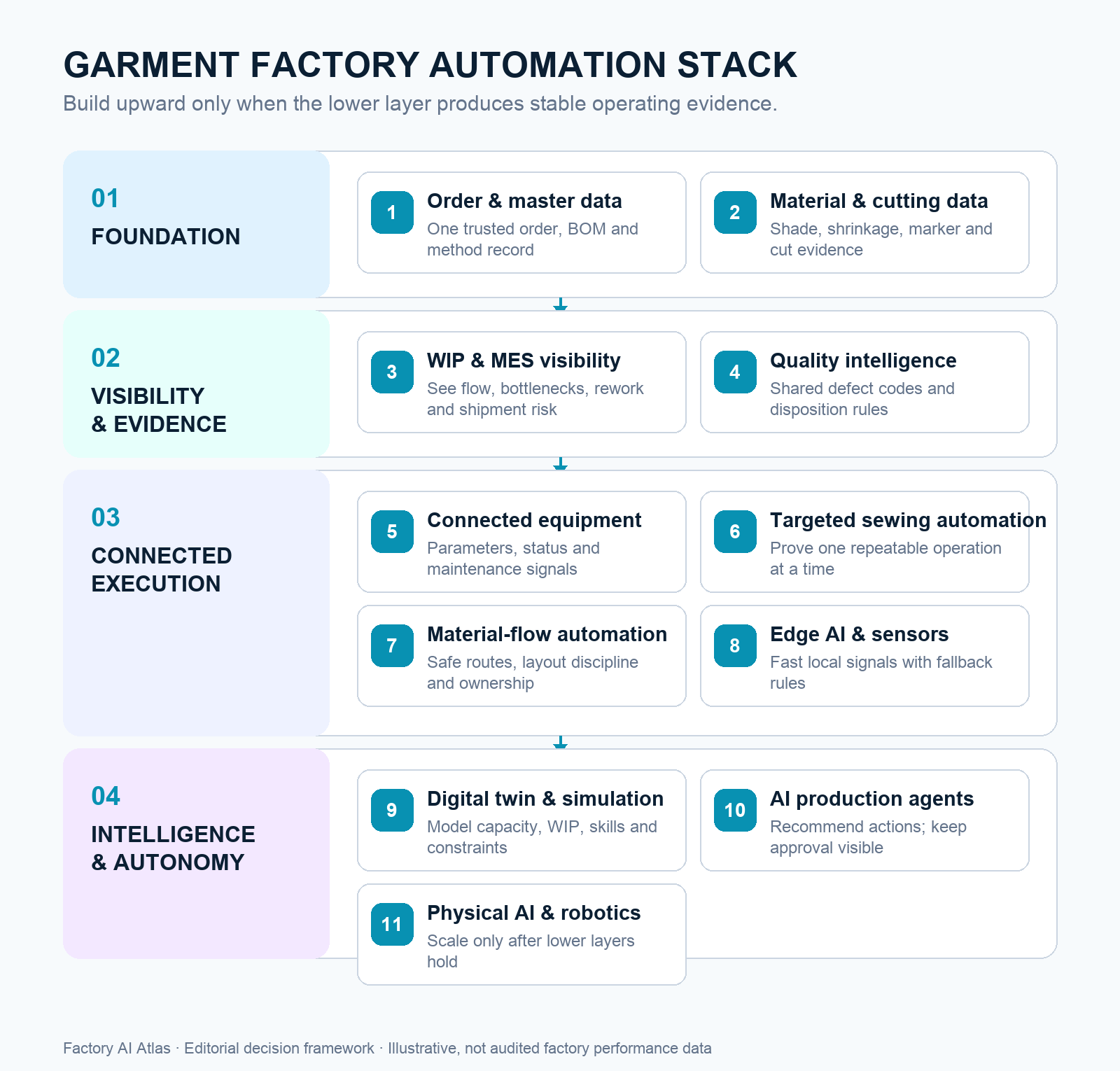
Use this stack as an investment sequence. Approve a higher layer only when the lower layer has stable inputs, a named exception owner, and evidence that works beyond a showcase test.
- GO: stable evidence and a clear owner.
- HOLD: the use case is sound, but lower-layer proof is incomplete.
- REDESIGN: the proposed tool is masking a basic control gap.
The garment factory automation stack moves from trusted order and material data to production evidence, connected execution, and finally intelligence and autonomy. A factory does not need every layer at once; it needs to know which missing layer will block the next investment.
Foundation: trusted production inputs
Layer 1: Order and Master Data
The first layer is not a machine. It is the data that defines the work: order information, BOM, material status, color and size breakdown, operation breakdown, SMV or SAM, machine requirements, quality standards, and shipment plan.
If this layer is weak, every higher layer becomes less reliable.
Advance when: one controlled record defines the order, BOM, method, quality requirement, and shipment commitment.
Layer 2: Material and Cutting Data
Many sewing problems begin before sewing. Fabric relaxation, shrinkage, shade lots, marker efficiency, spreading tension, cutting accuracy, numbering, bundling, and defect mapping all affect the sewing floor.
Smart cutting systems, CAD, auto spreading, automatic cutting, and cut panel tracking form one of the most mature automation layers in apparel manufacturing.
Advance when: Shade, shrinkage, cut accuracy, numbering, and bundle identity can be traced to the sewing floor.
Visibility & evidence: see and classify the loss
Layer 3: WIP and MES Visibility
The next layer is WIP visibility. Factories need to know where the order is, where the bottleneck is, how much rework exists, and whether packing is at risk.
MES, QR codes, barcodes, RFID, dashboards, and line monitoring tools create the production visibility required for better decisions.
Without this layer, advanced automation may work locally but fail system-wide.
Advance when: supervisors can locate WIP, label the bottleneck, and close an exception during the same shift.
Layer 4: Quality Intelligence
AI vision and quality analytics can support fabric inspection, print checks, embroidery inspection, label verification, trim checks, inline alerts, defect heatmaps, supplier feedback, and CAPA evidence.
Quality intelligence should be tied to buyer standards and factory disposition rules. AI can improve detection and consistency, but final QC remains a factory judgment linked to shipment risk.
Advance when: Defect codes, buyer limits, disposition authority, and corrective-action evidence are consistent.
Connected execution: control machines and movement
Layer 5: Connected Sewing Equipment
Connected sewing machines, digital parameter control, adaptive feed support, automatic trimming, operation memory, machine status, and maintenance alerts create a bridge between manual sewing and robotic automation.
This layer gives supervisors better visibility into machine utilization and process stability.
It also prepares the factory for more advanced AI-assisted equipment.
Advance when: parameter, status, downtime, and maintenance signals have an owner and a response rule.
Layer 6: Targeted Sewing Automation
Targeted sewing automation includes template sewing, programmable pattern sewing, pocket setting, label attachment, bartack, buttonhole, hemming, waistband operations, and selected robotic sewing cells.
This layer should be deployed operation by operation. The right question is not whether the machine looks advanced. The right question is whether it improves line balance, reduces WIP, lowers rework, and survives changeover.
Advance when: one operation stays repeatable through changeover and improves flow—not only machine speed.
Layer 7: Material-Flow Automation
AMRs, AGVs, smart carts, automated forklifts, warehouse systems, and conveyor or hanger systems can improve material movement.
In many factories, moving fabric, bundles, trims, and cartons is easier to automate than sewing fabric. This layer can reduce waiting time and material chasing.
But it requires layout discipline, safety rules, traffic management, and integration with WMS or MES.
Advance when: routes, safety zones, traffic priority, fallback handling, and MES or WMS ownership are proven.
Layer 8: Edge AI and Factory Sensors
Some factory decisions must happen close to the machine. Edge AI can support real-time inspection, anomaly detection, safety alerts, label verification, packing checks, and machine monitoring without sending every signal to the cloud.
For garment factories, edge AI is especially relevant where cameras, sensors, and machines need fast local decisions.
Advance when: Local signals have thresholds, false-alert review, cybersecurity controls, and a manual fallback.
Intelligence & autonomy: recommend, simulate, then act
Layer 9: Digital Twin and Simulation
A practical garment digital twin may not be a photorealistic 3D factory. It may be a capacity model built from SMV, WIP, operator skill, machine constraints, rework rates, and shipment deadlines.
Useful applications include line balancing, style change simulation, capacity planning, manpower planning, cutting-room load, and packing bottleneck prediction.
Advance when: model assumptions match current SMV, WIP, skill, machine, rework, and shipment constraints.
Layer 10: AI Production Agents
The first useful AI agent in a garment factory may not be a robot. It may be a production-control assistant that watches WIP, material delays, defects, rework, absenteeism, packing status, and shipment risk.
This agent can help supervisors focus on the next action: which line is behind, which material delay matters, which defect is increasing, and which shipment needs attention.
Advance when: recommendations cite the triggering evidence and a human retains visible approval authority.
Layer 11: Physical AI and Future Robotics
Physical AI connects perception, simulation, control, robotics, and real-world factory feedback. In apparel, this may eventually support deformable fabric handling, robotic sewing, folding, sorting, and adaptive workstations.
But this top layer needs the lower layers. A robot without process data, quality standards, maintenance routines, and line integration is not a factory solution.
Advance when: the lower layers remain stable and the cell can recover safely from fabric, quality, or equipment variation.
Final factory approval check
The stack is not a shopping list or a claim that every factory needs all 11 layers. Start with the first weak control point: invisible WIP, unstable cutting, inconsistent defect codes, missing maintenance ownership, or another lower-layer gap.
Approve the next investment only when the team can show stable inputs, a named owner, a working exception rule, and proof from normal production. The future garment factory will be defined less by one advanced machine than by how reliably people, data, equipment, quality, logistics, and AI work together.
Related Factory AI Atlas reading
- Factory AI Readiness Hub
- Factory AI Readiness Scorecard
- Why Garment Factory Automation Is So Difficult
- What Is Physical AI?
Technical and industry reference anchors
- OPC Foundation overview of OPC UA
- NIST Cybersecurity Framework for connected systems
- IFR industrial robot information
Factory AI Atlas is written from a manufacturing operations perspective shaped by hands-on apparel and textile production experience, including overseas factory management, woven and knit operations, production control, quality systems, and operational restructuring.
The site focuses on vendor-neutral, evidence-aware, and ROI-realistic guidance for AI, robotics, automation, and factory readiness. See the Editorial Policy & Disclaimer for sourcing standards and AI-use disclosure.