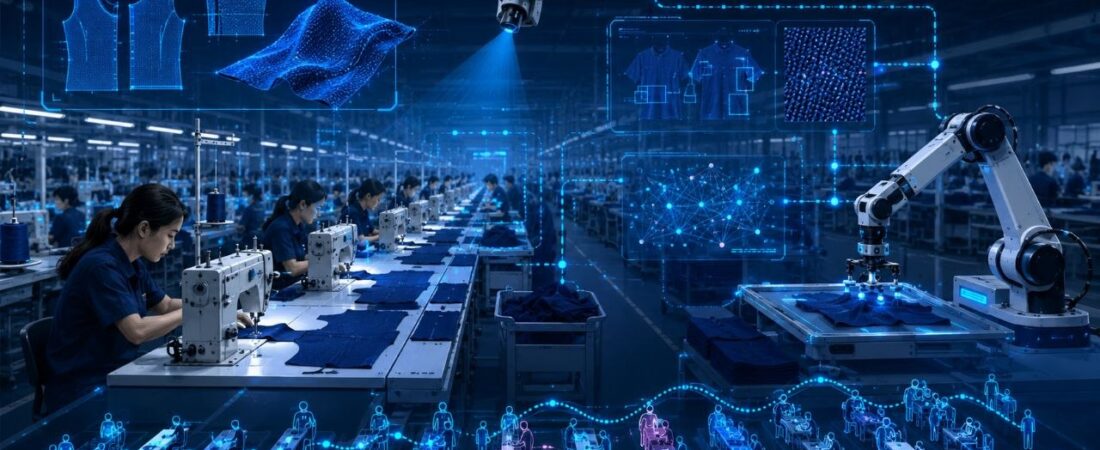
Factory decision note
Garment automation should not be approved because a demo looks smooth. It should be approved only when the factory can prove the operation, fabric family, quality rule, line balance, and support team will hold up in daily production.
Real sewing-floor risk, not robot drama
The trap is to judge automation like rigid-part manufacturing. Apparel work moves under the operator’s hands: fabric stretches, seams shift, trims interrupt the flow, and buyer quality tolerance changes by style. If those conditions are not tested, the ROI model is mostly a sales story.
What I would check before approving budget
- Which exact operation and product family will be tested, and how often does it repeat?
- What is the current baseline for SMV, output, WIP, defects, changeover, downtime, and rework?
- Who owns setup, maintenance, quality disposition, line balance, operator training, and fallback when the system stops?
Vendor proof requests
- Run the pilot on real production fabric, trims, sizes, and quality standards — not prepared demo material.
- Show output, defect movement, intervention time, changeover time, downtime, support labor, and fallback results.
- Compare the automation case against a practical work-aid, attachment, layout, or method-improvement alternative.
Pilot gate
GO if the whole process improves, not only the machine cycle. HOLD if the trial works but fabric/style variation is still unproven. REDESIGN if the project depends on heroic supervision, hidden support labor, or a fragile one-style demo.
Industrial robots are spreading quickly across manufacturing. According to the International Federation of Robotics, 542,000 industrial robots were installed in factories in 2024, and the global operational stock reached 4.66 million units. From automotive welding to electronics assembly and warehouse movement, automation is no longer a future concept.
So why does garment factory automation still feel difficult?
The short answer is that apparel production is not just a sequence of repetitive motions. It is a production system built around flexible materials, changing styles, human judgment, line balancing, quality control, and narrow margins. A sewing operator is not only moving fabric under a needle. The operator is aligning edges, managing tension, correcting small distortions, checking quality, and adapting to fabric behavior in real time.
Factory summary: why garment automation is harder than it looks
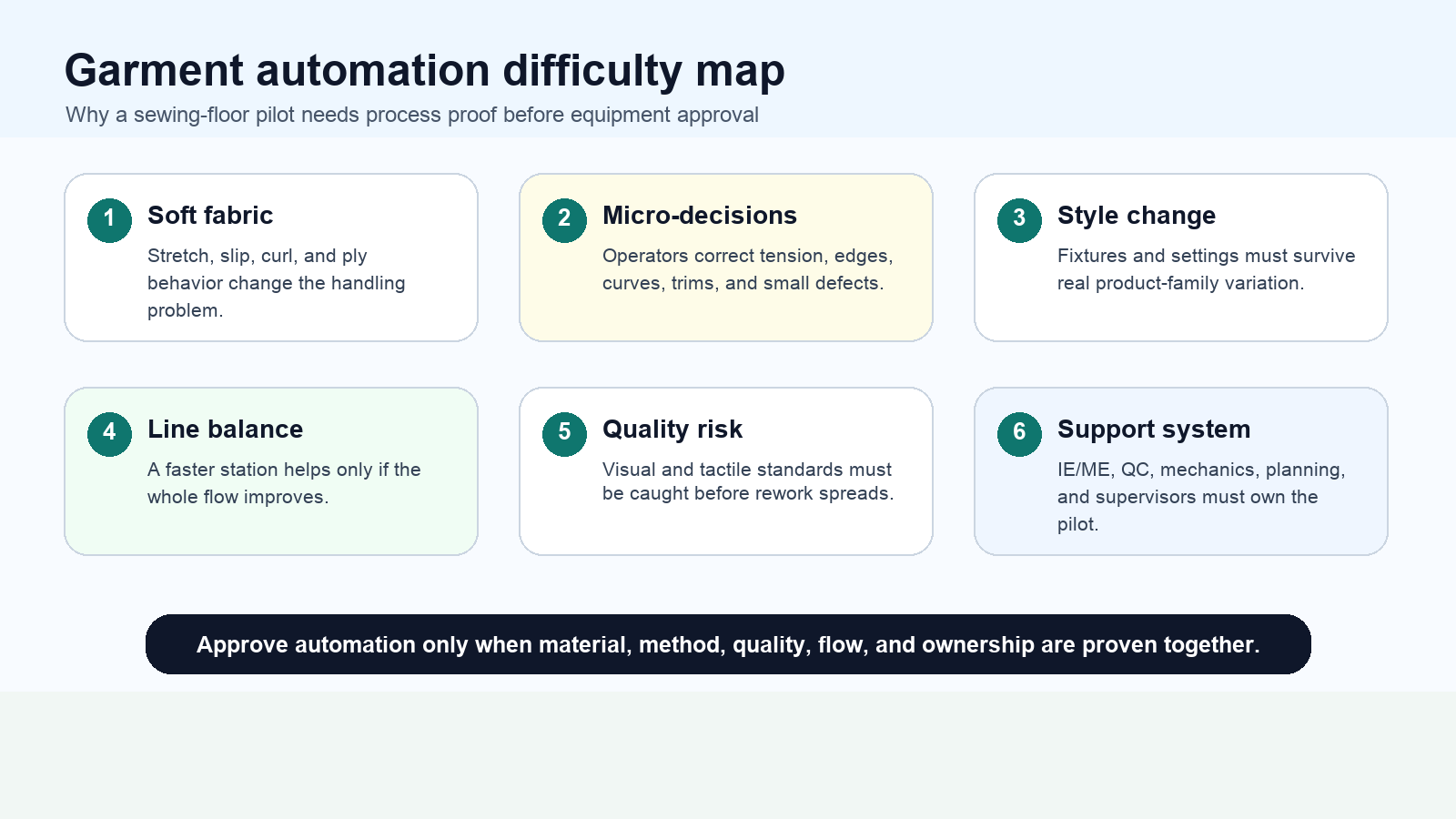
Garment factory automation is difficult because apparel production combines flexible fabric, changing styles, operator micro-decisions, line balancing, quality judgment, maintenance discipline, and narrow ROI windows. A robot demo can show one seam, but a factory must control the whole production system around that seam.
- Fabric stretches, slips, curls, and reacts differently by construction and wash.
- Sewing quality depends on small real-time corrections, not only needle movement.
- Style changeover can erase the benefit of a narrowly trained automation cell.
- Line balance and WIP behavior decide whether machine speed becomes real output.
- QC decisions are visual, tactile, contextual, and buyer-specific.
- Mechanics, supervisors, IE/ME, QC, and planning must support the system after installation.
That is why I would not treat garment automation as a simple robot purchase. I would treat it as a process-readiness test: material control, method stability, quality response, operator training, and realistic ROI must be visible before the machine gets credit.
Sewing-floor reality check
On a sewing floor, automation rarely fails because the brochure was not impressive. It fails because the surrounding process is not stable enough. Fabric tension, bundle handling, operator sequence, quality tolerance, and style-change rules decide whether a machine can repeat the same result after the vendor leaves.
If you are new to the broader concept behind factory automation, start with our guide to Physical AI in smart manufacturing. Physical AI becomes useful when machines can perceive, reason about, and act in real production environments. Garment factories are one of the hardest places to apply that idea.
Machine assist is not a full automation plan
Recent AI-assisted sewing machines show an important direction for garment factory automation. Instead of replacing the whole sewing process at once, some systems now focus on narrower but useful problems: detecting fabric thickness, adjusting feed torque, changing foot pressure, reducing thread breakage, and helping operators handle different materials with fewer manual adjustments.
That is useful, but it is not the same as automating the sewing floor. The operator, line balance, bundle flow, quality standard, and style changeover still decide the result. In many factories, assisted machine control is a better near-term step than waiting for an end-to-end robotic sewing cell.
Some newer industrial sewing machines now describe features such as AI-assisted fabric adaptation, feed torque control, foot pressure control, and IoT/cloud connectivity. These examples should not be read as a guarantee of full sewing automation, but they show where practical garment automation is moving first: machine-level control, data visibility, and operator support.
1. Fabric is not a rigid part
Many successful factory robots work with parts that are rigid, repeatable, and easy to locate. A metal bracket, plastic housing, or machined component normally keeps its shape. A robot can grip it, move it, and place it with predictable geometry.
Fabric does not behave that way.
In garment factory automation, the machine must deal with fabric behavior that changes from style to style, lot to lot, and even operator to operator.
A cut panel can stretch, curl, wrinkle, sag, slide, or fold over itself. Two pieces from the same style may behave differently if the fabric lot, humidity, cutting tension, or operator handling changes. Knit fabric moves differently from denim. Lightweight woven fabric behaves differently from coated material. A slippery lining fabric creates a different problem from a thick fleece panel.
For a human operator, these variations are normal. The operator adjusts by feel and sight. For a robot, those small changes can break the process.
This is one reason apparel automation is harder than automation in many rigid-part industries. The machine is not only moving an object. It must understand a deformable material that changes shape while it is being handled.
2. Sewing is not one simple repetitive action
From a distance, sewing looks repetitive: pick up fabric, align it, sew the seam, move to the next piece.
In reality, sewing includes many micro-decisions:
- keeping fabric edges aligned,
- controlling tension with both hands,
- correcting small wrinkles before they become defects,
- managing curves, corners, and seam allowances,
- checking stitch quality,
- adapting to fabric thickness changes,
- handling labels, trims, pockets, zippers, elastic, or linings.
The International Labour Organization notes that automation in apparel and footwear manufacturing remains limited in some operations, and that sewing is still largely labor-intensive. The reason is not that sewing machines are primitive. The difficult part is the handling and control around the sewing operation.
A sewing machine can make stitches. The harder question is whether the system can reliably feed the right fabric pieces into the machine, in the right orientation, with the right tension, at production speed, across many styles.
That is the real automation challenge.
3. Garment factories change styles too often
A robot project becomes easier when the product is stable. If the same part runs for months, the team can design fixtures, sensors, programs, and quality checks around that one process.
Garment factories often operate differently.
A factory may change styles, colors, sizes, trims, fabric types, and order quantities frequently. Even when the operation name is the same, the actual handling may change. Attaching a pocket on one fabric can feel very different from attaching a pocket on another. Sewing a straight seam on a stable woven fabric is not the same as sewing a curved seam on a stretchy knit.
This variation creates hidden automation cost.
Every changeover may require new guides, folders, clamps, programs, training, quality settings, or maintenance checks. If the automation cell works well for one style but struggles with the next three styles, the ROI model becomes unstable.
This is why garment automation should be evaluated by product family, not just by machine capability. The question is not only “Can this operation be automated?”
The better question is:
Can this operation be automated across enough styles and volume to justify the engineering cost?
4. Line balancing can erase the benefit
Garment production is usually a connected flow. One operation affects the next. If one station becomes faster but the bottleneck moves elsewhere, total output may not improve as much as expected.
This is a common trap in automation planning.
A factory may automate one operation because it is labor-intensive or difficult to staff. The automated station performs well during a trial. But after installation, the line still misses target because the next operation cannot absorb the output, the feeding process is inconsistent, or quality checks create delays.
In that case, the automation was technically successful but operationally incomplete.
Before investing in garment automation, the team should measure:
- current standard minute value or standard allowed minutes,
- actual output by operation,
- WIP buildup points,
- defect and rework locations,
- operator skill variation,
- changeover time,
- downtime and waiting time,
- line balance before and after automation.
This connects directly to the robot automation ROI checklist. A robot ROI model that ignores bottlenecks, downtime, and integration cost will almost always look better on paper than in production.
5. Labor economics are not simple
Garment factories are often located in countries where labor cost is lower than in automotive, electronics, or advanced manufacturing hubs. That does not mean labor is cheap in the full business sense. Turnover, training, overtime, absenteeism, quality variation, and management time all carry cost.
But lower base wages do affect automation payback.
If a robot system is expensive, difficult to maintain, and only replaces a small number of low-wage tasks, the financial case may be weak. If the same system also reduces rework, stabilizes output, improves delivery reliability, or supports a hard-to-fill operation, the case may become stronger.
This is why garment automation should not be sold only as labor replacement.
The better ROI categories are often:
- output stability,
- reduced quality variation,
- lower rework,
- improved delivery reliability,
- reduced dependency on scarce skills,
- better data capture,
- safer handling of repetitive or fatiguing tasks.
For many apparel factories, the strongest automation case is not “remove operators.” It is “make the process more stable with the people and skills available.”
6. Garment quality is visual, tactile, and contextual
Quality control in apparel is not only dimensional. A seam may be technically sewn but still unacceptable because it puckers, twists, pulls, waves, shines, damages the fabric, or looks inconsistent next to another panel.
Some defects are visible. Some are tactile. Some depend on customer standards, brand expectations, fabric behavior, or final garment appearance.
This makes automation harder in two ways.
First, the machine must avoid creating defects during handling and sewing. Second, the factory must detect quality problems early enough to prevent rework from spreading through the line.
AI vision can help with inspection, but inspection alone does not solve the root cause. If feeding, tension, needle selection, folder setup, or operator-machine interaction is unstable, the defect will keep returning.
A practical garment automation strategy should connect vision, process control, and operator feedback. The goal is not only to find defects. The goal is to understand why they happen and reduce variation at the source.
7. The support system is often underestimated
Automation does not end at installation. It needs an operating system around it.
A garment factory considering automation needs answers to basic questions:
- Who owns the machine after go-live?
- Who adjusts it when the style changes?
- Who troubleshoots sensor or feeding problems?
- Who maintains spare parts?
- Who trains operators and mechanics?
- Who tracks performance by style and operation?
- Who decides whether the automation should be scaled to another line?
Without clear ownership, automation performance can fade after the first trial. The machine may still run, but the actual benefit drops because no one is responsible for continuous improvement.
This is especially important in garment factories where production teams are already under pressure from delivery dates, buyer changes, material issues, and daily line problems. Automation adds value only when it reduces operating complexity or creates measurable stability. If it becomes another fragile system to manage, the project will struggle.
The support system garment automation needs
The first question is not whether a robot can sew one seam. It is whether the factory can keep fabric, method, quality, line balance, and maintenance stable enough for that seam to matter. The supervisor owns method and WIP flow; the mechanic owns setup and downtime response; IE/ME validates SAM, balance, and changeover; QC defines acceptability and disposition; planning chooses a style family stable enough for the pilot to learn.
What garment factories should automate first
The difficulty of sewing automation does not mean garment factories should avoid automation. It means they should start in the right place.
Good early candidates often include:
- fabric spreading and cutting,
- pattern and marker optimization,
- bundle or material movement,
- barcode/RFID production tracking,
- digital quality inspection support,
- AI-assisted defect classification,
- digital SOPs and operator guidance,
- automated data collection from sewing lines,
- semi-automated folders, guides, and work aids,
- repetitive sub-processes with stable fabric and high volume.
These steps may look less exciting than a fully robotic sewing cell, but they often create the foundation that advanced automation needs. Better data, cleaner processes, stable methods, and clearer ownership make future robotics projects more realistic.
A practical readiness checklist
Before asking whether a garment operation can be automated, ask these questions:
- Is the fabric behavior consistent enough for mechanical handling?
- Is the operation stable across operators and shifts?
- Is the product family large enough to justify fixtures and programming?
- Will automation improve the real bottleneck or only one isolated task?
- Can quality standards be measured clearly enough for machine control?
- Does the factory have maintenance and technical ownership after go-live?
- Is the ROI based on total process impact, not only direct labor savings?
- Is there a manual fallback plan if the system stops?
- Can the process data be captured before and after installation?
- Does the automation reduce complexity, or does it add a new fragile dependency?
If the answer to several of these questions is unclear, the next step may not be buying equipment. The next step may be process stabilization, data collection, or a smaller pilot.
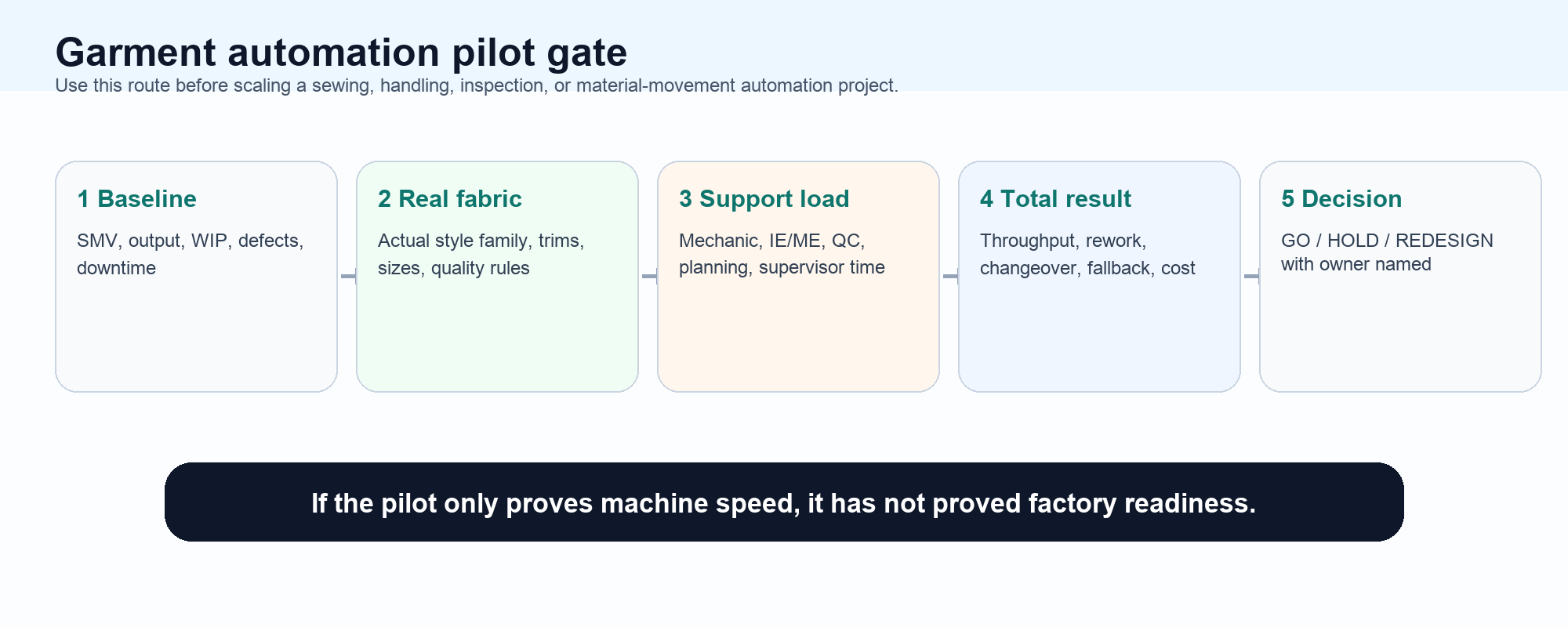
Final factory approval check
Garment factory automation is difficult because apparel production is built around flexible materials and human judgment. A sewing line is not just a set of machines. It is a living system of fabric behavior, operator skill, quality standards, delivery pressure, and constant variation.
That is also why the opportunity is meaningful.
Factories that understand the real difficulty can make better automation decisions. They can avoid expensive pilots that solve the wrong problem. They can start with process data, line balance, quality control, and stable sub-processes. Then, when robotics or Physical AI becomes practical for a specific operation, the factory is ready to use it well.
The future of garment automation will not arrive as one machine that replaces the whole sewing floor. It will arrive in layers: better baselines, better work aids, better inspection, better material handling, smarter machines, and finally more capable robotic systems for the few operations that are ready.
The factories that win will not be the ones that automate first. They will be the ones that automate the right process, for the right reason, with the right operating system behind it.
For readers comparing this with broader smart manufacturing adoption, the Factory AI Readiness Hub provides the wider path from Physical AI concepts to automation ROI decisions.
Garment automation buyer questions
Why is garment automation difficult? Because fabric behavior, sewing method, style change, quality judgment, and line balance change together. Why is sewing harder than rigid-part automation? The material bends, stretches, shifts, and requires judgment while being handled. What should factories automate first? Start with data discipline, cutting-room control, WIP visibility, QC records, maintenance response, work aids, and low-risk support processes before full sewing automation.
Is garment automation worth the ROI? It can be, but only when standard time, output, defect cost, downtime, changeover, and support capability are measured honestly against the real factory baseline.
Author and garment-automation perspective
Factory AI Atlas reviews garment automation from a manufacturing operations perspective shaped by hands-on apparel and textile production experience, including overseas factory management, woven and knit operations, production control, quality systems, IE routines, and operational restructuring.
The site focuses on practical, evidence-checked guidance for AI, robotics, automation, and factory readiness. The question is always the same: what would a factory need to prove before spending money or scaling the pilot? See the Editorial Policy & Disclaimer for sourcing standards and AI-use disclosure.
References
- International Federation of Robotics — World Robotics 2025 report
- International Labour Organization — The state of the apparel and footwear industry: Employment, automation and their gender dimensions
- Ajith et al. — Robotic Automation in Apparel Manufacturing: A Novel Approach to Fabric Handling and Sewing
For apparel and other labor-intensive factories, the Factory AI Readiness Scorecard can help separate a realistic first automation step from a technology wish list.
Continue the garment automation reading path
- What Garment Factories Should Automate First
- AI Sewing Machines Are Arriving Before Fully Automated Sewing Robots
- The Garment Factory Automation Stack: From Cutting Rooms to Physical AI
- Digital Product Passport for Garment Factories: Traceability Readiness
Sources checked for garment automation difficulty
- ILO textiles, apparel, leather and footwear resources — relevant for apparel-sector production realities and labor-intensive operations.
- NIST manufacturing resources — useful for grounding automation decisions in measurable process capability and improvement evidence.