
Robot-ROI baseline note
Robot ROI must start with the measured factory baseline
This article helps a factory decide whether a robot automation business case is grounded in real utilization, downtime, changeover, maintenance, integration cost, and operator workflow.
Ideal cycle time creates spreadsheet payback
The usual mistake is to calculate ROI from ideal cycle time and labor replacement while ignoring the unstable baseline that made the process expensive in the first place. If changeover, feeding, quality checks, maintenance, and waiting time are missing, the payback number is only a spreadsheet story.
Checks before approving robot ROI
- Current output, downtime, changeover, rework, and defect baseline
- Full integration cost: fixtures, conveyors, safety, software, maintenance, training
- Expected utilization under real style and order variation
- What the operator, mechanic, quality team, and supervisor must do differently
Vendor proof for real utilization
- Run the ROI model with pessimistic utilization, not only best-case speed.
- Show who handles jams, rework, inspection, maintenance, and replenishment.
- Prove cycle time across real product variation.
- Separate labor saving from capacity, quality, safety, and lead-time value.
ROI evidence gate: GO when the robot improves a measured bottleneck under real operating variation. HOLD when the payback depends on ideal speed. REDESIGN when the factory has not measured the baseline process well enough.
Evan Lee factory field note
Downtime and changeover decide robot payback
In apparel and labor-intensive factories, payback often looks attractive when the spreadsheet uses ideal cycle time. The real test is different: style changeover, operator support, maintenance response, blocked aisles, material waiting, quality rework, and buyer-priority changes. A robot pilot should carry these losses in the baseline before anyone accepts a payback number.
When a factory manager opens a spreadsheet and types “robot price ÷ labor savings = payback,” that formula is almost always wrong before the first number goes in. Calculating robot automation ROI accurately requires more groundwork than most project briefs allow. According to IFR’s World Robotics 2025 report, 542,000 industrial robots were installed globally in 2024 — yet deployment failures driven by flawed ROI calculations remain common. Before you commit capital to any automation project, these seven factors are worth reviewing. Most financial models undercount or miss them entirely.

Why Robot Automation ROI Calculations Often Disappoint
A familiar pattern: a project gets approved based on a simple payback estimate, the robot goes in, and eighteen months later the numbers don’t add up. Analysis compiled by Robotomated points to poor system integration (30% of failures), unrealistic ROI expectations (25%), and inadequate change management (20%) as the top three reasons robotic deployments fall short of targets. Most of these aren’t technology problems — they’re planning problems that start in the spreadsheet.
The following seven checks won’t make the math more optimistic. They will make it more accurate.
Robot automation ROI formula for real factory conditions
A useful robot automation ROI model should start with the process baseline, not with the robot price. The basic formulas are simple, but the inputs are where most factory projects fail.
- Annual net benefit = labor savings + quality savings + throughput gain + safety or risk reduction – added operating cost.
- ROI = annual net benefit ÷ total automation investment.
- Payback period = total automation investment ÷ annual net benefit.
The worksheet should include integration, tooling, fixtures, programming, training, downtime, maintenance, spare parts, floor layout changes, safety controls, process redesign, and manual fallback cost.
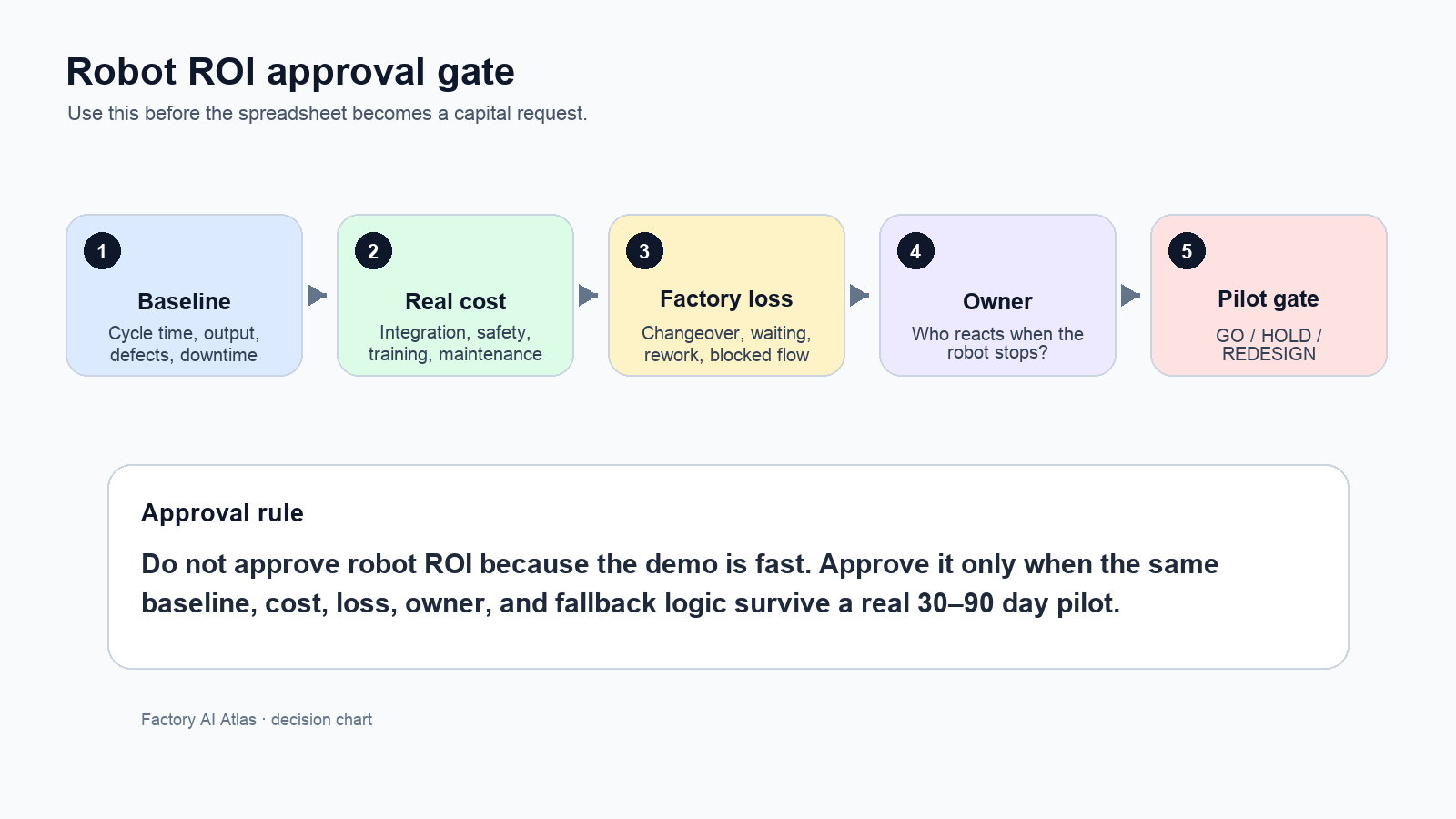
Factory approval check: ROI starts with the measured baseline
On a real factory floor, robot ROI is decided before the equipment is installed. I would not approve the budget until the target process has a measured baseline, stable input conditions, a known defect pattern, clear WIP behavior, and a named owner for downtime response. The practical question is not only “How much labor can this robot replace?” It is “Can this process prove improvement when style change, waiting time, rework, maintenance, and operator support are counted?”
1. Establish a Process Baseline Before You Model Anything
Why it matters
An ROI calculation is only as good as the baseline it’s measured against. If your current cycle time, defect rate, or throughput is not documented before automation begins, you’ll have no reliable way to measure whether the robot actually improved anything — or by how much.
What to do
Run a 30-day baseline measurement on the process you plan to automate. Capture average cycle time, reject rate, rework percentage, and output per shift across different operators and shifts. For garment manufacturing — where sewing line speeds vary significantly by operator skill level and fabric type — this step is especially critical. A pocket-attaching station that runs at 420 pieces per hour with a skilled operator may drop to 310 pieces per hour with an average operator. A robot that promises 380 pieces per hour continuous output looks different in each of those scenarios. The baseline determines which comparison is honest.
2. Use Fully Burdened Labor Cost, Not the Hourly Rate
The most common error in robot automation ROI analysis is dividing robot cost by the base hourly wage. In practice, a manufacturing employee’s fully burdened cost — including base wages, benefits, payroll taxes, workers’ compensation insurance, training time, and turnover management — runs 1.3 to 1.6 times the stated hourly rate (Source: Automate.org). In labor-intensive environments like cut-and-sew apparel or warehouse order picking, this gap compounds quickly across a large headcount.
Using the burdened rate instead of the headline wage can shift your calculated payback period by six months or more. In facilities in Southeast Asia where base wages are lower but benefits, overtime, and turnover costs are real, the multiplier still applies — it just starts from a different base.
3. Budget for Integration, Not Just the Robot Hardware
The price listed in any robot proposal is not the project cost. Robot hardware typically represents only 25 to 40 percent of the total investment required to get a working production cell running reliably (Source: AMD Machines). Integration — path programming, PLC logic, safety systems, sensor calibration, end-of-arm tooling, and facility modifications — commonly runs an additional 30 to 50 percent of project cost on top of hardware. Installation alone can add 20 to 50 percent of the robot’s base price, and for complex cells, that figure can reach 100 percent.
Before signing a purchase order, require your integrator to provide a full scope-of-work quote that includes all hardware, software, wiring, safety guarding, vision system training, and commissioning time. Budget surprises at go-live are one of the fastest ways to make a sound automation project look like a poor investment in the post-mortem.
For this reason, a realistic robot automation ROI model should treat integration as a core investment category, not as a minor add-on.
4. Validate Cycle Time Under Real Production Conditions
Cycle time is central to every robot automation ROI model. Most proposals use demo-floor cycle times — optimal conditions with ideal materials, no variance, and experienced technicians. Real production rarely matches those conditions.
In garment factories, fabric variability is a consistent complicating factor. Stretchy jersey knit behaves differently from rigid denim, and a robot handling fabric pieces must manage that range reliably. In distribution and logistics operations, mixed-SKU picking lines face variability in package size, weight distribution, and orientation that demo conditions don’t replicate. Before locking in throughput projections, run a cycle time trial in your own facility, with your own materials, across multiple shifts. A 10 percent gap between demo and production cycle time has an outsized effect on payback calculations across a multi-year horizon.
5. Include Downtime and Planned Maintenance in the Model
Every robot stops. The question is how often, for how long, and at what cost. Annual service contracts for industrial robots typically run 10 to 15 percent of the robot’s purchase price. Over a seven-year operating horizon, total cost of ownership averages 1.8 to 2.5 times the initial capital cost (Source: AMD Machines). Leaving maintenance cost out of an ROI model means the model will always look better on paper than in production.
Condition-based monitoring may reduce maintenance cost or unplanned downtime, but those benefits should not enter the ROI model as assumed percentages. Ask for comparable production records, the measurement period, included equipment, failure definitions, and the maintenance actions that followed each alert. Use a saving only after the factory’s own pilot or a genuinely comparable operating record supports it.
A stronger robot automation ROI calculation includes both scheduled maintenance and the financial impact of unexpected downtime.
6. Assess Process Stability Before You Commit
Automation rewards stable processes and amplifies unstable ones. If the upstream process feeding your robot cell has high variance — inconsistent input quality, irregular WIP flow, or unpredictable material specifications — the robot’s output will inherit that variability. In a cut-and-sew operation, if fabric cutting accuracy fluctuates due to blade wear or operator handling, a downstream sewing robot will encounter pieces it cannot reliably position. The result is stoppages, jams, and a throughput figure well below the projected rate.
Before automating any station, assess whether the processes upstream and downstream are stable enough to support a robotic operation. Stabilizing process inputs first is almost always less expensive than engineering around variability after the robot is installed — and it often improves the manual line performance in the interim.
7. Plan for Change Management and Workforce Transition
Robot deployments that skip the human side of the change regularly underperform those that plan for it. Research attributes roughly 20 percent of deployment failures to inadequate change management (Source: Robotomated). Complex industrial robot systems typically require approximately $10,000 per operator for one week of hands-on training (Source: EVS International). In facilities with mixed-skill workforces or significant turnover — common in garment assembly, light electronics, and consumer goods manufacturing in developing markets — training cost and retraining frequency deserve their own line item in the ROI model.
Also consider what happens to workers whose tasks are displaced. In facilities where operators are redeployed to inline quality inspection, line supervision, or material handling roles, the workforce transition becomes a net benefit rather than a headcount reduction. That reallocation has real dollar value in reduced inspection error, lower rework rates, and improved line balance. Factor it into the model.
Garment-specific ROI checks before buying automation
In apparel, the ROI model should not begin with operator wage. It should begin with the operation baseline: standard time, actual output, WIP behavior, rework, changeover, and the factory’s ability to support the system after installation.
- Does the selected style family repeat long enough for the pilot to learn?
- Are fabric variation, stretch, shrinkage, shade, and handling conditions stable?
- Do SAM/SMV, actual output, defect rate, rework, and downtime exist for the target operation?
- Will the robot improve the whole line, or only create a faster isolated station?
- Who owns maintenance response, spare parts, operator training, and bypass behavior?
- Is there a manual fallback plan if the system fails during peak shipment pressure?
Robot ROI baseline takeaway
Calculating robot automation ROI accurately is not a one-afternoon exercise. The seven checks above — baseline documentation, fully burdened labor cost, full integration budget, real-condition cycle time validation, maintenance cost modeling, process stability assessment, and change management planning — each have the potential to shift your payback projection by months. Getting these right before the capital request is approved is significantly cheaper than discovering the gaps after installation.
Robot-density reports can provide broad market context, but they do not prove that a specific factory should automate a specific process. Use the latest IFR country and industry data only as background. The investment decision should still come from the factory’s measured process, realistic utilization, full installed cost, and verified operating result.
If you are new to the broader concept behind factory automation, start with our guide to Physical AI for smart manufacturing readers, which explains how AI systems connect with sensors, machines, robots, and factory workflows.
Where This Fits in Factory AI Readiness
Robot ROI is one part of a larger readiness question. For the broader framework, see the Factory AI Readiness Hub and the guide to Physical AI in smart manufacturing.
For a real-world manufacturing example, read 7 Critical Reasons Garment Factory Automation Is So Difficult. It shows why automation readiness is especially difficult in garment factories, where flexible materials and frequent style changes can break simple ROI assumptions.
Lower-risk robot test: prove the route before chasing complex automation
In many factories, the first useful robot will not be a sewing robot, welding robot, or humanoid robot. It may be a cleaning robot because the route, obstacle pattern, labor comparison, and safety rule are easier to observe.
The value is not that cleaning robots are simple. They still need route ownership, charging space, floor discipline, obstacle control, operator training, and maintenance response. The reason they are useful as a first automation test is that the factory can compare planned route time, actual route completion, missed areas, safety stops, and labor coverage before scaling the next robot project.
If the factory cannot manage a stable cleaning route, it should be careful about approving robot ROI for fabric handling, complex assembly, or any process with wider variation.
Robot automation ROI FAQ
How do you calculate robot automation ROI?
Calculate annual net benefit from labor, quality, throughput, safety, and risk improvements, subtract added operating cost, then compare it with the total automation investment.
What is a good payback period for factory automation?
There is no universal number. A good payback period depends on capital policy, utilization, process stability, maintenance cost, product mix, and the risk of disrupting production.
What costs are often missed in automation ROI?
Commonly missed costs include integration, tooling, fixtures, programming, training, downtime, maintenance, spare parts, safety controls, process redesign, and management time.
Why do robot ROI calculations fail?
They fail when the model assumes perfect utilization, ignores line balance, uses lab cycle time, excludes downtime, or counts labor savings without checking process stability.
Should factories automate before stabilizing the process?
Usually no. A weak process can make robot ROI look good on paper but fail on the floor. Stabilize the baseline before investing in a high-risk automation cell.
Author and factory ROI perspective
Factory AI Atlas is written from a manufacturing operations perspective shaped by hands-on apparel and textile production experience, including overseas factory management, woven and knit operations, production control, quality systems, and operational restructuring.
The site focuses on source-linked, factory-readiness, and ROI-conscious guidance for AI, robotics, automation, and factory readiness. See the Editorial Policy & Disclaimer for sourcing standards and AI-use disclosure.
References
- IFR World Robotics 2025 — Global Robot Demand in Factories Doubles Over 10 Years: ifr.org
- Automate.org — Robotics and automation industry resources: automate.org
- AMD Machines — Robot Total Cost of Ownership: amdmachines.com
- EVS International — How Much Does an Industrial Robot Cost? (2026): evsint.com