
DPP evidence-chain decision note
A Digital Product Passport should not be approved as a label project. For a garment factory, the buying question is whether roll, lot, cutting, bundle, QC, packing, and claim evidence can be reconstructed without chasing five separate Excel files after the buyer asks.
A tag cannot repair weak traceability records
The common mistake is to choose QR, RFID, NFC, or a platform first, then discover that the factory cannot consistently connect the physical garment to material proof, production history, and claim approval records.
Checks before funding passport technology
- Can one finished carton be traced back to roll/lot identity, cutting number, sewing line, QC disposition, packing record, and shipment document?
- Are fiber composition, trim, care-label, and supplier-declaration files controlled by version, not only stored as PDFs?
- Who is accountable when buyer-facing traceability data conflicts with factory-floor reality?
Proof requests for buyer/auditor traceability
- Show a live trace from product ID to material and production evidence, not a dashboard screenshot.
- Export the data in a buyer-usable format and explain what happens when a bundle is split, repaired, reworked, or repacked.
- Prove how the system handles supplier document expiry, claim approval, and human correction logs.
Evidence-chain gate
GO if the factory can trace a real order across material, production, QC, and packing evidence. HOLD if the tag works but the evidence chain is manual. REDESIGN if the passport becomes a marketing page disconnected from operating data.
Digital Product Passport for garment factories is becoming more important as apparel supply chains face stronger traceability expectations. The practical question is not only which tag to use, but whether factory data is reliable enough to support a product passport. But many discussions make it sound like a tag problem: add a QR code, RFID tag, NFC chip, or digital label and the factory becomes traceable.
That is too simple.
The buyer or auditor will not only ask whether a passport exists. They will ask whether the evidence behind the passport can survive a real order review, a material claim question, a rework event, or a carton-level trace.
For garment factories, Digital Product Passport readiness is really a data discipline problem. Tags can identify a product, but they cannot create trustworthy production, material, QC, and packing evidence by themselves.
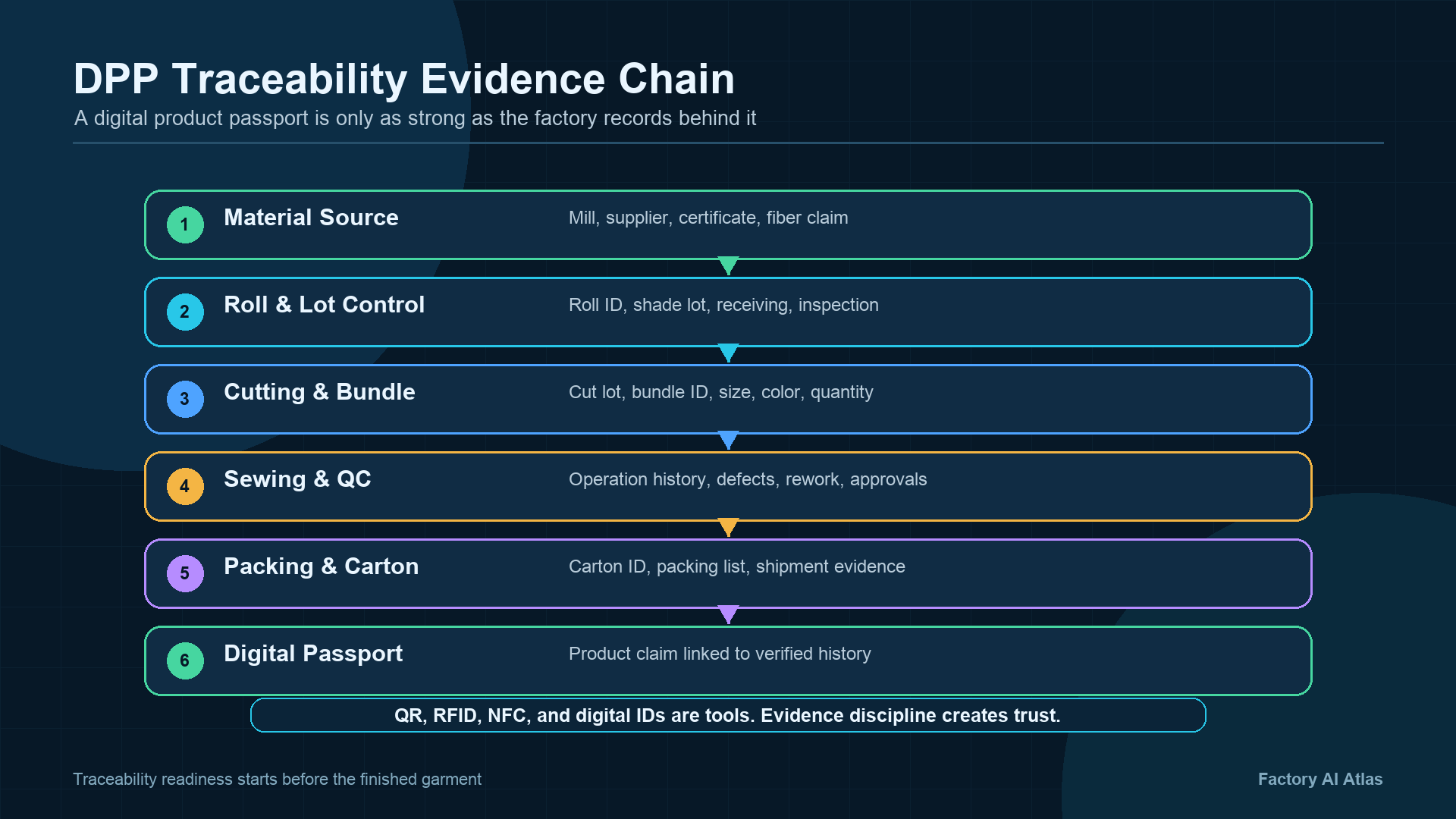
Why DPP matters for factory evidence control
The European Union’s Ecodesign for Sustainable Products Regulation points toward stronger product information, circularity, and digital product data. Product-specific rules are still evolving, but the direction matters for apparel: brands and suppliers will likely face growing pressure to connect product identity with material, sustainability, certification, and supply-chain information.
For garment factories, this means traceability may become part of smart manufacturing.
Traceability starts before the finished garment
A finished garment can carry a digital ID, but traceability starts much earlier.
Factories may need to manage fabric source, trim source, recycled content, certification records, shade lots, production lots, cutting records, sewing output, rework, packing, carton data, and shipment information.
If these records are inconsistent, a QR code on the final product only points to weak data.
QR, RFID, NFC, and digital IDs are only evidence carriers
QR codes, RFID, NFC, and serialized digital IDs can all support traceability. Each has a different role.
QR codes are simple and cheap. RFID can support faster item-level or carton-level reading. NFC can support consumer interaction or authentication. Digital ID platforms can connect physical products to online records.
But the technology choice is secondary. The real issue is whether the factory can maintain accurate master data and event data.
The Factory Data Needed for DPP Readiness
A garment factory preparing for stronger traceability should pay attention to:
- material master data,
- supplier and mill data,
- fabric roll IDs,
- shade and lot control,
- trim lot records,
- certification documents,
- cutting lot records,
- bundle tracking,
- rework or replacement records,
- packing and carton scan data,
- shipment references,
- and final product identity.
This is where MES, ERP, WMS, PLM, barcode, RFID, and document management become connected.
DPP readiness evidence gates before funding technology
Before approving a Digital Product Passport platform, factory teams should test whether the evidence chain can be reconstructed from daily operating records, not only from a label or dashboard.
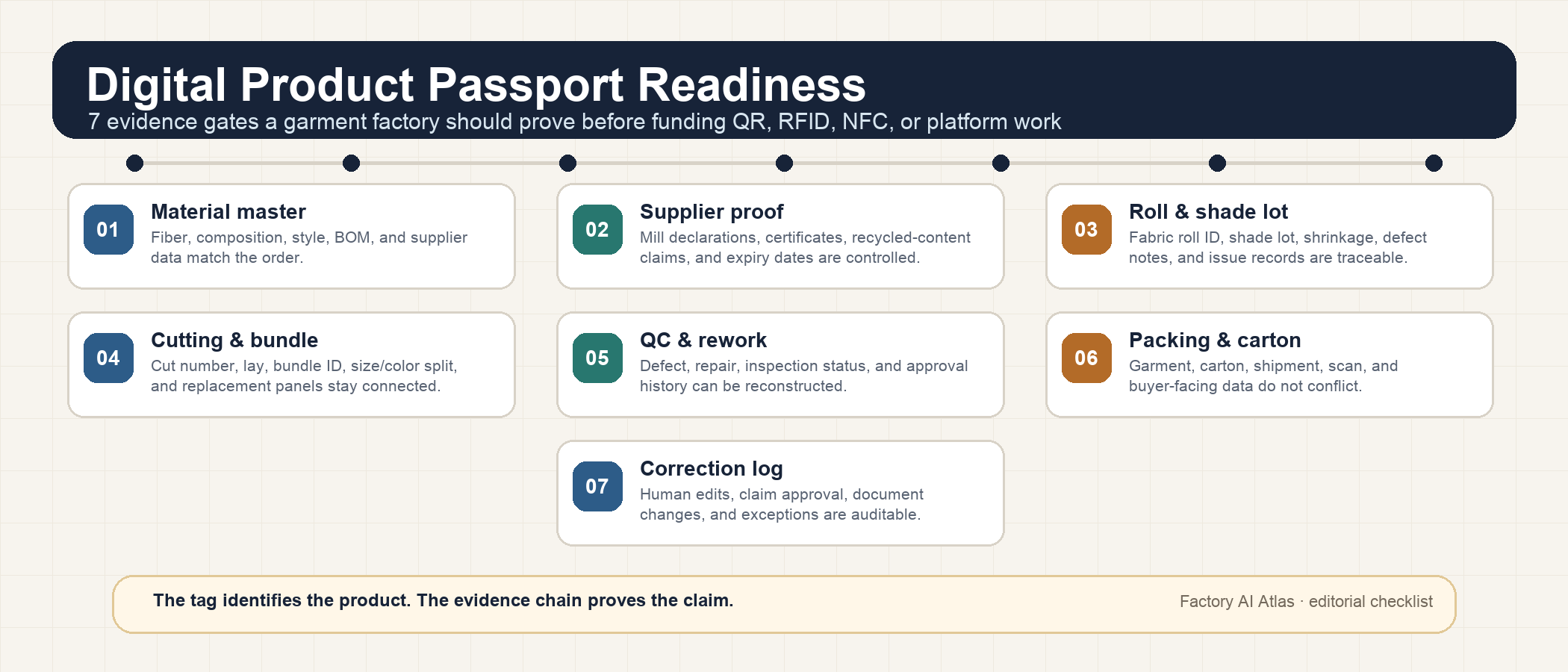
The practical test is simple: the tag identifies the product, but the evidence chain proves the claim. If any gate depends on manual reconstruction after the buyer asks, the passport project is not yet production-ready.
Traceability Is Connected to Quality and Compliance
Traceability is not only for sustainability reporting. It can also support quality investigation, supplier feedback, buyer audits, product claims, recall handling, and shipment verification.
If a factory can trace a defect back to fabric roll, shade lot, cutting batch, production line, or packing event, it can solve problems faster.
If it cannot, traceability becomes a marketing layer rather than an operating capability.
Factory lens: output without evidence is not traceability
Many factories can produce garments. Fewer can prove the path of the garment through material, cutting, sewing, finishing, packing, and shipment.
This is the gap Digital Product Passport pressure may expose.
A factory does not become traceable because it attaches a label. It becomes traceable when its daily operations create reliable evidence.
Common Implementation Risks
Common risks include inconsistent item codes, missing fabric roll IDs, weak shade control, manual rework that is not recorded, disconnected Excel files, certification documents that are not linked to lots, carton labels that do not match packing data, and systems that do not integrate.
Another risk is treating vendor platform claims as proof of compliance. Platforms can help, but factories still need disciplined processes.
What Garment Factories Should Do First
A practical starting point is not a full DPP project. It is a traceability readiness check.
Factories should map which data exists today, where it is stored, who enters it, how often it is wrong, which records are buyer-facing, and which records would be required if a product-level digital ID were introduced.
Start with material lots, cutting lots, WIP tracking, packing scans, and certification document control. These are practical foundations for future DPP requirements.
Connection to Factory AI
Digital Product Passport may sound like compliance, but it also supports Factory AI. AI systems need trustworthy data. If material, production, quality, and shipment data are connected, AI can help identify risk, predict delays, support audits, and improve decisions.
Traceability therefore belongs inside the smart manufacturing conversation.
DPP takeaway for factory teams
Digital Product Passport will push garment factories toward better data discipline.
The winning factories will not only attach smarter labels. They will connect material data, production data, quality data, certification data, and shipment data into a reliable operating system.
Traceability is not a tag technology problem. It is a factory data problem.
Digital Product Passport for Garment Factories: Readiness Questions
Before treating a Digital Product Passport as a label project, garment factories should check whether material records, production steps, quality results, packing data, and shipment references can be connected consistently.
Related Factory AI Atlas reading
- Factory AI Readiness Hub
- Factory AI Readiness Scorecard
- Why Garment Factory Automation Is So Difficult
- What Is Physical AI?
Source anchors for DPP readiness
- European Commission Ecodesign for Sustainable Products Regulation
- European Commission textile strategy
- GS1 Digital Link standards
About the Editorial Perspective
Factory AI Atlas is written from a manufacturing operations perspective shaped by hands-on apparel and textile production experience, including overseas factory management, woven and knit operations, production control, quality systems, and operational restructuring.
The site focuses on vendor-neutral, evidence-aware, and ROI-realistic guidance for AI, robotics, automation, and factory readiness. See the Editorial Policy & Disclaimer for sourcing standards and AI-use disclosure.