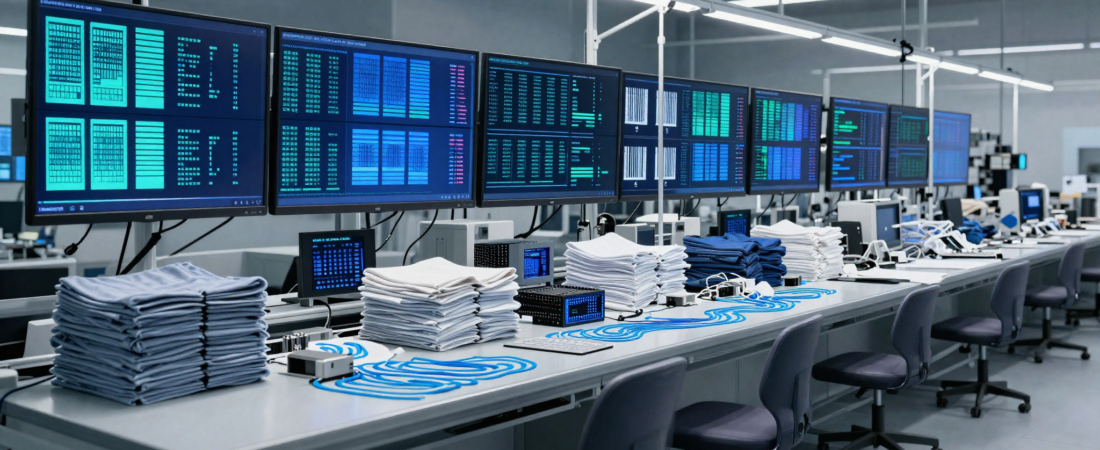
Trace one factory record from event to correction
Before using AI, follow one important record—output, defect, work-in-progress (WIP), downtime, or rework—from the moment something happens on the floor to the moment the factory closes the issue. The record is useful only if each handoff keeps the same meaning.
Name exactly what happened, when it counts, and which style, order, operation, machine, or location it belongs to.
Record the event close to the work instead of rebuilding it later from a line board, spreadsheet, and memory.
Allow a supervisor to correct a wrong entry without erasing who changed it, why it changed, or what the original record said.
Check that production, Industrial Engineering (IE), quality assurance, maintenance, warehouse, and merchandising are reading the same operating state.
Use the record to assign an owner, close the exception, and confirm that the physical floor now matches the system.
A small test before an AI project
Choose one repeated problem and review two weeks of records. Count missing fields, late entries, conflicting labels, manual corrections, and cases where the system status did not match the floor. If the team cannot explain and close those gaps, the next task is a recording rule—not a model.
Boundary: clean data does not guarantee a useful AI result. The model, workflow, user decision, safety limits, and final operating outcome still need separate testing.
Garment factory data problems are one of the quiet reasons AI projects fail before they reach the sewing floor.
Many people imagine factory AI as a camera, a dashboard, or a robot. In real apparel operations, the harder issue is often more basic: the factory does not yet have clean, consistent, operation-level data. The information exists somewhere, but it is split across paper bundle tickets, Excel sheets, line boards, buyer reports, ERP exports, QC forms, WhatsApp photos, and the memory of supervisors.
That does not mean the factory is weak. It means apparel production is complex. A garment order changes by style, size, color, fabric, trim, buyer requirement, shipment date, and inspection standard. If the data layer does not reflect that reality, AI will produce confident but shallow answers.
This article explains the data problems that matter most before a garment factory tries AI forecasting, AI inspection, digital production tracking, or smart manufacturing dashboards.
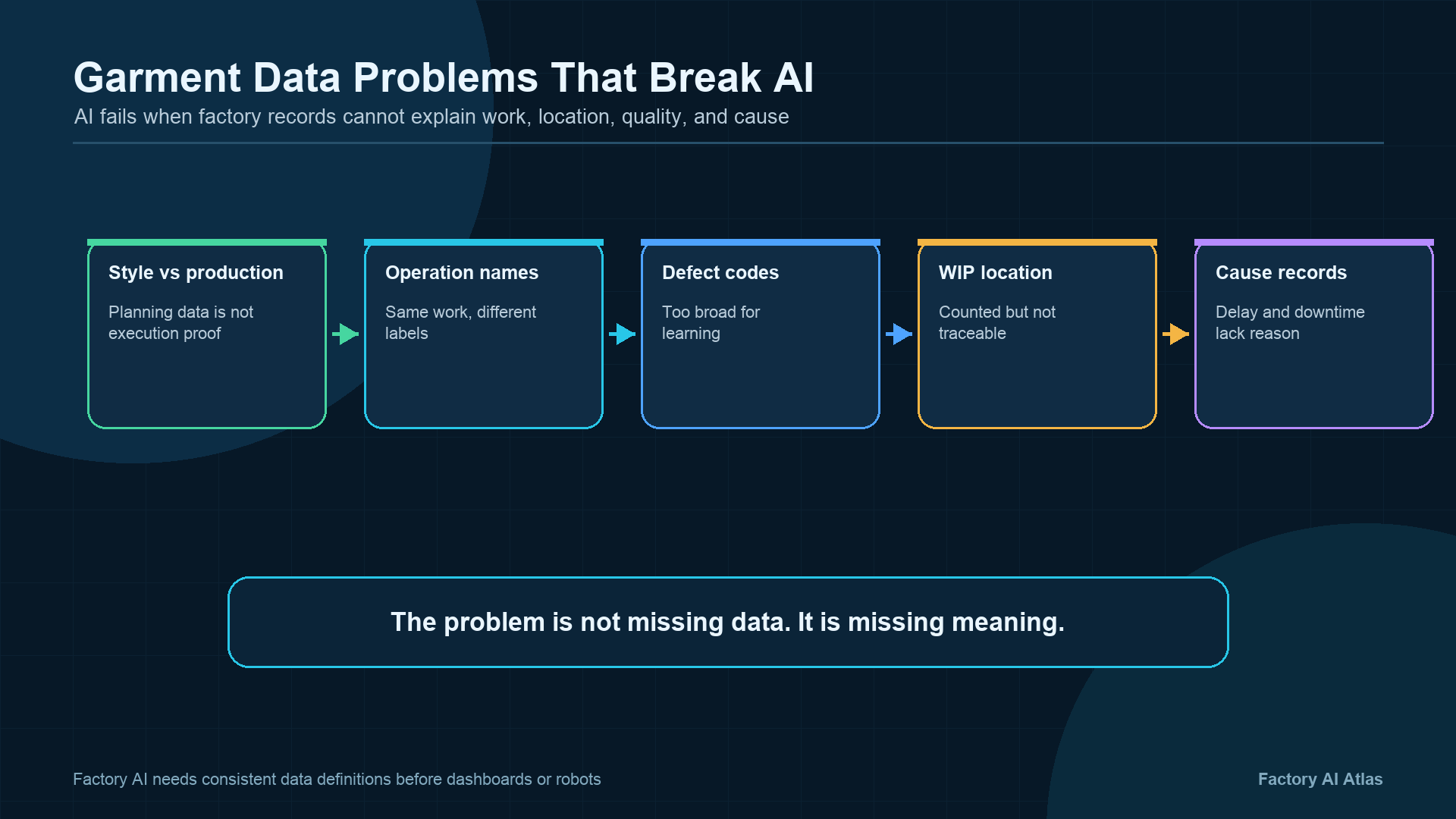
1. Style data is not the same as production data
A style file may include sketches, BOM, measurement specs, fabric, trims, and packing instructions. That is useful, but it is not enough for factory AI. Production needs operation sequence, SMV, operator allocation, machine type, quality risk points, WIP location, and changeover rules.
When style data and production data are not connected, the factory can know what the product is but still fail to understand how the product moves through the line.
A practical data model should connect style, order, operation, line, machine, operator skill, QC checkpoint, and shipment priority. Without that connection, a dashboard may look digital but still miss the real factory problem.
2. Operation names are inconsistent
One factory may write “attach collar,” another may write “collar join,” and another may split the same work into preparation, joining, topstitch, and press. Even inside one factory, IE, production, and QC may use slightly different names.
This matters because AI systems depend on consistent labels. If operation names are not standardized, the system cannot compare output, defect patterns, or bottlenecks correctly across styles and lines.
The first improvement is not expensive software. It is a controlled operation dictionary. Use the language the floor already understands, then map it carefully so future data can be compared.
3. Defect codes are too broad
Many QC reports use broad defect categories: sewing defect, measurement issue, stain, shade, broken stitch, puckering. Those categories are useful for summary reporting, but they may be too broad for AI learning.
For example, “sewing defect” can mean skipped stitch, uneven margin, twisted seam, needle damage, loose thread, mismatched panel, poor SPI, or poor handling at a difficult curve. If the code is too broad, the factory cannot identify which operation, fabric, machine setting, or skill gap is driving the problem.
Before adding AI, check whether defect codes are specific enough to support action. AI should not simply count defects. It should help locate the process reason behind them.
4. WIP is counted, but not located
Many factories know total WIP but do not always know exactly where WIP is waiting and why. In apparel production, the physical location matters. A bundle waiting before a bottleneck, a bundle waiting for trims, and a bundle waiting for rework are not the same problem.
If the system only counts pieces, it may show production volume without showing flow health. For factory AI readiness, WIP should be connected to line, operation, status, and reason for waiting.
This is also important for factory mobile robots such as AGVs, AMRs, and cleaning robots. Route planning and material movement only make sense when WIP locations are disciplined.
5. Manual records are not bad, but they need rules
Paper records are not automatically a problem. Many factories run well with practical manual control. The problem begins when manual records have no shared rule for timing, definition, correction, and responsibility.
For example, if one line updates output every hour and another updates only at the end of the day, the dashboard will compare different realities. If one supervisor records rework when found and another records it when corrected, the defect trend becomes misleading.
Before AI, set simple rules: who records, when to record, what each status means, and how corrections are handled.
6. Buyer reporting and factory improvement data are mixed together
Factories often prepare reports for buyers, internal management, production meetings, and QC follow-up. These reports do not always need the same level of detail.
Buyer reports are usually polished and summary-focused. Improvement data should be more honest and operational. It should show bottlenecks, defect location, root causes, waiting time, and missed assumptions.
If the factory only keeps buyer-facing data, AI will learn from a cleaned-up version of reality. For improvement, the system needs the uncomfortable details that actually explain performance.
7. The line board and the system disagree
One common field problem is a mismatch between the digital record and the line board. The system says one output number. The supervisor says another. The finishing section reports a third number. Usually, everyone has a reason.
AI cannot fix this disagreement by itself. The factory must define the official moment of counting. Is output counted after the operation, after inline QC, after endline QC, after finishing, or after packing?
The answer can differ by purpose, but the definitions must be clear. Otherwise, the system will look precise while the operation remains confused.
8. Maintenance and downtime data are under-described
Machine downtime is often recorded as a simple stop. But for automation and AI readiness, the reason matters: needle issue, folder adjustment, sensor problem, thread break, fabric feeding, operator waiting, electricity, air pressure, software, or missing input.
For sewing and support equipment, small stops can be more damaging than one large breakdown because they interrupt rhythm and line balance. Better downtime labels help the factory decide whether the problem is machine maintenance, process method, material preparation, or training.
9. AI inspection needs agreed standards before images
Computer vision is attractive, but image data is only useful when defect standards are agreed. A camera can capture defects, but the factory still needs to define what is acceptable, what is repairable, what is critical, and what depends on buyer tolerance.
If sewing QC, finishing QC, buyer QA, and third-party inspection apply different judgments, the AI model will inherit that inconsistency.
Before collecting thousands of images, align the defect language and decision rules. A smaller clean image set is more useful than a large confused one.
10. Data ownership is unclear
In many factories, production owns output, QC owns defects, IE owns SMV and line balance, maintenance owns downtime, warehouse owns input flow, and merchandising owns order changes. AI projects cut across all of them.
If nobody owns the combined data layer, the project becomes a dashboard with no operating authority. The practical owner should be able to bring departments together and change the recording rules when needed.
How clean does this data need to be?
A garment factory does not need perfect data before starting every AI project. But it does need data that is clean enough for the decision being made.
For a readiness dashboard, weekly operation-level data may be enough. For AI inspection, defect labels must be more precise. For AMR routing, physical location data matters more than financial reporting. For ROI analysis, time savings, rework reduction, and utilization are more important than a beautiful chart.
The factory should not digitize everything at once. Start with the data that explains one real operating problem.
Useful first steps
- Create one operation-name dictionary for common garment processes.
- Separate buyer reporting from internal improvement data.
- Define when output is counted and who owns corrections.
- Make defect codes specific enough to connect to operations.
- Track WIP by location and reason for waiting, not only quantity.
- Agree on AI inspection standards before collecting images.
These steps connect well with the five data foundations for AI in garment factories, the broader Factory AI readiness scorecard, the practical path toward Physical AI in smart manufacturing, a small-app-first approach such as apparel factory small apps before robots, and the concrete cutting plan readiness layer.
Close one data loop before adding AI
Garment factory data problems are not just IT problems. They are factory operating problems. If operation names, defect codes, WIP locations, output timing, and ownership are unclear, AI will amplify confusion instead of improving production. The best starting point is not a bigger dashboard. It is one clean data loop around a real factory problem.
Author and garment-data perspective
Factory AI Atlas is written from a manufacturing operations perspective shaped by hands-on apparel and textile production experience, including overseas factory management, woven and knit operations, production control, quality systems, and operational restructuring.
The site focuses on independent, evidence-aware guidance for AI, robotics, automation, and factory readiness. See the Editorial Policy & Disclaimer for sourcing standards and AI-use disclosure.
Sources checked and what they do not prove
- NIST AI Risk Management Framework — supports governance, measurement, monitoring, and risk controls around AI use.
- ISO/IEC 42001 AI management system standard — provides a management-system reference for responsibility and documented controls.
- NIST smart manufacturing resources — supports the need for manufacturing interoperability and process context.
These sources do not prove that a garment factory’s operation names, defect labels, WIP locations, downtime reasons, correction history, or department handoffs are reliable. That evidence must come from the factory’s own records and from checks against the physical floor.