Operator-data decision note
AI in garment factories should begin with the records operators and supervisors already use to run the day: style history, defect notes, bottleneck records, delay causes, WIP movement, and action follow-up. If those records are inconsistent, AI will only organize confusion faster.
New AI forms can miss shop-floor reality
The common mistake is to collect new data for an AI project while ignoring the daily records that already drive production behavior. Operators then see AI as an extra reporting burden, and managers receive dashboards that do not match shop-floor reality.
Checks before funding garment data AI
- Which existing record changes a real decision today: line balance, QC focus, training, replenishment, delay recovery, or shipment risk?
- Are operators and supervisors using the same definitions for defects, delays, operation names, WIP status, and closeout?
- Can the factory trace a data point to the person who acted on it and the result of that action?
Vendor proof for operator-record fit
- Map the AI workflow to current operator and supervisor records before adding new forms.
- Show how messy, missing, late, or conflicting shop-floor data is handled.
- Provide an action log that proves the system improves decisions, not only reporting quality.
Operator-record adoption gate
GO if the AI layer strengthens records people already trust. HOLD if the data is useful but definitions are not stable. REDESIGN if the project depends on new reporting habits that the line will not maintain.
Many garment factories are interested in AI.
Factory data answer
- AI in garment factories usually fails first on data visibility, not model capability.
- Production records, defect names, bottleneck causes, WIP movement, and decision history must be consistent enough for AI to use.
- Fixing data foundations improves factory decisions even before advanced AI tools are introduced.
Factory teams this applies to
Garment factory leaders, production planning teams, IE/ME teams, QC teams, digital-transformation owners, and apparel AI readers who need to prepare factory data before buying AI tools.
Evan Lee factory field note
Garment AI starts with daily records that operators already touch
For garment factories, the most useful AI foundation is often not a new platform. It is consistent daily discipline around style, order, operation, output, defect name, WIP movement, rework reason, and responsible owner. If operators and supervisors already trust these records, AI has a real operating base. If not, the first project should be data cleanup inside the current workflow.
They hear about predictive planning, automated quality inspection, smart line balancing, digital assistants, and real-time production dashboards. These technologies can be powerful. But in many factories, the biggest barrier to AI in garment factories is not the model, the software, or the machine. It is the operational data that makes factory reality visible.
It is the data.
A factory does not become AI-ready simply by buying a new tool. AI needs structured, consistent, and usable information. If the daily production records are incomplete, defect names are inconsistent, and delay reasons are written differently by each department, AI will only produce confusing results.
Before investing heavily in AI, garment factories should first fix the data foundations that support better decisions.
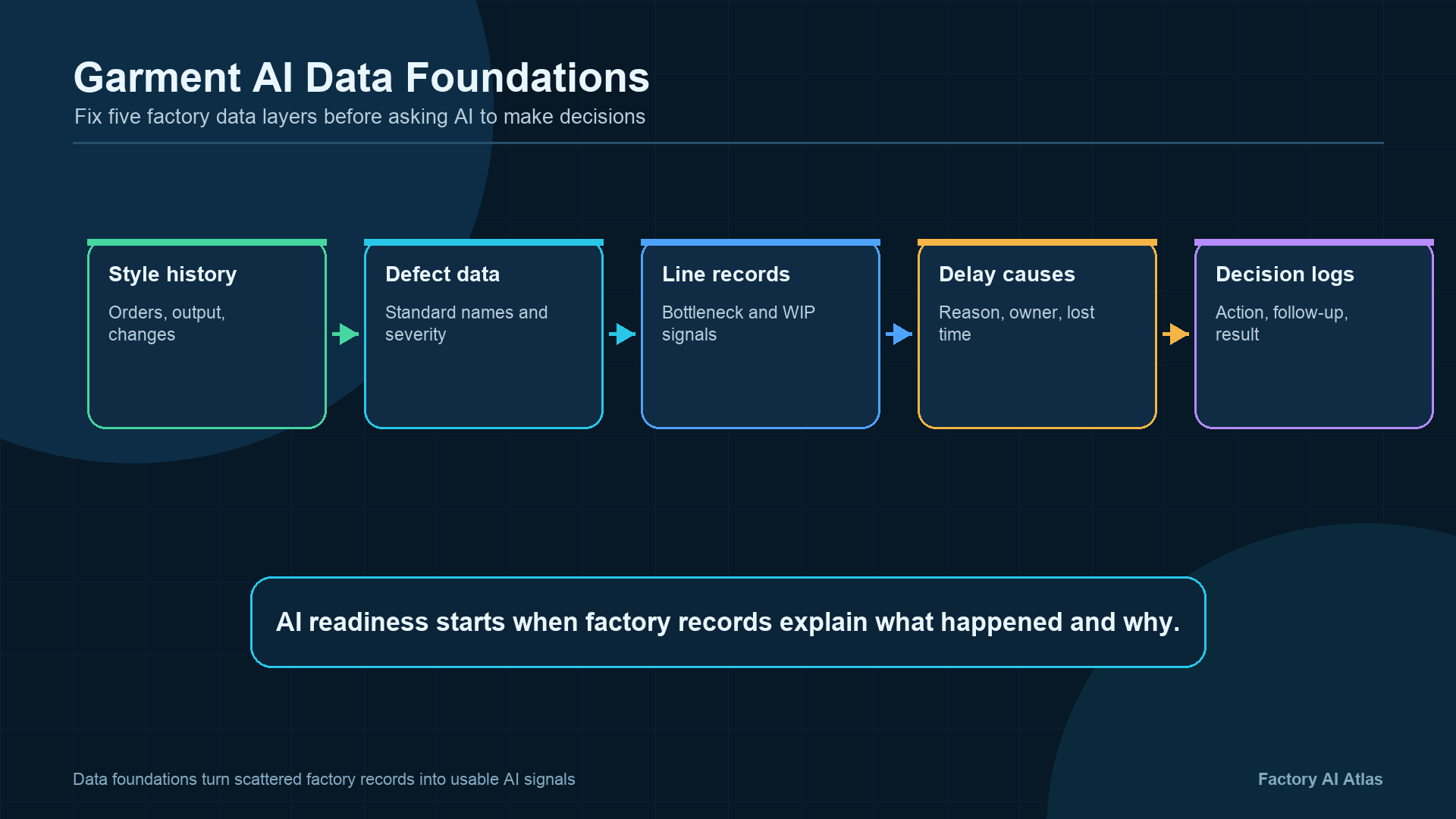
Here are five areas every factory should review first.
Garment data foundation map
- Style-level production history
- Standardized defect data
- Line performance and bottleneck records
- Delay and root cause tracking
- Decision logs and action follow-up
- A simple 30-day starting plan
1. Style-Level Production History
Every garment factory has production history. But not every factory has production history that can be used for decision-making.
A useful production history should show more than just order quantity and shipment date. It should help the factory understand what actually happened during production.
For each style, the factory should be able to track:
- Buyer or customer
- Product category
- Fabric type
- Order quantity
- Number of lines used
- Planned output
- Actual output
- Sewing start and finish dates
- Major production issues
- Rework or delay impact
- Final shipment performance
This matters because AI needs patterns.
If the factory wants to predict production risks for a new style, it needs reliable historical data from similar styles. Without that history, AI has very little context.
For example, a factory may want to know:
- Which styles usually create bottlenecks?
- Which fabrics tend to slow down sewing?
- Which product categories often require more rework?
- Which buyers usually need more inspection preparation?
- Which styles are difficult for new operators?
These questions cannot be answered well if style history is scattered across emails, Excel files, messaging apps, and handwritten reports.
A simple, clean style history database is one of the strongest foundations for future AI use.
2. Standardized Defect Data
Quality data is one of the most valuable data assets in a garment factory.
But in many factories, defect data is difficult to analyze because it is not standardized.
One QC may write “open seam.” Another may write “seam broken.” Another may write “stitching problem.” Another may simply write “sewing defect.”
To a human, these may look similar. To a system, they may become four different categories.
Before using AI for quality improvement, factories should standardize how defects are named, grouped, and recorded.
A stronger defect data structure should include:
- Defect name
- Defect category
- Operation or process where it occurred
- Garment part
- Severity level
- Quantity found
- Inspection stage
- Responsible area
- Photo evidence if possible
- Corrective action taken
This allows the factory to move from simple defect counting to real analysis.
Instead of only asking, “How many defects did we find?”, the factory can ask:
- Which operations create the most repeat defects?
- Which defect types are increasing?
- Which lines need more technical support?
- Which product categories create specific quality risks?
- Which defects are linked to rework, rejection, or buyer claims?
AI can help identify patterns, but only if the defect data is clean enough to compare.
Poor defect data produces poor recommendations. Good defect data can become the foundation for predictive quality control.
3. Line Performance and Bottleneck Records
Production output is often recorded every day, but output alone does not explain performance.
A line may miss its target for many reasons:
- Machine breakdown
- Operator absenteeism
- Material delay
- Difficult operation
- Poor line balancing
- Quality rework
- Feeding issue
- Changeover loss
- Supervisor decision delay
If the factory only records actual output, it knows what happened. But it may not know why it happened.
For AI to support line management, factories need better bottleneck records.
Useful line performance data should include:
- Line number
- Style
- Target output
- Actual output
- Working hours
- Manpower
- Key bottleneck operation
- Reason for output loss
- Downtime minutes
- Rework impact
- Support action taken
This does not need to start as a complex system. Even a simple daily structure can help.
The important point is consistency.
When factories collect bottleneck reasons in a structured way, they can begin to see patterns across styles, lines, and seasons.
For example:
- Some operations repeatedly become bottlenecks.
- Some lines perform better with certain product types.
- Some supervisors solve changeovers faster than others.
- Some output losses are actually caused by pre-production delays, not sewing performance.
AI can later help summarize these patterns and recommend actions. But first, the factory needs to record the right reasons behind the numbers.
4. Delay and Root Cause Tracking
Most factories track delivery dates. Fewer factories track delay causes in a way that can be analyzed.
When a shipment is late, the reason is often described too generally: “material delay,” “production issue,” “quality problem,” “approval delay,” “buyer change,” or “factory issue.”
These categories may be true, but they are often too broad to support improvement.
For better AI readiness, delay tracking should be more specific.
A factory should separate delay causes into practical categories such as:
- Fabric arrival delay
- Trim arrival delay
- Lab dip or approval delay
- Pattern or sample delay
- Cutting delay
- Sewing bottleneck
- Washing delay
- Finishing congestion
- Final inspection failure
- Rework after inspection
- Buyer change request
- Documentation issue
The factory should also record:
- Date the issue started
- Department responsible
- Number of days affected
- Whether the issue was preventable
- Corrective action
- Preventive action for future orders
This kind of data helps management understand whether delays are random or repeated.
If the same delay pattern appears again and again, it is not just an operational accident. It is a system issue.
AI can help identify these repeat patterns faster, but only when the delay data is detailed enough.
Without structured root cause tracking, AI may only confirm what managers already know: “The order was late.” With structured tracking, AI can help explain what needs to change.
5. Decision Logs and Action Follow-Up
One of the most overlooked data foundations in garment factories is the decision log.
Factories make hundreds of decisions every week:
- Change the line plan
- Add overtime
- Move operators
- Recut panels
- Negotiate shipment split
- Change inspection timing
- Increase QC checkpoints
- Send technical support to a line
- Prioritize one order over another
But many of these decisions are not recorded clearly.
As a result, the factory may know the final result, but not the decision path that led to it.
This becomes a problem when trying to improve management systems or use AI assistants.
A good decision log does not need to be complicated. It can include:
- Date
- Issue
- Decision made
- Person or team responsible
- Reason for decision
- Expected result
- Follow-up date
- Actual result
- Lesson learned
This is especially useful for recurring problems.
For example, if a factory frequently adds overtime to recover delays, the decision log can help answer:
- Was overtime actually effective?
- Which problems were solved by overtime?
- Which problems came back again?
- Was the root cause fixed?
- Did the action create extra quality risk?
AI can summarize decision histories and highlight repeated management patterns. But if decisions are not recorded, AI has no management memory to work with.
Factories do not only need production data. They also need operational learning data.
AI in Garment Factories Starts With Practical Data Discipline
AI in garment factories should not begin with a big promise.
It should begin with better operational discipline.
Factories do not need perfect data from day one. They do not need an expensive system before they start. But they do need a clear structure for the information they already produce every day.
The most useful starting point is not to collect more data randomly.
The better approach is to define:
- What decisions the factory wants to improve
- What data is needed for those decisions
- Who records the data
- When the data is recorded
- How the data is reviewed
- What action follows the review
This turns data collection into a management tool, not just an administrative task.
A Simple 30-Day Starting Plan
Week 1: Review Current Data
Check the factory’s current production, quality, and planning records. Identify where information is missing, duplicated, inconsistent, or too general. Focus on the data that affects daily decisions.
Week 2: Standardize Key Categories
Standardize defect names, delay reasons, bottleneck categories, and production issue codes. Keep the structure simple enough for daily use. If the system is too complicated, teams will not maintain it.
Week 3: Start Daily Structured Recording
Apply the new structure to a small number of lines, styles, or departments. Do not try to change the entire factory at once. Test whether the format is practical for supervisors, QC, planning, and production teams.
Week 4: Review Patterns and Improve
At the end of the month, review the collected data. Look for repeated issues, missing fields, unclear categories, and useful insights. Then improve the format before expanding it.
The goal is not to build a perfect AI system in 30 days. The goal is to build the habit of structured operational learning.
Factory data must become usable factory memory
AI can help garment factories become faster, more consistent, and more responsive.
But AI cannot replace missing factory memory.
If production history is incomplete, defect data is inconsistent, bottleneck reasons are unclear, delay causes are too general, and decisions are not recorded, AI will struggle to provide useful guidance.
The first step toward AI in garment factories is not always automation.
Often, the first step is organizing what the factory already knows.
Factories that build strong data foundations today will be better prepared for AI tomorrow. They will also make better decisions even before AI is fully introduced.
In garment manufacturing, data readiness is not a technical project only. It is an operational discipline.
Operator-used data source anchors
For a factory AI pilot, operator-used records should be reviewed against broader AI risk and workplace-evidence guidance such as the NIST AI Risk Management Framework, NIST smart manufacturing resources, ILO textile and apparel sector resources, and Better Work reports and publications. The point is not to copy a framework into the line; it is to make daily operator data auditable enough for a supervisor to trust.
- NIST AI Risk Management Framework — useful for grounding AI data work in accountable, reliable, and monitored decision systems.
- Better Work reports and publications — helpful context for practical factory improvement and worker-facing operating systems.