Lower-risk robot pilot note
Lower-risk robot pilots should be chosen because they expose factory operating discipline before the factory touches sewing automation. The best first robot pilot is usually not the most impressive demo; it is the one that reveals route control, safety discipline, WIP visibility, maintenance ownership, and supervisor response.
The useful pilot is the one that teaches the factory how people, traffic rules, charging, maintenance, exceptions, and supervisor decisions behave around automation before the project reaches a sewing-critical operation.
Robot pilots are chosen by demo appeal instead of learning value
The common mistake is to select a robot pilot by vendor video, not by factory learning value. If traffic rules, floor markings, operator handoff, charging/maintenance, exception handling, and WIP ownership are weak, even a simple cart or inspection-assist pilot will become a workaround project.
Checks before funding a lower-risk robot pilot
- Which factory behavior will the pilot prove: stable route, safe handoff, inspection repeatability, or WIP visibility?
- Can the team measure baseline time, labor touch, waiting, rework, near misses, and recovery actions before the robot enters?
- Who stops, restarts, services, and overrides the robot when production reality changes?
Proof requests for robot-pilot vendors
- Show the robot working in a mixed pedestrian, trolley, bundle, and supervisor environment, not only on an empty demo route.
- Provide a failure-mode log: blocked path, wrong pickup, late charging, dropped item, operator override, maintenance delay.
- Explain what data the factory receives after each shift and how it changes the next-day pilot decision.
Robot-learning pilot gate
GO if the pilot teaches a repeatable operating rule. HOLD if the robot works but exception ownership is unclear. REDESIGN if the factory is using the robot to hide weak flow, WIP, or safety discipline.
Robot pilots for apparel factories should usually begin before the sewing robot conversation.
That may sound conservative, but it is practical. Sewing automation is difficult because garments are soft, variable, and quality-sensitive. A factory that has not yet learned how to operate a smaller robot project may struggle if it jumps directly into the hardest operation on the floor.
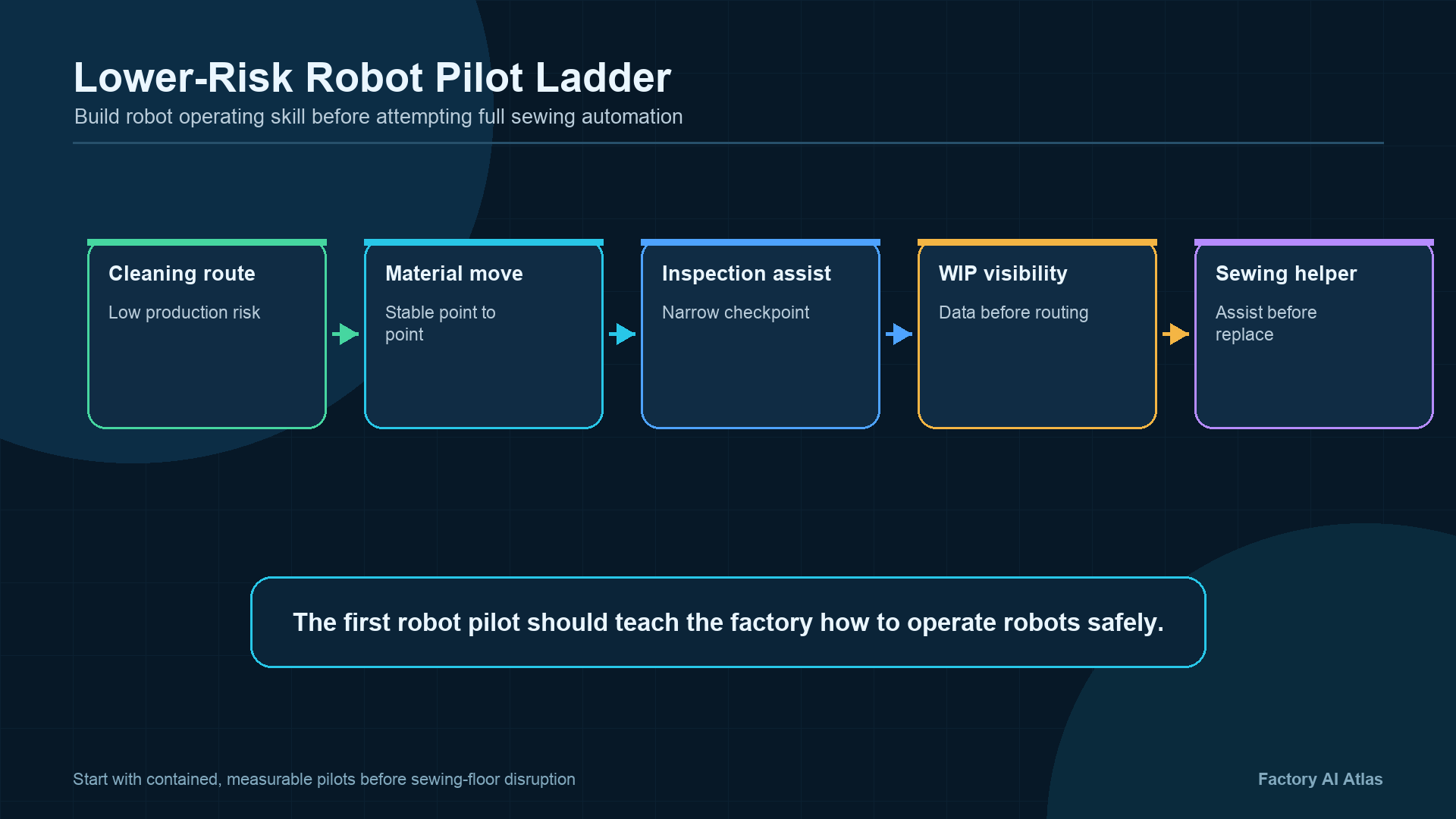
A better path is to use lower-risk robot pilots to build operating skill. Cleaning robots, material movement, simple inspection support, and defined internal transport routes can teach the factory how to manage safety, routes, maintenance, data, operator acceptance, and ROI without disrupting core sewing output.
This article explains how apparel factories can use staged robot pilots as a bridge toward more advanced factory AI and robotics.
Why lower-risk pilots matter
In a garment factory, production stability is valuable. A failed automation test can disturb line rhythm, take supervisor attention, and create resistance from operators. That is why the first robot project should not be chosen only because it looks advanced.
The first project should be chosen because it is measurable, contained, and operationally safe.
Cleaning routes, fabric-cart movement, empty-cart return, inspection support, and simple warehouse-to-line logistics are often better learning areas than full sewing automation. They still require discipline, but the technical and quality risk is lower.
Pilot 1: autonomous cleaning routes
Industrial cleaning robots can be a useful first pilot because cleanliness affects safety, quality, and factory discipline, but the project does not directly control a sewing operation.
A cleaning pilot should not be treated as a gadget. Define the route, timing, floor condition, obstacles, charging point, cleaning standard, and human handover rule. The factory should measure whether cleaning becomes more consistent, whether supervisors spend less time chasing basic floor condition, and whether the route can run without interrupting production.
This connects with the idea that cleaning robots in factories can be a lower-risk first automation test when the goal is to learn robot operations, not simply to replace a cleaner.
Pilot 2: material movement between stable points
AMRs and other mobile robots are most useful when pickup and drop-off points are clear. Apparel factories often have many carts, trolleys, bundle areas, and urgent movements. That can become chaotic if the factory tries to automate everything at once.
A better pilot is one stable route: warehouse to cutting, cutting to sewing preparation, sewing to finishing, empty cart return, or trim movement to a controlled point.
Before starting, the factory should mark lanes, define right-of-way rules, confirm floor quality, check elevator or doorway constraints if relevant, and decide who can override the route. The robot is only one part of the system. The route discipline is the real test.
Pilot 3: inspection assistance at a narrow checkpoint
AI vision and inspection tools can help apparel factories, but they should start with a narrow, well-defined checkpoint. Do not begin with every possible defect across every style.
Choose a repeated problem: missing label, wrong component, color/shade check, obvious stain, button or trim presence, packaging error, or a specific seam area on a stable product. Align defect standards first, then collect examples.
This type of pilot teaches the factory how to define visual standards, collect usable images, and connect inspection results to corrective action. That learning becomes important before more advanced robotic or AI sewing projects.
Pilot 4: WIP visibility before robot routing
Some factories want AMRs but do not yet have good WIP visibility. In that case, the first pilot may not be a robot. It may be a WIP-location discipline project using barcode, QR, RFID, or simple digital scanning at key points.
Why? Because a robot cannot solve unclear material flow. If nobody knows where a bundle should wait, who requested movement, or which order has priority, a mobile robot will only move confusion faster.
For apparel factories, WIP visibility is a foundation for later robot routing.
Pilot 5: helper automation around sewing, not full sewing
Before a full sewing robot, consider support automation: folders, guides, clamps, semi-automatic feeding aids, needle/thread monitoring, AI-assisted setup checks, or workstation sensors that reduce variation.
These improvements may not look as dramatic as a robot arm, but they often fit apparel reality better. They support operators rather than trying to remove all skill at once.
This staged approach also fits the broader challenge described in why garment factory automation is difficult.
What to measure in a robot pilot
A pilot should have a short scorecard. Avoid vague statements like “the robot worked well.” Measure practical outcomes:
- Route completion rate
- Number of human interventions
- Downtime and restart reasons
- Impact on walking time or waiting time
- Safety incidents or near misses
- Operator acceptance and supervisor workload
- Cleaning consistency, movement accuracy, or inspection accuracy
- Maintenance effort and spare-part needs
The goal is to learn whether the factory can operate the system every day, not just whether the robot can move during a demo.
Safety and traffic rules come before scale
Mobile robots and automated equipment introduce new interactions between people, carts, machines, and routes. International safety standards such as ISO 3691-4 for driverless industrial trucks and their systems show that route design, protective measures, and operating rules matter as much as the vehicle itself.
For an apparel factory, this means the pilot must include aisle rules, pedestrian behavior, emergency stop access, charging areas, night-shift assumptions, and clear responsibility when the robot blocks a route.
A robot that is safe only when everyone is watching is not ready for factory scale.
Field Lens: choose the pilot that teaches the factory
The best first robot pilot is not always the one with the highest theoretical ROI. It is the one that teaches the factory how to manage automation as an operating system.
For an apparel factory, a good pilot answers these questions:
- Can our floor follow routes and rules consistently?
- Can supervisors manage exceptions without stopping production?
- Can maintenance support the system without waiting for the vendor every time?
- Can operators trust the system instead of working around it?
- Can we measure the result in time, quality, safety, or flow?
If the pilot answers those questions, the factory is building capability for harder automation later.
Final lower-risk robot-pilot takeaway
Robot pilots for apparel factories should start where the operational risk is controlled. Cleaning robots, material movement, inspection support, and WIP visibility can build the factory’s automation muscle before sewing robotics. The point is not to avoid advanced automation. The point is to make the factory ready enough that advanced automation has a real chance to work.
About the Editorial Perspective
Factory AI Atlas is written from a manufacturing operations perspective shaped by hands-on apparel and textile production experience, including overseas factory management, woven and knit operations, production control, quality systems, and operational restructuring.
The site focuses on vendor-neutral, evidence-aware, and ROI-realistic guidance for AI, robotics, automation, and factory readiness. See the Editorial Policy & Disclaimer for sourcing standards and AI-use disclosure.
Lower-risk robot-pilot source anchors
- OSHA robotics guidance — useful for grounding robot pilots in safety, traffic, guarding, and human-machine interaction discipline.
- International Federation of Robotics industrial robot resources — relevant for realistic robot adoption and staged industrial automation planning.