
Cutting-plan decision note
A cutting plan is an AI-readiness layer because it turns buyer quantity, ratio, allowance, fabric behavior, marker logic, and revision history into an executable factory control point. The goal is not a prettier plan; it is fewer uncontrolled changes between order recap and cutting execution.
Cutting cannot absorb unstable upstream assumptions
The common mistake is to treat cutting as a downstream execution task after merchandising and planning have already made unstable assumptions. When allowance, grouping, marker, fabric shrinkage, and size-ratio changes are not controlled, AI only accelerates a weak plan.
Checks before digitizing cutting plans
- Can the factory trace every cutting-plan revision back to an order, material, ratio, or approval change?
- Are cut groups, marker constraints, fabric behavior, shortage risk, and replacement logic recorded clearly?
- Can cutting-plan data connect to fabric inventory, CAD/marker, spreading, cutting output, and shipment priority?
Vendor proof for cutting-plan logic
- Show the revision trail from order recap to approved cutting plan.
- Demonstrate how shortage, excess, ratio change, and re-cut cases are handled.
- Export a cutting-plan evidence file that merchandising, cutting, and management can all verify.
Cutting approval gate
GO if the cutting plan becomes a controlled decision record. HOLD if the logic is right but master data is still unstable. REDESIGN if the tool produces a plan without revision accountability.
Cutting plan is one of the most practical places for an apparel factory to begin Factory AI readiness because it turns buyer order information into structured production decision data.
Many factory AI conversations begin with a large image: robots, full MES integration, vision inspection, digital twins, or real-time optimization. Those topics matter. But in apparel manufacturing, the first useful AI layer often appears much earlier, inside the daily documents that already control production.
One of those documents is the cutting plan.
A cutting plan may look like a production file, an Excel sheet, or a planner’s working document. But in reality, it sits at the intersection of merchandising, planning, cutting, IE/ME, fabric control, QA/QC, and shipment risk. It translates a buyer order recap into something the factory can actually execute.
That is why cutting plan should not be treated only as paperwork. It is a readiness layer.
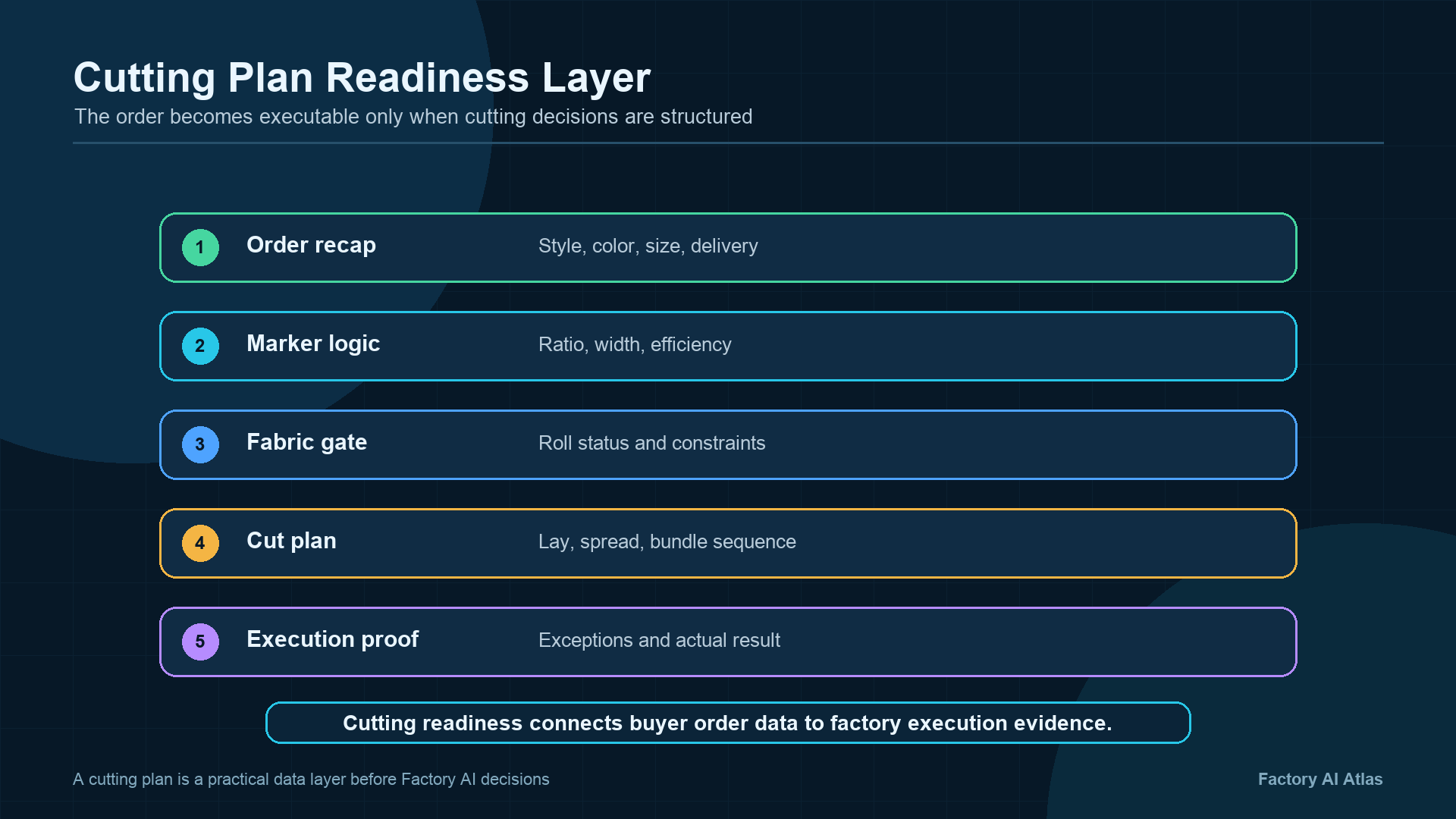
Cutting plan is where the order becomes executable
A buyer order may start with style information, colors, sizes, delivery requirements, and quantity breakdowns. But the factory cannot cut fabric from a sales recap alone.
Before cutting starts, the order has to be converted into practical execution logic:
- Which colors and sizes are included?
- What is the order quantity by color and size?
- What allowance is needed for cutting, replacement, shade, shrinkage, or factory-specific risk?
- How should sizes be grouped for marker planning?
- How many plies are reasonable for each group?
- Which cutting group should be prepared first?
- What has changed from the first draft to the latest version?
These questions are not abstract digital-transformation questions. They are daily production questions.
When they remain scattered across PDFs, spreadsheets, chat messages, and individual planner knowledge, the factory depends heavily on manual interpretation. When they become structured, the same workflow can support review, comparison, audit trail, and eventually AI assistance.
The key flow: Order Recap to Draft Cutting Plan
A practical cutting-plan workflow can be understood in five layers.
1. Order Recap
The Order Recap is the starting point. It contains the commercial order view: style, buyer requirements, color and size quantities, delivery expectation, and sometimes packaging or shipment logic.
For factory execution, the Order Recap is not enough by itself. It needs to be translated into a planning view.
2. Quantity Review
The factory must confirm color, size, and total quantity logic before any cutting plan is trusted.
This step sounds basic, but it is where many later problems begin. If the quantity breakdown is unclear, duplicated, manually copied, or not aligned with the latest buyer change, then every downstream decision becomes fragile.
A digital workflow should make this review visible:
- original order quantity;
- revised quantity if applicable;
- color and size matrix;
- total quantity check;
- exception or mismatch notes;
- responsible reviewer.
This is already AI-readiness data because it creates a reliable baseline.
3. Allowance and Cutting Logic
A cutting plan is rarely just the buyer quantity. Factories often need allowance logic for practical production conditions.
The public point is not to reveal a factory’s allowance formula. The important point is that allowance should be explicit, reviewable, and version-controlled.
If allowance is hidden in someone’s spreadsheet habit, the factory cannot easily explain why the plan changed. If allowance is structured as a field, the factory can compare planned quantity, adjusted quantity, and actual cutting result later.
4. Cut Groups and Marker Planning
Cut groups connect the quantity breakdown to physical fabric execution.
A group may be shaped by color, size range, fabric width, marker efficiency, shade control, production priority, or cutting-table constraints. The exact logic differs by factory and product type, but the readiness principle is the same:
A cutting group is a decision object. If it is structured, it can be reviewed, compared, and improved.
This is where a small operating app can become valuable. It does not need to optimize everything automatically. It first needs to help the team see what groups were created, why they were created, and how the draft changed after review.
5. Draft Plan and Revision History
The first cutting plan is rarely the final plan.
Quantities change. Color ratios change. Fabric availability changes. Marker logic changes. Production priority changes. A planner may prepare a first draft, then revise it after MR/MD review, cutting feedback, IE/ME input, or factory execution constraints.
That is why version history matters.
A practical workflow should separate two types of memory:
- official saved versions, such as first draft, second draft, third draft;
- short-term working memory, such as autosaved recovery snapshots.
The official versions are useful for review and approval. The short-term memory is useful for recovery when someone needs to go back to a recent working state.
This may sound like a software feature, but for apparel factories it is also an operating discipline. It prevents a common problem: nobody is fully sure which plan is the current plan, what changed, and why.
Why this matters for Factory AI
AI cannot help much if the factory cannot describe the decision it wants help with.
For cutting plan, the important question is not simply, “Can AI create a plan?” The better first question is:
Can the factory structure the information that a good planner already uses?
That information includes order quantity, color-size ratio, allowance assumptions, cutting group logic, marker-related constraints, draft revisions, and review comments.
Once those elements are structured, several AI-supported use cases become more realistic:
- checking whether the color-size total matches the order recap;
- highlighting unusual allowance changes;
- comparing the current draft with a previous draft;
- summarizing what changed between first, second, and third plan versions;
- identifying missing review fields before cutting approval;
- turning repeated planning exceptions into a knowledge base;
- helping MR/MD, planning, cutting, IE/ME, and QA/QC teams review the same version.
This is not about replacing the planner. It is about giving the planner a structured working layer.
Cutting-plan control point: where AI readiness starts
In an apparel factory, the cutting plan is one of the first places where commercial order data becomes a production decision. If the assumptions are unclear here, later dashboards or AI assistants will only accelerate the wrong plan.
The practical question is not whether the factory has software. It is whether MR/MD, planning, cutting, IE/ME, and QA/QC can see the same approved version, the same allowance logic, and the same reason for every revision before fabric is released.
If the factory can structure the cutting-plan control point, it gains several benefits before any advanced AI model is introduced:
- fewer unclear handoffs between MR/MD, planning, and cutting;
- better review of quantity and allowance logic;
- clearer comparison between draft versions;
- stronger traceability for why a plan changed;
- better preparation for future dashboards or AI assistants;
- more realistic connection between commercial order data and factory execution.
This is the practical side of Factory AI readiness. The factory is not jumping from Excel to robots. It is first proving that a repeated cutting-room decision can be reviewed, approved, and traced as structured evidence.
A simple readiness checklist for cutting plan digitization
Before building or buying a cutting-plan app, an apparel factory can ask seven questions.
- Is the Order Recap converted into a clear color-size quantity matrix?
- Can the team see the difference between buyer order quantity and factory adjusted cutting quantity?
- Are allowance assumptions visible and reviewable?
- Are cut groups defined as structured records, not only spreadsheet rows?
- Can reviewers compare first, second, and third drafts easily?
- Does the current plan show who changed what and why?
- Can MR/MD, planning, cutting, IE/ME, and QA/QC teams refer to the same current version?
If the answer is no, the first improvement is not advanced AI. The first improvement is a better operating data layer.
Tool choice is secondary
This workflow can begin in many ways: Excel, Google Sheets, AppSheet, Power BI, a simple database form, a custom web app, or an MES extension.
The tool is not the strategy.
The strategy is to convert a repeated production decision into structured data that can be reviewed, compared, and improved.
For some factories, the best first step may be a cleaner spreadsheet with version control. For others, it may be a small web app that accepts an Order Recap and produces a draft cutting plan. For larger operations, it may eventually connect to ERP, MES, fabric inventory, marker systems, and AI assistance.
But the sequence matters. If the daily logic is not structured, integration only moves confusion into a bigger system.
How this connects to the Factory AI Atlas reading path
Cutting plan should be read together with the broader Factory AI Atlas field-lens articles. Small operating apps help factories structure WIP, QC, PPC, SMV and cutting data before large platforms. GSD, SAM and SMV provide the standard-time layer. Garment factory data problems explain why weak source data breaks AI projects. Factory AI readiness validation gates help teams decide whether a workflow is ready for an AI or robot pilot.
Sources checked and claim boundary
This article uses apparel production-planning and cutting-room references as context for the workflow, not as proof that any software can automatically optimize cutting. The sources support the operating logic: PPC discipline, production-planning structure, cutting-room numbering, and the broader factory-improvement environment.
- Online Clothing Study — production planning and control in apparel
- Online Clothing Study — production planning system in apparel
- Online Clothing Study — cutting-room small-parts numbering automation
- Better Work research and Better Work reports and publications — used as broader apparel-factory context for improvement discipline and evidence-based production systems.
The claim boundary is important. A cutting-plan tool should not be approved because it can display a plan neatly. Before budget approval, the factory should ask for evidence that order recap changes, ratio pressure, allowance logic, marker decisions, fabric-lot exceptions, cut-group release, and revision ownership are all captured clearly enough for the next department to trust.
Final factory approval check
Factory AI does not begin only with robots, cameras, or large platforms. In apparel manufacturing, it can begin with a smaller approval question:
Can we turn the cutting plan from a fragile working document into a structured decision layer that planning, cutting, IE/ME, QA/QC, and production can all trust?
If the answer is yes, the factory has already started building the foundation for AI-ready production planning. The win is not a prettier file. The win is a cutting decision that carries its assumptions, revision history, approval owner, and execution proof into the next process.
Evan Lee factory field note
Cutting-plan data connects fabric reality to AI readiness
A cutting plan is not only a planning document. It carries shade/lot control, marker efficiency, ratio pressure, fabric width variation, remnant handling, cutting-room capacity, and shipment priority. If these fields are not reliable, AI may optimize the wrong version of reality and create downstream line-feeding or material-shortage problems.
Author and cutting-room perspective
This page is written from a manufacturing-operations perspective: how a factory should approve a cutting-plan workflow before treating it as an AI-ready data layer. The focus is not software excitement; it is whether the plan can survive real order changes, fabric variation, allowance pressure, marker logic, and production handoff.
Factory AI Atlas keeps vendor claims separate from factory evidence. See the Editorial Policy & Disclaimer for sourcing standards and AI-use disclosure.
External validation anchors for cutting-plan control
- ILO textiles, apparel, leather and footwear sector resources — useful context for apparel production systems and productivity assumptions.
- Better Work reports and publications — helpful for linking production discipline, compliance evidence, and factory improvement reality.