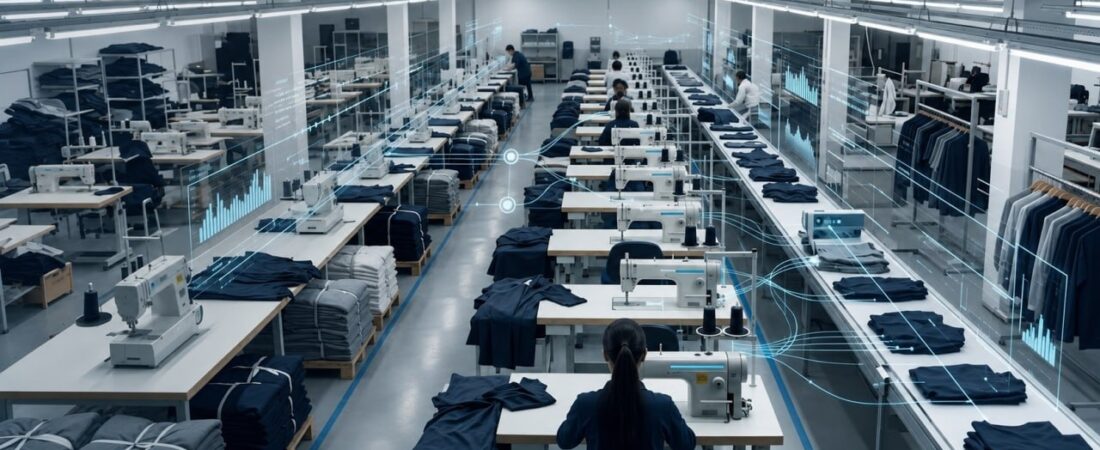
Standard-time data decision
GSD, SAM, and SMV are useful for Factory AI only when standard-time data reflects how the line actually behaves. The decision is not whether the factory owns standard times; it is whether those times connect to method, skill, fabric, layout, quality, and learning-curve reality.
Fixed SAM/SMV numbers mislead AI
The common mistake is to treat SAM or SMV as a fixed number copied from costing into production. When standard time is not maintained against actual operation method, style complexity, operator skill, and quality loss, AI planning will optimize against a weak baseline.
Checks before funding standard-time analytics
- Can IE explain how the standard time was built, revised, and approved for the current style?
- Are deviations between standard time and actual cycle time reviewed by operation, operator skill, and fabric condition?
- Can planning, costing, line balancing, incentive, and capacity decisions use the same controlled time logic?
Vendor proof for SAM/SMV control
- Show how the system imports, versions, and protects standard-time data.
- Demonstrate comparison between SAM/SMV baseline, actual cycle time, efficiency, and quality loss.
- Explain how method changes and style revisions update the standard-time layer.
IE validation gate
GO if standard-time data becomes a shared decision layer for IE, planning, production, and costing. HOLD if data exists but revision control is weak. REDESIGN if AI planning uses old SAM/SMV numbers without factory validation.
GSD SAM SMV can become the standard-time data layer that makes apparel Factory AI practical, measurable, and safer to pilot.
Factory answer
- GSD, SAM, and SMV can become the standard-time data layer behind apparel costing, capacity planning, line balancing, and automation ROI.
- AI should not blindly guess standard time when method, operation sequence, allowance, and factory reality are not controlled.
- The practical goal is not more acronyms; it is better production evidence before advanced Factory AI decisions.
Factory readers this helps
IE/ME teams, costing teams, planning leaders, production managers, and apparel automation readers who need to connect standard-time data with Factory AI readiness.
Evan Lee factory field note
Standard-time data must match how the line actually behaves
GSD, SAM, and SMV only become useful for AI when they are connected to the real method, skill mix, bottleneck behavior, and daily production record. If the standard time is treated as a costing artifact only, an AI scheduling or line-balancing tool will inherit a frozen assumption instead of a living production signal.
In many garment factories, the most important production knowledge is not stored in an AI system. It sits inside the ME and IE teams: operation breakdowns, method studies, GSD analysis, SAM, SMV, costing assumptions, line balance sheets, and the practical judgment of people who know how a garment is actually made.
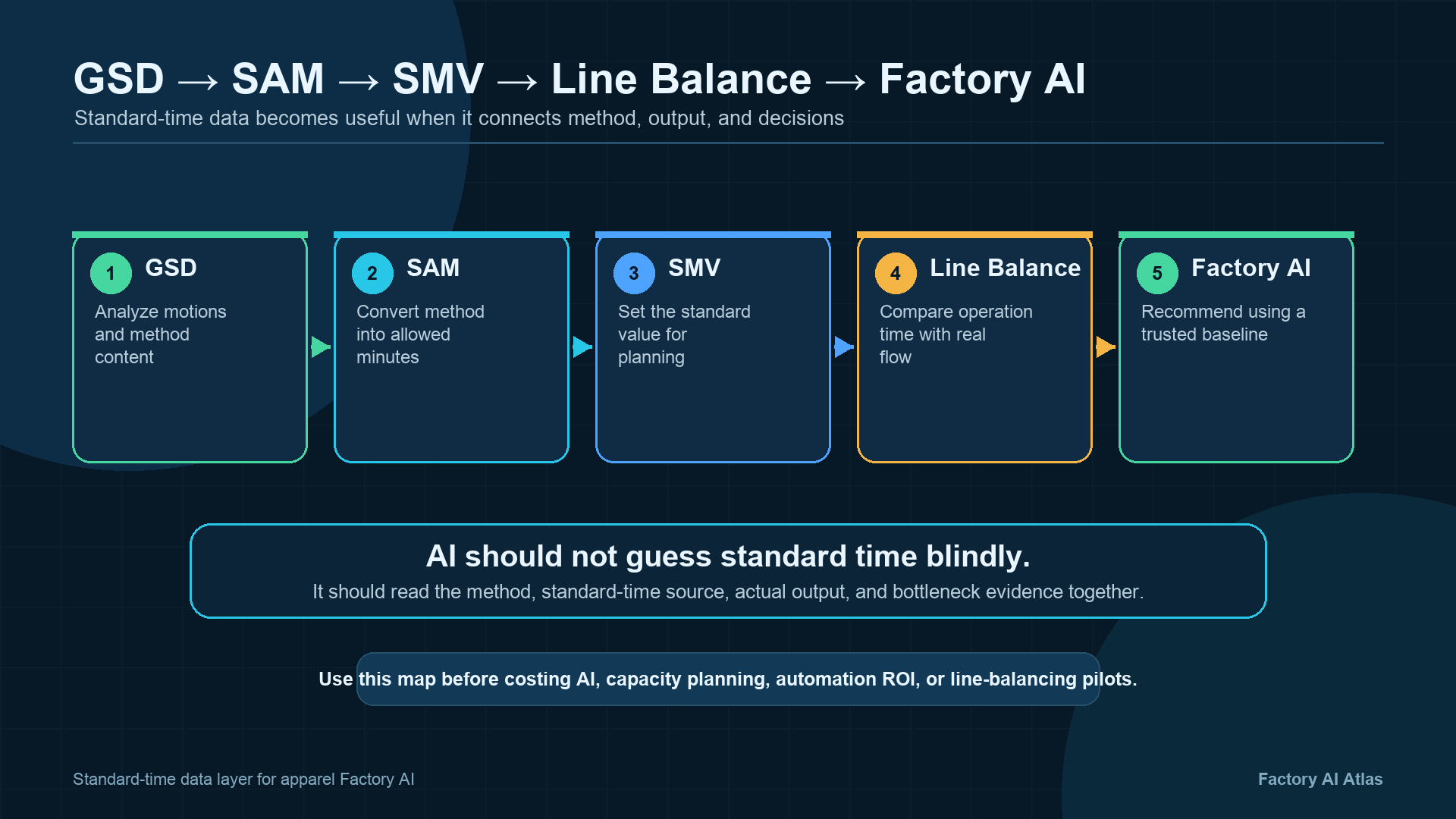
GSD, SAM and SMV definitions for searchers
GSD, SAM, and SMV are not only IE abbreviations. They are the standard-time language that connects style construction, costing, capacity planning, line balance, automation ROI, and Factory AI readiness.
| Term | Meaning | Factory AI relevance |
|---|---|---|
| GSD | General Sewing Data, a predetermined motion/time system used to analyze garment operations. | Helps build a more consistent method and time baseline. |
| SAM | Standard Allowed Minutes for an operation, style, or garment. | Supports costing, capacity, target setting, and line-balance comparison. |
| SMV | Standard Minute Value, often used similarly to standard time in apparel planning. | Gives AI a reference point before comparing actual output, bottlenecks, or ROI. |
That data is often treated as a costing or IE file. For apparel factories that want useful AI, it should become a working evidence layer: standard time, target, actual output, efficiency, and exception reason in one place.
If a factory cannot explain how a style’s standard time was built, which operations create bottlenecks, or why costing assumptions differ from actual factory output, AI will not fix the problem. It may only make weak assumptions faster.
How I would read a GSD SAM SMV dashboard before an AI pilot
A dashboard like this should not be read as decoration. It is a management check on whether the factory has a usable baseline before asking AI to predict capacity, rebalance lines, or justify automation.
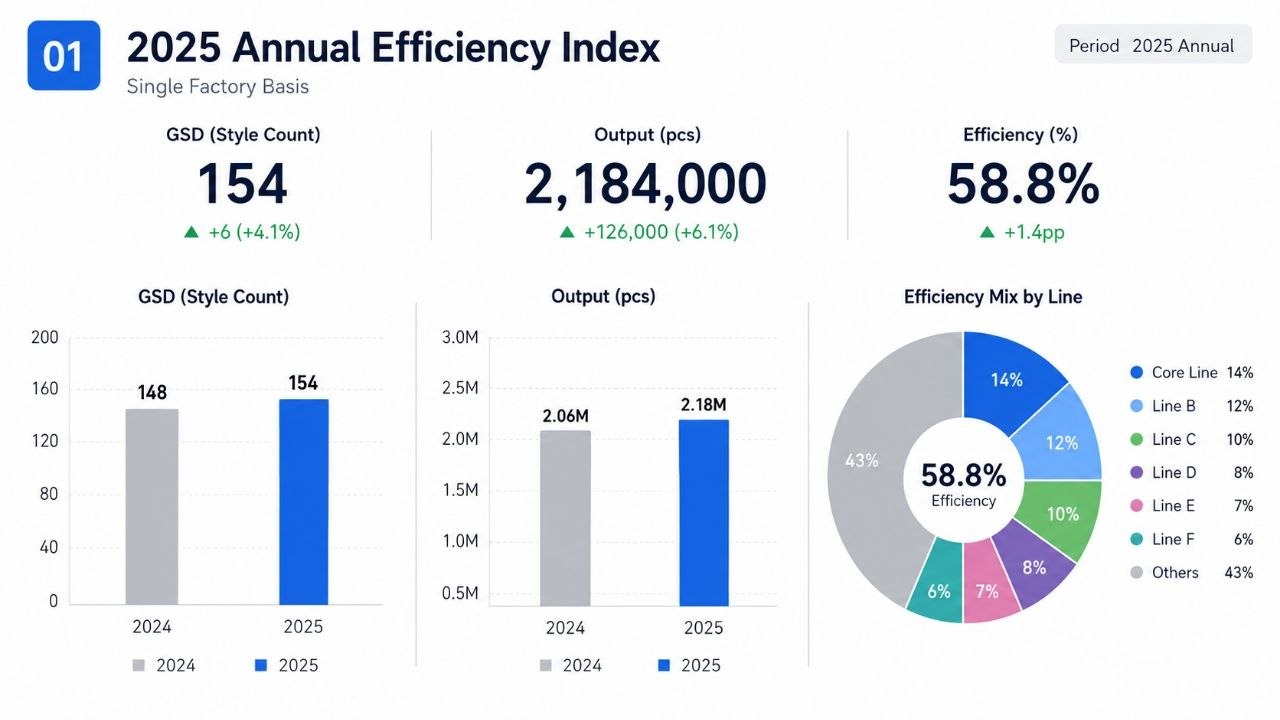
The scale matters. This example is labelled 2025 Annual and Single Factory Basis, so the output figure should be read as an annual factory-level view, not as one month of production. That framing makes the volume more realistic and avoids overstating what one factory can produce in a single month.
- GSD/style count shows complexity pressure across the year. More styles usually means more changeover, learning curve, and method-control risk.
- Annual output should connect the standard-time file to real factory volume, not sit only in costing.
- Efficiency versus plan tells management whether the baseline is usable, drifting, or hiding a bottleneck.
- Efficiency mix by line helps decide whether the problem is factory-wide or line-specific: method, skill, layout, product mix, or rework.
GSD, SAM, SMV gives apparel Factory AI a standard-time baseline
Apparel Factory AI systems are only useful when they have a reliable baseline to compare against. In a garment factory, one of the most important baselines is standard time.
- Is this new style more complex than the previous one?
- Is the quoted sewing cost realistic?
- Which operation is likely to become the bottleneck?
- Can this factory accept the order within the available capacity?
- Where should automation or a low-risk robot pilot be tested first?
- Is the production line underperforming, or was the original target unrealistic?
None of these questions can be answered well if the factory cannot translate garment construction into time, labor, method, output, and line-by-line performance evidence.
What GSD SAM SMV means in practical garment work
GSD is a method-time system used in apparel manufacturing to analyze garment operations and build standard-time benchmarks. In public industry language, GSD Cost is described as a method-time-cost solution for garment costing and SMV calculation.
SAM means Standard Allowed Minute. SMV means Standard Minute Value. In many factories, the two terms are used closely in daily costing and production conversations, although each organization may apply its own definitions and calculation rules.
- the operations required to make the style
- the time allowed for each operation
- the expected labor content
- the basis for costing and quotation
- the target output for a line
- the comparison point for actual efficiency
- the starting point for capacity planning
For a commercial team, SAM/SMV helps support quotation and costing. For a factory team, it helps translate the style into manpower, target output, line balance and expected production behavior.
The ME/IE team is the bridge between costing and execution
In an apparel manufacturer, the commercial team may ask: Can we quote this style at the required price?
The factory may ask: Can we produce this style at the required output and delivery date?
The ME/IE function sits between those two questions. A strong ME/IE team interprets the garment, reviews the construction, estimates the labor content, considers the factory method, and helps both sides understand what the style means operationally.
That bridge is extremely important for Factory AI. A useful AI system needs the ME/IE layer because that is where the commercial view and factory execution view meet.
7 reasons GSD SAM SMV can improve apparel Factory AI
AI should not blindly replace GSD analysts, ME teams or IE teams. But it can support them if the data foundation is strong.
1. Similar-style comparison
AI can help compare a new style with past styles and highlight where the construction appears similar or different. This can speed up early discussion before a full technical review.
2. Early SAM or SMV screening
AI-assisted tools are already being marketed for image-based costing and standard-minute estimation. This direction is promising, especially for early-stage costing and sample review. But early screening is not the same as final factory standard time.
3. Costing scenario simulation
AI can help run costing scenarios faster: factory comparison, efficiency assumptions, CM sensitivity, labor-cost drivers, and style features that are sensitive to method or skill variation.
4. Line balance risk detection
If the factory has operation-level SAM/SMV and actual output history, AI can help identify likely bottlenecks before the style reaches bulk production.
5. Automation ROI screening
Before testing a robot or automation device, the factory should understand the operation baseline: time consumed, repeatability, bottleneck source, style change frequency, method stability and actual output behavior.
This connects directly to the Factory AI Atlas principle in the article on Factory AI readiness validation gates: factories should validate process stability and data readiness before AI or robot pilots.
6. Commercial and factory alignment
GSD SAM SMV helps the commercial team and the factory team discuss the same style with the same production baseline. That makes apparel Factory AI more useful because costing, planning, and execution are not separated into disconnected spreadsheets.
7. Feedback loops after bulk production
After production, the factory can compare planned SAM/SMV with actual output, bottlenecks, rework, and efficiency. This feedback loop is where AI becomes more practical: not by guessing a perfect number once, but by learning from verified factory results.
Why AI should not guess SAM blindly
The most dangerous version of AI costing is the one that looks confident but does not know the factory.
- fabric thickness, stretch, slipperiness or shrinkage behavior
- operator skill level
- machine attachments, folders, guides or fixtures
- seam quality requirement
- rework tendency
- pressing, inspection and handling time
- changeover and learning curve
- factory-specific method differences
- actual efficiency by line or product type
A better model is: AI suggests a first estimate or risk flag, ME/IE reviews the method and assumptions, the factory compares the estimate with real production, and the database improves after feedback.
Use SMV as decision logic, not as a universal garment benchmark
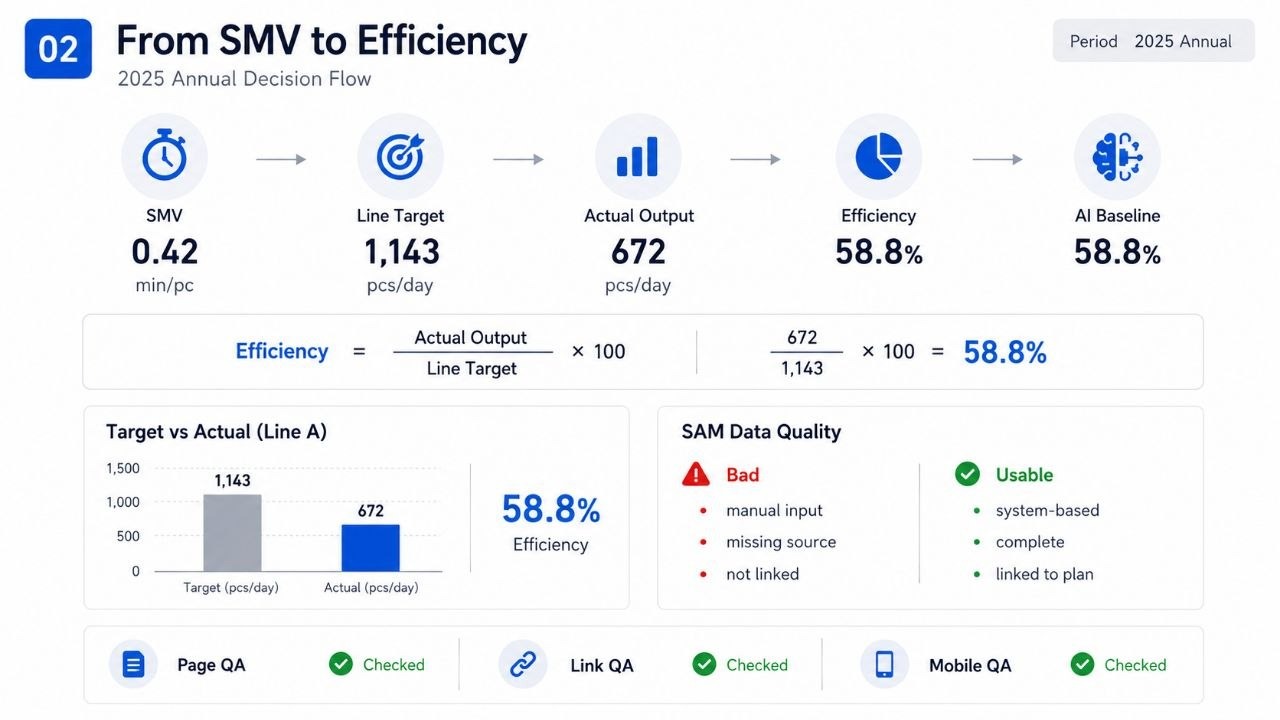
The SMV figure in this visual is a simplified example for explaining the formula, not a universal benchmark for a complete garment. In real apparel IE work, SAM or SMV depends on product type, construction, fabric behavior, operation breakdown, machine mix, learning curve, and quality requirements.
The useful lesson is the decision flow: standard time creates a line target, actual output tests that target, and the efficiency gap becomes the baseline for AI. If the SMV source is manual, incomplete, or not linked to the plan, AI can still generate reports, but the report will not be reliable enough for budget or automation decisions.
Field Lens: GSD SAM SMV is a Factory AI readiness gate
For apparel factories, standard-time discipline should be treated as an AI readiness gate.
- Do we have a reliable operation breakdown for core product types?
- Are SAM/SMV values built from a consistent method-time logic?
- Do commercial costing and factory production use the same baseline?
- Do we compare standard time with actual output and efficiency?
- Do we track where WIP, rework and bottlenecks actually occur?
- Can ME/IE, planning, production and sales see the same version of the data?
- Do we update the standard-time database after real production feedback?
If the answer is no, the factory may not be ready for advanced Factory AI yet. It may first need to clean the data layer that already exists inside the ME/IE workflow.
GSD SAM SMV can support a practical apparel digital twin
A garment factory digital twin does not have to start with a 3D simulation of the whole building. A practical apparel digital twin can start with style, operation breakdown, machine type, skill requirement, SAM/SMV by operation, line layout, WIP movement, defect and rework points, actual output and shipment readiness.
When this data is connected, the factory can begin to simulate decisions: which line can handle the style, which operation will constrain output, whether the bottleneck is sewing time or material flow, and where AI support should be tested first.
The value of ME/IE data will increase, not disappear
AI will not make good ME/IE work less valuable. It will make it more valuable. Factories with weak standard-time discipline may struggle because AI has no reliable foundation. Factories with strong ME/IE data can use AI to speed up comparison, identify risk, simulate scenarios and close the feedback loop between costing and production.
The future ME/IE role may include more data stewardship: maintaining clean operation libraries, validating AI-suggested estimates, linking costing assumptions to production reality, reviewing exceptions, building feedback loops, and helping management decide where automation is realistic.
A simple standard-time data model for apparel Factory AI
In apparel, standard time is not just a number for costing. It is the language that connects style construction, manpower, line balance, capacity, and automation risk.
A practical data layer can start with simple fields: operation, machine type, attachment or folder, skill grade, SAM/SMV, actual output, rework point, defect risk, bottleneck risk, and changeover note.
- Quoted SAM vs pilot actual output.
- Standard time vs WIP buildup at bottleneck operations.
- Similar style history vs actual construction difference.
- Machine or attachment choice vs quality and rework behavior.
- Automation cycle time vs real line-balance effect.
Final standard-time data takeaway
GSD SAM SMV should not be viewed only as traditional industrial-engineering tools. In apparel manufacturing, they can become the standard-time data layer for apparel Factory AI.
Before asking AI to predict costing, optimize production or justify a robot pilot, first ask whether the factory has a trusted way to measure work. Because in apparel manufacturing, AI readiness begins with the ability to explain how the work is done.
Standard-time data search questions
What is GSD in garment manufacturing?
GSD stands for General Sewing Data, a predetermined motion and time system used to analyze garment operations and build standard time.
What is SAM?
SAM means Standard Allowed Minutes. It estimates how many minutes an operation, style, or garment should take under defined method and performance assumptions.
What is SMV?
SMV means Standard Minute Value. In apparel factories it is commonly used as a standard-time value for costing, planning, capacity, and line balancing.
What is the difference between SAM and SMV?
They are often used closely in apparel planning, but the key is not the label. The factory must know how the value was built, what assumptions it contains, and how actual output compares.
Why do GSD, SAM and SMV matter for Factory AI?
Factory AI needs a trusted baseline before it can compare styles, detect bottlenecks, simulate capacity, screen ROI, or explain why production differs from plan.
Can AI calculate SAM automatically?
AI may assist with estimation and comparison, but it should not blindly replace ME/IE judgment without method validation, actual output feedback, and factory context.
Related Factory AI Atlas reading
- Factory AI Readiness hub
- Factory AI readiness validation gates
- Apparel factory small apps before robots
- AI apparel costing as ME/IE scenario support
- Jumper pool systems for flexible operator control
- Sewing line layout choices for garment factory flow
- Garment factory data problems that break AI projects
- Cutting plan as an apparel Factory AI readiness layer
- Why garment factory automation is difficult
Standard-time data source notes
- Coats Digital — GSDCost for garment manufacturers
- Coats Digital — GSDCost method-time-cost benchmarks
- Coats Digital — GSDQuest AI-assisted costing direction
- ILO — apparel and footwear automation context
- Robotic automation in apparel manufacturing research
Author and IE data perspective
Factory AI Atlas is written from a manufacturing operations perspective shaped by hands-on apparel and textile production experience, including overseas factory management, woven and knit operations, production control, quality systems, and operational restructuring.
The site focuses on source-linked, field-practical guidance for AI, robotics, automation, and factory readiness. See the Editorial Policy & Disclaimer for sourcing standards and AI-use disclosure.
Standard-time data validation anchors
- ILO textiles and apparel resources — useful context for productivity, skills, and labor-intensive apparel operations.
- Better Work reports and publications — helpful for connecting factory improvement, productivity discipline, and worker-condition evidence.