
Factory decision note
AI can help a factory compare costing options. It should not invent a final cost. ME and IE teams still need to review the method, standard time, efficiency, and production limits behind the number.
The mistake factories usually make
Teams often ask for a faster quote before they agree on the assumptions. The software then gives a clean number built on weak data. That number may move quickly through sales, but the factory finds the error later.
What I would check before approving budget
- Can the team see the operation breakdown and the SAM or SMV behind each estimate?
- Does the tool separate factory data from a sales target or buyer request?
- Can ME and IE compare the estimate with actual production?
- Does every change have an owner, reason, date, and approval record?
Vendor proof requests
- Show the full assumption table behind one costing result.
- Compare the estimate with actual records from a similar style.
- Show how ME or IE corrects an assumption without deleting the old version.
- Explain who can approve a number for quotation or production planning.
Pilot gate
GO when the tool makes assumptions easier to review and improves the discussion between commercial and factory teams. HOLD when the data exists but the rules are not consistent. REDESIGN when the tool hides uncertain inputs behind one confident price.
Apparel costing begins with how the garment will be made. Fabric and trims matter, but so do the operation sequence, machine type, handling difficulty, quality risk, and expected line performance.
AI can help teams search old styles and compare options. It can also flag a large gap between an estimate and past production. The final number still needs a factory review because a tech pack or photo does not show every production condition.
Cost starts with the method, not the AI tool
Two garments can look similar and still need different work. A small construction change may add handling, an attachment, a pressing step, or another quality check. A fabric may stretch, slip, mark, or require slower feeding. These details change time and risk.
The costing team may begin with a buyer target or a similar style. ME and IE teams look at the operation breakdown and ask whether the factory can use the same method. Both views matter, but they are not the same. The estimate should show where each assumption came from.
This is why a fast AI answer can be misleading. The model may find a close style in the database, but it cannot know whether the old record used the same fabric, machine, skill level, or quality requirement unless those details were recorded.
Five assumptions that need a factory review
1. Garment construction and method
Start with the operation breakdown. Check seams, folders, attachments, special machines, handling points, pressing, and inspection. If the method changes, the time and cost may change too. The estimate should link to the method version that ME or IE reviewed.
2. SAM or SMV
SAM and SMV give the factory a time baseline. They are useful only when the method is clear. The system should show whether the value came from a measured method, a standard data system, a similar style, or an early estimate. These sources do not have the same level of confidence.
The guide to the GSD, SAM, and SMV data layer explains why the factory needs one reviewed version rather than separate values in costing, planning, and production files.
3. Efficiency and learning
A standard time does not become factory output by itself. The estimate also needs an efficiency assumption. New styles, new operators, difficult materials, and frequent changeovers may lower early performance. A strong costing file shows the expected learning period instead of using one flat efficiency number.
4. Quality and rework risk
A low labor estimate may hide extra inspection or repair work. Tight tolerances, visible topstitching, shade control, print matching, or unstable fabric can increase the risk. The team should record these points before the quote is fixed, not after defects appear on the line.
5. Factory and order conditions
The same style can cost differently across factories or order conditions. Machine availability, operator skill, line size, order quantity, size mix, delivery pressure, and changeover loss all matter. The tool should let the team change these inputs and see which part of the estimate moved.
Where AI can help
AI is useful when it reduces search and comparison work. It can find similar styles, group past records, compare scenarios, and flag unusual assumptions. For example, it may show that the proposed SMV is far below the result from a similar style or that actual efficiency has been lower for the same fabric family.
It can also help the team see the effect of a change. If the method uses another attachment, the system can compare time, training, machine availability, and expected output. If the buyer changes the order mix, the team can review the effect on capacity and cost.
After production, AI can compare the estimate with actual output, WIP, rework, and line efficiency. This feedback is useful only when someone reviews it. A bad record should not update the standard-time database automatically.
Where AI should stop
A garment photo, tech pack, or short product description is not enough for a reliable final cost. Important details may be missing. The image may not show the inside construction, fabric behavior, seam tolerance, pressing work, or the method the factory will use.
The tool can propose a starting point. ME and IE should check the method and time. Commercial teams should decide how the buyer target and margin affect the quote. Factory management should approve the level of risk the business is willing to accept.
Do not use the AI result as proof that the factory can meet the target. It is an estimate based on stated inputs. If the inputs are uncertain, the result should show that uncertainty.
Use one review loop across teams
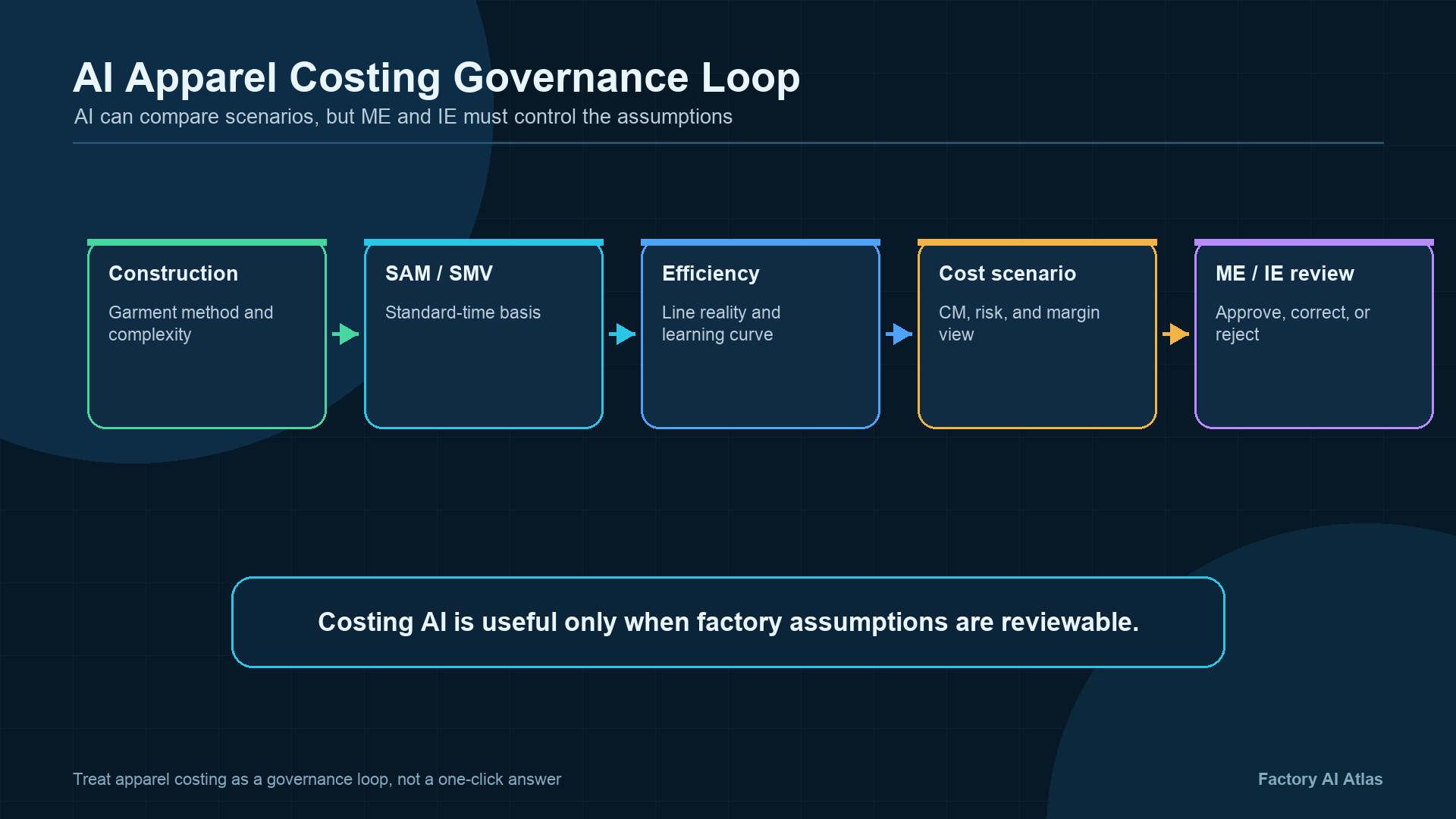
A useful costing system keeps one review trail:
- Commercial or merchandising enters the style and buyer requirements.
- ME or IE reviews the construction, operation breakdown, and SAM or SMV.
- The factory adds efficiency, skill, machine, material, and quality conditions.
- The team compares the estimate with similar styles and actual records.
- An approved owner accepts, corrects, or rejects the assumption set.
- Production results return to the database after review.
This loop prevents one team from changing a number without showing why. It also gives planning and production the same baseline that commercial teams used during quotation.
Pilot one product family
Do not begin with every product and every factory. Choose one product family with enough historical data. A stable basic style is often easier to test than a new fashion item with many unknowns.
For the pilot, compare the AI-assisted estimate with the current costing method. Record the operation breakdown, SAM or SMV, efficiency, quality risk, and actual production result. Review every large gap with ME and IE.
The pilot should answer practical questions:
- Did the tool reduce search or comparison time?
- Did it expose assumptions that were previously hidden?
- Could the team explain every major difference?
- Did the final estimate match production closely enough for the intended decision?
- Did the review create extra work without improving the result?
A pilot is useful even when it finds weak data. That result tells the factory what to fix before scaling. The Factory AI validation gates provide a broader test for moving from a demo to production use.
Connect costing to factory readiness
Costing data should not sit alone. The same operation and time records support capacity planning, line balance, training, quality review, and automation screening. They can also support a cutting-plan review when material and order assumptions change.
A factory that cannot explain its standard time will also struggle to explain automation ROI. Before adding more AI, fix the basic data rules described in Garment Factory Data Problems That Break AI Projects.
This work is part of Factory AI readiness. The goal is not to make every decision automatic. The goal is to make the assumptions visible, reviewable, and useful across teams.
Sources and limits
This article is an operating framework. It does not claim that one product or model can produce an accurate final cost from limited style data. Tool results depend on the factory’s records, methods, review rights, and production conditions.
- Coats Digital GSDQuest is a vendor example of AI-assisted method and time analysis. Its claims should be tested with the factory’s own styles and records.
- ILO research on automation in apparel and footwear gives wider context for technology use in flexible-material production.
- ILO textile and apparel resources cover the sector’s work and production context.
- Better Work reports provide factory-level context for productivity, working conditions, and improvement programs.
Final factory check
AI apparel costing is useful when it helps people review the number. ME and IE teams should be able to see the method, standard time, efficiency, and risk behind every estimate.
Start with one product family. Keep the old and new assumptions visible. Compare the estimate with actual production. If the team cannot explain the difference, do not scale the tool yet.