Layout-flow decision note
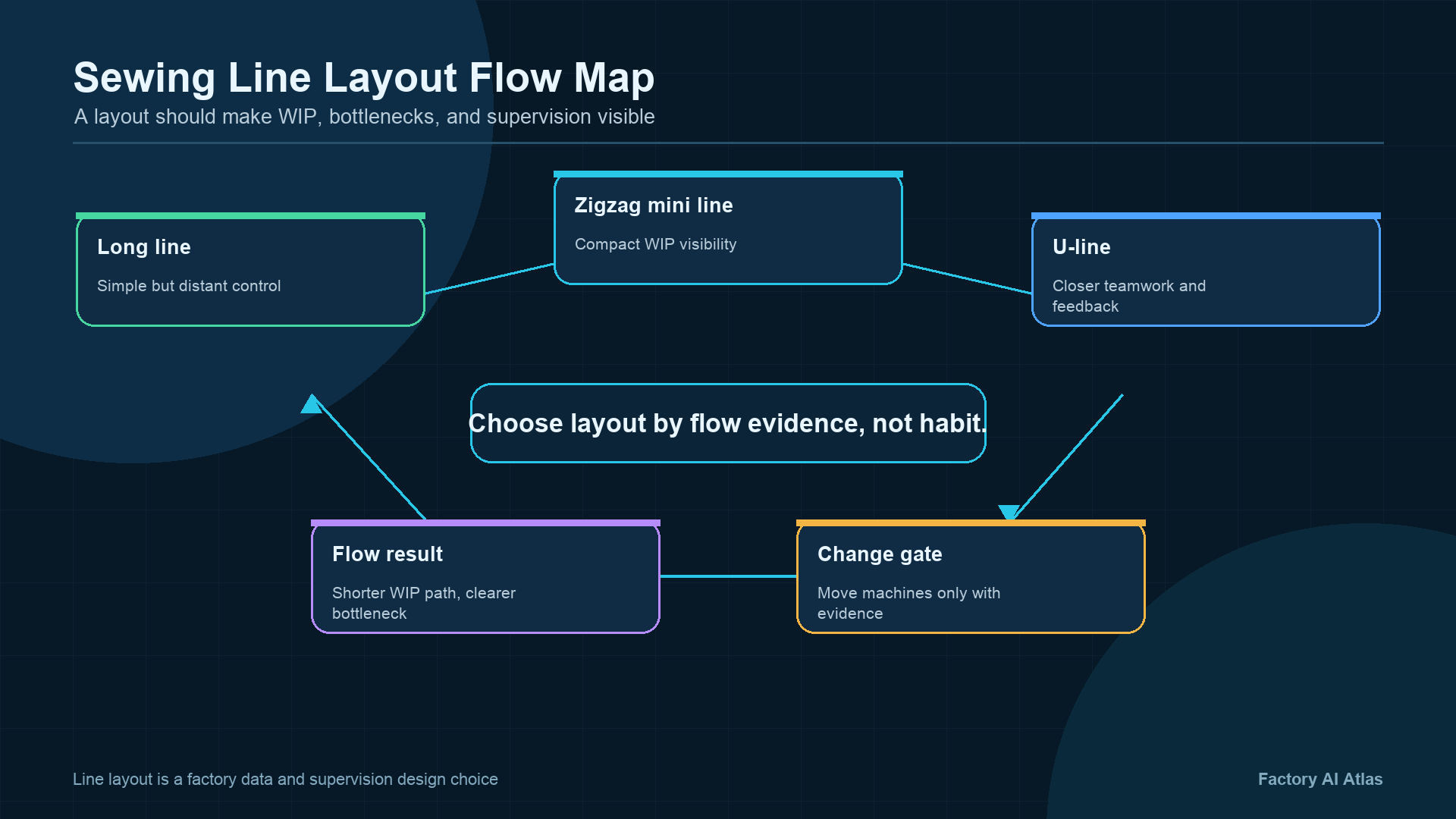
Sewing line layout is a factory AI readiness decision because layout determines whether WIP, walking distance, helper movement, bottlenecks, and supervisor response can be seen and corrected. A layout change should be judged by flow evidence, not only by how neat the line looks.
Moving machines before proving the flow problem
The common mistake is to move machines before proving the operating problem. A U-line, zigzag line, mini-line, or long line can all fail if skill balance, material supply, bundle movement, quality checks, and style-change behavior are not controlled.
Checks before changing a sewing line layout
- Which flow problem is the layout meant to solve: walking, WIP, bottleneck recovery, quality delay, or supervisor visibility?
- Can the factory compare before/after output, WIP, rework, helper movement, and operator fatigue?
- Does the layout match style mix, skill matrix, machine type, material handling, and line-leader span of control?
Proof requests for layout-change evidence
- Show a layout simulation or pilot record using real operation sequence and WIP movement.
- Explain how the design changes under absenteeism, style changeover, fabric difficulty, or helper shortage.
- Provide a before/after decision record, not only a CAD drawing.
Flow-visibility gate
GO if layout data improves flow and same-shift control. HOLD if the design is promising but the measurement baseline is weak. REDESIGN if the factory is moving machines without a clear operating problem.
sewing line layout is not only a floor planning topic. In a garment factory, the way a sewing line is arranged affects WIP movement, bottleneck visibility, supervisor control, operator communication, and the factory’s ability to respond when the plan changes.
A strong sewing line layout gives supervisors a clearer view of flow, helps operators support each other faster, and creates a better foundation for Lean improvement before any Factory AI project begins.
Many garment factories still use the traditional long sewing line. It is familiar, easy to understand, and matches the way many factories have been managed for decades. But as product mix becomes more complex, order quantities become smaller, and delivery windows become shorter, the traditional long line is often not flexible enough.
Factories are now being asked to produce more styles with less waiting time, faster changeovers, better quality control, and lower WIP. In this environment, sewing line layout becomes more than a machine placement issue. It becomes a Lean management decision.
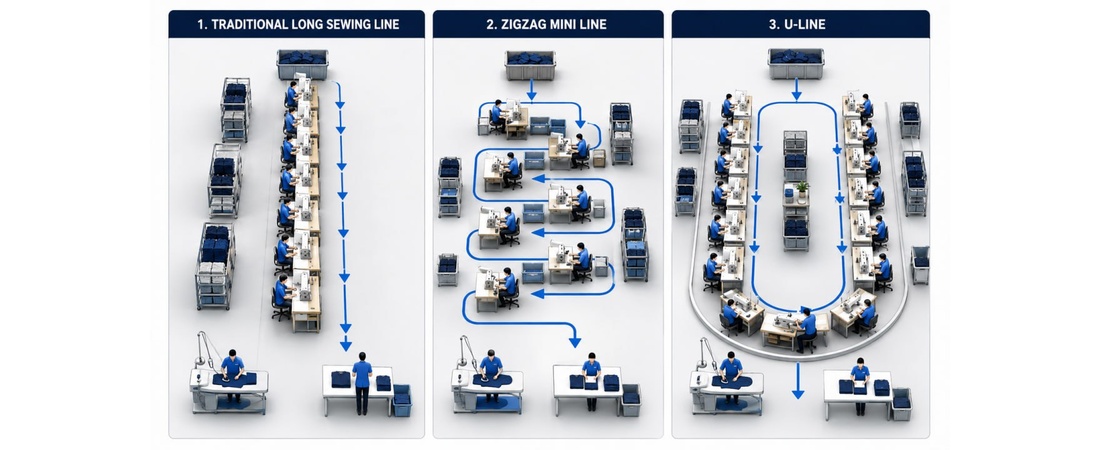
The hero image above compares three common sewing line layout options: traditional long sewing line, zigzag mini line, and U-line. Each layout creates a different material flow pattern and a different management problem.
The important question is not, “Which layout looks more modern?” The better question is: which layout helps the factory see problems faster, reduce unnecessary movement, and control WIP more effectively?
Sewing line layout map
- Traditional long sewing line
- Why layout matters in Lean garment production
- Zigzag mini line
- U-line
- Layout change requires more than moving machines
- How to choose the right sewing line layout
- Layout, jumper operators, and the skill matrix
- Factory AI readiness
- Practical pilot method
1. Traditional Long Sewing Line
The first layout in the image is the traditional long sewing line. In this system, sewing machines are arranged in one long direction. Operators sit one after another, and the garment moves from the first operation to the next until it reaches the end of the line.
This layout is common because it is simple and familiar. It can work especially well when the style is stable, order quantity is large, the operation sequence is repetitive, and operators are specialized in one or two operations.
- Stable high-volume production
- Repetitive operation sequence
- Specialized operator structure
- Fixed floor, power, and air layout
- A line management culture already built around long-line control
For high-volume, stable production, the long sewing line can still be effective. The layout itself is not wrong. The weakness appears when the factory needs flexibility.
In a long line, the material flow is physically stretched. WIP can accumulate between operations. A bottleneck may not be visible immediately. The line supervisor may need to walk a long distance to check the full line. Quality problems may travel too far before being detected.
A long line can also make communication slower. If one operator is waiting, another is overloaded, and a quality issue appears near the end of the line, the team may not react quickly enough.
2. Why Sewing Line Layout Matters in Lean Garment Production
In Lean manufacturing, flow is more important than the shape of the line. A factory can have a beautiful layout but still have poor flow. A factory can also have a simple layout but strong discipline and excellent WIP control.
The purpose of changing a sewing line layout is not decoration. The purpose is to improve the operating system.
A good sewing line layout should help the factory:
- Reduce unnecessary material movement
- Make WIP visible
- Detect bottlenecks faster
- Improve supervisor visibility
- Support practical line balancing
- Shorten feedback loops for quality problems
- Make operator support easier
- Improve flexibility when the style changes
This is why zigzag mini lines and U-lines are often discussed in Lean garment production. They are not magic solutions, but when used correctly, they can make production flow easier to see and easier to control.
3. Zigzag Mini Line: Compact Flow and Better Visibility
The second layout in the image is the zigzag mini line. Instead of arranging all machines in one straight direction, the zigzag line places operators and machines in a compact, alternating pattern. The material flow moves through the line in a zigzag path.
The main advantage is shorter distance. Operators are closer to each other. WIP does not need to travel as far. The line leader can observe more stations from a shorter distance. Problems become easier to see.
A zigzag mini line can be useful when the factory wants to:
- Reduce walking distance
- Reduce material handling
- Improve line leader visibility
- Control WIP in a smaller area
- Support medium or small lot production
- Make the line easier to balance and adjust
This layout can also help when a factory has frequent style changes. Because the line is more compact, the production team can sometimes adjust operations faster than in a long straight line.
However, zigzag lines also need discipline. If WIP racks are placed poorly, the layout can become crowded. If the flow direction is unclear, operators and helpers may become confused. If the aisle is too narrow, material movement can become worse instead of better.
A zigzag mini line works best when the factory clearly defines the input point, output point, WIP rack position, operator position, material feeding route, quality checkpoint, and escalation rule for bottlenecks.
4. U-Line: Lean Flow for Closer Control
The third layout in the image is the U-line. In a U-line, sewing stations are arranged around a U-shaped or loop-shaped flow. The input and output points are closer together than in a traditional long line.
This layout is often associated with Lean production because it can improve visibility and control. In a U-line, the line leader can often see more of the process at once. Operators are positioned closer to each other. Material movement can be shorter. The start and end of the line are easier to monitor.
A U-line can support:
- Small-batch production
- Faster response to bottlenecks
- Better communication between operators
- Closer WIP control
- Easier support from multi-skilled operators
- Improved line leader observation
The U-line is especially useful when operators are cross-trained. For example, if one operator can support two nearby operations, or if a jumper operator can quickly assist a bottleneck point, the U-line structure makes that support easier.
This connects directly to skill management. A U-line without multi-skilled operators may not deliver strong results. If every operator can only perform one narrow task, the layout alone will not create flexibility.
5. Layout Change Requires More Than Moving Machines
Some factories make the mistake of thinking that layout improvement means simply moving sewing machines. But Lean layout improvement is not just a mechanical activity.
A good layout change requires coordination between Industrial Engineering, Production, sewing supervisors, line leaders, mechanics, quality, cutting and WIP feeding, warehouse or material handling, and training teams.
Before changing a line layout, the factory should understand the current condition:
- Where does WIP accumulate?
- Which operation is the bottleneck?
- How far does material travel?
- How often does the supervisor walk the full line?
- Where are defects first detected?
- Which operators are multi-skilled?
- How often does the style change?
- Are machines easy and safe to move?
Without this analysis, layout change becomes guesswork. The factory may create a new layout that looks Lean but does not perform better.
6. How to Choose the Right Sewing Line Layout
There is no single best layout for every garment factory. Each layout has a proper use case.
A traditional long line may be suitable when production is stable and order quantity is large. If the factory produces the same style repeatedly with specialized operators, the long line can be simple and efficient.
A zigzag mini line may be suitable when the factory wants a more compact flow. It is useful when the supervisor needs better visibility and when WIP movement should be reduced.
A U-line may be suitable when the factory has more multi-skilled operators and wants closer control of input, output, and bottlenecks.
A modular or cellular layout may be suitable for high-mix, low-volume production, but it requires stronger training, team responsibility, and sometimes a different incentive system.
The right layout depends on the factory’s actual operating conditions: product type, style change frequency, order quantity, operation complexity, operator skill flexibility, machine mobility, floor space, WIP discipline, supervisor capability, and quality feedback speed.
A factory should not copy a layout only because another factory is using it. It should test the layout against its own product mix and production problems.
7. The Link Between Layout, Jumper Operators, and the Skill Matrix
Flexible layouts work better when the factory also has flexible people. This is where jumper operators and skill matrices become important.
A jumper operator is a multi-skilled operator who can support different operations when the line has an imbalance, absenteeism, or bottleneck. But a jumper operator is only effective if the factory knows which operations the operator can perform, at what skill level, with what quality level, at what speed, on which machine type, and for which product category.
This information should be managed in a skill matrix. When the factory combines a better layout with a good skill matrix, the line becomes much easier to control.
- In a long line, a jumper may need to move a long distance to support a bottleneck.
- In a zigzag mini line, support distance becomes shorter.
- In a U-line, the jumper or line leader can often support multiple nearby points faster.
Flexible layout needs flexible skill. Flexible skill needs clear data. Clear data becomes the foundation for future AI-assisted line planning.
8. Factory AI Readiness: Why Layout Data Matters
Many factories want to use AI for line balancing, production planning, or bottleneck prediction. But AI cannot optimize a line that the factory cannot describe clearly.
Before using AI, the factory needs clean operating data. For sewing line layout, useful data includes layout type, machine position, operation sequence, operator assignment, skill level, SAM or SMV, WIP quantity, bottleneck history, defect location, output by hour, changeover time, helper movement, and supervisor response time.
This is why Lean layout improvement is also part of Factory AI readiness. A factory that can map its line, measure its WIP, identify its bottlenecks, and update its skill data is already building the foundation for AI-assisted operations.
AI does not replace basic production discipline. AI depends on it.
9. Practical Sewing Line Layout Pilot Method
A factory should not convert all lines at once. A better approach is to run a small pilot.
- Map the current long line: machine positions, WIP locations, input point, output point, inspection area, and material movement.
- Measure the current condition: WIP quantity, output, bottleneck operations, defect rate, waiting time, and supervisor walking distance.
- Select one product family that is important but not too complex for the first test.
- Design layout alternatives such as current long line, zigzag mini line, and U-line.
- Run a controlled pilot with floor marking, clear WIP positions, defined operator assignments, and a visible line control board.
- Measure the result: output, WIP, defect rate, response time, operator movement, and line stability.
- Standardize or adjust based on measured performance, not appearance.
Practical References for Sewing Line Layout Improvement
For a factory team, sewing line layout improvement should be connected to reliable Lean references and to internal operating knowledge. The Lean Enterprise Institute explanation of flow is useful when teams discuss why long movement, waiting, and hidden WIP matter. The Lean Enterprise Institute overview of Lean thinking is also a practical external reference for waste reduction and continuous improvement.
Inside Factory AI Atlas, this topic connects directly with jumper pool systems for garment factories, GSD, SAM, and SMV as a Factory AI data layer, and small operating apps for apparel factories. Together, these articles show that sewing line layout, skill data, standard time, WIP rules, and simple dashboards must work together before advanced AI can improve factory control.
Common Mistakes to Avoid
The first mistake is assuming that a U-line is always better. In garment production, fabric handling, machine type, attachments, pressing, and inspection points can make a full U-line difficult.
The second mistake is reducing distance but increasing congestion. A compact layout is only useful when aisles, racks, and material movement are properly planned.
The third mistake is ignoring operator skills. A flexible layout cannot work well if operators are too specialized and there is no cross-training plan.
The fourth mistake is forgetting maintenance and safety. Movable or flexible layouts need safe electric connections, air lines, machine stability, and clear floor discipline.
The fifth mistake is changing the layout without changing the management system. WIP rules, line balancing, quality checkpoints, and escalation routines must change together.
Flow-visibility takeaway: the best layout makes problems visible
The traditional long sewing line is not wrong. It can still work well for stable, high-volume production. But when factories face more style changes, smaller lots, higher quality pressure, and shorter lead times, they need more flexible line options.
Zigzag mini lines can reduce movement and improve visibility. U-lines can support closer control and faster response. Flexible layouts can help factories adjust to changing production needs.
But the best Lean layout is not the one with the most modern shape. The best layout is the one that makes flow visible, reduces unnecessary WIP movement, supports the real skill level of operators, and helps supervisors respond before small problems become full-line disruptions.
A practical sewing line layout review should therefore be treated as a management routine, not a one-time IE project. The layout must keep matching the product mix, skill matrix, WIP rule, and line balancing method.
For garment factories preparing for Factory AI, layout improvement is not an old-fashioned Lean topic. It is part of the data foundation. Before a factory can use AI to optimize production, it must first understand how its people, machines, materials, and WIP actually move. That understanding starts with the sewing line layout.
External validation anchors for sewing line layout
- ILO textiles, apparel, leather and footwear resources — useful context for labor-intensive apparel production and productivity improvement.
- Better Work reports and publications — helpful for connecting factory improvement with practical working-condition and productivity realities.