Operating-data control note
Operating-data decision note
This article helps a factory decide which operating records must be cleaned, named, timed, owned, and connected before an AI pilot is worth approving.
Conflicting records are the real AI risk
Factories often buy AI tools before agreeing on the basic meaning of order status, WIP, defects, downtime, rework, and shipment risk. When the same event has different names in Excel, ERP, QC sheets, and supervisor notes, AI only scales confusion.
Checks before funding a data-readiness pilot
- Which data field changes a factory decision?
- Who owns the record when production reality differs from the system?
- Can the same order, line, defect, and delay be traced across departments?
- Is the data good enough to stop, hold, release, or escalate work?
Vendor proof for operating-data quality
- Do not show only dashboard screenshots; show source records and exception handling.
- Explain how duplicate, late, or manually corrected records are treated.
- Provide a pilot data dictionary before model training.
- Show how operators and supervisors correct wrong data without breaking the workflow.
Data-readiness gate: GO when the factory can trace a decision from source record to action. HOLD when the data is useful for reporting but not reliable for decisions. REDESIGN when departments still maintain conflicting versions of the truth.
Evan Lee factory field note
Scope note: this article is the general data-readiness layer, not the garment-only version
This article now treats factory data readiness as a broader operating-data problem across production environments. For the garment-specific version — style/order/operation/WIP/defect records used by sewing, cutting, QA, IE, and planning teams — see the companion article on AI data foundations in garment factories.
Factory example: one order should not create five truths
A practical data-readiness check is to follow one delayed order across five records: order recap, production output, QC defect log, material delay note, and shipment-risk update. If each department reports a different reason, date, owner, or status, the factory does not have an AI problem yet. It has an operating-data control problem.
- Good signal: the same order, style, line, defect, and delay code can be traced across departments.
- Weak signal: managers need chat history or supervisor memory to explain the latest status.
- Pilot rule: do not train a model until the factory can explain how wrong, late, duplicate, or corrected records are handled.
Factory data readiness is becoming one of the most important questions for garment factories that want to use AI in a practical way.
Many teams expect AI to improve production planning, predict quality issues, monitor delivery risks, and help managers make faster decisions. These expectations are not wrong. AI can support factory operations in many practical ways.
But there is one condition that often gets overlooked.
Before AI can help a factory, the factory must first build factory data readiness: clean order, production, quality, workforce, and delivery-risk information that managers can trust.
AI does not magically understand a factory just because a company installs new software. AI works by reading, connecting, and interpreting information that already exists inside the operation.
In many garment factories, the real problem is not that data does not exist. The problem is that data is scattered.
Order details may be in Excel files. Production output may be written on line boards. Defect records may be kept in inspection notebooks. Material delays may be discussed in messaging apps. Delivery risks may exist only in the experience of a few senior managers.
When information is spread across different people, files, departments, and formats, even the best AI system will struggle to create reliable insights.
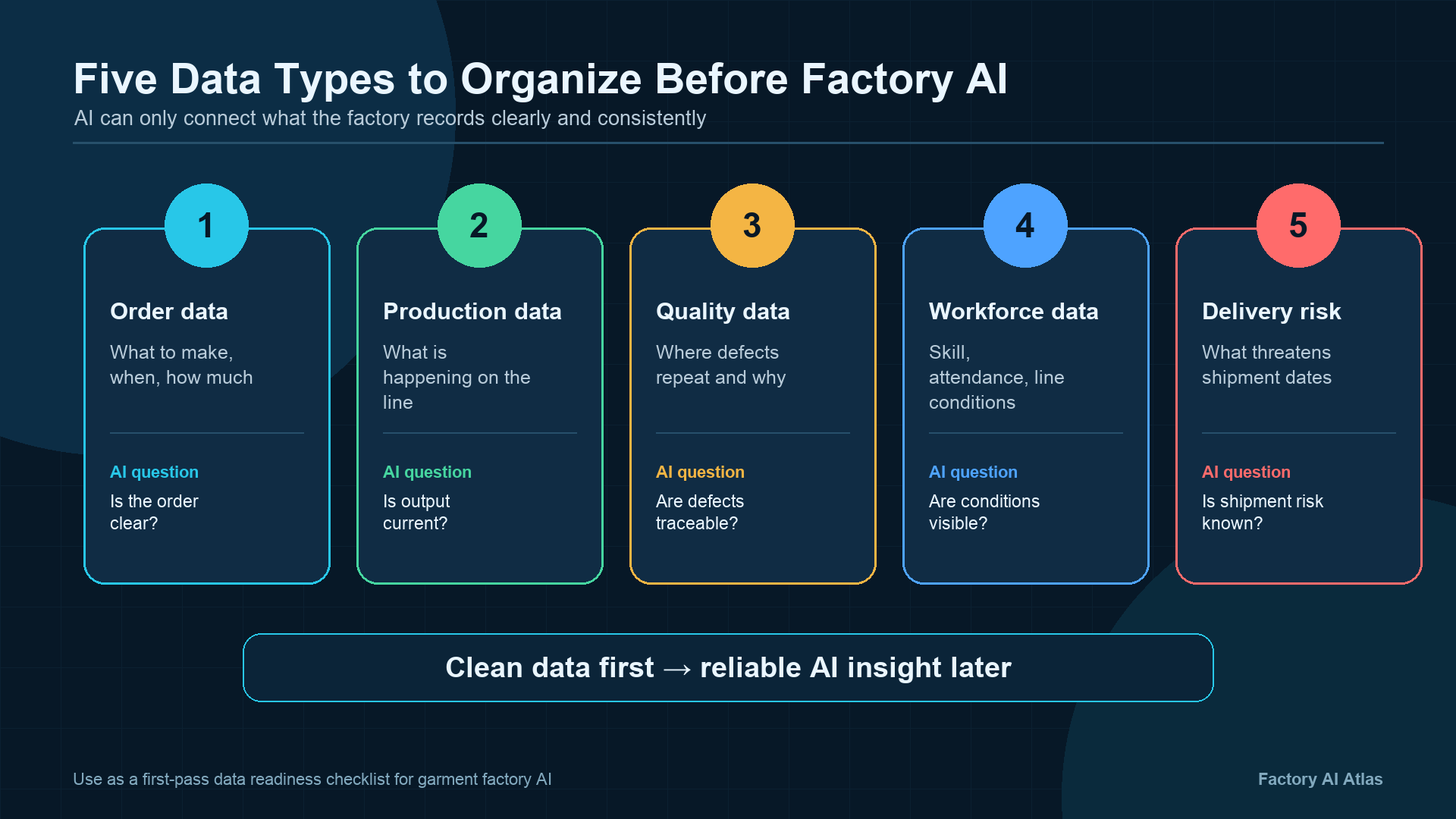
Before AI can transform a garment factory, factory data readiness should begin with these five types of operational data.
Factory data map
- Order data: what needs to be made, when, and how much?
- Production data: what is actually happening on the line?
- Quality and defect data: where do problems keep repeating?
- Workforce and line data: under what conditions is production happening?
- Delivery and risk data: which problems lead to shipment delays?
- AI adoption does not start with buying software
- How small and medium factories can start
1. Order Data: What Needs to Be Made, When, and How Much?
The first type of data every factory should organize is order data.
In garment manufacturing, everything starts from the order. Production planning, material preparation, line allocation, quality control, and shipment all depend on clear order information.
At a minimum, a factory should be able to see:
- Buyer name
- Style number
- Season
- Product category
- Color and size breakdown
- Total order quantity
- Delivery date
- Fabric status
- Trims and accessories status
- Planned production start date
- Shipment method
In many factories, this information exists, but it is not always centralized. The merchandising team may have one version of the order. The production team may work from another file. The warehouse team may track material status separately. QA may refer to buyer standards from another document.
When different departments work with different versions of the same order, decision-making becomes slow and unreliable.
For AI to support production planning or risk prediction, it first needs to understand the basic question: What exactly does this factory need to make? That answer begins with clean and consistent order data.
2. Production Data: What Is Actually Happening on the Line?
The second type of data is production data.
Factory managers ask simple but important questions every day:
- How many pieces did we produce today?
- Which line is behind target?
- What is the current output compared with the plan?
- Can we still meet the delivery date at this speed?
- Where is the bottleneck?
To answer these questions properly, production data must be recorded in a consistent way.
Useful production data includes:
- Date
- Line number
- Style number
- Number of workers
- Daily target quantity
- Actual output
- Hourly output
- Cumulative output
- Efficiency or achievement rate
- Main delay reasons
Many factories already record daily output. But the problem is often the format.
Some data is written on paper. Some is saved in daily Excel files. Some is collected by supervisors but not shared across departments. Some is reported only at the end of the day, when it is already too late to react.
For AI to analyze production performance, a simple output number is not enough. It needs to know which style was produced, on which line, with how many workers, under what conditions, and at what speed.
Only then can AI help answer more useful questions, such as whether a style is slower than similar styles produced before, whether a line is likely to miss the daily target, or whether the current production speed is creating delivery risk.
Production data is the basic signal that shows the current condition of the factory. Without it, AI has no real visibility into the shop floor.
3. Quality and Defect Data: Where Do Problems Keep Repeating?
The third type of data is quality and defect data.
Quality control is one of the areas where AI can create real value. However, AI cannot identify patterns if defects are not recorded clearly.
Most factories already know their quality problems from experience. Supervisors know which processes are difficult. QA teams know which defects repeat. Line leaders know which styles create more rework.
But if this knowledge is not converted into data, the factory cannot easily analyze patterns over time.
Defect data should include:
- Date
- Line number
- Style number
- Process name
- Defect type
- Inspection quantity
- Defect quantity
- Defect rate
- Possible cause
- Corrective action
- Recurrence status
The key is not just to record that a defect happened. The key is to classify defects in a consistent way.
Common garment defect categories may include:
- Sewing defect
- Stain or contamination
- Measurement issue
- Fabric defect
- Print or embroidery defect
- Labeling mistake
- Missing trims
- Ironing or packing issue
Once defect data is organized by type, style, line, and process, AI can help detect repeated quality patterns.
For example, a specific style may show a high defect rate in one operation. A certain line may have recurring measurement problems. A fabric type may be linked with higher sewing difficulty. A defect may appear more often during the first few production days.
AI-based quality improvement does not start with a camera or an inspection machine. It starts with knowing what types of defects are happening, where they happen, and how often they repeat.
4. Workforce and Line Data: Under What Conditions Is Production Happening?
The fourth type of data is workforce and line data.
Garment manufacturing is still a people-centered industry. Output is not determined only by machines or order quantity. It depends heavily on the skill level, experience, attendance, and balance of the production line.
The same style may perform very differently depending on which line produces it.
A factory should organize data such as:
- Number of workers by line
- Skill level of workers
- Key operators by process
- Absenteeism
- New worker ratio
- Line leader
- Working hours
- Overtime
- Style changeover
- Learning curve period
This data gives context to production performance.
For example, if one line has low output, it does not always mean the line is poorly managed. The line may have several new workers. A skilled operator may be absent. The style may have just started. The fabric may be difficult to handle. Or the line may still be in the learning curve stage.
AI cannot understand this context from output numbers alone.
To explain why productivity is low, production data must be connected with workforce and line conditions.
This is especially important in garment factories because performance is rarely caused by one factor. It is usually the result of multiple conditions working together: style difficulty, operator skill, material behavior, line balance, absenteeism, and management response.
If factories want AI to give better recommendations, they must help AI understand the human and operational conditions behind the numbers.
5. Delivery and Risk Data: Which Problems Lead to Shipment Delays?
The fifth type of data is delivery and risk data.
For many garment factories, one of the most expensive problems is delivery delay. A delay can lead to air shipment cost, buyer claims, production schedule disruption, and loss of trust.
However, shipment delays rarely happen suddenly. In most cases, there are warning signs before the final delay.
Common risk signals include:
- Fabric arrival delay
- Missing trims
- Sample approval delay
- Pattern correction
- Late production start
- Low initial output
- High defect rate
- Line change
- Rework increase
- Final inspection failure
- Packing delay
If these risks are not recorded, the factory can only react after the problem becomes serious.
Useful delivery and risk data includes:
- Style number
- Original delivery date
- Current production progress
- Material status
- Approval status
- Quality issues
- Main delay reason
- Estimated completion date
- Actual completion date
- Shipment result
This is where AI can become especially valuable. AI can help factories move from reactive management to early warning management.
For example, AI may help identify patterns such as: styles with low output during the first three production days often become delivery risks; fabric delays of more than two days may affect shipment for certain order types; styles with early defect rates above a certain level may require additional QA support; or lines with frequent changeovers may show higher delivery instability.
But these predictions are only possible when the factory records risk signals before the delay happens.
Delivery risk data helps AI understand not only what went wrong, but also what usually happens before something goes wrong.
AI Adoption Does Not Start with Buying Software
When factories think about AI, they often start by looking for solutions.
They ask which software they should buy, which system they should install, which AI tool they should use, or which dashboard they should build.
These are valid questions, but they are not the first questions.
The first question should be: Can our factory provide AI with clean and meaningful data?
AI adoption is not just a technology project. It is also an operational discipline project.
If order data is incomplete, production data is inconsistent, defect data is unclear, workforce data is missing, and delivery risks are not recorded, AI will have very limited value.
In that situation, AI may create attractive dashboards, but the insights will not be reliable enough for real decision-making.
A factory does not become AI-ready because it buys advanced software. A factory becomes AI-ready when its operational reality is recorded in a structured and usable way.
How Small and Medium Factories Can Start
Factories do not need to build a perfect data system from day one.
In fact, trying to build a large and complex system too early can create resistance from the shop floor. The better approach is to start small and practical.
A factory can begin with five simple actions:
- Keep basic order information in one shared format.
- Record daily production output by line and style.
- Standardize the main defect types.
- Record delay reasons every day.
- Review repeated issues once a week.
These steps may look simple, but they can change how the factory sees itself.
Once data is recorded consistently, managers can start to see patterns that were previously hidden. They can compare lines, styles, defect types, and delivery risks with more confidence.
This creates the foundation for future AI applications.
AI should not be treated as a replacement for factory discipline. It should be treated as a tool that becomes more powerful when the factory already has good operational discipline.
Final operating-data readiness takeaway
Factory data readiness is not a side task. It is the foundation that makes AI useful in garment manufacturing.
It can support better planning, faster decision-making, quality improvement, productivity analysis, and delivery risk management. But AI can only work well when the factory gives it reliable data to work with.
Before adopting AI, garment factories should first organize these five types of data:
- Order data
- Production data
- Quality and defect data
- Workforce and line data
- Delivery and risk data
When these five data areas are connected, the factory begins to shift from a busy operation to an analyzable system.
That is the real starting point of AI readiness.
The future of factory competitiveness will not depend only on who buys the most advanced system first. It will depend on which factories can record, connect, and use their operational data more effectively.
In garment manufacturing, AI transformation does not begin with technology. It begins with making the factory visible through data.
Factory data-readiness source anchors
Factory data readiness should be checked against both AI-risk and manufacturing-improvement references. The NIST AI Risk Management Framework, NIST manufacturing resources, NIST Manufacturing Extension Partnership, and Better Work reports and publications all point to the same operating discipline: make definitions, evidence, ownership, and follow-up reliable before asking software to recommend factory decisions.
For broader context, factories can compare this approach with NIST Manufacturing Extension Partnership resources and the Better Work perspective on practical improvement in apparel supply chains.