Run a maintenance loop, not just a cleaning route
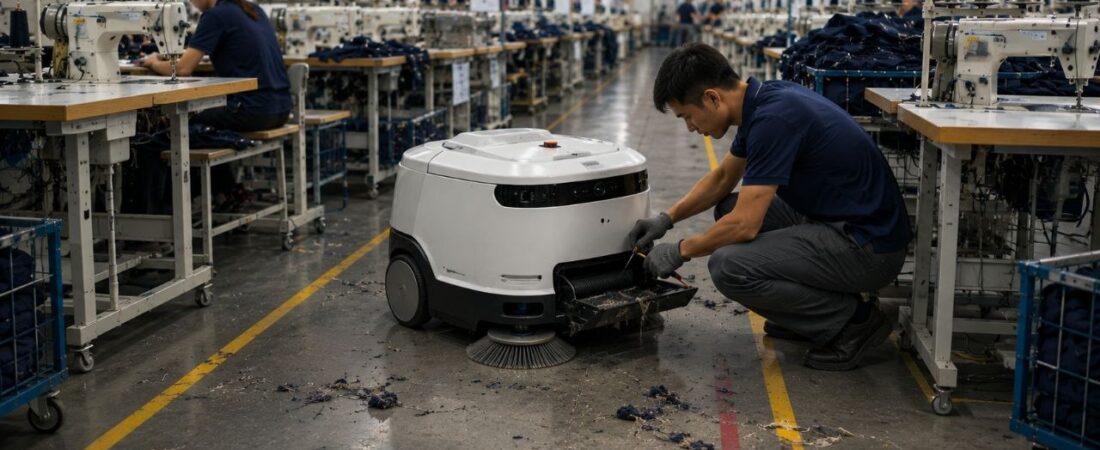
A garment factory should test whether it can restore the robot after thread, lint, obstacles, battery limits, and rescue events—not only whether the robot can finish a route. The useful record is a closed maintenance loop:
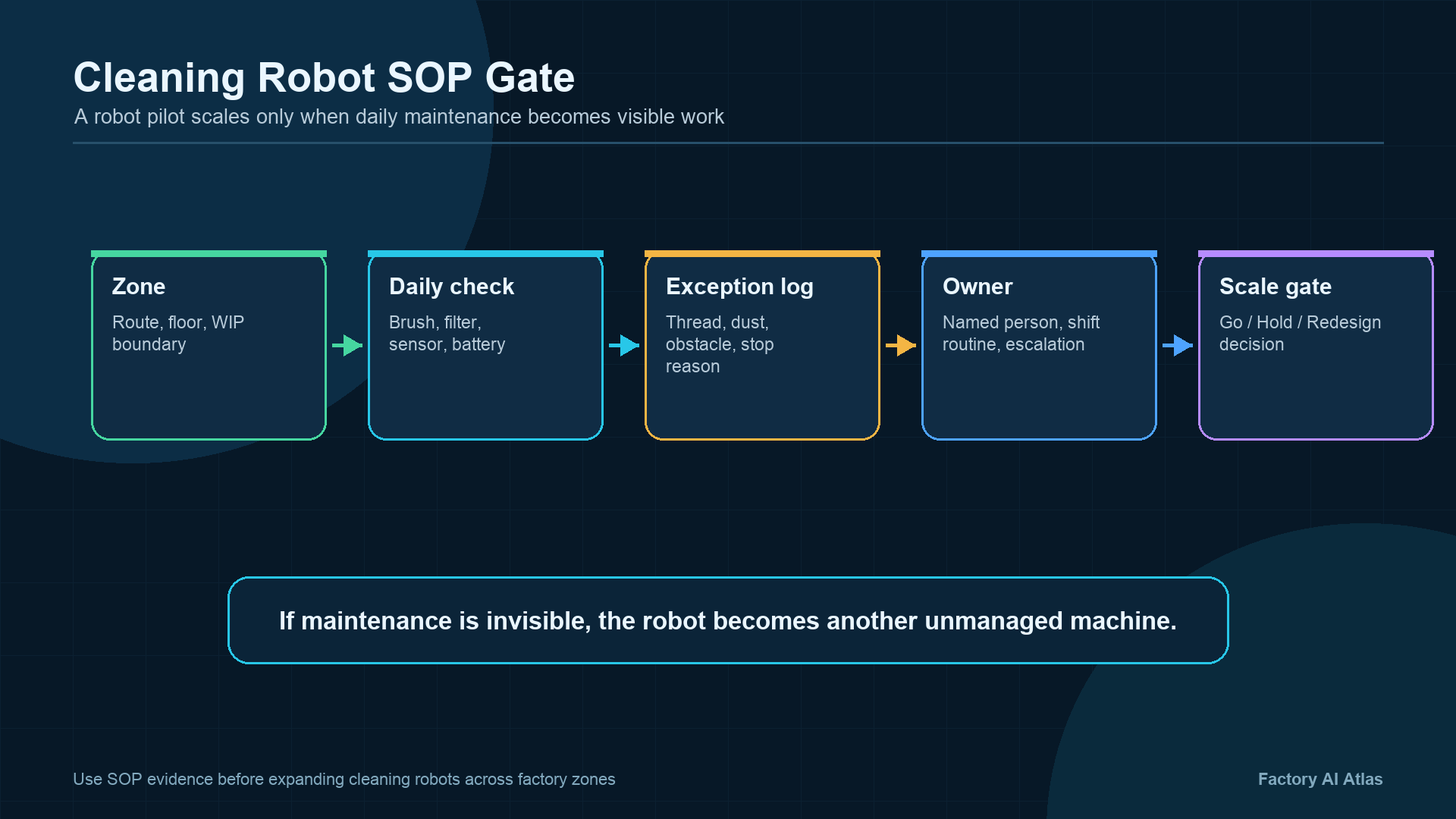
- Expose the route: run the robot in one named zone under normal production traffic.
- Inspect after the run: check brushes, wheels, suction, sensors, dustbin, charging contacts, and the floor left behind.
- Restore before release: remove thread and lint, clear blockages, replace worn parts, and confirm safe operation.
- Log the cause: record the zone, failure, rescue time, action, and whether manual cleaning was still needed.
- Change the routine: adjust the route, cleaning frequency, ownership, exclusion zone, or manual backup rule before the next run.
This loop separates a machine problem from a route, floor-condition, or ownership problem. It also prevents a successful demonstration from being mistaken for reliable daily operation.
Cleaning robot maintenance is the part of a garment factory pilot that decides whether the robot becomes useful or quietly stops being used. Cleaning robots can look simple compared with sewing robots, autonomous mobile robots, or AI inspection systems. They move, clean, return to charge, and repeat.
The maintenance decision should be treated as a small autonomy rehearsal: route ownership, brush checks, thread removal, rescue logs, battery discipline, and shift handover prove whether the factory can support a robot after the demo.
But in a garment factory, the real question is not only whether the robot can clean the floor.
The more important question is:
Can the factory maintain the robot every day without creating another source of downtime?
A cleaning robot pilot in an apparel factory often reveals one hidden problem very quickly: thread entanglement. Loose sewing thread, lint, fabric scraps, labels, polybag pieces, and dust behave differently from normal factory dirt. They do not simply disappear into the dustbin. They can wrap around brushes, block suction paths, trigger errors, and reduce cleaning quality.
This is why garment factories need a maintenance SOP before they scale cleaning robots across the floor.
Why cleaning robot maintenance matters more in garment factories
Many commercial cleaning robots are designed for relatively stable floor environments: warehouses, offices, shopping malls, airports, or large open industrial spaces.
A sewing factory floor is different.
- Loose sewing thread on the floor
- Lint from fabric handling
- Small fabric scraps
- Narrow walking paths between lines
- Chairs, carts, bins, racks, and bundle trolleys
- Operators moving frequently
- Uneven cleaning needs by zone
- Corners and under-table areas that are difficult to reach
This does not mean cleaning robots are unsuitable for garment factories.
It means the factory should not treat the robot as a “set and forget” machine.
A robot cleaner in a sewing factory needs an operating routine, a maintenance owner, and a realistic zone plan.
The hidden failure mode: thread entanglement
Thread entanglement is one of the most common problems in garment environments.
Loose thread can wrap around:
- Main brush
- Side brush
- Wheel axle
- Suction inlet
- Roller parts
- Edge-cleaning components
At first, this may look like a small issue. But if it is not controlled, it can cause several problems.
The robot may continue moving but clean poorly. It may skip areas. It may create error alerts. It may require manual rescue during production hours. In some cases, the maintenance team may stop using the robot because it feels like “extra work.”
The issue is not only a technical problem. It is an ownership problem.
If nobody checks the brush, nobody removes the thread, and nobody records recurring stoppages, the pilot result will look worse than the robot’s actual potential.
A cleaning robot should have a daily owner
Before expanding a cleaning robot pilot, the factory should assign one clear daily owner.
This does not need to be a senior engineer. In many factories, the owner could be from:
- Housekeeping
- Maintenance
- IE or continuous improvement
- Admin or facility team
- Production support team
The important point is that one person or one team must be responsible for checking the robot at defined times.
Without ownership, cleaning robots often fall into a gap. Production assumes maintenance will handle it. Maintenance assumes housekeeping will handle it. Housekeeping assumes the robot is automatic. The result is poor cleaning, avoidable stoppages, and weak pilot data.
Daily cleaning robot maintenance SOP for garment factories
A practical SOP should be simple enough for daily use.
The goal is not to create a complicated engineering document. The goal is to prevent small issues from becoming downtime.
1. Check the main brush before and after operation
The main brush is the first place to inspect.
In garment factories, the brush can collect thread, lint, dust, and small fabric pieces. If thread wraps around the brush, cleaning performance can drop quickly.
The operator should check:
- Is thread wrapped around the brush?
- Is lint blocking the brush movement?
- Are fabric scraps stuck inside?
- Does the brush rotate freely?
- Is the brush worn or damaged?
If thread is found, it should be removed before the next cleaning cycle.
For sewing areas, this check may need to happen more than once per shift.
2. Inspect the side brush and edge-cleaning parts
Side brushes are useful for edges and walkways, but they can also collect loose thread.
This is especially important near sewing lines, cutting areas, packing zones, and places where operators trim thread manually.
The operator should check:
- Is the side brush bent?
- Is thread wrapped around the brush base?
- Are the bristles still effective?
- Is the brush pushing waste outward instead of collecting it?
If the side brush is not checked, the robot may move normally but leave visible waste along edges.
3. Clear the suction inlet
The suction inlet can become blocked by lint, fabric dust, thread bundles, or small packaging material.
A blocked suction path reduces cleaning quality even if the robot continues to move.
The daily check should include:
- Remove visible lint
- Clear thread bundles
- Check for fabric scraps
- Confirm suction flow is not blocked
This is important because factory teams may mistakenly think the robot is “cleaning,” when in reality it is only driving over the floor.
4. Empty and inspect the dustbin
In garment factories, the dustbin may fill with a mixture of lint, thread, dust, fabric pieces, and small waste.
The dustbin should not only be emptied. It should be inspected.
The operator should check:
- Is the dustbin full?
- Is lint packed tightly inside?
- Is the filter clogged?
- Is fine dust escaping?
- Does the robot need more frequent emptying in certain zones?
A warehouse floor and a sewing floor do not produce the same kind of waste. The dustbin schedule should be adjusted by actual factory conditions.
5. Clean sensors and contact points
Sensors can be affected by dust and lint. Charging contact points can also become dirty.
A simple daily wipe can prevent many small errors.
The operator should check:
- Obstacle sensors
- Cliff or floor sensors if applicable
- Camera or navigation sensors if used
- Charging contact points
- Docking station area
This is especially important in factories with high lint levels or fabric dust.
6. Record error alerts and rescue events
If the robot gets stuck, stops, or needs manual help, the event should be recorded.
The log does not need to be complicated.
- Date
- Time
- Zone
- Error type
- Cause
- Action taken
- Minutes lost
This data helps the factory decide whether the problem is caused by the robot, the floor condition, the route, or the cleaning schedule.
Without a log, the pilot discussion becomes based on opinions.
With a log, the factory can improve the route, remove obstacles, adjust cleaning time, or exclude unsuitable areas.
Zone-based maintenance is better than one factory-wide rule
A garment factory should not apply the same cleaning robot rule to every area.
Different zones create different maintenance needs.
Main walkways
Main walkways are usually the best fit for cleaning robots.
They are wider, more repeatable, and easier to map. Maintenance needs may be moderate if thread levels are low.
Warehouse and finished goods areas
These areas may also be suitable if traffic is controlled and floor conditions are stable.
The main risk is obstacle movement: pallets, cartons, racks, and trolleys.
Sewing line edges
This is more difficult.
The robot may collect thread and lint, but it may also face frequent obstacles and higher brush entanglement.
These zones may need more frequent brush checks.
Under-table areas
Most cleaning robots are not a full replacement for manual cleaning under sewing tables.
The robot may miss corners, legs, wires, foot pedals, chairs, and tight spaces.
Manual cleaning should remain part of the SOP.
Thread-heavy zones
Areas with frequent trimming, rework, or loose thread should be treated carefully.
The factory may need to clean these areas manually first, then allow the robot to handle general dust and remaining light waste.
A simple maintenance frequency model
A practical factory SOP can start with three levels.
Low-risk zones
Examples:
- Main corridors
- Office-side factory walkways
- Stable warehouse aisles
Suggested routine:
- Brush check once per shift
- Dustbin check once per shift
- Sensor wipe once per day
Medium-risk zones
Examples:
- Packing area
- Finished goods area
- Cutting room walkway
- Sewing floor main aisle
Suggested routine:
- Brush check before and after each run
- Dustbin check after each run
- Sensor wipe once per day
- Error log review weekly
High-risk zones
Examples:
- Sewing line edges
- Thread trimming areas
- Rework areas
- Under-table zones
Suggested routine:
- Manual pre-clean if needed
- Short robot run only where route is stable
- Brush check after every run
- Exclude areas with repeated entanglement
- Keep manual cleaning responsibility clear
This type of zoning prevents the factory from making a simple yes/no decision.
The better question is:
Where does the cleaning robot work reliably, and where does manual cleaning still remain necessary?
Cleaning robot downtime is often a process issue
When a cleaning robot fails in a factory, the first reaction is often to blame the machine.
Sometimes the machine is not suitable. But often, the real problem is that the factory has not created a process around the robot.
Common process gaps include:
- No daily owner
- No brush cleaning routine
- No error log
- No zone classification
- No manual backup rule
- No charging station discipline
- No spare brush or consumable plan
- No pilot KPI beyond “does it clean?”
A cleaning robot is still a robot. It needs a workflow.
If the factory does not define that workflow, the robot becomes another unmanaged asset.
Record one week of maintenance before adding routes
Before buying more units or expanding the robot to more zones, the factory should answer these questions.
- Who checks the robot every day?
- How often is the main brush inspected?
- Which zones create the most thread entanglement?
- Which zones are suitable for automatic cleaning?
- Which zones still require manual cleaning?
- How often is the dustbin emptied?
- Are sensors and charging contacts cleaned daily?
- Are rescue events recorded?
- Is there a spare brush or consumable plan?
- Has the factory measured downtime by cause?
- Has production agreed when the robot can operate?
- Is the pilot result measured by zone, not by the entire factory?
If these questions are not answered, the factory is not yet ready to scale.
The operating system around the robot
The most useful lesson from cleaning robot pilots is not that robots can or cannot clean garment factories.
The lesson is that automation success depends on the operating system around the machine.
A cleaning robot needs:
- A stable route
- A clear zone plan
- A daily owner
- A maintenance SOP
- A manual backup rule
- A realistic ROI model
- A way to learn from errors
This is the same principle that applies to more advanced factory AI systems.
The tool matters. But the workflow around the tool often matters more.
The daily question that decides whether the robot stays in use
Cleaning robots can be useful in garment factories, especially for main walkways, stable zones, and repeatable cleaning tasks.
But thread, lint, fabric scraps, and sewing-floor obstacles create a different maintenance reality from normal commercial environments.
The factory should not ask only:
Can the robot clean?
It should also ask:
Can we maintain the robot every day without creating avoidable downtime?
For garment factories, a cleaning robot maintenance SOP is not optional. It is the difference between a useful automation pilot and another machine that quietly stops being used.
What public sources support—and what the factory must prove
- OSHA Walking-Working Surfaces supports the general need to keep work areas clean and free of hazards. It does not prove that a cleaning robot is safe or effective in a specific garment layout.
- OSHA robotics guidance provides general safety and workplace-control context. It does not set the maintenance interval for a particular robot, brush, battery, sensor, or textile-dust condition.
- International Federation of Robotics resources provide broader industrial-robot context. They do not demonstrate route reliability, labor savings, or thread tolerance in this factory.
The factory still needs its own route logs, rescue time, after-run inspection, maintenance records, manual-cleaning exceptions, and named owner. Those records—not a vendor demonstration or a general source—show whether the robot remains useful after normal production pressure.