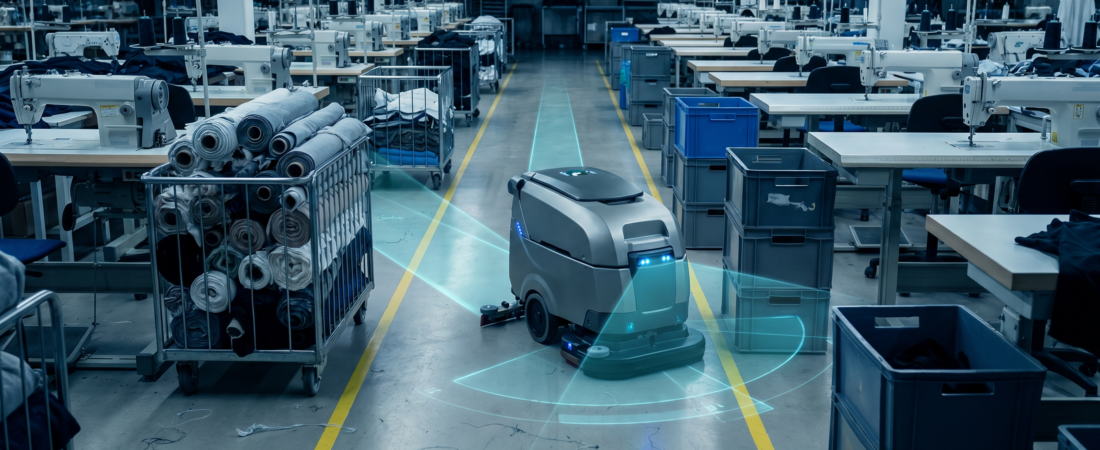
Cleaning-robot trial decision
An autonomous cleaning robot is a useful first factory robot only if it proves route discipline, floor readiness, safety behavior, maintenance ownership, and exception handling. The real value is not cleaner floors alone; it is learning whether the factory can operate a mobile robot inside normal production movement.
Movement is not the hard part
The common mistake is to judge the robot by whether it can move. Movement is the easy part. The harder factory question is what happens when fabric scraps, threads, trolleys, pallets, operator traffic, wet areas, blocked aisles, or urgent line changes interrupt the route.
Checks before expanding the route
- Which zones are stable enough for autonomous cleaning, and which still require manual control?
- Can the factory measure cleaning coverage, missed areas, stoppages, near misses, operator overrides, and maintenance time?
- Who owns charging, water/refill, brush/filter cleaning, route updates, and incident review?
Vendor proof from the trial floor
- Run the robot during realistic shift movement, not only after-hours on an empty floor.
- Provide a route exception log with blocked path, debris type, manual override, downtime, and recovery action.
- Explain how the pilot data will decide whether to expand, hold, or redesign the route.
Route-expansion evidence gate
GO if the pilot creates safer and more repeatable floor-control rules. HOLD if cleaning improves but route ownership is weak. REDESIGN if the robot is compensating for poor 5S, blocked aisles, or unmanaged material flow.
Factory field asset: one-shift cleaning robot route log
A useful trial needs a working field record, not just a robot opinion. For a garment factory, the first record should be a one-shift route log that separates cleaning performance from factory-readiness evidence.
Open aisle
Record: Route completion %, stop count, operator crossings, and emergency-stop events.
Why: Shows whether the robot can work around normal movement, not just an empty-floor demo.
Sewing-line walkway
Record: Thread/lint pickup, chair or trolley blockage, missed edges or corners, and manual handover time.
Why: Tests garment-floor conditions that can break a simple cleaning claim.
Cutting or fabric-area edge
Record: Fabric scrap type, dust/lint load, brush or filter cleaning interval, and after-cleaning inspection.
Why: Connects robot use to quality and 5S control, not only labor saving.
Packing or warehouse route
Record: Pallet obstruction, route changes, charging/refill discipline, and the supervisor owner.
Why: Shows whether the factory can operate the robot after the vendor leaves.
Factory use: run the log for three normal shifts before buying more units. If the same zone fails for the same reason twice, treat it as a 5S/material-flow problem first and a robot problem second.
Autonomous cleaning robots in garment factories look like a simple automation project at first. The task sounds clear: follow a route, clean the floor, avoid people and machines, return to charge, and repeat.
But a real garment factory trial tells a more useful story. The robot was not only being tested as a cleaner. It was also testing how well Physical AI can operate in a semi-structured production environment where chairs move, carts appear, operators cross the route, threads wrap around brushes, and sewing lines change rhythm throughout the day.
This article uses anonymized internal factory evaluations as a practical Factory AI Atlas field note. The goal is not to promote a specific robot brand or claim universal results. The goal is to explain what this type of pilot can teach factory teams before they invest in more complex automation.
Trial scope and evidence boundary
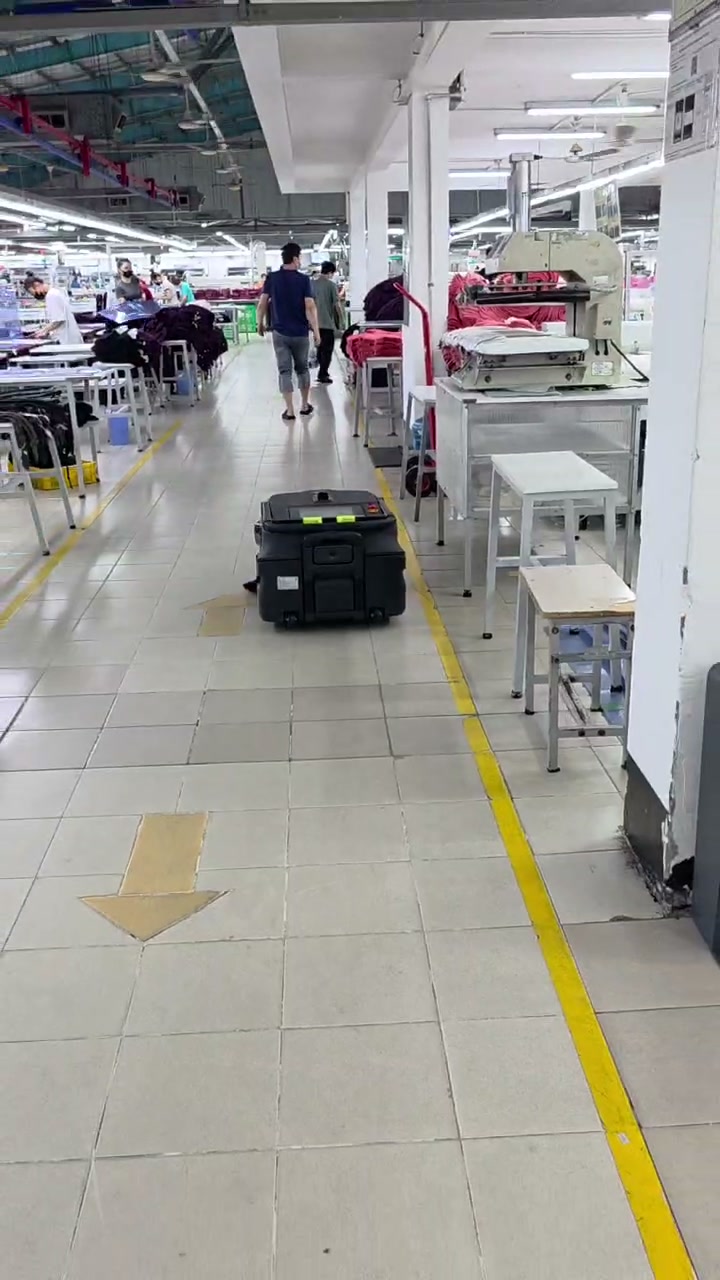
This was a limited factory evaluation, not a controlled factory-wide performance study. The team observed open aisles, sewing-line walkways, edges, corners, and areas near production equipment during factory-area testing.
The record is anonymized. The walkway percentage below is an observation from the later evaluation, not a universal vendor benchmark. It should be used to design another factory’s test, not to predict its result.
Field evidence boundary: These operating notes come from anonymized internal factory evaluations. Company, location, people, vendor names, prices, contract details, and original records are withheld. The observations are practical operating signals, not a universal benchmark or proof of labor or contract savings.
Trial result: open routes passed, dense sewing areas did not
In the later evaluation, the robot was tested across factory areas including open floor routes, walkways, edges, corners, and areas near sewing-line equipment. The observed results were not a simple pass or fail.
The strongest result appeared in open routes and walkways. In those areas, the robot could follow a scheduled cleaning pattern and remove visible lint, threads, and fabric scraps. Walkway cleanliness was reported at more than 90% in the later evaluation. That result supports scheduled open-route cleaning; labor or contract savings were not established.
The result inside production lines was weaker. Around sewing tables, chair legs, foot pedals, material baskets, cables, and narrow spaces, the robot had more difficulty. Cleaning inside line areas was not sufficient for detailed cleaning, and no verified line-area cleanliness percentage was recorded.
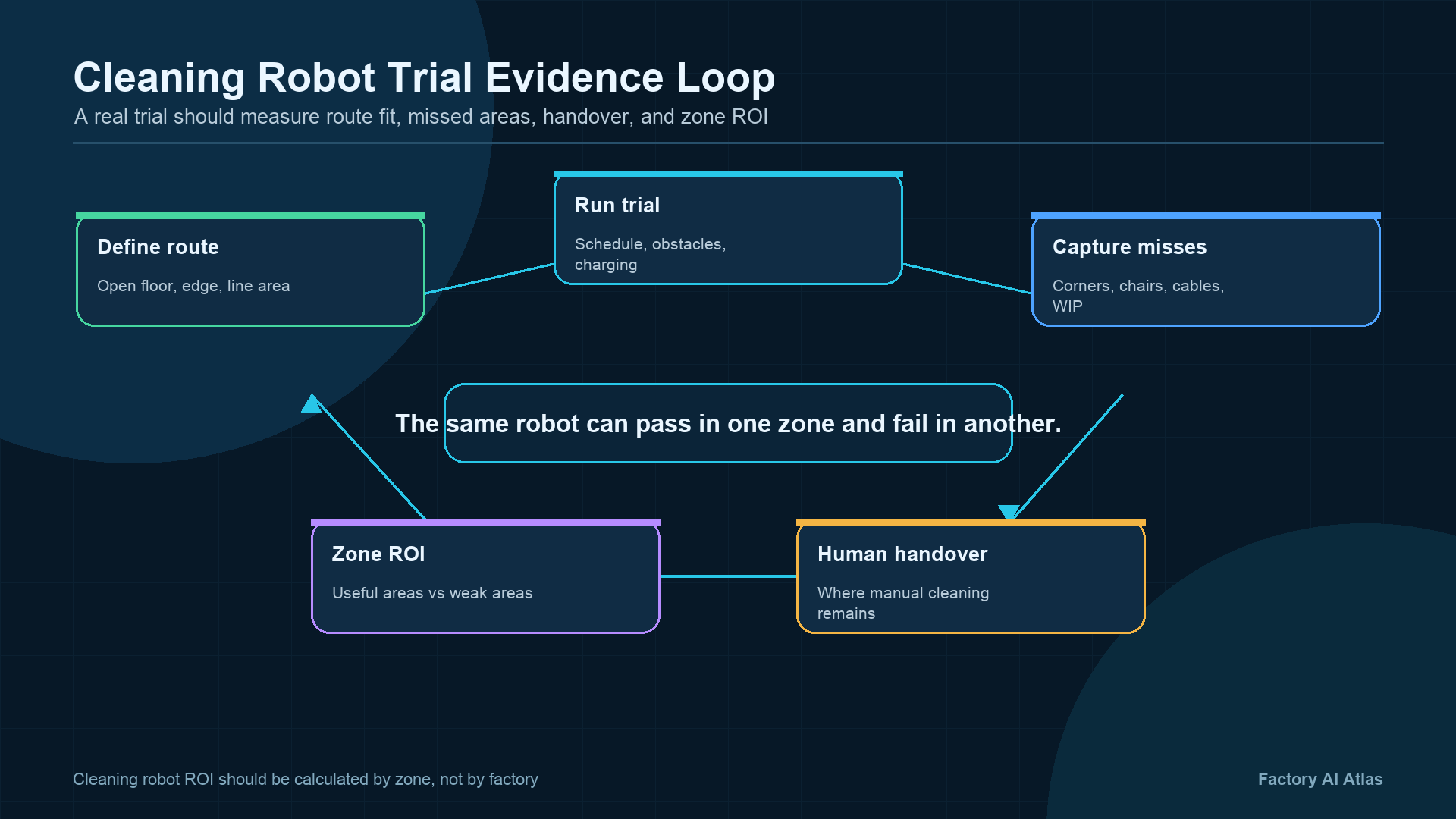
That gap is the most important lesson. The same robot can be useful in one factory zone and limited in another. For ROI, route selection matters as much as robot capability.
Why sewing floors are harder than normal floors
A garment factory is not the same as a shopping mall, office lobby, or warehouse corridor. The floor condition changes throughout the shift.
- Operators move chairs and foot pedals.
- Fabric carts and WIP bins appear in different positions.
- Power cables, air hoses, and small tools can interrupt the route.
- Loose threads, lint, and fabric scraps accumulate around workstations.
- Line layout may change when styles, buyers, or production quantities change.
- Some areas are narrow, partially blocked, or under tables.
For a human cleaner, these conditions are normal. A worker sees the chair, moves around it, checks the missed area, returns later, or cleans by hand. For a robot, each of these conditions becomes a perception and planning problem.
The Physical AI lesson: avoid is not the same as understand
In this context, Physical AI means a machine that must perceive, navigate, and act in the physical world. It is not only processing data on a screen. It must make useful decisions while the real environment changes.
The cleaning robot’s behavior showed the current gap clearly. When it met an obstacle, the basic pattern was often:
- Obstacle found.
- Avoid the obstacle.
- Continue the route.
That is already useful. But for a garment factory, the future requirement is more advanced:
- Obstacle found.
- Understand whether the area still needs cleaning.
- Re-plan the route.
- Return when the path opens.
- Clean the missed area or alert an operator.
This is why a cleaning robot trial matters. It shows that the real challenge is not only suction power or brush design. The deeper challenge is environmental understanding.
Observed strengths during the trial
1. Scheduled cleaning became easier
The robot could support repeatable cleaning routines during defined windows, such as break time, shift change, or low-traffic periods. This is valuable because cleaning is often treated as a flexible task, but a factory benefits when floor care becomes more consistent and measurable.
2. Walkways were a strong fit
Open walkways are the best use case. They have clearer routes, fewer legs and foot pedals, and easier visibility. For many factories, this is where the first ROI case should start.
3. Thread, lint, and fabric scraps could be removed
The robot could collect common sewing-floor waste such as loose threads, lint, and small fabric scraps. These materials are among the most common floor contaminants in sewing and garment production areas.
4. Manual operation gave the team flexibility
Hybrid operation matters. A robot that supports both automatic routes and manual operation is easier to introduce because the factory team can still intervene when the environment is too complex.
Observed failures and manual handovers
1. Threads wrapped around the brush
This is a garment-specific issue. Long threads and lint can wrap around brush components. If maintenance is required too often, the labor-saving argument becomes weaker. Any pilot should measure not only cleaning time, but also brush cleaning and daily maintenance time.
2. Sewing-line obstacles caused missed areas
When the robot met chairs, carts, tables, or narrow passages, it could skip part of the cleaning area. This is a normal limitation of many autonomous systems, but it matters in factories because missed areas can accumulate lint and scraps over time.
3. Under-table and corner cleaning remained weak
Manual cleaning is still needed around table legs, under sewing stations, corners, edges, and hard-to-reach areas. A robot can reduce workload, but it should not be positioned as a full replacement for all cleaning tasks inside sewing lines.
4. Production disturbance must be controlled
A cleaning robot should not interrupt operators, block material movement, or create confusion in a live line. The route schedule must be designed around the factory rhythm, not around the vendor demo.
ROI should be calculated by zone, not by factory
A common mistake is to ask whether a robot can clean the entire factory. A better question is: which zones are ready for robotic cleaning today?
| Factory zone | Fit for cleaning robot | Practical interpretation |
|---|---|---|
| Main walkways | High | Good first deployment area with measurable route coverage. |
| Warehouse and logistics routes | High | Strong candidate if traffic rules and charging space are clear. |
| Office or common areas | High | Lower complexity and easier scheduling. |
| Cutting room | Medium | Useful, but fabric dust and scrap volume must be checked. |
| Sewing-line aisles | Medium to low | Useful as support, but route discipline and obstacle control are required. |
| Under sewing tables | Low | Manual cleaning is still needed. |
| Fully unmanned cleaning | Low | Not realistic without exception handling and maintenance ownership. |
This zone-based view is more useful than a single ROI number. A robot may create value in walkways and logistics areas while still needing human support inside dense production lines.
Evidence to capture in the next three shifts
Before any route expansion, repeat the trial during three normal shifts and keep answers to these questions:
- Which zones will the robot clean first?
- What percentage of the route must be cleaned successfully?
- How often will the robot run each day?
- Can cleaning be scheduled without disturbing production?
- Where will the robot charge and park?
- Who will empty the dust bin and clean the brush?
- How often do threads wrap around the brush?
- What happens when a cart, chair, or worker blocks the route?
- Will the robot return to missed areas or simply skip them?
- Which areas still require manual cleaning?
- How will the factory compare robot cleaning against current labor hours?
- Who owns daily operation: maintenance, production, or administration?
What this trial proves—and what it does not
The trial shows that open routes can be measured and scheduled, while dense sewing areas still need manual handover. It also shows that route ownership, brush cleaning, obstacle logs, and missed-area checks matter as much as the robot’s movement.
It does not prove full-factory labor replacement, universal ROI, or readiness for every production zone. Those decisions need the factory’s own shift data.
What this means for factory AI readiness
Autonomous cleaning robots in garment factories should be viewed as part of a factory AI readiness journey. If a factory cannot keep routes clear, assign ownership, maintain the robot, and measure results in a cleaning pilot, it will struggle with more complex automation later.
But if the factory learns from the pilot, the benefits go beyond cleaning. The team builds habits that also matter for AMRs, inspection AI, smart carts, digital SOPs, and future sewing automation.
This connects directly to the broader Factory AI Atlas view: successful automation is not only a technology purchase. It is an operating system upgrade for the factory.
Trial decision: expand by zone, not by factory
Autonomous cleaning robots in garment factories can already reduce manual cleaning work in factory walkways, warehouses, offices, and other repeatable routes. Inside sewing lines, they are still better understood as support tools, not full replacements.
The most important result of this trial is not that the robot cleaned the floor. It is that the robot revealed the factory’s readiness level. Threads, chairs, carts, operators, and changing layouts are not minor details. They are the real test of Physical AI in garment manufacturing.
For factories considering robotics, that is a useful place to begin: start with a lower-risk robot pilot, measure the real operating conditions, and use the lesson before moving into harder automation.
Use the right page for the next decision: For general buying checks, read Cleaning Robots in Factories. For daily and weekly ownership after a trial, use the Cleaning Robot Maintenance SOP. For investment review, use the Robot Automation ROI Checklist. This page remains the field-trial evidence record.
Author and evidence perspective
Zone-level trial evidence to keep
For a garment floor, the useful trial record is not a single factory-wide ROI number. It is a zone-by-zone log: open aisle, cutting-room edge, sewing-line walkway, packing area, wet area, and blocked corner. Each zone should show route completion, missed area, stoppage reason, debris type, manual override, and the owner who fixed the cause.
- Expand: zones with repeatable routes and low human-interaction risk.
- Hold: zones where cleaning improves but route ownership is not stable.
- Redesign: zones where poor 5S or material flow keeps creating the same exception.
Factory AI Atlas is written from a manufacturing operations perspective shaped by hands-on apparel and textile production experience, including overseas factory management, woven and knit operations, production control, quality systems, and operational restructuring.
The site focuses on operator-led, source-linked, and ROI-realistic guidance for AI, robotics, automation, and factory readiness. See the Editorial Policy & Disclaimer for sourcing standards and AI-use disclosure.
Autonomous cleaning robot trial source anchors
For cleaning-robot trials, route evidence should be checked against safety and automation references such as OSHA robotics guidance, OSHA walking-working surfaces guidance, International Federation of Robotics industrial robot resources, and NIST smart manufacturing resources. These sources do not replace a factory trial; they help the team keep route, obstacle, and safety evidence visible.
- OSHA robotics guidance — useful for grounding mobile robot pilots in safety, interaction, and operational risk control.
- International Federation of Robotics industrial robot resources — relevant for staged adoption and realistic industrial robot expectations.