Smoke-test buying decision note
A Factory AI smoke test should be used before vendor commitment, not after procurement. Its purpose is to expose whether input conditions, ground truth, evidence capture, operating action, and scale risk are strong enough for a paid pilot.
Vendor demos replace pass/fail evidence
The common mistake is to treat a successful demo as a smoke test. A real smoke test uses messy factory inputs, clear pass/fail rules, and operational consequences. It should be allowed to fail before money and reputation are tied to the project.
Checks before moving from demo to pilot
- Does the test use real production variation: lighting, fabric, operator method, data gaps, machine stops, and timing pressure?
- Is the pass/fail rule tied to a factory action, not just model accuracy or a nice dashboard?
- Can the team explain what would block scale even if the first result looks promising?
Proof requests for smoke-test evidence
- Run the smoke test on a sample the vendor did not pre-clean or select.
- Show false positives, false negatives, uncertain cases, human overrides, and the resulting action log.
- Document which failure means data cleanup, process redesign, user training, or vendor rejection.
Smoke-test pass gate
GO if the smoke test survives real factory variation and produces a usable action. HOLD if the test works but scale risks remain. REDESIGN if the demo cannot be converted into a measurable factory decision.
Factory AI smoke tests help factories avoid buying AI tools before the process, data, and evidence are ready.
Many factories start their AI journey by asking the wrong first question.
They ask, “Which AI tool should we buy?” “Which robot is the best?” or “Which vendor has the most advanced model?” Those questions matter, but they should not come first.
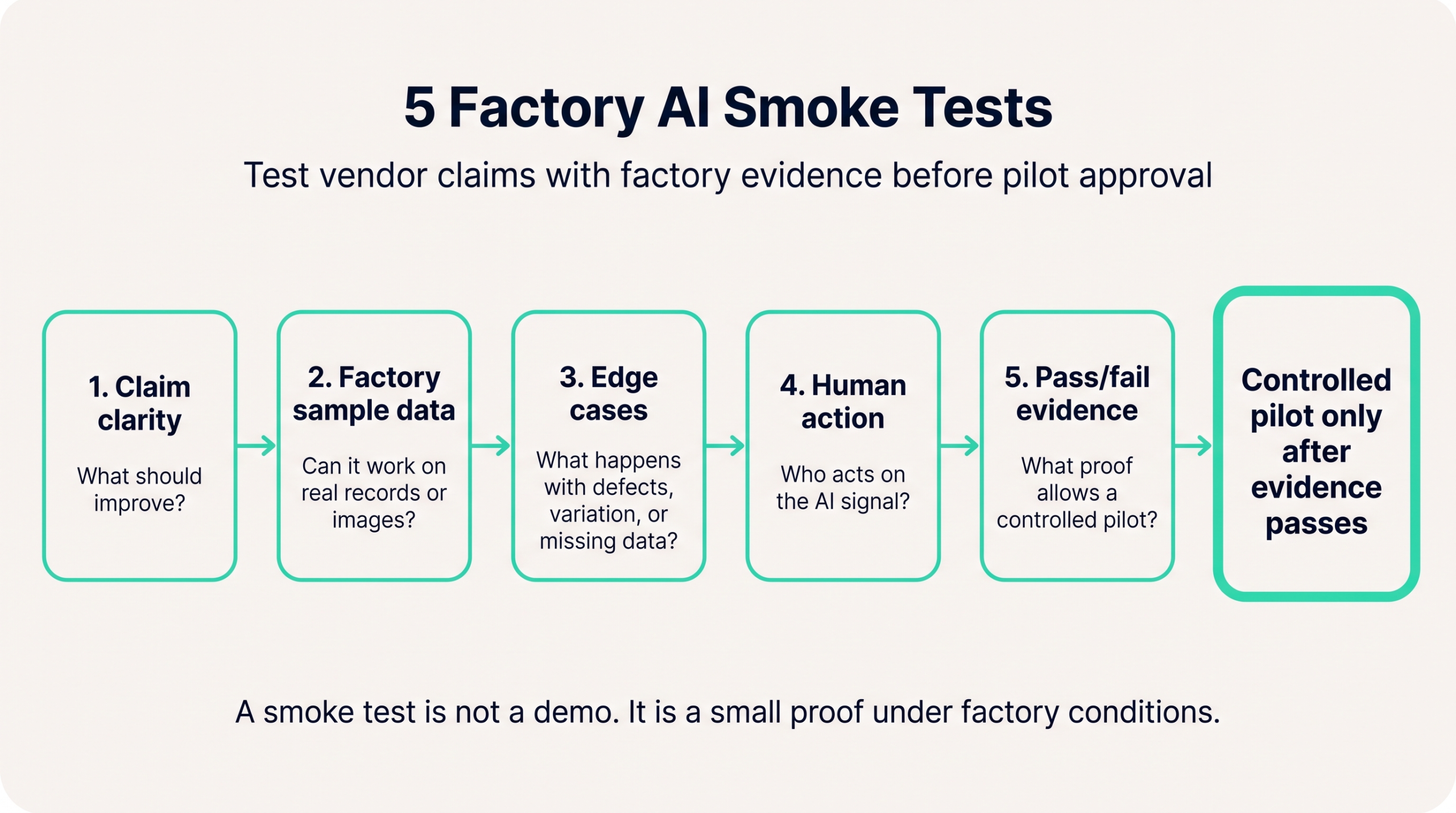
Before a factory chooses an AI tool, robot, computer vision system, or automation vendor, it should run a small Factory AI smoke test.
A smoke test is not a full pilot. It is not a long transformation project. It is a short, practical test designed to answer one question: can this AI use case survive real factory conditions?
For garment factories, this matters because the factory floor is not a clean software demo. A sewing line has changing styles, inconsistent defect labels, operator habits, unstable input data, urgent buyer requirements, material variation, rework loops, and daily production pressure.
If the smoke test fails, the factory learns something early and cheaply. If the smoke test passes, the factory has evidence to move toward a controlled pilot. That is a better starting point than buying technology first and discovering later that the process was not ready.
Why factories should not start with model selection
AI vendors often present strong demos. A defect detection model may show accurate results on sample images. A planning tool may show beautiful dashboards. A robot system may show smooth movement in a controlled environment.
But factories do not operate in controlled demo conditions. In real production, the problem is often not only the AI model. The bigger problems are usually weak data discipline, unclear process ownership, inconsistent defect definitions, missing ground truth, poor camera conditions, no pass/fail rule, no escalation process, and no rollback plan. These smoke tests are a practical bridge between early AI pilots and Physical AI in smart manufacturing.
This is especially true in apparel and other labor-intensive manufacturing environments. A factory may think it has an AI problem, but the real issue may be that the factory cannot clearly define the process, data, quality standard, or operating rule that the AI must follow.
This is why Factory AI readiness should begin with a small test, not a purchase decision. If your team has not checked the basics yet, start with the Factory AI Readiness Checklist before comparing tools.
What is a Factory AI smoke test?
Factory AI smoke tests are small, fast, evidence-based tests that check whether an AI use case is ready for deeper evaluation.
- It should be narrow in scope.
- It should be connected to a real factory problem.
- It should be easy to repeat.
- It should be measurable.
- It should be documented with evidence.
- It should be reviewed by both operations and management.
The goal is not to prove that AI is perfect. The goal is to check whether the proposed AI use case has enough operational foundation to continue.
For example, a factory might run a smoke test on AI defect detection, WIP tracking, cutting room data capture, sewing line delay alerts, production meeting dashboards, packing error detection, supplier document classification, or buyer evidence readiness checks.
Each test should answer a practical question: if we use this AI in one small area, can the factory produce reliable input, evaluate the output, and act on the result?
Five critical checks for Factory AI smoke tests
Useful Factory AI smoke tests should not only check whether the AI “works.” They should check whether the factory can operate the AI responsibly.
1. Input condition
The first question is simple: what input does the AI need, and can the factory provide it consistently?
For AI QC, the input may be defect images, inspection records, or video frames. For WIP tracking, the input may be operation status, line output, bundle movement, or barcode scans. For planning AI, the input may be style data, order quantity, SMV, capacity, material status, and shipment date.
A smoke test should check whether the input is available, complete, current, consistent, usable by the tool, and connected to the correct process step.
In garment factories, input quality is often the first failure point. An AI QC tool may look promising, but the factory may not have a consistent defect library. One QC may call an issue “puckering,” another may call it “seam tension,” and another may record it only as “sewing defect.” If the input is not stable, the AI output will not be stable.
2. Ground truth and pass/fail rule
A smoke test needs a clear pass/fail rule. Without this, the factory cannot know whether the AI result is useful.
For AI QC, the factory should define what defect is being tested, what counts as correct detection, what counts as false accept, what counts as false reject, who confirms the final result, and what evidence is saved.
For planning or WIP use cases, the factory should define what signal the AI is expected to produce, how early the warning must appear, who receives the alert, what decision should follow, and how the result is reviewed later.
This is where many AI projects become weak. The factory says, “The system looks good,” but no one defines what “good” means. A smoke test should turn vague expectations into a reviewable rule.
3. Evidence captured
Factory AI should not rely only on opinions. Every smoke test should create an evidence trail.
Depending on the use case, this evidence may include before/after photos, defect image samples, inspection records, system screenshots, WIP logs, production meeting notes, operator feedback, rework records, downtime records, pass/fail summaries, and management decision notes.
This matters because a factory AI project is usually reviewed by different people: production, QA, IE, maintenance, IT, finance, and senior management. If the evidence is weak, the decision becomes political or emotional. If the evidence is clear, the factory can discuss the next step more objectively.
The NIST AI Risk Management Framework emphasizes the need to govern, map, measure, and manage AI-related risks. In factory terms, this means AI decisions should be connected to process evidence, not just vendor claims or dashboard impressions.
4. Operational action
A smoke test should not stop at output. The next question is: if the AI gives a result, what does the factory do?
If AI detects a seam defect, does QC isolate the garment? If WIP tracking shows delay, does the line leader act? If planning AI predicts a shipment risk, does merchandising escalate? If a robot fails a task, who stops the test? If the system produces a wrong result, what is the rollback action?
A factory does not need AI output for decoration. It needs AI output that supports a real operating decision. A dashboard that no one uses is not factory AI. A detection result that no one verifies is not quality control. An alert that no one acts on is not operational intelligence.
5. Scale risk
A smoke test should also ask what will break if the factory scales this use case.
A small test may pass in one line, one style, one defect type, or one shift. But scaling may create new problems: more styles create more variation, more operators create more process inconsistency, more cameras create calibration issues, more lines create data synchronization problems, and more automation creates maintenance and safety questions.
This does not mean the factory should avoid AI. It means the factory should understand the scale risk before expanding. A good smoke test produces not only a pass/fail result, but also a list of conditions required for the next stage.
Garment factory example: AI QC smoke test
Imagine a garment factory wants to test AI visual inspection for sewing defects. A weak approach would be: “Let’s test an AI camera and see if it detects defects.”
A stronger smoke test would define the test like this:
- Use case: detect visible seam defects on one garment style.
- Scope: one production line, one operation, one defect family.
- Input: accepted and rejected sample images with confirmed QC labels.
- Ground truth: final confirmation by senior QC.
- Pass/fail rule: the tool must correctly flag the target defect within an agreed review threshold.
- Evidence: image set, QC confirmation, false accept/false reject summary, and operator feedback.
- Action: if the defect is detected, the garment is isolated for QC review.
- Rollback: if detection is unstable, continue manual QC and revise the defect definition before another test.
This is small, but it is useful. The factory is not trying to automate everything at once. It is testing whether the process, data, and decision rule are ready. For more context, see AI Visual Inspection in Garment Factories.
Garment factory example: WIP tracking smoke test
Another example is WIP tracking. A factory may want a live dashboard showing line progress. But before buying a large system, it can run a smoke test.
- Use case: track bundle movement from sewing input to output on one line.
- Scope: one style, one line, one day.
- Input: bundle quantity, operation status, line output, defect count, and rework count.
- Pass/fail rule: the system must match the manual production record within an agreed tolerance.
- Evidence: WIP log, manual record comparison, and production meeting review.
- Action: if delay appears, the line leader checks the bottleneck operation.
- Rollback: if data entry is unreliable, simplify the capture point before scaling.
This type of test reveals the real issue quickly. Sometimes the problem is not the dashboard. The problem is that the factory does not have a reliable data capture routine. That is exactly what a smoke test should reveal.
Smoke tests help separate vendor claims from factory evidence
Vendor claims can be useful, but they are not enough. A vendor may say, “Our AI improves quality,” “Our system reduces labor,” or “Our platform gives real-time visibility.” Those claims should be translated into factory-verifiable questions.
- What data is required?
- What process step is affected?
- What result will be measured?
- What evidence will be saved?
- What happens if the output is wrong?
- What does the factory need to change before scaling?
This is the difference between vendor-stated value and factory-verified value. A smoke test gives the factory a practical way to make that distinction. It also connects well with the process discipline behind ISO 9001 quality management and continuous manufacturing improvement approaches such as the NIST Manufacturing Extension Partnership.
From smoke test to controlled pilot
If the smoke test passes, the factory should not immediately scale across the whole factory. The next step should be a controlled pilot.
A controlled pilot should have defined scope, a responsible owner, baseline data, success metrics, risk review, user training, management review, rollback plan, ROI tracking, and documentation.
This is where AI becomes an operating system issue, not just a tool issue. Factory AI is not only about choosing a model. It is about building a workflow where data, people, process, quality, safety, and management decisions are connected.
That is why Factory AI semantic maps matter. AI tools need to understand the factory process before they can produce useful decisions. Smoke tests are the first evidence checkpoint in that workflow.
A simple Factory AI smoke test checklist
Before choosing an AI tool or robot, use these Factory AI smoke tests questions:
- What exact factory problem are we testing?
- Which process step is included?
- What input data or image evidence is required?
- Who confirms the ground truth?
- What is the pass/fail rule?
- What evidence will be saved?
- Who acts on the AI result?
- What happens if the AI result is wrong?
- What must be fixed before scaling?
- What decision will management make after the test?
If the factory cannot answer these questions, it is probably not ready to choose the tool yet. It should first strengthen the process foundation.
Final factory takeaway
The best Factory AI projects do not begin with hype. They begin with a small, practical question: can this use case survive real factory conditions?
A smoke test helps answer that question before the factory spends too much time, money, or trust on the wrong solution.
For garment factories, this is especially important. Fabric changes. Styles change. Operators change. Defects are interpreted differently. Buyer requirements vary. Production pressure is real.
That is why Factory AI should begin with evidence, not the biggest promise, the most impressive demo, or the most advanced model.
Start with a smoke test. Save the evidence. Then decide whether the factory is ready for a controlled pilot.
External validation anchors for Factory AI smoke tests
- NIST AI Risk Management Framework — useful for separating test evidence, model behavior, monitoring, and risk controls.
- NIST manufacturing resources — relevant for validating AI pilots against measurable factory operating conditions.