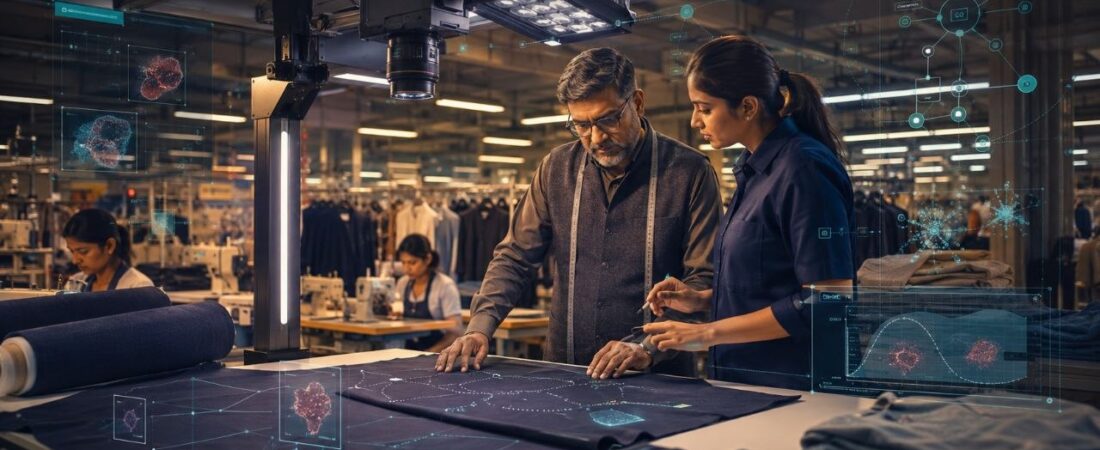
Garment AI inspection readiness note
AI visual inspection should be approved only when it improves a specific QA decision under real fabric, style, lighting, and buyer-tolerance conditions. The factory is not buying image recognition; it is buying a repeatable defect decision that operators, QA leaders, and buyers can trust.
Clean demo images hide QA workflow variation
The common mistake is to test the model on clean demonstration images and then expect it to survive real sewing variation. Garment inspection fails when defect definitions, lighting, camera angle, fabric behavior, rework routing, and AQL interpretation are not controlled together.
Checks before buying AI visual inspection
- Which defect family is the first pilot target, and why is that defect expensive or repeated enough to justify AI?
- Can the factory measure false positives, escapes, rework time, buyer dispute risk, and operator override reasons?
- Does the QA team have a clear process for acting on flagged pieces, not only viewing alerts?
Proof requests for garment inspection vendors
- Run a sample using actual production fabric, shade variation, wrinkles, seams, trims, and lighting conditions.
- Show the confusion matrix by defect type and explain the operational cost of each error type.
- Demonstrate how buyer standards, AQL logic, retraining data, and QA closeout are stored for audit.
Inspection-readiness gate
GO if the pilot reduces escape risk or inspection burden with explainable QA action. HOLD if detection works but workflow ownership is unclear. REDESIGN if the system detects defects that the factory cannot consistently define or act on.
AI visual inspection in garment factories can be useful, but it is not ready just because a vendor demo looks accurate. Apparel quality is shaped by fabric variation, lighting, handling, operator judgment, buyer tolerance, rework flow, and defect definitions. If those foundations are weak, the system may produce a beautiful dashboard while the QA team still argues about what counts as a defect.
The buying decision should therefore be tied to a controlled QA workflow: defect taxonomy, image capture rules, rework ownership, false-positive cost, escape-risk tolerance, and buyer acceptance.
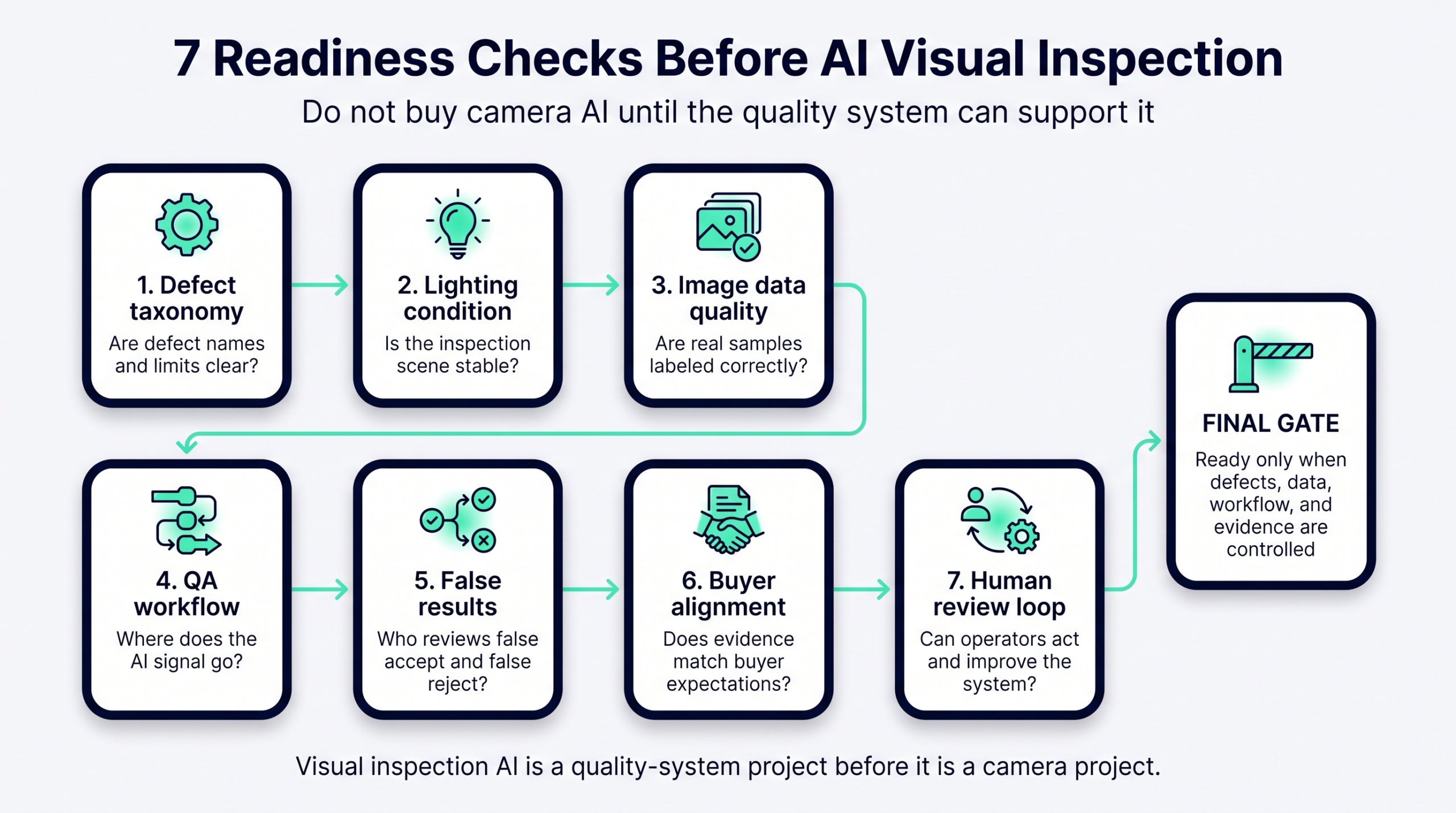
The safest question is not “Which AI inspection camera should we buy?” The better question is: “Is our factory ready to give an AI system stable visual conditions, clear defect labels, and a practical QA workflow?” This article gives seven readiness checks factory leaders should complete before buying or piloting AI visual inspection in garment factories.
In practical terms, AI visual inspection in garment factories should be evaluated as an operating-system upgrade for QA, not as a standalone camera purchase. The goal is to connect what the camera sees with what the factory can actually confirm, repair, report, and explain to buyers.
Why garment inspection is different from rigid-part inspection
In many manufacturing sectors, inspection targets are rigid, repeatable, and geometrically stable. Garments are different. Fabric moves, stretches, wrinkles, reflects light, hides defects in texture, and changes appearance across color, wash, print, embroidery, and construction type.
This does not mean AI vision is impossible. It means the readiness work matters more. A camera can capture an image. A model can classify defects. But the factory still needs to decide whether a mark is acceptable, repairable, buyer-critical, style-specific, or simply normal fabric character.
That is why garment factory automation is difficult. Soft materials make the boundary between process variation and real defect more complicated than many vendor demos show.
1. Defect taxonomy: do you define defects the same way every shift?
The first readiness check is defect taxonomy. AI visual inspection in garment factories needs consistent labels. If one QA auditor calls a problem “stain,” another calls it “oil mark,” and a third records it as “fabric defect,” the training data becomes noisy.
Factories should standardize defect groups before expecting AI to learn them. At minimum, the team should define:
- Defect category and subcategory
- Severity level
- Repairability
- Buyer-critical vs factory-internal defect
- Location on garment or fabric panel
- Photo examples of accepted and rejected cases
Academic surveys on fabric defect detection show that textile defect categories can be broad and complex. The practical lesson is simple: do not start with “detect all defects.” Start with a small number of high-cost, clearly defined defects that the factory can label consistently.
For research context, recent textile-defect studies such as Textile Defect Detection Using AI and Computer Vision and broader survey work on automated fabric defect detection are useful references. They support the opportunity, but they do not remove the factory-specific readiness work behind AI visual inspection in garment factories.
2. Lighting and camera position: can the same defect be seen twice?
AI inspection is only as stable as the image capture process. If lighting changes by shift, if fabric tension changes by operator, or if the camera angle changes after maintenance, the model may see a different world every day.
Before buying a system, run a simple test: take images of the same defect under the expected production conditions. If the defect appears clearly in one image and disappears in another, the factory has a capture problem before it has an AI problem. This is one reason AI visual inspection in garment factories should be tested at the actual inspection station, not only in a vendor demo room.
For garment factories, this is especially important for shine, shade variation, loose thread, stain, yarn irregularity, print alignment, seam puckering, and subtle fabric defects. Controlled lighting and camera positioning are not technical accessories. They are core inspection requirements.
3. Fabric and style variation: what changes every week?
A model trained on one fabric family may not work reliably on another. Dark colors, melange fabrics, printed fabrics, lace, denim, fleece, coated materials, and washed garments all create different visual challenges.
Factory leaders should map style variation before choosing an AI visual inspection system. Ask:
- Which fabric types repeat often enough to justify training?
- Which defects are visually obvious across many fabrics?
- Which defects are buyer-specific and style-specific?
- How often do new colors, washes, prints, or trims change the inspection condition?
- Can the system be retrained or adjusted without slowing production?
If the factory changes styles constantly, the first AI inspection use case should be narrow. A good starting point might be fabric inspection for a repeated material family, inline detection of one recurring defect, or final inspection support for a stable product group.
4. Image data: do you have enough useful examples?
Many vendors talk about AI accuracy. Fewer talk clearly about the data behind that accuracy. AI visual inspection in garment factories needs useful image examples: good samples, defect samples, borderline samples, repaired samples, and false alarm examples.
The factory should not only count images. It should check whether the images represent real production conditions. A training folder full of clean demo images may not help when the line has wrinkles, shadows, operator hands, bundle tags, size variation, and mixed lighting.
A practical image dataset should include:
- Accepted and rejected examples
- Multiple fabric colors and textures
- Multiple sizes and garment areas
- Normal variation that should not be rejected
- Borderline examples that QA teams debate
- Images captured from the actual inspection station, not only from a lab
For Factory AI Atlas, this connects directly to the broader data foundation for AI in garment factories. Inspection AI is not just a camera purchase. It is a data discipline project.
This is why AI visual inspection in garment factories should start with a small, traceable data loop: image capture, human confirmation, defect reason, repair action, and final buyer outcome.
5. False positives and escape rate: which error is more expensive?
Headline accuracy can mislead factory teams. A system can look impressive in a demo but still create business problems if it rejects too many good garments or misses the wrong defects.
Two error types matter:
- False positive: the system flags an acceptable garment or panel as defective.
- Escape: the system fails to catch a real defect that should have been stopped.
In apparel, the cost balance depends on the buyer, product, defect type, and shipment pressure. Too many false positives can overload repair and slow output. Too many escapes can create buyer claims, chargebacks, air shipment risk, or reputation damage.
This is why mAP, accuracy, or demo scores should not be translated directly into ROI. A textile defect detection study may report useful benchmark performance, but factory leaders still need to convert that into false reject rate, escape rate, repair workload, and buyer acceptance.
6. QA workflow: what happens after the AI flags a defect?
AI visual inspection should not end at detection. The real operational question is what happens next.
When the system flags a defect, the factory must know:
- Who confirms the defect?
- Is the garment repaired, downgraded, replaced, or released?
- Is the defect sent back to the line supervisor, mechanic, cutting room, washing team, or fabric supplier?
- How is the rework time recorded?
- Does the defect update the daily quality dashboard?
- Does planning know if repair workload threatens shipment?
If the workflow is unclear, AI detection becomes another alarm system. The better approach is to connect inspection signals to an AI garment factory dashboard where QA, production, IE, and planning can see risk together. This integration view also fits the broader NIST smart manufacturing framing: data should support better operational decisions, not simply create another disconnected report.
7. Buyer and AQL alignment: will the buyer accept the decision logic?
The final readiness check is commercial. Apparel quality is not only technical. It is also buyer-specific. Some buyers are strict about shade, print, measurement, seam appearance, or packaging. Others may accept minor appearance variation if function and presentation are acceptable.
Before using AI inspection as a decision tool, factories should align the logic with buyer standards, AQL process, internal QA manuals, and final inspection expectations. AI can support judgment, but it should not silently rewrite the buyer’s quality standard. For export factories, AI visual inspection in garment factories should always be mapped back to the buyer’s actual acceptance logic.
This is especially important for export factories. If the AI system flags defects that the buyer would accept, the factory may waste time. If the system misses defects the buyer rejects, the factory carries the risk.
AI visual-inspection source anchors
For garment leaders, these source anchors should be read as evidence controls, not as a promise that vision AI is ready after one demo. The useful question is whether the defect taxonomy, lighting setup, capture method, AQL logic, and human follow-up loop are stable enough to compare AI findings with real QA decisions across styles, colors, and production shifts.
- NIST AI Risk Management Framework — useful for grounding model performance, monitoring, and accountable AI decisions.
- Better Work reports and publications — helpful context for practical factory quality systems and operating discipline.
Where AI visual inspection should start
The best first use case is usually not the broadest one. It is the use case where the defect is visible, repeated, costly, and operationally actionable.
Good starting points may include:
- Fabric inspection for a repeated fabric family
- Inline support for one recurring seam or appearance defect
- Final inspection assistance for stable product groups
- Photo-based defect library creation for QA training
- Trend detection that helps supervisors investigate root causes
This fits the broader Physical AI in manufacturing path. AI visual inspection becomes more valuable when it converts shop-floor evidence into operational decisions, not when it is treated as a standalone software feature.
Vendor proof questions before buying AI inspection
Before approving a purchase or pilot, ask the vendor practical questions:
- Which garment or fabric defect types have been tested under production conditions?
- How does the system handle new fabrics, new colors, and style changes?
- What is the false reject rate and escape rate, not only accuracy?
- How many defect examples are needed for a new class?
- Can QA staff review and correct model decisions?
- How are flagged defects connected to repair, rework, and root-cause reporting?
- Can results connect to MES, QA dashboards, or production planning?
These questions prevent the factory from buying an impressive demo that cannot survive real garment production variation.
Final garment-inspection takeaway
AI visual inspection in garment factories is not just a technology decision. It is a readiness decision. The factory must prepare defect definitions, lighting, camera setup, fabric variation rules, image data, error targets, QA workflow, and buyer alignment before expecting the system to improve quality.
The right goal is not to replace QA judgment overnight. The right goal is to make quality risk visible earlier, reduce repeated manual checking where the task is stable, and connect defect signals to production decisions. When that foundation is ready, AI inspection can become part of a practical Factory AI system rather than another isolated pilot.
Garment AI inspection readiness questions
What is AI visual inspection in garment factories?
AI visual inspection in garment factories uses computer vision to help detect fabric, sewing, appearance, or finished-garment defects. It works best when defect definitions, image capture, QA workflow, and buyer standards are already clear.
Can AI visual inspection replace garment QC inspectors?
Not in most factories. AI can support inspectors by flagging repeated visible defects and building quality data, but human QA judgment is still needed for borderline cases, buyer interpretation, repair decisions, and root-cause action.
What should a factory prepare before buying AI inspection?
A factory should prepare a clear defect taxonomy, stable lighting and camera position, representative image data, false-positive and escape-rate targets, QA workflow rules, and buyer/AQL alignment.
Why do AI inspection accuracy claims need caution?
Accuracy claims are often demo-specific. Factory leaders should ask about false reject rate, escape rate, fabric variation, live-line robustness, rework impact, and buyer acceptance rather than relying on a single accuracy number.
Related Factory AI Atlas reading
- Factory AI Needs Semantic Maps, Not Just Robots — use this to map how defect locations, rework carts, hold areas, and packing status become factory meaning.
- Operator Skill Matrix: The Human Data Layer Apparel Factories Need Before AI — use this to connect inspection results with training, flexibility, and operator capability data.
- Factory AI Checklist Library — use checklists to turn visual-inspection vendor claims into practical yes/no gates.