Operator-skill decision note
An operator skill matrix is not an HR file; it is a production control layer. For Factory AI, the matrix must explain which operator can run which operation, at what speed and quality level, under which fabric, style, machine, and learning-curve conditions.
Static skill charts fail in production
The common mistake is to record skill as a static grade. Real production needs a dynamic view: skill changes by operation, fabric behavior, quality risk, absenteeism, style transition, and whether the operator can recover a bottleneck without creating rework.
Checks before funding a skill-matrix tool
- Is skill data current enough for line balancing, jumper deployment, training, and absenteeism recovery?
- Does the matrix separate speed, quality, flexibility, fabric experience, and learning curve?
- Can supervisors use the matrix during the shift, or is it only updated for audit or HR review?
Vendor proof for skill data
- Show how skill scores are created, reviewed, updated, and approved by production and IE.
- Demonstrate line-balance and replacement recommendations using real skill constraints.
- Provide an action log showing training, reassignment, and bottleneck-recovery decisions from skill data.
Staffing pilot gate
GO if the skill matrix improves staffing and recovery decisions. HOLD if data exists but update discipline is weak. REDESIGN if the matrix is a static checklist disconnected from production action.
Factory AI cannot optimize a sewing line if it does not know who can actually do the work.
That sounds obvious. But many garment factories still manage operator skills through supervisor memory, handwritten notes, old training charts, or simple assumptions like "she is good at collar" or "he can handle difficult operations."
That may work when the same supervisors stay close to the same lines every day. It becomes weaker when the factory wants to use AI dashboards, line balancing tools, production planning systems, or skill-based labor allocation.
AI needs structured data. In a garment factory, that does not only mean machine data, output data, quality data, or SAM and SMV records. It also means human capability data.
This is where the operator skill matrix becomes important. The operator skill matrix gives AI a practical view of human capability, not just machine capacity.
A good operator skill matrix is not just a training chart on the wall. It is a practical data layer that shows which operators can perform which operations, at what skill level, under what quality and speed conditions, and with what flexibility.
Without that layer, Factory AI will see the line as numbers. It will miss the people who make the line actually run.
A skill matrix is more than a training record
In many factories, the skill matrix is treated as an HR or training document.
It may show operator names, operation names, and a simple rating such as beginner, medium, or skilled. Sometimes the chart is updated before an audit. Sometimes it is used for training plans. Sometimes it is posted near the line and then forgotten.
That is better than having no record at all. But it is still too limited for AI readiness.
A factory does not need a complicated system at the beginning. But it does need a skill matrix that reflects real production capability, not just whether an operator was once trained on an operation.
There is a difference between:
- trained on an operation
- able to do it slowly
- able to do it at target quality
- able to do it at production speed
- able to help during line balancing pressure
- able to train another operator
- able to shift between similar operations when someone is absent
Those differences matter.
If the skill matrix does not capture them, the factory may think it has more flexibility than it really has.
Why operator skill data matters before AI
AI line balancing or production planning tools need to understand constraints.
A sewing line is not only a list of operations. It is a group of people with different strengths, weaknesses, learning speeds, quality risks, and fatigue patterns.
Two operators may both be marked as skilled in the same operation. But one may be faster, while the other may produce better quality. One may handle difficult fabric better. One may be stable only when the operation is repeated every day. Another may be flexible across several operations but slower during the first hour after changeover.
These details affect production.
They also affect Physical AI in smart manufacturing, because operator skill data becomes part of the human evidence layer that AI needs before factories automate real shop-floor decisions.
They affect:
- line balancing
- bottleneck control
- absentee coverage
- training plans
- style changeover
- first-hour output
- quality risk
- overtime pressure
- delivery reliability
When AI does not know these human constraints, it may recommend a line plan that looks good on screen but fails on the floor.
A dashboard may say the line has enough capacity. The supervisor may know that the only operator who can handle a critical operation is absent.
That gap is where AI planning becomes weak.
The problem with supervisor memory
Supervisors often carry the real skill matrix in their heads.
They know who can handle difficult sleeve setting. They know who struggles with slippery fabric. They know who is fast but needs quality checking. They know who can move between operations when the line is short of people.
This memory is valuable. It is also fragile.
If the supervisor changes, the knowledge moves with that person. If the factory expands, memory becomes harder to manage. If production pressure increases, decisions become reactive. If AI tools are introduced without capturing this knowledge, the system starts from incomplete data.
Factories should not replace supervisor judgment. They should structure it.
The operator skill matrix is one way to turn supervisor knowledge into a shared production asset.
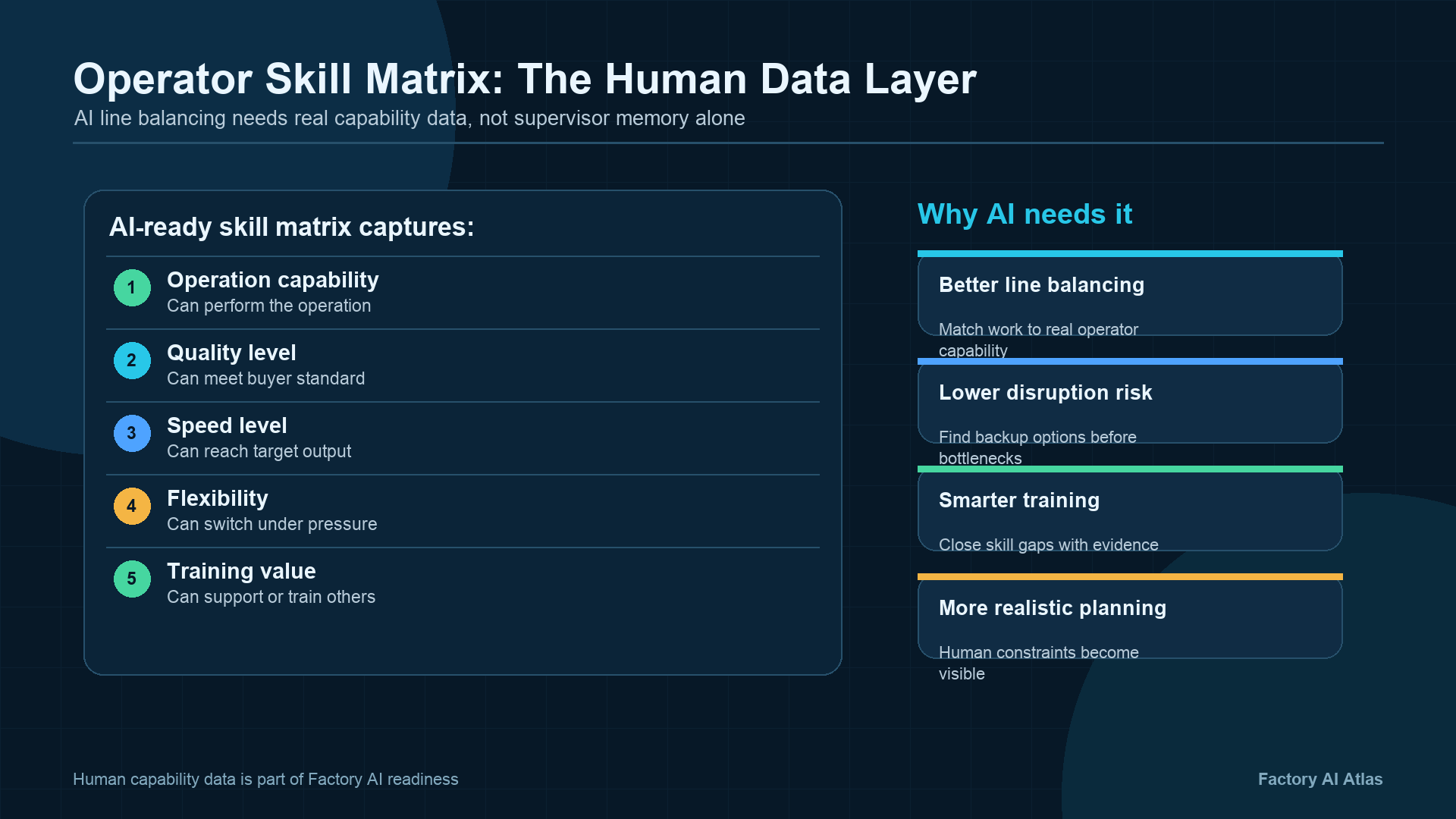
What an AI-ready operator skill matrix should capture
An AI-ready operator skill matrix does not need to be fancy. But it should capture more than a simple yes or no.
At minimum, a garment factory should consider these fields.
1. Operation capability
The first layer is basic operation coverage.
Which operators can perform which operations?
For example:
- collar attach
- sleeve join
- placket
- pocket attach
- waistband
- zipper attach
- overlock
- coverstitch
- buttonhole
- bartack
- final inspection support
- ironing or pressing support
The operation list should match the factory's real product mix. A woven shirt factory, knitwear factory, outerwear factory, denim factory, and lingerie factory will not need the same matrix.
The matrix should not be copied from a generic template without adjusting to the actual factory.
2. Skill level
A simple rating can still be useful if it is clear.
For example:
- Level 1: trained, needs close supervision
- Level 2: can perform the operation with acceptable quality at slower speed
- Level 3: can meet normal production speed and quality
- Level 4: can handle difficult styles or fabric variations
- Level 5: can train others or support line balancing
The exact scale is less important than consistency.
If one supervisor gives Level 4 easily and another gives Level 4 only to top operators, the data becomes hard to trust. The factory needs a common meaning for each level.
3. Speed versus quality
Skill should not be measured only by speed.
In garment production, a fast operator who creates rework may not be truly productive. A slower operator with stable quality may be better for certain operations, especially when the buyer has strict standards or the material is difficult.
The matrix should separate speed and quality where possible.
For example:
- target output achievement
- defect tendency
- rework history
- ability to maintain quality under pressure
- need for inline checking
This helps the factory avoid a common mistake: assigning the fastest person without considering quality risk.
4. Product and fabric experience
An operator may be good at an operation in one product type but weak in another.
For example, attaching a pocket on a stable woven fabric is not the same as handling a slippery, lightweight, or stretch material. A sewing operator may be reliable on basic T-shirts but slower on performancewear, outerwear, or styles with special attachments.
The skill matrix should capture product and fabric experience when it matters.
Useful fields may include:
- woven
- knit
- denim
- outerwear
- light fabric
- stretch fabric
- slippery fabric
- thick fabric
- lining
- wash-sensitive product
- special seam or attachment experience
This does not need to become overly detailed. But the factory should capture the differences that affect real production.
5. Flexibility and backup coverage
A skill matrix is useful for planning only if it shows flexibility.
The question is not only "Who can do this operation?"
The better question is:
"If the main operator is absent, who can cover this operation without damaging output or quality?"
Factories often discover their real weakness during absence, urgent style change, or production recovery. One missing operator can slow an entire line if the operation has no backup.
The skill matrix should show backup coverage for critical operations.
This helps supervisors and planners see where the factory is exposed.
6. Learning curve
Some operators learn new operations quickly. Others need more time. Some can learn simple operations but struggle with complex handling. Some perform well during training but slow down under production pressure.
This matters for AI planning because new styles often require learning time.
If a factory treats all operators as equally trainable, the plan may be too optimistic. The first production days may then suffer from lower output, more rework, and more supervisor intervention.
A practical skill matrix can include a learning curve note:
- learns quickly
- needs repeated practice
- needs visual guide
- needs close supervisor support
- suitable for simple operations first
- can transfer skills from similar operations
This turns training from a vague activity into a planning input.
7. Trainer and mentor capability
Some strong operators are not good trainers. Some operators may not be the fastest, but they explain methods clearly and help others stabilize.
For Factory AI readiness, this matters.
If the factory wants to improve flexibility, it needs internal trainers. If it wants to reduce dependency on one or two key operators, it needs people who can transfer skill.
The skill matrix should identify operators who can train others.
This is especially useful for:
- new style introduction
- new operator onboarding
- multi-skill development
- absentee risk reduction
- line recovery after disruption
A factory with good trainer coverage has more resilience.
How weak skill data breaks line balancing
Line balancing depends on more than SMV.
A balancing plan may look correct mathematically. But if the assigned operators do not match the operation difficulty, the line will not behave as planned.
For example, a bottleneck operation may need a high-skill operator. If the system assigns an available but weak operator, the bottleneck gets worse. If a critical operator is moved to another line without understanding the skill gap, the original line may lose stability.
Weak skill data can create several problems:
- unrealistic output targets
- poor backup planning
- slow style changeover
- hidden quality risk
- supervisor firefighting
- repeated overtime
- overdependence on a few key operators
- weak training prioritization
This is why operator skill data should be connected to line balancing, not kept separately as an HR file. A weak operator skill matrix can make a line balancing plan look correct while the sewing line still struggles.
How AI can support skill-based planning
AI can help if the factory gives it reliable skill data.
It can compare operator capability with operation requirements. It can flag critical operations with weak backup coverage. It can suggest training priorities based on future style needs. It can show which lines are too dependent on one skilled operator. It can support what-if planning when absenteeism or urgent order changes happen.
But AI should not blindly assign people.
A good system should support supervisors, not bypass them.
The supervisor still knows details that may not be in the system: mood, fatigue, recent conflict, new health issue, family situation, temporary quality problem, or whether an operator is ready for a harder task this week.
Factories should be careful here. Human skill data is sensitive. It should be used to improve planning and training, not to punish workers unfairly.
A practical starter template
A garment factory can start with a simple structure.
For each operator:
- operator ID or name
- department or line
- primary operation
- secondary operations
- skill level by operation
- quality stability
- speed stability
- fabric or product experience
- backup operation capability
- training needs
- trainer capability
- last review date
- supervisor comment
For each operation:
- operation name
- machine type
- attachment or folder requirement
- difficulty level
- quality risk
- standard time reference
- number of trained operators
- number of production-ready operators
- backup coverage status
This is enough to start.
The factory does not need to wait for a perfect AI platform. It can begin by making human capability visible and reviewable. The operator skill matrix should be reviewed as production data, not stored as a one-time training file.
Review rhythm matters
A skill matrix becomes useless if it is not updated.
Operator capability changes over time. People improve. Some skills weaken if not used. New styles introduce new requirements. Operators move lines. Supervisors change. Training happens. Production pressure reveals gaps.
A practical review rhythm may be:
- update after new style introduction
- update after training completion
- update after major quality issue
- update after line balancing change
- review monthly for critical operations
- review before peak season or large new orders
The goal is not paperwork. The goal is to keep the factory's human capability map close to reality.
Source notes and factory context
This article treats the operator skill matrix as a factory AI readiness layer, not as a standalone HR document. The concept connects with standardized work, skills development, sewing ergonomics, and practical production planning. Public references on standardized work and sewing ergonomics, including Lean Enterprise Institute and OSHA, are useful background. Each factory still needs to define skill levels in a way that matches its product mix and operating reality.
Field lens
Factory AI needs human capability data.
Machine data may show what equipment exists. Production data may show what output happened. Quality data may show what defects occurred. Standard time data may show how long an operation should take.
But the operator skill matrix shows who can actually make the plan work.
Without that, AI line planning is incomplete.
In garment manufacturing, people are still the most flexible part of the system. If the data does not describe that flexibility, the AI will not understand the factory.
Final factory takeaway
An operator skill matrix is not just a training chart.
For apparel factories, it is one of the most practical foundations for Factory AI readiness. It connects human capability with line balancing, production planning, quality risk, training, and daily execution.
Factories do not need perfect AI first.
They need a reliable map of who can do what, where the weak points are, and how quickly the team can adapt when production changes. A living operator skill matrix helps Factory AI understand flexibility, backup coverage, and training risk before it recommends a plan.
That is the human data layer.
And without it, Factory AI will always be missing part of the factory.
Related Factory AI Atlas reading
- Factory AI Needs Semantic Maps, Not Just Robots — read this next to connect operator-skill data with WIP, rework, hold-area, and movement meaning.
- AI Visual Inspection in Garment Factories: 7 Readiness Checks Before You Buy — use this to connect skill coverage with quality review and defect-handling gates.
- Factory AI Readiness Scorecard — use the scorecard to test whether one AI use case has enough process and ownership stability.
External validation anchors for operator skill data
- ILO apparel-sector resources — useful context for skills, productivity, and labor-intensive factory operations.
- Better Work reports and publications — relevant for linking skills, worker conditions, and factory improvement evidence.