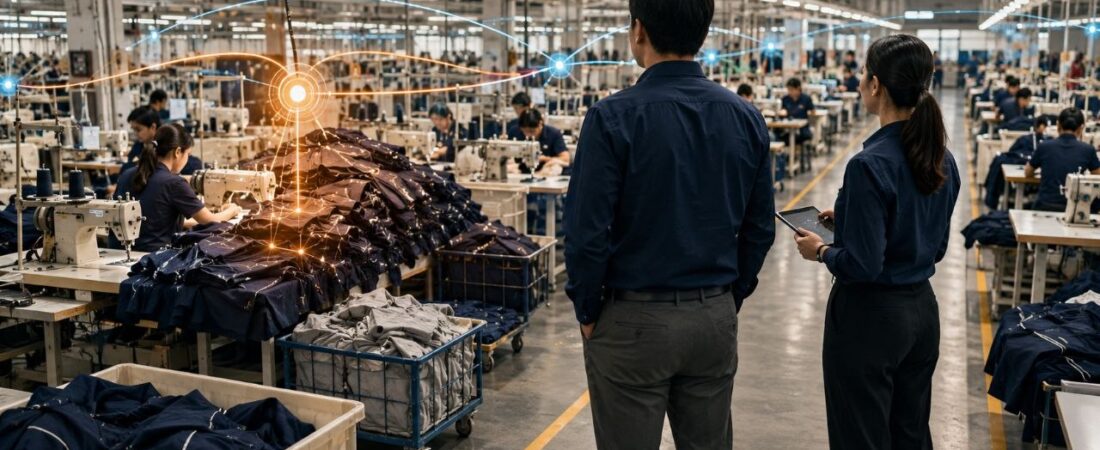
Line-balance evidence note
Garment line balancing is a factory AI gate because it determines whether recommendations can actually move through the line. If bottlenecks, WIP, helper work, absenteeism, skill gaps, and style changeover are not visible, AI scheduling or robotics advice will look logical but fail on the floor.
Bottlenecks are hidden behind standard-time plans
The common mistake is to balance the line on standard time only. Real lines are affected by operator skill, fabric behavior, repair loops, machine availability, helper allocation, and learning curve; these conditions must be recorded before AI can recommend changes responsibly.
Checks before AI changes line balance
- Can the factory see bottleneck operations, WIP build-up, helper movement, and line stop reasons during the shift?
- Are operator skill and learning-curve assumptions connected to the balance plan?
- Does the system show the cost of moving work, adding helpers, changing sequence, or splitting operations?
Proof requests for line-balancing tools
- Show a line-balance view using real attendance, skill, WIP, and quality data.
- Explain how recommendations change when an operator is absent or a style changes.
- Provide an action log showing which balance recommendation was accepted, rejected, or redesigned.
Bottleneck-visibility gate
GO if line-balancing data improves a same-shift recovery decision. HOLD if the standard-time layer is ready but live conditions are weak. REDESIGN if the tool balances a theoretical line rather than the actual sewing floor.
Standard time gives a garment factory a time language. Garment line balancing tests whether that time language can survive real production.
The release test is whether bottleneck evidence is visible during the shift: WIP build-up, helper movement, absenteeism, quality return, operation splitting, and skill mismatch must be recorded before AI suggests a rebalance.
A sewing line can have good SMV values, trained operators, and clear daily targets. But if one or two operations consistently hold back the flow, the line will still build WIP, miss hourly targets, create helper work, and hide the real reason production is unstable.
This is the fourth practical layer in the Factory AI Atlas garment IE sequence: cycle time, kaizen, standard time, and now garment line balancing.
Before Factory AI can recommend manpower, automation, or scheduling changes, it must understand where the line actually gets stuck.
Garment line-balancing article map
- Why line balancing matters after standard time
- How bottlenecks break Factory AI recommendations
- WIP, helper work, and hidden imbalance
- Absenteeism, skill, and real line conditions
- Style changeover and learning-curve imbalance
- What Factory AI needs from line balancing data
- Garment line balancing readiness checklist
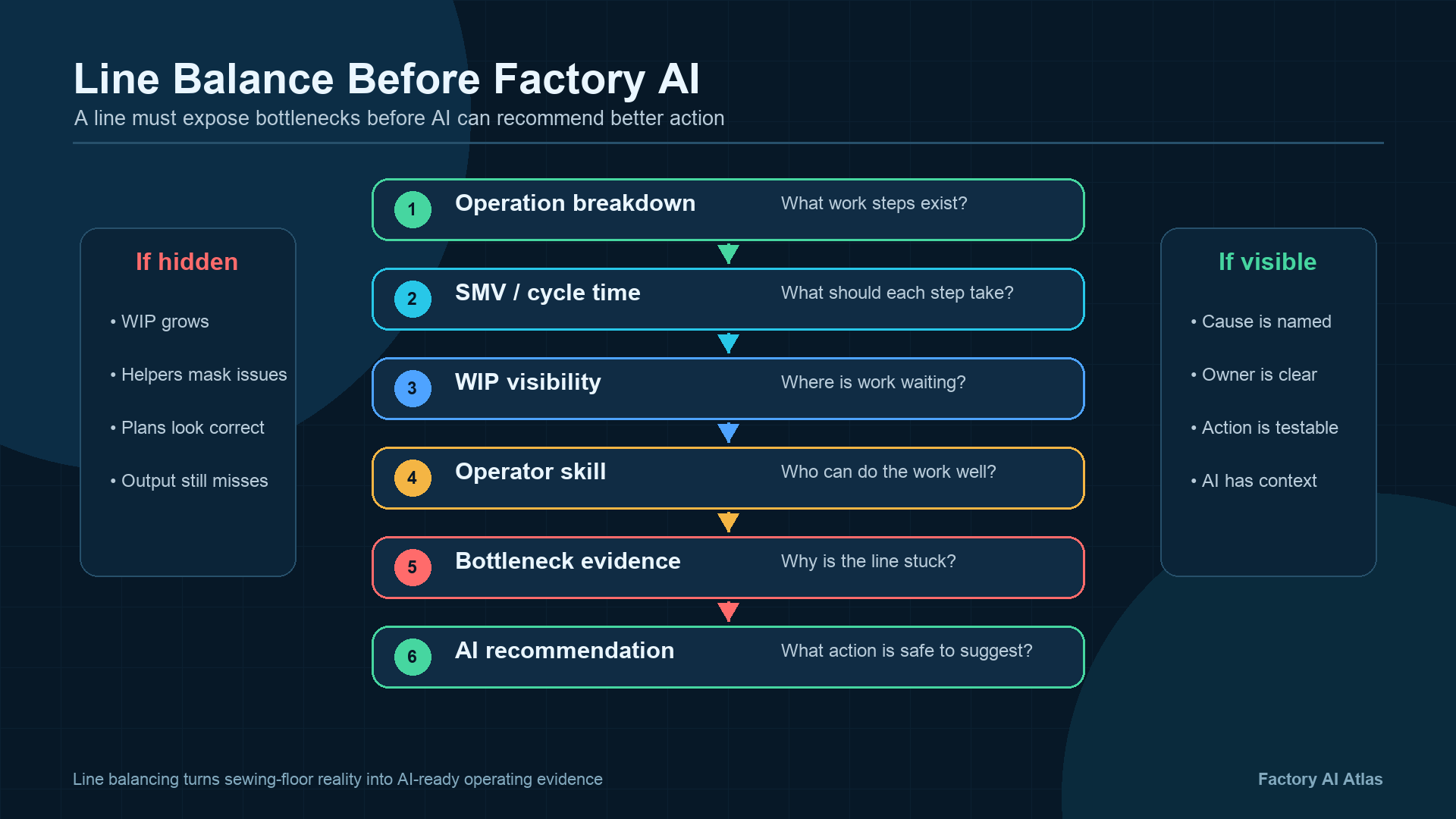
Why line balancing matters after standard time
The previous article in this sequence focused on garment standard time. Standard time helps the factory define expected work content. It connects sewing methods, SMV, SAM, GSD-style logic, costing, planning, and capacity assumptions.
But standard time alone does not guarantee production flow.
A line may have a total style SMV that looks acceptable. Each operation may have a reasonable time value. The planning team may calculate the correct target. Yet the line can still fail because the operations are not balanced around the actual takt, manpower, skill mix, feeding condition, and quality requirement.
In garment production, garment line balancing is where the paper plan meets the sewing floor.
It answers practical questions:
- Which operation is holding the line back?
- Is the bottleneck caused by work content, skill, method, machine, attachment, fabric behavior, or feeding?
- Can work be split, combined, shared, or supported?
- Is helper work solving the issue or just hiding it?
- Does the line have enough flexibility when one key operator is absent?
- Is the target based on real balance or only total SMV?
This is why garment line balancing becomes an AI-readiness issue. A factory that cannot explain its bottlenecks clearly should be cautious about asking AI to optimize the line.
How bottlenecks break Factory AI recommendations
AI systems can analyze production data, compare planned and actual output, and recommend actions. But recommendations are only useful when the system understands the operating constraint.
If a line is behind target, a simple AI model may suggest adding manpower. That may be correct in some cases. But it can also be wrong.
The real issue may be:
- one operation with a longer cycle time than the balance target;
- a difficult handling step caused by fabric behavior;
- a quality checkpoint that slows the operator;
- an attachment that is not stable;
- poor feeding from the previous operation;
- rework flowing back into the line;
- an absent skilled operator;
- a new style still inside the learning curve.
If the AI system sees only output numbers, it may recommend the wrong action. It may treat the symptom as the cause.
For example, adding one more operator after a bottleneck does not help if the bottleneck operation itself cannot feed enough pieces. Adding helpers may increase movement without improving balance. Increasing the target may create more WIP and rework. Moving the style to another line may repeat the same problem if the method is not corrected.
Factory AI needs bottleneck context, not only production results.
WIP, helper work, and hidden imbalance
One of the easiest ways to spot poor line balance is to look at WIP.
In a balanced line, work should move with reasonable rhythm. Some WIP is normal, especially in bundle-based production. But when WIP piles up before one operation and the next operations are waiting, the line is sending a clear signal.
WIP tells the factory where flow is blocked.
Helper work is another important signal. In many garment factories, supervisors use helpers to move bundles, trim threads, turn parts, prepare components, feed difficult operations, or support weaker operators. Helper work is not automatically bad. It can be necessary and practical.
But helper work becomes dangerous when it hides the true balance problem.
A line may appear to meet target only because helpers are constantly supporting one operation. If the helper is removed, the bottleneck returns. If the same helper is needed every day, the factory should ask whether the operation method, machine setup, attachment, layout, or manpower allocation needs to be redesigned.
For Factory AI, helper work should not be invisible. If AI analyzes operator output without seeing helper support, the system may overestimate the stability of the line.
A useful garment line balancing data layer should capture:
- where WIP accumulates;
- which operations require helper support;
- which support tasks are planned versus emergency support;
- whether helper work changes the true capacity of the operation;
- whether the same bottleneck repeats across styles.
Without this context, AI may read an unstable line as a normal line.
Absenteeism, skill, and real line conditions
Garment line balancing is not only a mathematical exercise. It is a people-centered operating problem.
The same operation may perform differently depending on the operator’s skill, experience, fatigue, familiarity with the style, and ability to handle the fabric. A balanced plan created in the IE office may break when the actual line has absenteeism, new workers, skill gaps, or operator changes.
This matters because apparel production still depends heavily on human skill and coordination.
When a key operator is absent, the line may slow down even if the standard-time sheet has not changed. When a new worker takes over a difficult operation, the bottleneck may shift. When a line leader moves an experienced operator to solve one problem, another part of the line may become weak.
AI systems that ignore skill and attendance may misread the reason behind poor output.
A practical garment line balancing system should connect line performance to:
- operator skill level by operation;
- critical operation coverage;
- absenteeism and replacement status;
- new worker ratio;
- line leader intervention;
- training or learning-curve status;
- overtime and fatigue conditions.
This does not mean factories need a complex HR system before starting. It means the production team should at least record the conditions that explain why the line behaved differently from the plan.
Style changeover and learning-curve imbalance
Many line-balance problems become visible during style changeover.
A line may be stable on a repeat style but unstable on a new style. The first few production days often reveal issues that were not obvious in planning: difficult fabric handling, unclear operation sequence, missing work aids, weak feeding, poor workstation layout, or operators who need more practice.
This is why changeover and ramp-up data are valuable for Factory AI.
Instead of asking only whether the line hit the daily target, the factory should ask:
- Which operation became the first bottleneck after style start?
- Did the bottleneck shift after training or method correction?
- How many hours or days did the line need to stabilize?
- Which work aids or attachments were added during ramp-up?
- Was the original balance plan revised?
- Did quality issues create a second bottleneck?
These answers help the factory build a stronger memory. When a similar style appears later, AI can support the team by retrieving previous ramp-up issues, expected bottleneck operations, skill requirements, and method warnings.
But that only works if the factory records the learning. If changeover problems stay inside supervisor memory, AI has nothing reliable to learn from.
What Factory AI needs from line balancing data
For Factory AI to support garment line balancing, the factory does not need perfect data from day one. But it needs structured signals.
At minimum, the system should know:
- operation sequence;
- standard time or target time by operation;
- actual cycle time observations;
- assigned operator and skill condition;
- machine, attachment, and work-aid status;
- hourly output by line;
- WIP accumulation points;
- bottleneck operation notes;
- helper support and method changes;
- quality or rework feedback affecting flow;
- changeover and ramp-up status.
With these signals, AI can become more practical. It can help compare planned balance against actual balance. It can highlight repeated bottleneck operations. It can suggest where supervisors should observe first. It can retrieve similar past styles. It can support capacity simulation with more realistic assumptions.
But AI should not replace line leaders, IE teams, or production managers. Line balancing requires floor observation, worker communication, method judgment, and practical trade-offs. AI is most useful when it helps the team see patterns faster and ask better questions.
The goal is not to create a perfect algorithmic line. The goal is to reduce invisible imbalance.
Garment line balancing readiness checklist
Before using AI for manpower planning, bottleneck prediction, or automation prioritization, a garment factory should ask:
- Do we have an operation sequence for the style?
- Are standard-time values linked to actual operations and methods?
- Can we compare target time and observed cycle time by operation?
- Do we know where WIP accumulates during the day?
- Do we record bottleneck operations, not only total output?
- Can we see where helper work is used and why?
- Do we record absenteeism or key skill replacement when output changes?
- Do we review line balance during style changeover and ramp-up?
- Do quality and rework issues feed back into the line-balance review?
- Can we learn from previous similar styles instead of starting from zero?
If these answers are weak, the factory may not need a more advanced AI system yet. It may need a more disciplined garment line balancing routine.
External validation anchors for line balancing and skills
- Better Work reports and publications — useful for connecting line performance with broader factory improvement and working-condition evidence.
- ILO textiles and apparel resources — relevant for productivity, skills, and labor-intensive production context.
Final line-balancing takeaway
Garment line balancing is one of the most practical bridges between industrial engineering and Factory AI.
Cycle time shows the real work. Kaizen improves the method. Standard time defines the expected work content. Line balancing tests whether all of that can flow through a real sewing line with real people, real fabric, real quality issues, and real daily disruptions.
That is why bottlenecks matter so much. A bottleneck is not only a production problem. It is a data-quality signal. It tells the factory where the operating system is not yet visible enough.
Before robots, before advanced optimization, and before AI scheduling, garment factories need to understand where their sewing lines lose flow.
That is the real starting point for practical Factory AI in apparel manufacturing.
Related Factory AI Atlas reading
- Cycle Time: 5 Practical Lessons for Factory AI
- Why Garment Factory Kaizen Is Still About Motion, Not Robots
- Garment Standard Time: From Method Improvement to Factory AI
- AI Apparel Costing: 7 Essential Ways to Support ME and IE Teams
- Why Garment Factory Automation Is Difficult
- Lean Enterprise Institute: Takt Time
- NIST Manufacturing Extension Partnership