Factory decision note
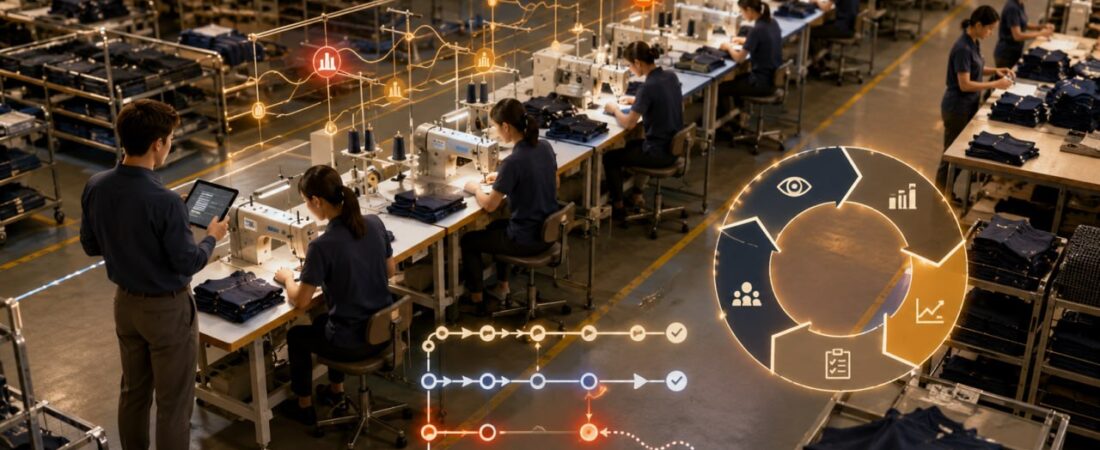
Cycle time is not a number I would use to pressure operators. I use it as a simple way to see where the sewing line is losing time. In a real garment factory, the loss is often not one slow person. It is a blocked flow: bundles wait, trims arrive late, a machine needs adjustment, the method is unclear, or rework keeps coming back to the same operation.
The mistake factories usually make
The common mistake is to average cycle time until the problem disappears. The average may look clean, but the line still feels unstable. A supervisor may already know this from the floor: one bundle moves smoothly, the next bundle stops, and nobody can explain the difference from the daily output report alone.
What I would check before approving budget
- Can the factory see cycle time by operation, not only by line output?
- Can the team separate normal sewing time from waiting, rework, machine stop, material delay, and method confusion?
- Does the signal reach the supervisor while there is still time to act, not only after the end-of-day report?
- Can IE, production, and quality agree on the reason for the delay?
Vendor proof requests
- Show the spread of cycle time, not only the average.
- Show how the system labels waiting, rework, machine stop, method change, and material delay.
- Show one alert becoming one supervisor action, with a close-out note.
- Show that the system protects the operator from blame-only monitoring.
Pilot gate: GO / HOLD / REDESIGN
GO if cycle-time data exposes a loss the line can fix. HOLD if the factory can measure time but cannot explain the cause. REDESIGN if the project only rewards faster numbers without showing why the work became faster.
Many apparel factories now hear the same promise: AI dashboards, alerts, digital assistants, cameras, and better production planning.
Those tools can help. But from my experience, they do not start in the software screen. They start at the sewing line, where a supervisor asks a very plain question:
Why did this operation take longer this time?
That question is the real value of cycle time. It is not just a stopwatch number. It is a way to see whether the work is flowing, waiting, repeating, or being corrected again and again.
A factory may know the daily output, the target, and the shipment status. But output alone does not explain the line. It does not show where the bundle stopped, where rework entered, or where a good method failed to repeat.
For AI-ready apparel manufacturing, the more useful question is simple:
Can the factory explain process time at the operation level?
Five practical cycle-time lessons
- Output does not explain the loss.
- The spread matters more than the average.
- Separate work time from interruption.
- One signal needs one owner and one action.
- Keep the lesson for the next style.
Lesson 1 — Output does not explain the loss
Daily output matters, but it is only the final result. It tells management what came out of the line. It does not show what happened inside the line.
Two sewing lines can hit the same output for very different reasons. One line may be balanced and calm. Another line may reach the number only because the supervisor keeps rescuing it, overtime is added, a strong operator is moved in, or rework is hidden inside normal flow.
If both lines are judged only by output, the factory may miss the difference between a healthy process and a fragile process.
This is where cycle time becomes useful. It helps the factory look under the production number and see how the work is actually moving.
For example, a line may miss target because of a visible bottleneck operation. But it may also lose time through smaller issues:
- extra handling between operations;
- waiting for bundles, trims, or instructions;
- method variation between operators;
- unplanned machine adjustment;
- quality checking that happens too late;
- rework that is not clearly separated from normal output;
- operator movement caused by poor layout or missing tools.
These issues may not be obvious in a daily output report. They become clearer when the factory starts observing and comparing cycle time.
Lesson 2 — The spread matters more than the average
In sewing production, cycle time is not just a stopwatch number. It is a floor signal.
At the operation level, it can show whether the method is stable, whether the operator has the right support, whether the bundle flow is even, and whether a change really improved the work.
This is why cycle time is different from a normal production report. A production report asks, “How many pieces did we make?” Cycle-time review asks, “How is the work being done, and where is it breaking?”
For garment factories, this distinction matters because every style can bring a different combination of fabric, construction, trim, seam type, machine setting, operator familiarity, buyer requirement, and quality risk.
A factory that only records output may treat each production problem as a new event. A factory that records cycle-time learning can begin to build operational memory across styles.
Cycle time turns sewing knowledge into comparable operating data.
That is why cycle time becomes the first language of factory AI. Before AI can detect an anomaly, compare similar styles, or recommend a support action, the factory needs a way to describe normal and abnormal process time.
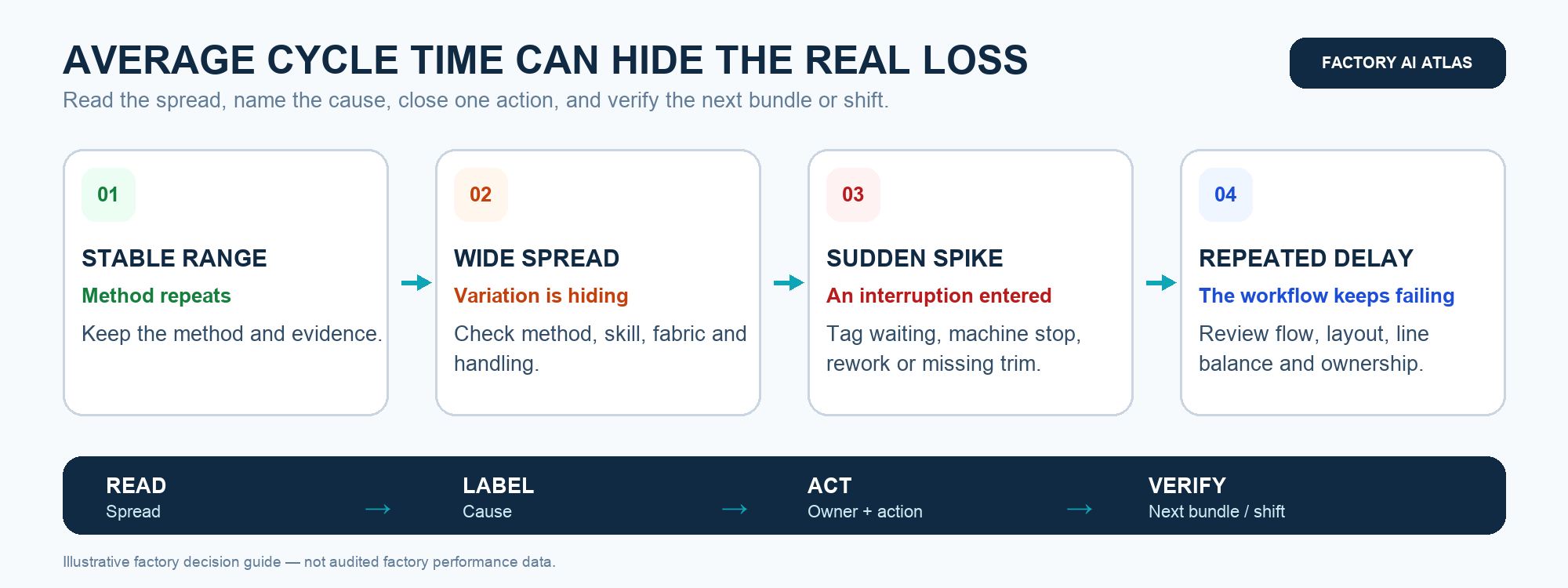
I would not approve a dashboard that shows only one average. The same average can come from a stable method or from a line that keeps jumping between normal work, waiting, rework, and machine stops. The spread and the cause label are what make the number useful.
Lesson 3 — Separate work time from interruption
A garment factory can use cycle-time visibility to see several types of hidden loss.
1. Bottleneck operations
A bottleneck is not always the operation that looks busiest. It is the operation that limits the flow of the line. Cycle-time review helps IE, ME, production, and supervisors find where the line is really being held back.
Once the bottleneck is visible, the team can decide whether the solution is method improvement, attachment support, machine setting, operator training, line balancing, layout change, or extra quality control.
2. Method variation
Two operators may complete the same operation with different motions, handling sequences, or preparation habits. Output may hide this variation, especially if the line is supported by experienced supervisors.
Cycle-time observation helps the factory see which method is repeatable and why it works. This is where standard work starts.
3. Rework and quality interruption
If rework is mixed into normal production flow, the line may appear slower without a clear reason. Cycle-time review can help separate true operation time from quality interruption, checking delay, repair, and repeated handling.
This is especially important for AI readiness because quality and productivity data should not be treated as separate worlds. In sewing production, poor quality often becomes lost time.
4. Waiting and handoff loss
Operators may lose time not because the sewing method is difficult, but because the next input is not ready, the bundle flow is uneven, or tools and instructions are not available at the right time.
Cycle time, when reviewed together with line flow, can make these waiting losses visible.
5. Style transition risk
New styles, repeat styles, carry-over styles, and copied styles do not create the same ramp-up risk. The same operation name may behave differently depending on fabric, construction, trim, and team familiarity.
If a factory keeps cycle-time lessons from previous styles, supervisors can prepare better before the next style starts. This is often where a simple record is more valuable than another dashboard.
Lesson 4 — One signal needs one owner and one action
Cycle-time improvement should not be treated as a one-time measurement exercise. Each signal needs a named owner, one same-day action, and a check on the next bundle or shift. Without that close-out, the dashboard only records delay.
- Observe the real operation at the line, not only the report.
- Measure the current cycle time and identify the main loss.
- Improve the method, work aid, layout, attachment, sequence, or support condition.
- Standardize the better method so it can be repeated.
- Transfer the lesson to similar styles, lines, and future changeovers.
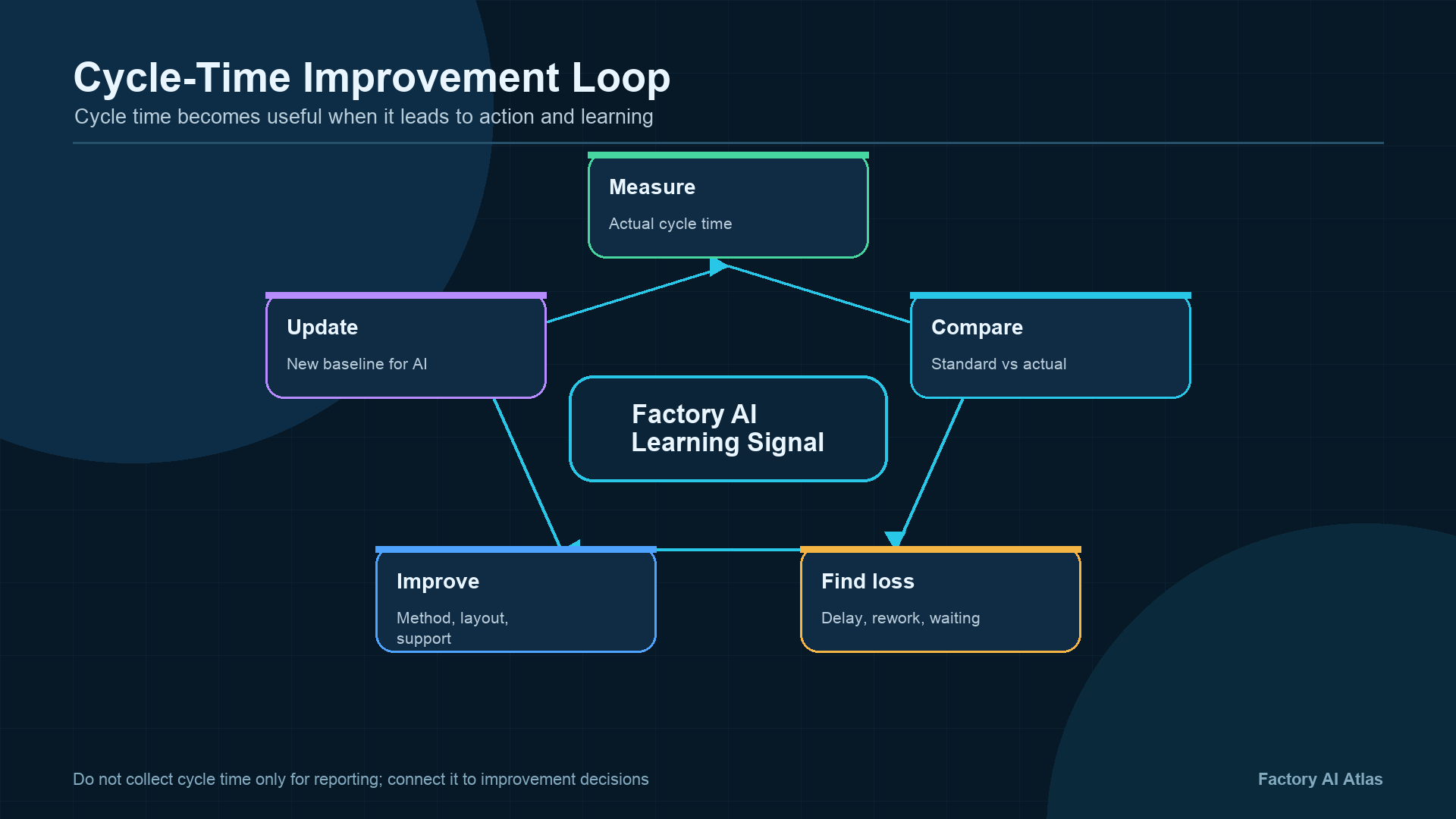
This loop is simple, but it is powerful. It turns small daily fixes into factory memory.
Many factories already run improvement activities. The AI-readiness question is whether those activities are captured in a way that can be searched, compared, and reused.
A useful cycle-time improvement record does not need to be complex. It can include:
- style or product category;
- operation name;
- before cycle time;
- after cycle time;
- main loss identified;
- method or tool changed;
- quality risk checked;
- operator or line condition;
- photo or short video reference if appropriate;
- lesson learned and reuse condition.
The point is not to publish private buyer, style, or factory data. The point is to keep enough internal evidence so the factory can make a better decision next time.
What I would ask the supervisor after one week
If this was my pilot, I would not ask only for a better average. I would ask for a short floor note:
- Which operation stopped the flow most often?
- Was the loss caused by method, machine, bundle flow, quality, material, or layout?
- What action did the supervisor take the same day?
- Did the next bundle or next shift improve, or did the same delay return?
That small note is the bridge between cycle-time data and real factory learning.
Lesson 5 — Keep the lesson for the next style
When cycle-time data becomes consistent, AI becomes more practical. The first use cases do not need to sound futuristic.
AI can support the factory in several realistic ways.
Similar-style comparison
When a new style is prepared, AI can help search previous styles with similar construction, fabric, operation sequence, or bottleneck history. This helps supervisors and IE teams prepare before the problem appears on the line.
Bottleneck prioritization
A factory may have many improvement opportunities. AI can help rank which operations deserve attention first by comparing cycle-time gap, output impact, quality risk, and recurrence across styles.
Anomaly detection
If actual cycle time starts drifting away from the expected method, AI can flag the change earlier. This does not replace the supervisor. It gives the supervisor a faster signal to check.
Best-practice retrieval
A best-practice library becomes more useful when each case is connected to operation type, before/after cycle time, method change, and reuse condition. AI can help retrieve the right case when a similar problem appears again.
Training and coaching support
Cycle-time records, method notes, and approved videos can become practical training material. AI can help summarize the improvement, generate coaching prompts, or prepare a short supervisor briefing.
These use cases are realistic because they do not ask AI to magically understand the whole factory. They start with one clear operating signal: process time.
Cycle time must not become a blame tool
Factories should be careful about how cycle time is introduced. If workers feel it is only a pressure tool, they will naturally resist it. If supervisors use it only to blame operators, the data will become less honest and less useful.
Cycle time should be framed as a method-improvement tool, not a punishment tool.
The best question is not, “Who is slow?” The better question is:
What condition, method, tool, layout, or support issue is making this operation unstable?
This is especially important in garment manufacturing because sewing performance depends on many conditions outside the operator’s individual effort. Fabric behavior, machine condition, bundle flow, attachment availability, quality instructions, line balance, and style difficulty all matter.
A fair approach makes cycle-time data more reliable. It also makes AI adoption more credible because the team can see the purpose: better support, clearer methods, and faster problem solving — not blind monitoring.
Cycle-time readiness checklist
Before a garment factory expects AI to support production decisions, it should ask a few practical questions:
- Can the factory measure cycle time at the operation level?
- Can it compare before and after method changes?
- Can it separate actual output from hidden rework, waiting, and quality interruption?
- Can supervisors retrieve previous improvement cases from similar styles?
- Can IE or ME teams explain why a cycle-time improvement worked?
- Can cycle-time learning be transferred across lines, factories, or product categories?
- Can the data be reviewed without exposing private buyer, style, or factory information outside the organization?
If the answer is no, the first step is not advanced AI. The first step is better process visibility.
Final factory approval check
I would not approve a factory AI project because the software can calculate cycle time. I would ask whether the factory can explain the spread, label the loss, name the action owner, and show whether the next bundle or shift improved.
If cycle time becomes only a speed score, it will damage trust. If it separates normal work from waiting, rework, method drift, machine stops, and style-change risk, it becomes useful factory evidence.
That evidence—not another average—is what AI can compare, retrieve, and turn into reusable factory memory.
Related Factory AI Atlas reading
- Before AI in Garment Factories: 5 Data Foundations Every Factory Must Fix First
- Factory data readiness: five data types to organize before AI adoption
- Cutting Plan: A Factory AI Readiness Layer for Apparel
- AI Apparel Costing: 7 Essential Ways to Support ME and IE Teams
- NIST Manufacturing Extension Partnership
- Lean Enterprise Institute: What is Lean?
Sources checked and claim boundary
- NIST manufacturing resources — useful context for manufacturing measurement and process-improvement systems.
- ILO apparel-sector resources — relevant when cycle-time discussions touch productivity, skills, and working conditions.