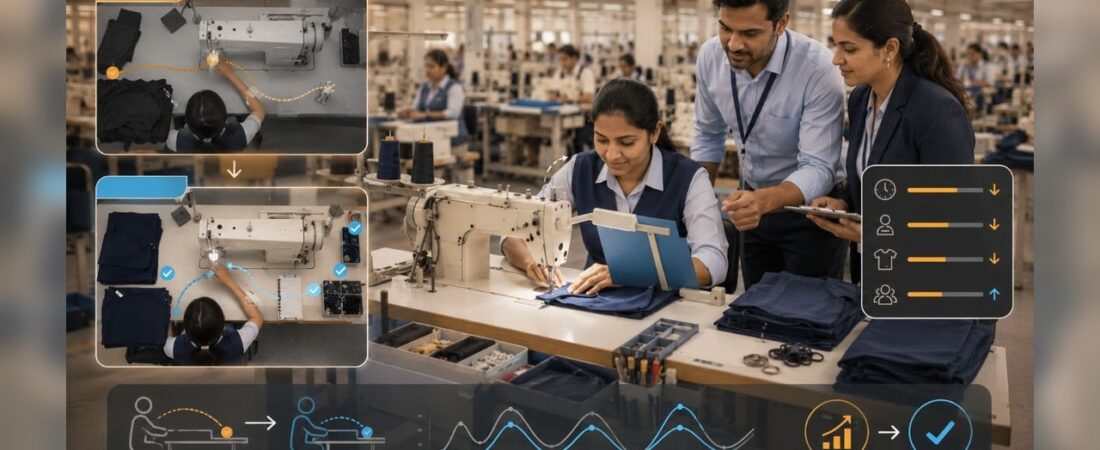
Follow one motion loss from observation to reuse
Kaizen becomes valuable when a factory can show how one repeated motion changed: what the operator did before, what was altered, what happened to time and quality, and whether the method worked again on a comparable style. A robot may eventually be part of the answer, but the record should begin with the work.
- Observe the motion: record the reach, turn, search, re-grip, walk, wait, or correction under normal production conditions.
- Test the smallest practical change: adjust the layout, work aid, guide, attachment, bundle position, or method before assuming a robot is required.
- Check the trade-off: compare cycle time together with defects, rework, fatigue, safety, and line-balance effects.
- Keep the context: note the operation, fabric behavior, style family, machine setup, operator learning period, and sample size.
- Prove reuse: repeat the method on another line or comparable style and record what had to change.
Reader test: another supervisor should be able to reproduce the improvement without relying on the original operator’s memory. If the record cannot support that transfer, it is still a useful observation—not yet a reusable factory method or proof that automation will perform better.
Robots attract attention. Motion improvement pays the bills.
That may sound old-fashioned in an age of factory AI, computer vision, digital twins, and automated sewing systems. But inside many apparel factories, the most practical productivity opportunity is still not full automation. It is the repeated removal of small motion, handling, waiting, and method losses across many sewing operations.
This is why garment factory kaizen is still mostly about motion before it is about robots. In practical terms, garment factory kaizen begins with the way people handle, position, sew, and repeat the work.
Robotics and automation matter. They will become more important in apparel manufacturing. But if a factory has not yet learned how to see motion waste, standardize better methods, and transfer small improvements from one line to another, advanced automation may only automate an unstable process.
For Factory AI readiness, the first question is not, “Which robot should we buy?” The better first question is:
Can the factory see where time is lost in the way work is actually done?
The best kaizen evidence is not a slogan. It is before/after motion, method, quality, fatigue, and line-balance evidence that a supervisor can explain and repeat on the next style family.
Article map for motion-first kaizen
- Robot headlines vs daily kaizen
- Why motion loss compounds in sewing factories
- The practical kaizen categories factories should track
- Method-first thinking before automation-first thinking
- Work aids, folders, guides, and standard time
- How AI can support garment factory kaizen
- Kaizen-to-AI readiness checklist
Robot headlines versus daily method loss
Most public conversations about apparel automation focus on large visible technologies: robotic sewing, automated handling, computer vision inspection, autonomous transport, or full digital production systems.
These topics are important. But they do not describe most daily improvement work inside a sewing factory.
On the sewing floor, improvement is often smaller, more repeated, and more practical:
- reducing one unnecessary reach;
- removing one extra turn of the garment;
- making a guide easier to use;
- changing the position of trims or panels;
- adding a simple folder, template, jig, or attachment;
- combining two handling steps;
- removing a waiting point between operations;
- making the better method easier for operators to repeat.
Each change may look small. But in sewing production, small repeated losses become large because the same operation may be repeated hundreds or thousands of times across a style.
That is why a factory should not dismiss motion improvement as a basic lean topic. Motion is one of the most important places where factory knowledge becomes productivity.
Why small motion loss compounds in sewing lines
Garment manufacturing is different from many high-volume repetitive manufacturing environments. Styles change. Fabrics change. Construction details change. Trim location changes. Quality requirements change. Operator familiarity changes.
Because the work changes often, motion loss can return again and again in new forms.
An operator may lose time because the garment has to be turned too often. Another may lose time because pieces are not positioned correctly before sewing. A third may lose time because a template or folder is missing. A fourth may lose time because the layout forces extra reach, bend, or bundle movement.
These losses are not always dramatic. They may not appear clearly in a daily output report. But they affect cycle time, quality, fatigue, line balance, and ramp-up stability.
This is why the previous article in this series focused on cycle time. Cycle time helps the factory see that a process is slow. Kaizen helps the factory understand what should change.
If cycle time is the signal, motion kaizen is one of the first practical responses.
For apparel factories, the economic logic is simple: small savings become meaningful when they are repeated at scale. But the management logic is just as important. A factory that can repeatedly remove motion waste is building the discipline needed for more advanced AI and automation later.
Motion categories factories should track before automation
Garment factory kaizen should not be recorded only as a total count of improvement cases. A useful garment factory kaizen system shows what kind of loss was removed and whether the method can be repeated. A total count may show activity, but it does not show learning.
A better improvement system classifies kaizen by type. This helps IE, ME, production, and factory leadership understand what kind of losses are being solved and what type of support is most useful.
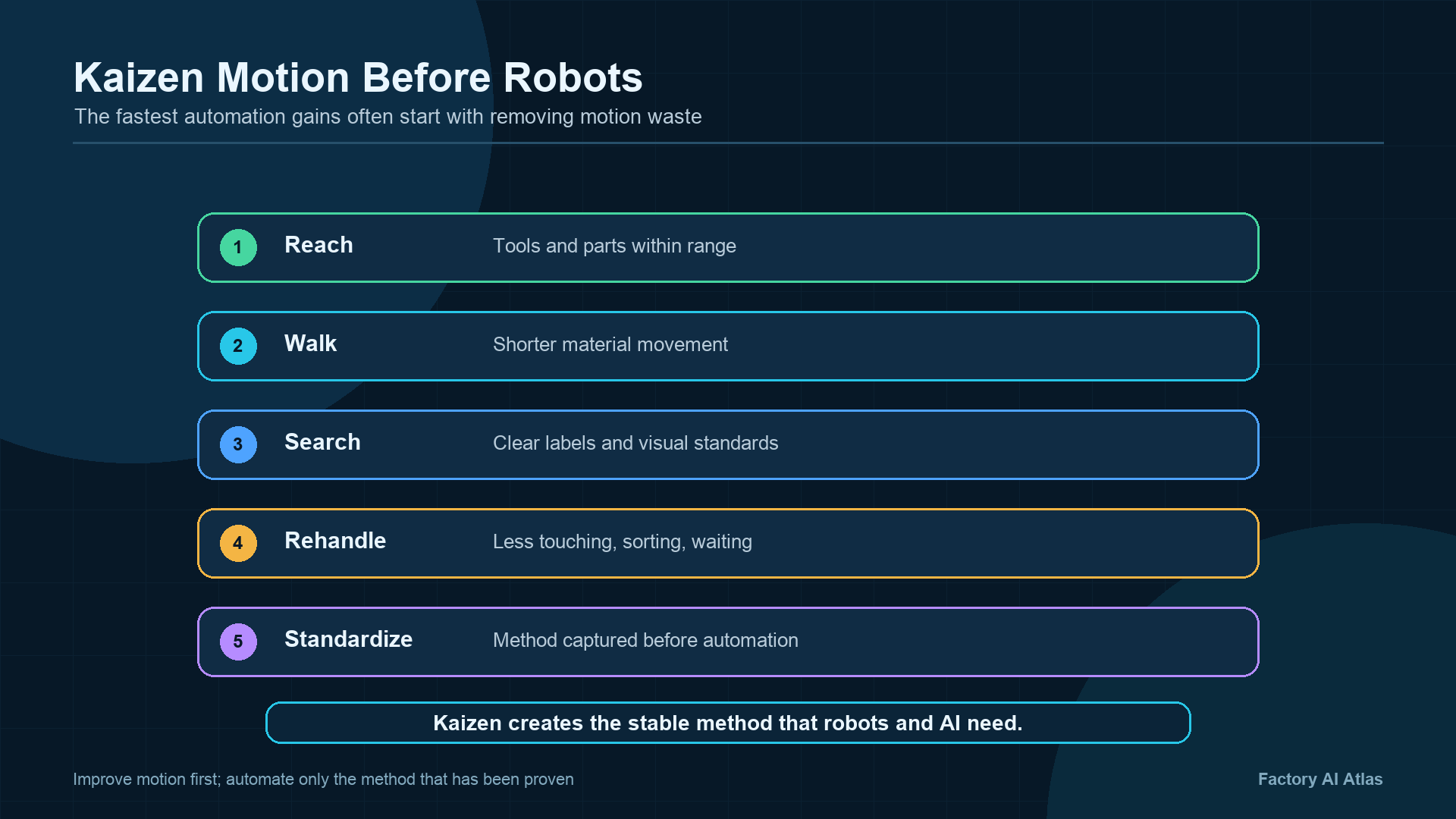
1. Motion improvement
This includes reducing reach, turn, align, pick-up, put-down, hand change, walking, searching, or repeated repositioning. Motion improvement is often the most common and practical layer because sewing is still highly dependent on human handling skill.
2. Work aids and tools
Simple work aids can reduce variation and make the better method easier to repeat. This may include guides, templates, folders, jigs, improved positioning aids, material holders, or small fixtures designed for a specific operation.
3. Combine and eliminate
Some improvements come from removing unnecessary steps or combining steps that were separated by habit rather than necessity. The goal is not to rush the operator. The goal is to remove work that does not add value.
4. Machine or attachment change
A different machine setup, attachment, folder, gauge, presser foot, guide, or workstation arrangement may reduce handling and improve repeatability. The important point is to connect the change to operation-level impact, not only to equipment preference.
5. Ergonomics and fatigue reduction
Better posture, reach distance, lighting, table height, seating, foot control, bundle location, and material flow can reduce fatigue and improve consistency. Ergonomics is not separate from productivity. In sewing production, fatigue often becomes quality and output variation.
6. Selective automation
Automation can be powerful when the process is understood. But selective automation should be applied to the right problem: repeated handling, unstable quality, high-frequency operation, or a task where machine support is more reliable than manual repetition.
The point is not to choose between kaizen and automation. The point is to understand the process clearly enough to know where automation will actually help.
Method-first thinking before automation spend
Automation-first thinking begins with the tool. It asks, “What machine or robot can we buy?”
Method-first thinking begins with the process. It asks, “What is the work, where is the loss, and what condition would make the better method repeatable?”
For garment factories, method-first thinking is safer because style variation is high. A solution that works for one product type may not work for another. A machine that looks efficient in a demo may not solve the factory’s real bottleneck if the issue is feeding, bundle flow, skill mix, quality checking, or method instability.
Method-first thinking does not reject technology. It prepares the factory to use technology better.
Before investing in advanced automation, the factory should understand:
- which operation creates the largest recurring loss;
- whether the loss is motion, waiting, rework, layout, machine setup, or operator skill;
- whether a simple work aid can solve the problem;
- whether the improved method can be standardized;
- whether the same solution can be reused across similar styles;
- whether the improvement affects quality risk.
This is the difference between buying technology and building operating capability.
Work aids, folders, guides, and standard time
One reason motion kaizen matters is that it connects directly to measurable production language: cycle time, SMV, standard time, bottleneck behavior, and line balance.
A work aid should not be treated only as a clever shopfloor trick. It should be documented as a method change.
A strong kaizen record should explain:
- what operation was improved;
- what motion or handling loss existed before;
- what changed in the method, tool, layout, or attachment;
- how cycle time or SMV changed;
- whether quality risk was checked;
- which style types can reuse the idea;
- what training note supervisors should remember.
This kind of record turns kaizen into a reusable knowledge asset.
Without this structure, improvement knowledge stays in people’s memory. With this structure, the factory can build a best-practice library that supervisors and IE teams can search before a new style starts.
The best kaizen case is not only an improvement. It is a transferable lesson.
How AI can support motion evidence without replacing kaizen
AI should not be positioned as a replacement for IE managers, ME teams, supervisors, or skilled operators. In this context, AI is more useful as decision support, retrieval support, and coaching support.
When a factory already records kaizen cases clearly, AI can support the process in practical ways.
AI-assisted video review
Approved operation videos can help teams review repeated reach, turn, align, repositioning, waiting, or handling waste. AI may help summarize what appears in the video, but the final method decision should remain with experienced factory teams.
Similar-operation retrieval
When a supervisor faces a difficult operation, AI can help search previous cases with similar operation type, fabric behavior, machine setup, or work-aid solution.
Before-and-after method summaries
AI can help convert improvement notes into clear training summaries: what changed, why it worked, what to watch during training, and where the idea may or may not apply.
Prioritization of high-frequency operations
Not every small improvement deserves the same attention. AI can help prioritize cases where small cycle-time savings repeat frequently, affect bottlenecks, or appear across many styles.
Supervisor coaching prompts
AI can help prepare short coaching prompts for supervisors: what to observe, what question to ask, what quality risk to check, and which previous best practice to review.
These use cases are realistic because they start from factory knowledge that already exists. The factory is not asking AI to invent productivity. It is asking AI to help organize, retrieve, and apply improvement knowledge.
Kaizen-to-AI readiness: method evidence checklist
Before a garment factory expects AI to support productivity improvement, it should ask these practical questions:
- Does the factory classify kaizen by type, not only by total count?
- Are motion improvements documented with before-and-after method notes?
- Are work aids linked to specific operations and style types?
- Is cycle-time or SMV impact recorded?
- Is quality risk checked after method changes?
- Can supervisors retrieve similar kaizen examples before launching a new style?
- Can IE and ME teams explain why an improvement worked?
- Can the factory transfer the lesson across lines, factories, or product categories?
If the answer is no, the factory may not need a bigger AI platform yet. It may need a better improvement memory.
What these sources support—and what the factory must still prove
- NIST manufacturing resources provide public context for measurement, process improvement, and manufacturing technology. They do not prove that a specific robot, attachment, or method will improve one sewing operation.
- ILO textiles and apparel resources provide sector context for labor-intensive production and working conditions. They do not supply the factory’s operation-level time study, ergonomic assessment, quality result, or transfer evidence.
The factory-specific claim therefore rests on a traceable before/after record, comparable operating conditions, and human review of quality, fatigue, safety, and repeatability.
Motion-first kaizen takeaway for factory leaders
Garment automation will continue to advance. Robots, vision systems, and AI assistants will become more capable. But apparel factories should not skip the practical foundation.
Most sewing productivity improvement still begins with motion, handling, method, work aids, ergonomics, and standardization.
This is not a rejection of automation. It is the preparation for better automation.
A factory that understands motion loss can choose technology more wisely. A factory that records method improvement can train supervisors better. A factory that turns kaizen into searchable knowledge can use AI more realistically.
That is why garment factory kaizen is still about motion before it is about robots. For Factory AI Atlas, this is the practical bridge between lean improvement and future automation readiness.
Related Factory AI Atlas reading
- Cycle Time: 5 Practical Lessons for Factory AI
- Before AI in Garment Factories: 5 Data Foundations Every Factory Must Fix First
- AI Apparel Costing: 7 Essential Ways to Support ME and IE Teams
- Apparel Factory Small Apps: The Practical Step Before Robots
- Lean Enterprise Institute: Kaizen
- OSHA Ergonomics