
Build the proof chain before the buyer review
A buyer review becomes difficult when a factory has many documents but cannot connect them to the claim being made. A usable proof pack should follow one chain from the requirement to the current record, its scope, its owner, and any unresolved gap.
Write the exact labor, safety, quality, traceability, chemical, environmental, or certificate statement the factory expects to explain.
Link the claim to the source file, system, date, facility, material, product, order, or process that the record actually covers.
Confirm version, expiry, issuing body, market, product category, certificate scope, and whether the buyer accepts that evidence type.
Name who updates the record, approves external sharing, applies redaction, explains exceptions, and protects confidential factory data.
Mark missing or conflicting evidence, the corrective action, due date, and the new record needed to close the gap.
Review test: another responsible manager should be able to trace the claim to a current, in-scope record without rebuilding the explanation during the meeting.
Buyer evidence readiness is not the same as document storage.
Many apparel factories believe they are ready for a buyer review because they “have the documents.” They may have policies, certificates, inspection records, payroll files, test reports, and corrective action forms.
But the real question is different: can the factory prove the specific operational claim it is making?
If a factory says it controls overtime, can HR, payroll, attendance, and production-pressure records support that statement? If a factory says it manages product safety, can test reports, material scope, product category, certificate validity, and shipment records be connected? If a factory says it has traceability, can the team link supplier, material lot, cutting lot, sewing bundle, packing list, and carton records without confusion?
That is the purpose of buyer evidence readiness. It helps factories organize documents, photos, logs, certificates, traceability records, and CAPA proof before buyer reviews, audits, ESG checks, compliance conversations, or factory improvement projects.
Buyer evidence readiness should answer one practical question before the meeting starts: which proof package supports each claim the factory plans to make?
This is not legal advice, audit advice, or a buyer approval guarantee. It is a factory-side operating discipline.
Good factories do not only have documents. They know which evidence proves which operational claim.
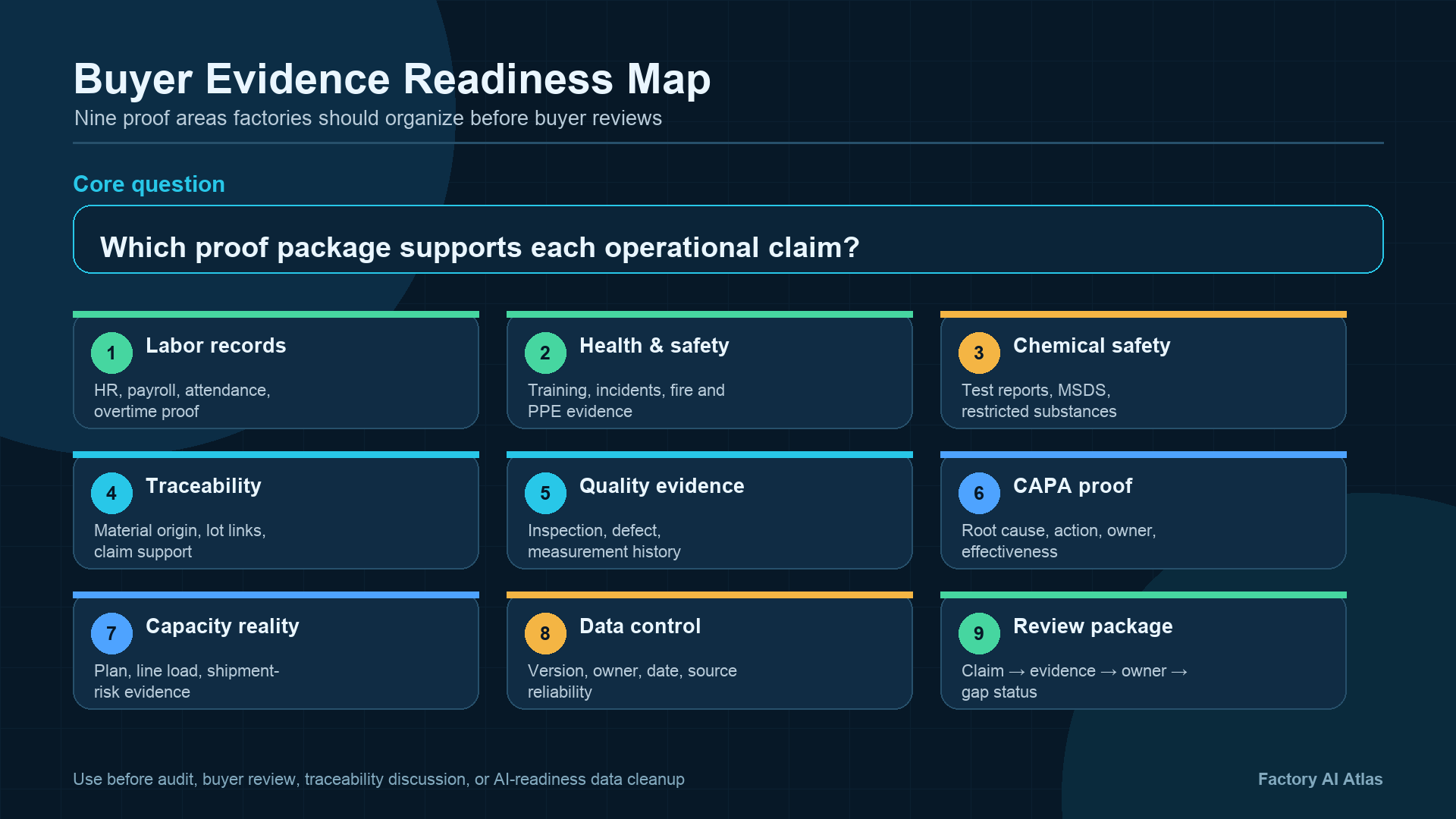
Why buyer reviews now require claim-to-proof control
Buyer requirements have become broader. Factories are no longer reviewed only on price, capacity, and quality. They are increasingly asked to show evidence across labor, safety, chemical control, product safety, traceability, ESG, QA/QC, CAPA, certificate validity, and data discipline.
This is also connected to Factory AI readiness. AI tools, dashboards, automation pilots, and traceability platforms all depend on controlled records. If the factory cannot organize evidence manually, an AI system will not magically create trustworthy evidence.
Before AI can analyze factory performance, the factory must know where its evidence comes from, who owns it, how current it is, and whether it actually supports the claim being made.
Labor proof pack: working-time reality
Labor and social compliance evidence often starts with policies, but policies alone are not enough.
A factory should be able to organize records such as employee handbooks, anti-forced-labor policies, age verification processes, contracts, attendance records, payroll records, overtime approvals, grievance logs, training records, and recruitment or labor-agency control documents.
The important point is consistency. If payroll, attendance, overtime approval, and production records do not match, the evidence becomes weaker. A factory may have the right policy, but the buyer may still ask whether the policy is actually implemented.
A signed policy is only the beginning. Implementation records make the evidence stronger. This is where buyer evidence readiness turns a policy folder into a provable operating record.
Health and safety proof pack: controls that can be shown
Health and safety evidence should show both prevention and response.
Common evidence includes fire safety inspection records, emergency exit maps, fire drill records, fire extinguisher inspection logs, electrical inspection records, machine safety inspection records, PPE issue records, training records, accident logs, near-miss logs, and corrective action records for safety findings.
For apparel factories, production-floor safety records may also include needle control procedures, broken needle logs, metal detection records where applicable, cutting room safety checks, and maintenance logs for high-risk equipment.
A clean factory photo is not enough. Buyers usually need to see that the factory has a repeatable safety control system. This is why specific operational records matter more than general statements.
Chemical and product safety proof pack: scope and validity
Chemical and product safety evidence is often misunderstood. A factory may have certificates or supplier declarations, but that does not automatically prove product safety for every order.
Factories should check whether evidence is linked to the correct material, product category, market, and buyer requirement.
Useful records may include chemical inventory, SDS or MSDS files, chemical approval process, restricted substances policy, supplier chemical declarations, fabric and trim test reports, certificate copies where applicable, care label review evidence, shrinkage reports, colorfastness reports, and physical performance test reports.
For U.S. children’s products, factories may need CPSC or CPSIA-related evidence where applicable. For EU-bound products, factories may need REACH or SVHC-related declarations where applicable. The key is not to claim compliance casually. The test report, scope, product category, certificate logic, and market requirement must match.
A certificate is weak if it is expired, outside scope, or not linked to the material being shipped. Certificate validity should be part of the factory’s evidence system, not a last-minute document search.
Traceability proof pack: material claim to shipment link
Traceability is one of the areas where evidence often breaks.
A factory may know its supplier. But buyer evidence may require more than a supplier name. Traceability evidence may include supplier lists, material origin records, purchase orders, invoices, lot or batch tracking, fabric roll records, cutting lot records, sewing bundle records, packing records, carton records, scope certificates, transaction certificates, chain-of-custody records, and product data fields needed for future digital product requirements.
The weak point is often the connection between stages. Fabric roll data may not connect cleanly to cutting lot data. Cutting lots may not connect to sewing bundles. Sewing bundles may not connect to carton packing records.
When that chain breaks, the factory may still have many records, but the evidence does not form a traceable story. A buyer evidence system should make the chain visible from material to shipment. This connects directly to Digital Product Passport readiness and future product-data discipline.
Quality proof pack: QC, defect, and CAPA evidence
Quality evidence is not only inspection reports. Factories should also be able to explain what the results mean, what changed after a problem, and whether the corrective action worked.
Useful evidence includes incoming material inspection records, inline inspection records, final inspection records, AQL plans and results where applicable, defect classification lists, DHU or defect-rate trends, rework records, customer complaint records, nonconformance reports, root-cause analysis, corrective action plans, preventive action records, verification of effectiveness, before-and-after evidence, owners, and due dates.
CAPA is weak when it only says “trained workers again.” Strong CAPA shows root cause, system change, and verification.
For example, if a repeated defect happens because of unclear method, wrong attachment setup, poor bundle handling, or weak inline feedback, the evidence should show what changed in the process — not only that workers were reminded.
This also affects AI visual inspection readiness. An AI QC system still needs defect taxonomy, ground truth, inspector baseline, false-accept review, false-reject review, and a CAPA process that humans can trust.
Environmental proof pack: measurable factory records
Environmental and ESG evidence becomes stronger when it is connected to actual operations.
Useful records may include energy use records, water use records, waste records, wastewater records where applicable, chemical disposal records, emissions or boiler fuel records where applicable, environmental permits where applicable, and platform-related evidence such as Higg FEM, Cascale, ZDHC, SLCP, Sedex, or amfori records where applicable.
The key is not just having monthly files. The factory should be able to connect evidence to production volume, process type, and trend. Energy data becomes more useful when it can be compared with output, operating hours, process changes, or improvement actions.
Certificate proof pack: version, expiry, and scope control
Certificates are often treated as static documents. They should be treated as controlled evidence.
For every certificate, a factory should verify the certificate holder name, facility address, product or material scope, certificate number, issuing body, issue date, expiry date, transaction certificate link where applicable, and whether the buyer accepts the certificate for the specific requirement.
This matters because a certificate may exist but still not support the buyer’s question. The scope may be wrong. The facility address may not match. The expiry date may be close. The material may not be covered. The transaction certificate may be missing.
A certificate folder is not enough. A certificate tracker is stronger. Buyer evidence readiness improves when certificate ownership, expiry dates, scope, and order linkage are visible before the buyer asks.
Buyer-review workflow: map proof before the meeting
A practical factory should not keep evidence only by department. It should also create buyer-specific evidence folders.
A simple structure could include public standards and policies, labor and social evidence, health and safety evidence, chemical and product safety, traceability and material claims, QA/QC and CAPA, certificates, and open gaps.
This structure helps the factory see what is ready, what is partial, and what is missing before the buyer conversation begins.
However, factories should be careful with wording. Do not say “buyer approved,” “audit pass guaranteed,” “certified” unless the certificate is valid and in scope, or “compliant” without market and category-specific verification.
Safer language includes “evidence-ready for public buyer standard categories,” “aligned with public supplier requirement categories,” “requires buyer-specific confirmation,” and “requires certificate or test report validation.”
Evidence scorecard: claim-to-proof readiness
Factories can use a simple internal score:
- Ready = 2 points
- Partial = 1 point
- Missing = 0 points
- Not applicable = excluded from the denominator
A practical interpretation is:
- 80–100%: evidence pack is organized, but buyer-specific gap review is still needed.
- 60–79%: usable base, but several gaps remain before buyer conversation.
- 40–59%: high risk; organize evidence before external review.
- Below 40%: not buyer-ready; start with document ownership and evidence locations.
This is not a buyer approval probability. It is only an internal preparation score. The goal is to find weak evidence before the buyer finds it.
Why evidence control is also Factory AI readiness
Buyer evidence readiness is not separate from Factory AI readiness. The same evidence discipline supports AI projects.
If a factory cannot define the owner, source, update cycle, and meaning of each evidence record, then AI tools will struggle with the same problem.
A dashboard may show numbers, but it will not know whether those numbers are trusted. An AI quality tool may classify defects, but it still needs a defect taxonomy, ground truth, inspector baseline, and CAPA process. A traceability platform may store records, but it cannot repair a broken roll-to-carton evidence chain by itself.
Factory AI starts with evidence discipline.
Source backbone for buyer evidence control
This article is aligned with public-source categories commonly used in apparel and manufacturing evidence systems, including labor and social frameworks from ILO and Better Work, traceability and product-data discussions from UNECE garment and footwear traceability materials, product identification and data standards from GS1 standards, AI risk thinking from the NIST AI Risk Management Framework, and quality-system thinking from ASQ quality resources.
Factories should always verify buyer-specific requirements, market-specific product rules, certificate scope, and current official guidance before making compliance claims.
What these sources support—and what they cannot confirm
ILO and Better Work resources provide useful public context for labor, safety, factory improvement, and remediation evidence in apparel supply chains. They help identify evidence categories and operating questions. They do not define every buyer’s acceptance rule or prove that a specific factory record is current, complete, or in scope.
- Better Work reports and publications — context for factory improvement, compliance evidence, and remediation follow-up.
- ILO textiles, apparel, leather and footwear resources — sector context for labor and safety evidence.
The NIST AI Risk Management Framework cited above can help structure risk and evidence questions for AI-enabled systems. It is not a buyer-compliance standard. Final requirements still depend on the buyer, market, product, facility, certificate scope, and current official guidance.
Buyer-evidence takeaway for factory leaders
Buyer evidence readiness is not about creating more paperwork. It is about making factory claims provable.
A factory should be able to answer: what claim are we making, what evidence supports it, who owns the evidence, is it current, is it linked to the right facility, product, material, order, or process, what is missing, and what should be improved before a buyer review?
Factories that can answer these questions are better prepared for buyer conversations, audits, traceability requests, compliance reviews, and AI-enabled improvement projects.
The strongest factories do not simply collect documents. They build evidence systems. In that sense, buyer evidence readiness is a practical bridge between compliance preparation, buyer trust, traceability discipline, and Factory AI readiness.
Next step: Use this article as a starting point for a Buyer Evidence Readiness Checklist. Review labor, safety, chemical, product safety, traceability, QA/QC, CAPA, ESG, and certificate evidence before buyer reviews or compliance conversations.