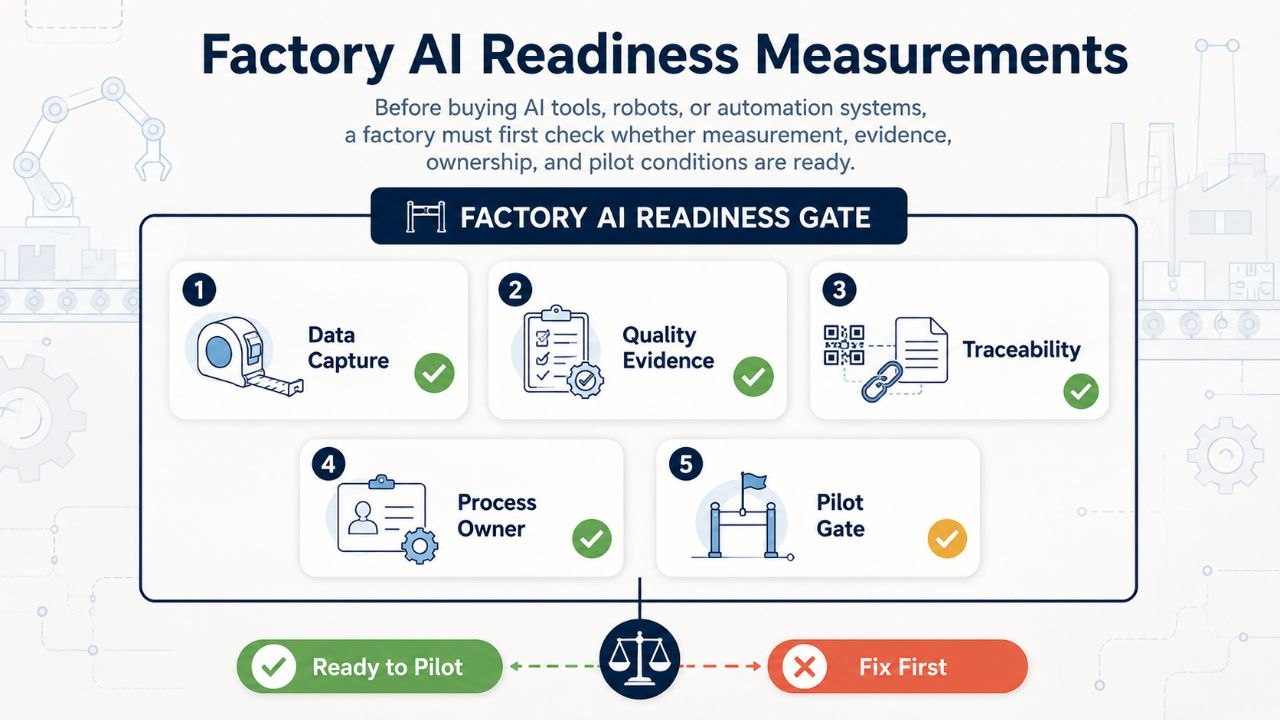
Measurement-readiness control note
Factory AI readiness measurements are not a data-collection exercise by themselves. The factory should measure distance, WIP, walking, rework loops, table dimensions, and layout changes only when those measurements will change a real automation or layout decision.
The useful measurement is the one that can be repeated with the same definition and then tied to layout, handling, staffing, quality, safety, or fatigue. Otherwise the numbers become a slide-deck baseline rather than operating evidence.
Measurements are collected once and never tied to a factory decision
The common mistake is to collect measurements once for a presentation and then never connect them to pilot approval, line redesign, operator motion, or material-flow control. Static numbers do not create readiness unless they become a repeatable operating signal.
Checks before using measurement data for automation
- Which measurement will change the layout, handling method, staffing plan, or automation scope?
- Can the factory repeat the same measurement next week using the same definition?
- Are measurement changes linked to output, quality, safety, and operator fatigue rather than treated as isolated geometry?
Proof requests for measurement and layout tools
- Show how measurement data becomes a before/after decision record.
- Explain how the system handles layout changes, temporary buffers, and manual exceptions.
- Provide one pilot example where measurement changed the automation recommendation.
Repeatable-measurement pilot gate
GO if measurement improves a specific factory decision. HOLD if the data is useful but not yet repeatable. REDESIGN if the project collects numbers without a decision owner.
A factory does not become ready for AI because it buys a dashboard, a robot, or a new software platform.
It becomes ready when the physical reality of the factory can be measured, recorded, compared, and improved.
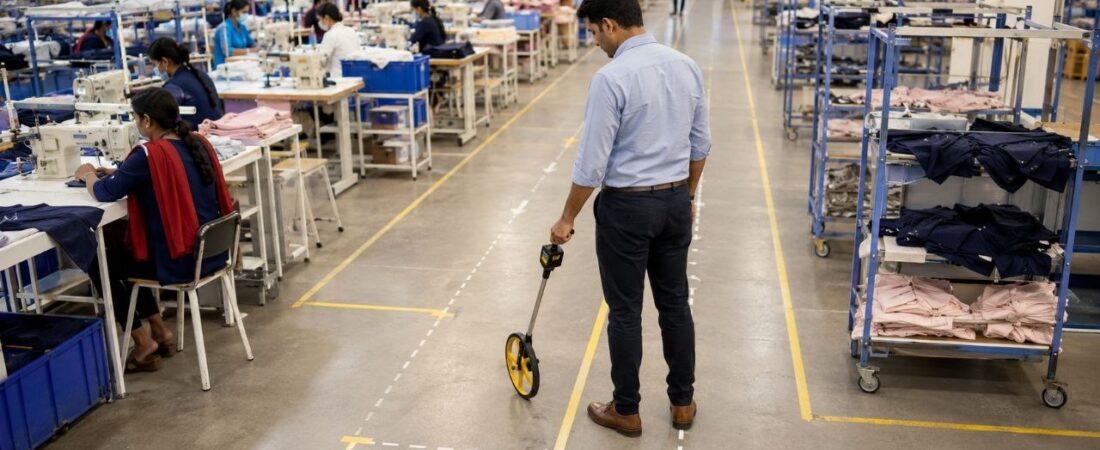
This is why some of the most important factory AI readiness measurements start far away from algorithms. They start on the floor: measuring walking distances, line lengths, WIP locations, table spacing, aisle width, and material movement.
A compact digital measuring wheel or pocket digital ruler will not make a factory smart by itself. But it can reveal a problem many automation projects ignore:
The factory does not measure enough of its own reality.
Before a factory can automate movement, predict bottlenecks, calculate robot ROI, or ask AI to recommend layout changes, it needs factory AI readiness measurements that are consistent enough to trust.
These factory AI readiness measurements give teams a practical baseline before any serious automation or Factory AI project.
These factory AI readiness measurements also give managers a shared language for discussing automation risk with production, IE, maintenance, quality, and finance teams.
1. Material Travel Distance
One of the most overlooked factory measurements is the distance materials travel between process steps.
In a garment factory, this may include movement from fabric warehouse to cutting room, cutting room to bundle preparation, bundle preparation to sewing line, sewing line to inline QC, QC to finishing, finishing to packing, and packing to carton staging.
In many factories, these distances are not measured. They are estimated. That is a problem.
If a factory does not know how far materials move today, it cannot calculate whether automation, carts, conveyors, AGVs, AMRs, or layout changes will actually reduce waste. A robot does not fix a poor flow map. It only moves inside the flow the factory gives it.
Without factory AI readiness measurements, automation ROI is usually based on layout assumptions instead of floor evidence.
Factory AI readiness question: Can the factory measure and compare material travel distance before and after a layout or automation change?
2. Operator Walking Distance
Factory leaders often focus on machine time, but operator movement can hide a large amount of waste.
In labor-intensive manufacturing, especially garment production, workers may walk repeatedly to pick up bundles, trims, tools, samples, labels, instructions, or quality approvals.
A few extra meters per cycle may look small. But multiplied across hundreds of operators, thousands of pieces, and multiple shifts, it becomes a major productivity loss.
- distance from operator station to WIP rack
- distance from sewing machine to helper table
- distance from QC table to rework area
- distance from supervisor desk to line bottleneck points
- distance from mechanic station to key machine groups
Factory AI readiness question: Can the factory identify which operator movements are necessary, repeated, and avoidable?
3. Line Length and Station Spacing
Factory layout is one of the most practical areas where measurement discipline matters.
A sewing line, assembly cell, inspection area, or packing zone should not be evaluated only by visual impression. It should be measured.
- total line length
- distance between operators
- machine-to-machine spacing
- helper station spacing
- WIP rack location
- aisle width
- emergency passage clearance
These numbers help the factory compare layouts objectively. Without them, layout improvement discussions often become opinion-based: the line feels crowded, the operator walks too much, or the rack should be closer.
Those observations may be correct, but Factory AI needs more than opinions. It needs repeatable measurements.
Factory AI readiness question: Can layout changes be compared with before-and-after measurement data?
4. WIP Distance and Buffer Location
Work-in-progress is not just a quantity. It also has a location.
Where WIP sits inside the factory affects flow speed, line visibility, defect discovery, supervisor control, rework time, space utilization, and automation feasibility.
A factory may count WIP pieces but fail to measure WIP distance and placement.
- How far is the WIP rack from the first operation?
- How far does a bundle travel before it reaches bottleneck operations?
- Is rework WIP stored near the responsible process?
- Is excess WIP blocking movement paths?
- Are carts staged in a way that creates unnecessary walking?
These questions are not advanced AI questions. They are basic factory data questions. But without this data, any AI system trying to optimize production flow will be working with an incomplete picture.
Factory AI readiness question: Does the factory know not only how much WIP exists, but where it physically sits?
5. QC and Rework Loop Distance
Quality problems create hidden movement.
When a defect is found, the product may move from QC to rework, from rework back to QC, and sometimes back to the original operation. This loop can become expensive when it is not measured.
- distance from inline QC to rework station
- distance from end-line QC to responsible operation
- distance from finishing QC to repair area
- distance from packing inspection to rework holding area
- distance from buyer inspection area to sample room or technical office
This matters because AI quality systems, computer vision tools, and defect dashboards cannot solve quality waste if the physical rework loop is poorly designed.
Factory AI readiness question: Can the factory measure the physical cost of quality problems, not only the defect percentage?
6. Table, Rack, and Machine Dimensions
Automation planning often fails when basic physical dimensions are missing or inconsistent.
Before evaluating new equipment, robotics, or digital layout tools, the factory should know the dimensions of its core physical assets.
- cutting table length and width
- spreading table clearance
- sewing table height
- inspection table size
- WIP rack footprint
- trolley dimensions
- carton staging area size
- machine spacing and aisle width
A factory may want a robot, but the robot may require space, clearance, repeatable positioning, or stable object placement. If the factory does not know its current dimensions, the automation discussion starts with assumptions.
Factory AI readiness question: Can the factory provide accurate physical dimensions before discussing automation equipment?
7. Baseline Change Measurements
The most important measurement is not a single number. It is the ability to compare before and after.
- What was the distance before the change?
- What is the distance after the change?
- What movement was removed?
- What process step became shorter?
- What new bottleneck appeared?
- Did the improvement reduce walking, waiting, rework, or handling?
This is where small digital measurement tools can be useful. A compact digital measuring wheel or electronic ruler is not a replacement for calibrated industrial measurement systems. But it can reduce friction for quick layout checks, kaizen walks, improvement discussions, and baseline collection.
The tool is not the point. The habit is the point.
A factory that regularly measures its own physical reality is more prepared for AI than a factory that only talks about AI.
Where Low-Cost Digital Measurement Tools Help
Low-cost digital measuring tools can be useful for quick layout checks, internal kaizen discussions, walking-distance estimation, workstation spacing checks, factory flow mapping, and before-and-after comparison.
However, they should not be treated as a replacement for calibrated industrial measurement systems where formal accuracy, compliance, buyer requirements, safety, or engineering validation are required.
For factory AI readiness, the best use of these tools is not official certification. It is building measurement discipline.
A factory that captures rough but consistent baseline data is often in a better position than a factory that waits for a perfect system and measures nothing.
The Real Lesson: Small Data Before Big AI
Many factories want to jump directly to AI dashboards, robot pilots, computer vision, or predictive analytics. But AI depends on the quality of the data it receives.
In factories, some of the most important data is physical: how far people walk, how far materials move, where WIP waits, how long rework loops are, how much space machines require, and how layout changes affect flow.
These are not abstract software questions. They are factory-floor questions.
Before asking AI to optimize the factory, the factory must first measure itself.
Factory AI does not start with a robot. It starts with a reliable baseline.
Practical Checklist: Factory AI Readiness Measurements Before Automation
- Material travel distance between process steps
- Operator walking distance during repeated tasks
- Line length and station spacing
- WIP rack distance and buffer location
- QC-to-rework loop distance
- Table, rack, machine, and aisle dimensions
- Before-and-after measurements for layout changes
If these numbers are missing, the factory may not be ready to evaluate automation ROI. It may first need a measurement discipline project.
That project can start with simple tools, a floor map, a checklist, and a consistent habit: measure the factory before trying to automate it.
Related Factory AI Atlas Guides
- Factory AI Readiness Scorecard
- Sewing Line Layout: 7 Essential Ways to Improve Garment Factory Flow
- Robot Automation ROI Checklist
- Factory Data Readiness: 5 Data Types to Organize Before AI
- The Garment Factory Automation Stack
Measurement-discipline source notes
The purpose is not to create paperwork. The purpose is to make factory AI readiness measurements visible enough that teams can compare today’s floor with tomorrow’s proposed automation layout.
For teams building a more disciplined improvement system, two useful external references are the Lean Enterprise Institute explanation of gemba and Lean Enterprise Institute explanation of kaizen for connecting observation with continuous improvement. Factory AI readiness measurements become more useful when floor observation, production data, and management systems are connected instead of treated as separate projects.
Factory AI readiness measurement FAQ
What is factory AI readiness?
Factory AI readiness is the ability of a factory to provide reliable process, layout, quality, production, and operational data before using AI tools or automation systems.
Why are physical measurements important before automation?
Physical measurements reveal how people, materials, machines, and WIP actually move inside the factory. Without this baseline, automation ROI calculations are based on assumptions.
Can a digital measuring tool improve factory automation readiness?
A digital measuring tool cannot automate a factory by itself, but it can help teams capture faster and more consistent layout and movement data for improvement discussions.
What should garment factories measure before automation?
Garment factories should measure material travel distance, sewing line layout, WIP rack locations, operator walking distance, QC rework loops, machine spacing, and cutting-to-sewing flow.
Are consumer-grade digital rulers accurate enough for factory use?
They may be useful for quick layout checks and internal improvement discussions, but formal compliance, engineering, safety, or buyer-required measurements should use calibrated industrial tools.
Factory measurement validation anchors
- NIST manufacturing resources — useful for treating measurement as part of manufacturing-system improvement rather than one-time observation.
- OSHA ergonomics resources — relevant when distance, motion, and layout measurements affect operator workload and risk.