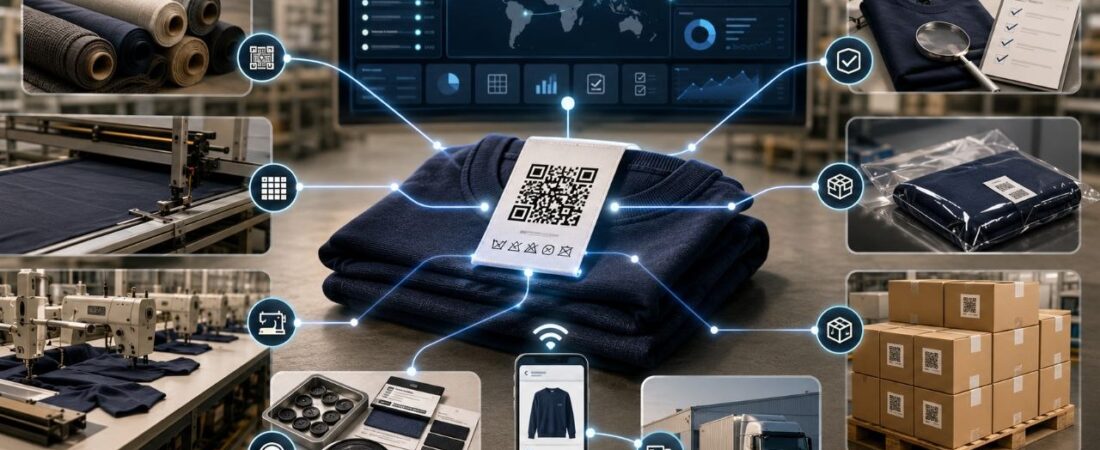
Label-traceability evidence note
Garment label traceability should be judged by whether a QR label can reopen the real factory history behind the product. If the label only opens a static page, it may be useful for communication, but it is not yet a traceability system.
QR labels are treated as the traceability system
The common mistake is to treat the QR label as the transformation. In practice, the label is only the last visible point. The value comes from the hidden discipline behind it: lot control, bundle movement, QC disposition, packing identity, and correction history.
Checks before funding label traceability
- Can one scanned label connect to material, cutting, sewing, QC, packing, and shipment evidence?
- Can the factory handle rework, bundle split, repair, carton change, and replacement-label cases?
- Who approves the data before it becomes buyer-facing?
Proof requests for label-traceability vendors
- Show a live scan from a real label to order-level and production-level evidence.
- Explain the data model behind the label, not only the mobile page design.
- Export the traceability record in a buyer-usable format.
Traceability-evidence gate
GO if the QR label reveals a controlled evidence chain. HOLD if it depends on manual file chasing. REDESIGN if the label is a marketing layer disconnected from factory records.
Garment label traceability often begins before a platform, dashboard, or buyer portal. On the factory floor, it often begins with something much smaller: the garment label.
The traceability check should follow the label backward into real operations: who created the data, when it changed, which lot or bundle it belongs to, and what evidence the factory can show when a buyer asks.
A label is easy to underestimate. It is small, low-cost compared with fabric and labor, and often appears near the end of the production process. But a label carries information that connects the product to the factory’s operating system: size, care, fiber content, origin, style identity, batch reference, placement, and sometimes special handling instructions.
If that information is wrong, late, unreadable, or not linked to the correct style, size, color, and carton, the factory does not have a traceability problem only at the end. It has a data-control problem upstream. This is why garment label traceability is a practical readiness check before larger MES, DPP, or apparel AI data-layer pilots.
Why garment label traceability matters before AI
Factory AI depends on trustworthy operational data. MES, digital product passport evidence gates, QC dashboards, and AI inspection tools all become weaker if the factory cannot control basic product information.
Garment labels are a useful readiness test because they touch several departments:
- merchandising and tech pack confirmation;
- BOM and trim card control;
- sample approval and PP/TOP review;
- sewing attachment and Inline QC;
- Final QC and packing;
- carton, PO, and shipment documentation;
- returns, claims, and customer-care evidence.
When label control fails, the issue may look small at first. A wrong size label may pass through sewing. A missing care label may be found only after packing. A label version may change after bulk production starts, but the old version remains in the line or trim store. These are not advanced AI problems. They are basic evidence-chain problems.
The factory-floor traceability loop
A practical apparel factory can treat label control as a small traceability loop:
- Tech pack and BOM lock — confirm label wording, size set, care/origin/fiber content, placement, approved supplier, and revision version.
- Trim card control — keep the physical approved label and the digital record aligned.
- Pre-production check — compare PP Sample or TOP label against the approved data before bulk risk multiplies.
- Inline QC check — verify position, readability, attachment, comfort, and size/style matching during sewing.
- Final QC check — confirm content accuracy, attachment strength, alignment, and consistency by size/color.
- Packing linkage — connect label version and size/color records to carton, PO/style, and shipment logs.
This garment label traceability loop does not require a large system on day one. It requires ownership, version discipline, and evidence records.
Factory Lens
If a factory cannot answer which label version was used for which style, size, color, lot, and carton, it is not ready to claim advanced traceability. Start with the label control loop before buying a bigger AI or MES story.
Real factory example: QR labels as production history links
In some apparel factories, garment labels already work as more than printed information. A QR code or serial reference on the label can connect the product to MES or a factory traceability system.
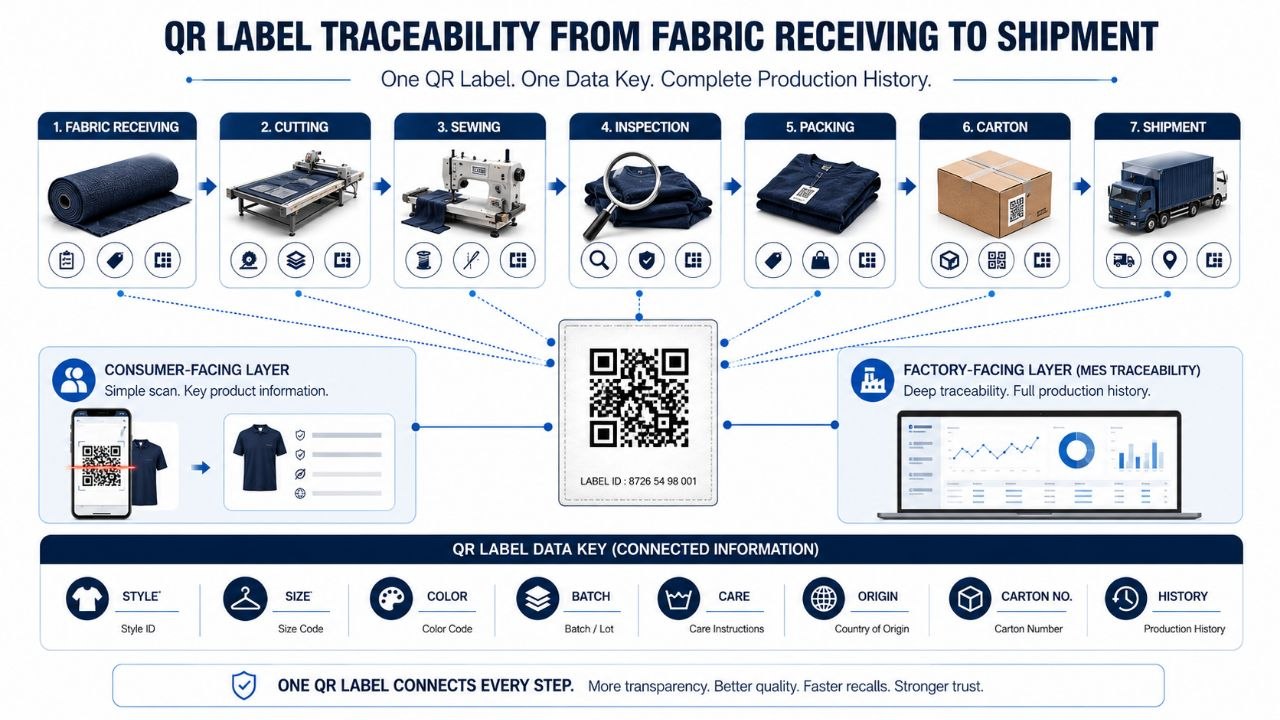
In a practical setup, the QR or label number may be linked to production history from fabric receiving to cutting, sewing, inspection, packing, and shipment. A consumer may scan the QR code and see product-facing information, while the factory or authorized production owner can use the related number to trace internal production history.
This does not mean every consumer should see every factory record. The public-facing layer and the factory-facing layer should be different. The consumer may only need product identity, care information, authenticity, or limited traceability details. The factory may need the deeper evidence chain: fabric lot, cutting lot, bundle movement, sewing line, inspection results, packing record, carton number, shipment reference, and exception history.
This is where garment label traceability becomes valuable for Factory AI readiness. The label is not only a communication item for the buyer or consumer. It can become the physical key that connects product identity to factory process evidence.
A useful QR/MES traceability model separates three layers:
- Consumer-facing scan — product identity, care, origin, authenticity, or limited sustainability information.
- Factory-facing traceability record — fabric receiving, cutting, sewing, QC, packing, carton, and shipment history.
- AI/MES readiness layer — structured events, timestamps, owners, exception records, and evidence links that can later support analytics, claims review, DPP-style reporting, or AI pilots.
The risk is that factories may print QR labels before the process data behind them is reliable. A QR code does not create traceability by itself. It only exposes whether the factory has a controlled data chain behind the product.
If the QR number can connect the garment to fabric lot, cutting batch, sewing line, QC result, packing record, and carton shipment, it becomes a serious garment label traceability control point. If it only opens a marketing page, the label is not yet a Factory AI readiness signal.
What this means for Factory AI readiness
The lesson is not that labels are more important than fabric, sewing quality, or measurement. The lesson is that small control points reveal the factory’s real data maturity.
A factory that controls label data well usually has stronger habits in other areas too:
- clearer BOM ownership;
- better revision control;
- stronger QC evidence discipline;
- faster mismatch escalation;
- more reliable packing records;
- cleaner communication between merchandising, production, QC, and warehouse.
Those habits are the foundation for AI. Without them, AI tools can only process inconsistent data faster.
Traceability gate: GO / HOLD / REDESIGN
GO
Proceed with a digital traceability or AI-readiness pilot when:
- label master data is locked before bulk production;
- label inspection is included in Inline and Final QC;
- label version, size/color, PO/style, and carton records can be traced;
- QC has a clear HOLD trigger for label mismatches;
- changes after approval create a documented owner/date/evidence record.
HOLD
Pause the pilot and fix the control loop when:
- label approval exists only in chat messages or email attachments;
- care/origin/fiber changes are not connected to BOM revision control;
- packing can identify current labels but not older lots;
- replacement labels are issued without a controlled record;
- supervisors rely on memory instead of a visible approved sample.
REDESIGN
Do not start an AI traceability pilot yet when:
- labels are treated as decorative trims with no clear process owner;
- QC checks seams and measurements but not label content accuracy;
- different teams use different label versions;
- the factory cannot link label issues to PO/style/carton records;
- the proposed system promises traceability before the basic evidence chain exists.
Vendor-neutral caution
This is not a recommendation to buy a traceability platform first. Vendor systems can help, but only after the factory defines the control points, owners, records, and escalation rules.
For many apparel factories, the first step is simpler: turn label control into a visible operating routine. Once that routine is stable, digital tools have something real to capture.
Final label-traceability takeaway
Garment labels are not just trims. They are a small but revealing test of Factory AI readiness.
If the factory can control label data, version changes, QC checks, and carton linkage, it is building the discipline that larger AI systems require. If it cannot, the next improvement is not a bigger platform. It is a better evidence chain.
Factory AI starts with the boring records that prove the floor is under control.
Source notes for label-traceability decisions
- Online Clothing Study: Why Garment Labels Are Becoming a Key Part of Apparel Traceability
- Online Clothing Study: Garment Labels: What They Are, Types, and Why They Matter
External validation anchors for label traceability
- GS1 Europe Digital Product Passport resources — useful for treating product identity as structured data, not only a printed code.
- GS1 Digital Link standard — a reference point for connecting product identifiers to web-based information.