
EPR evidence decision note
Textile EPR and circularity should be treated as an evidence-control problem, not a sustainability slogan. A factory is useful to buyers when it can connect product data, material proof, waste records, supplier declarations, and claim approvals into one defensible chain.
Certificates collected late become audit risk
The common mistake is to collect certificates only when a buyer asks. That creates a document chase. It does not create a factory system that can survive style changes, supplier substitutions, recycled-content claims, or post-shipment questions.
Checks before funding circularity data work
- Can the factory trace fiber composition, recycled material proof, trims, waste route, and claim approval by style or order?
- Are supplier declarations checked for version, expiry, and scope?
- Does the factory know which circularity claims are approved, restricted, or not yet supported by evidence?
Vendor proof for style-level evidence
- Show how material and trim evidence is linked to BOM, purchase order, production lot, and finished product identity.
- Explain how the system handles missing certificates, expired declarations, supplier changes, and rejected claims.
- Export an evidence file a buyer or auditor could actually review without logging into a custom dashboard.
Circularity evidence gate
GO if one live style can produce a complete evidence chain. HOLD if evidence exists but is scattered by department. REDESIGN if circularity data is created after shipment instead of during production preparation.
Why textile EPR is becoming a factory evidence problem
Textile EPR evidence should connect the product BOM, fiber composition, supplier declaration, recycled material proof, waste route, and buyer-facing claim. Without that connection, circularity evidence becomes a document chase instead of a factory control system.
Textile EPR is changing apparel sustainability from a marketing claim into a factory evidence challenge. For apparel factories, circularity now requires clean product data, material proof, waste records, supplier declarations, and claim approval discipline.
Across Europe and nearby markets, textile policy is moving toward extended producer responsibility, circular design, textile waste reduction, and more structured product data. The legal obligation may sit with brands or importers, but the evidence burden often moves back to the factory.
For apparel factories, the message is simple: circularity is becoming a factory data requirement. Factories that cannot organize material, trim, waste, durability, and claim evidence will struggle to support buyers under the next generation of textile rules.
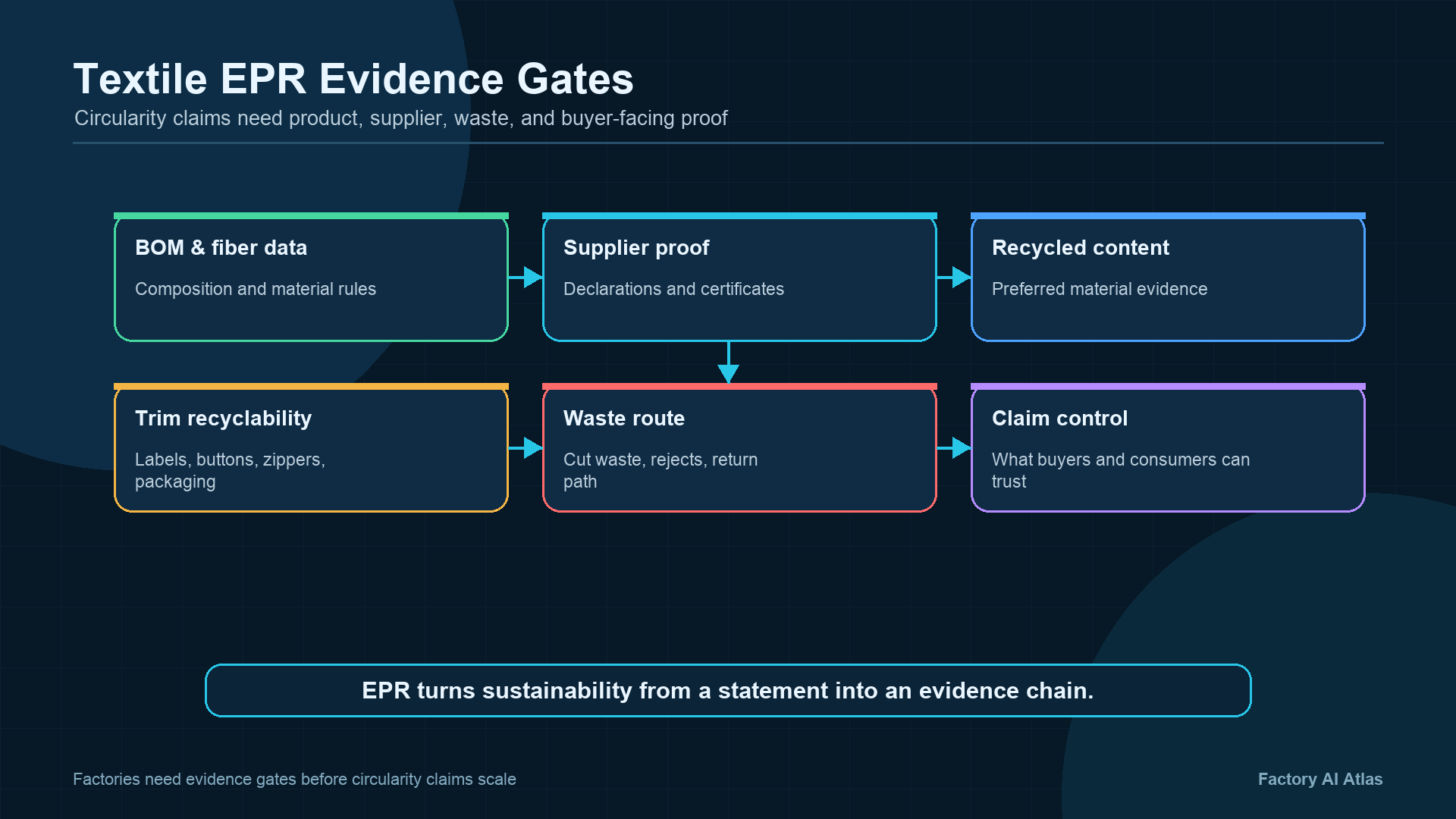
Textile EPR shifts sustainable products into evidence-ready products
The old conversation focused on broad claims such as sustainable, recycled, responsible, circular, or conscious. The new conversation is more specific: what is the product made of, which part is recycled, can the product be repaired or recycled, and which document proves the claim?
This is where many factories are weak. The issue is not always lack of compliance. The issue is that evidence is scattered across BOM files, supplier emails, test reports, certificates, chat messages, and Excel sheets. That is not audit-ready, and it is not AI-ready.
Factories should treat textile EPR as an evidence system, not only as a European regulation. A practical question is: if a buyer asks for the circularity profile of one style, can the factory answer within 24 hours?
Evidence Gate 1: fiber composition data
The first gate is basic, but often poorly controlled. Factories must be able to confirm the actual fiber composition of the product, not only what appears in the original buyer tech pack.
This includes shell fabric, lining, rib, pocketing, interlining, padding, embroidery, and major trims where relevant. A clean material ledger should connect the BOM item, supplier, material description, fiber composition, lot reference, declaration, and test report if available.
Fiber composition is the foundation of circularity data. Without it, every later claim becomes fragile.
Evidence Gate 2: recycled or preferred material proof
Many products now use recycled polyester, organic cotton, or other preferred materials. A factory should not keep certificates as loose attachments. It should connect them to the exact order, material lot, and product claim.
A weak system says, “We have the certificate somewhere.” A strong system says, “This PO used this fabric lot from this supplier, linked to this scope certificate, transaction certificate, or supplier declaration.”
The minimum chain should include buyer style number, PO number, supplier, material lot, certificate or declaration, received quantity, used quantity, and balance or waste record.
Evidence Gate 3: trim and accessory recyclability check
Circularity is not only about the shell fabric. A garment may look recyclable on paper, but trims can create problems: mixed-material labels, metal eyelets, plastic stoppers, coated zipper tapes, bonded decorations, or difficult-to-remove embellishments.
Factories should create a trim circularity check during BOM review. The question is not only whether the trim is approved. The better question is whether this trim makes the product harder to recycle, repair, or disassemble.
This gate forces merchandisers, sourcing teams, technical teams, and sustainability teams to review the product together.
Evidence Gate 4: care label and durability evidence
Care label accuracy is becoming more important because durability is part of circularity. A product that fails after several washes cannot be called circular simply because it uses a preferred material.
Factories should connect care label decisions to shrinkage data, colorfastness results, print or embellishment durability, buyer wash requirements, sample wash comments, and final approved care instructions.
A care label is not just a label. It is a durability evidence point.
Evidence Gate 5: waste and offcut tracking
Textile waste is one of the central issues behind EPR and circularity policy. Factories do not need a perfect sustainability report on day one, but they should begin tracking waste in categories that buyers can understand.
At minimum, factories should separate cutting waste, rejected fabric, leftover rolls, sample room waste, rework scrap, packaging waste, and disposal or recycling route.
The goal is to move from vague statements such as “we reduce waste” to measurable statements such as “this product category creates cutting offcuts, leftover fabric rolls, and rejected panels, tracked by order and disposal route.”
Evidence Gate 6: supplier declaration file
Most circularity evidence starts upstream. Factories need a standard supplier declaration process for fiber composition, recycled content, chemical compliance, country of origin if required, restricted substances, packaging material, and finishing process information.
The mistake is to request this only when the buyer asks. A better factory builds the declaration request into sourcing and material approval before the order becomes urgent.
This creates an evidence file early, not a document chase at the end of production.
Evidence Gate 7: claim approval record
Environmental claims are becoming more sensitive. Words such as recycled, sustainable, eco, organic, low impact, and circular require evidence. Factories may not write the final marketing claim, but they often provide the supporting documents.
A claim approval record should answer: what claim is being supported, which material or process supports it, which document proves it, who checked it, whether the evidence applies to this specific order, and whether the buyer approved the claim.
This gate is especially important when claims appear on product pages, hangtags, packaging, or buyer sustainability reports.
Factory AI angle: textile EPR data must become machine-readable
Most factories still manage compliance as document storage. But the next stage requires structured data. AI cannot reliably help if a factory only has random PDFs, scattered supplier emails, inconsistent BOM names, unclear file versions, and unlinked certificates.
A factory that wants to become AI-ready should structure circularity evidence around product, PO, BOM item, supplier, material lot, certificate, test result, claim, and waste category.
This is the difference between a document archive and an evidence system. If your team is still building the basics, the Factory AI Readiness Checklist is a useful starting point.
Final textile-EPR evidence takeaway
Textile EPR and circularity regulation will not affect every factory in the same way, but the direction is clear. Factories will be asked to provide more product-level evidence, faster and more accurately.
The winning factory will not simply say, “we are sustainable.” It will show what the product is made of, where the material evidence is, how the claim is supported, what waste is generated, and how the product fits into a circular system.
In the next phase of apparel manufacturing, compliance will not be only a file. It will be a data layer. The factories that build that layer early will be easier for brands, auditors, and AI systems to work with.
Textile-EPR source notes
This article is based on public source lanes reviewed for Factory AI Atlas, including WRAP UK Textiles Pact, Netherlands textile EPR guidance, Stichting UPV Textiel, Close The Loop circular fashion guide. Legal, standard, audit, and certification materials should be treated as reference-only and converted into factory question gates, not copied as operating rules.
Factory AI Atlas circularity-evidence takeaway
Start with one product category. Build a simple circularity evidence gate covering BOM, material proof, trims, care label, waste, supplier declarations, and claim approval. If your team needs a broader starting point, use the Factory AI Readiness Checklist and the Factory AI semantic maps approach to structure the evidence layer.