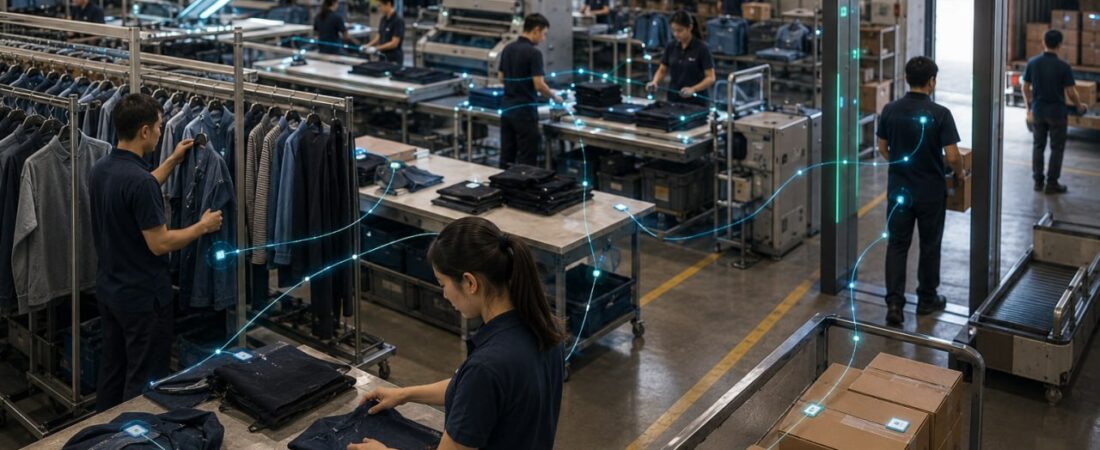
RFID becomes useful when it closes an exception loop
A tag read is only a signal. Factory value appears when the signal helps the team find a garment or bundle, understand what changed, assign the next action, and confirm that the flow recovered.
Choose the right level: roll, bundle, garment, carton, trolley, or location.
Record entry, exit, wait, rework, inspection, packing, or shipment—not a scan with no process meaning.
Define who handles a missed read, duplicate ID, split bundle, failed inspection, repair, or carton change.
Confirm that the item returned to the correct flow and that the status used by production and shipment teams now matches reality.
What to measure in a limited pilot
- Read coverage: successful reads by checkpoint and real product condition.
- Exception time: how long the team takes to detect, assign, and close a problem.
- Status agreement: whether the system, floor, and packing or shipment record show the same state.
- Operator burden: extra scans, manual corrections, and workarounds needed per shift.
Boundary: RFID can improve identity and event capture. It does not prove that a factory has clean master data, stable processes, reliable decisions, or a positive return on investment.
What a smart laundry factory reveals about apparel finishing automation, traceability, and factory AI readiness.
The stronger starting point is identity discipline: the factory must know which object is moving, where it is, which process status it carries, and what exception changed its history before automation can make reliable decisions.
AI factories often sound like they should begin with robots, automated sewing lines, or lights-out production. In apparel manufacturing, the more practical starting point is usually less dramatic: the ability to identify each garment, track its movement, and connect that movement to quality, timing, and operational history.
A recent smart laundry factory case is useful because it shows how product-level visibility changes a physical operation. The lesson is not only about laundry. It applies to apparel manufacturing factories that handle washing, pressing, inspection, packing, shipment staging, and rework every day.
The smart laundry story is not just about laundry
Laundry may sound like a service business, but operationally it shares many problems with apparel finishing. Each item has to be received, identified, sorted, processed, inspected, finished, packed, and returned or dispatched correctly.
That sounds familiar to anyone who has managed washing, denim finishing, pressing, inspection, alteration, rework, packing, carton matching, or shipment staging. In many factories, these areas still depend heavily on manual coordination: operators know what is happening because they can see it, remember it, or ask someone.
The problem is that this knowledge often disappears once the supervisor leaves the area. The process exists physically, but not digitally. This is where smart laundry becomes a useful reference point: once every garment has a digital identity, the factory can begin to manage flow differently.
Why AI factories start when products become visible
For most garment factories, the practical starting point is not full automation. It is making product flow visible, traceable, and measurable so the factory can understand what is actually happening on the floor.
Before AI factories can optimize operations, they need reliable answers to basic questions: where is this garment now, which process has it completed, how long did it wait, was it reworked, who handled it, which machine processed it, and what quality issue was found? Without this visibility, AI has very little operational reality to learn from.
RFID, QR codes, barcodes, and other identification systems are not just tracking tools. They are the foundation for turning garments into data objects inside the factory. That is why AI factories may start with RFID, not robots.
Why finishing may automate before sewing
In apparel manufacturing, sewing is often seen as the core production process. It is also one of the hardest areas to automate fully because flexible materials, handling methods, operator skill, construction complexity, and style variation all change the work.
Finishing can be a more practical starting point. Washing, drying, pressing, curing, inspection routing, folding, packing, labeling, sorting, and dispatch preparation are often easier to map, tag, measure, and improve before a factory attempts more complex automation.
These operations happen after sewing, but they strongly affect delivery performance, quality consistency, and buyer experience. They are also where bottlenecks, rework, missing items, mixed lots, and last-minute confusion can quietly damage factory performance.
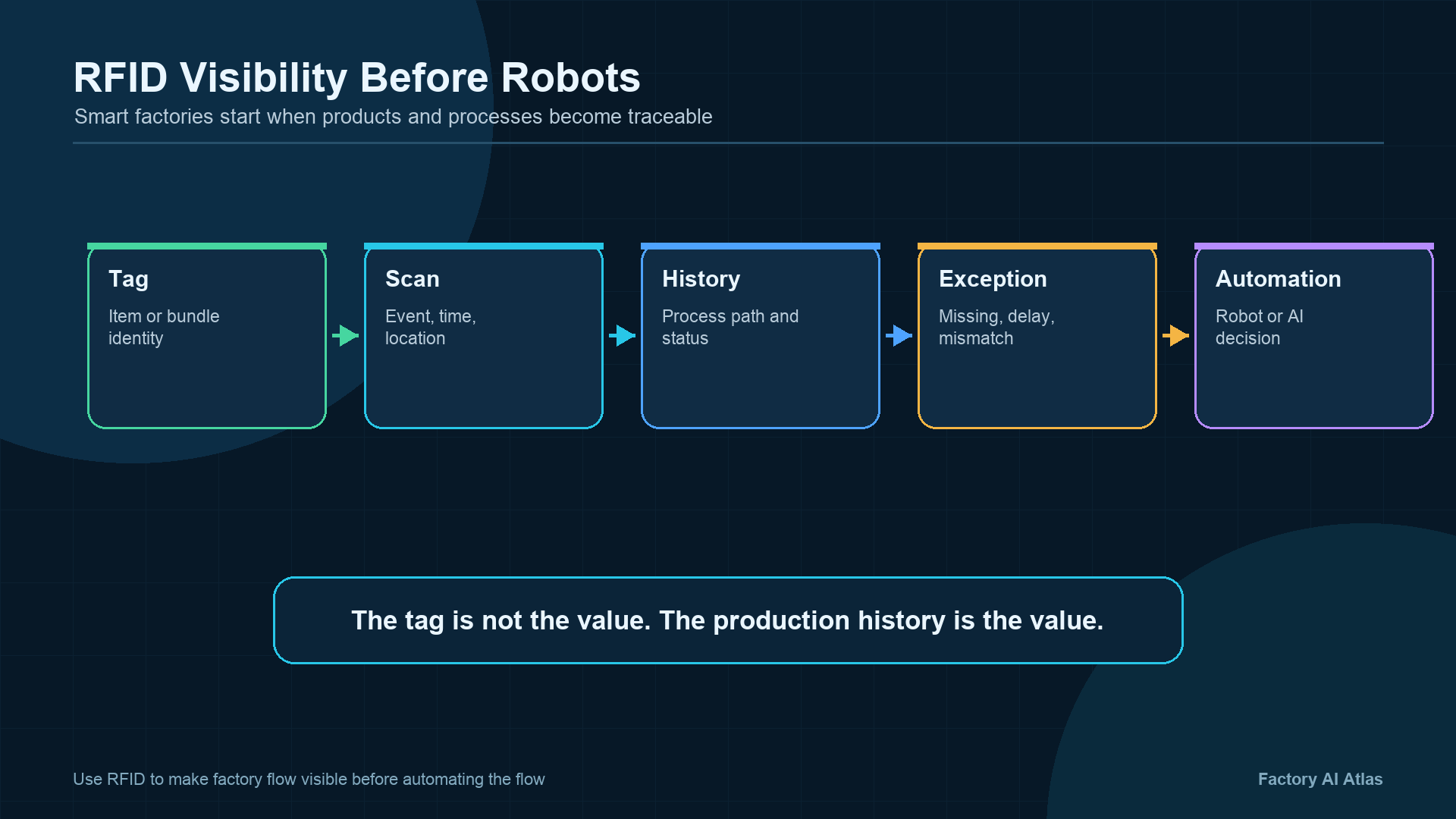
The real value is not the tag. It is the history.
RFID itself is not the transformation. The real value comes from the process history that builds around each garment: received, sorted, washed, dried, pressed, inspected, repaired, packed, and shipped.
This creates a form of process memory. Over time, that memory can support better decisions: predicting delays, identifying repeated quality issues, detecting abnormal waiting time, improving line balancing, reducing missing-item errors, comparing process recipes, and understanding rework patterns.
In other words, garment-level traceability becomes the basis for operational intelligence. Factories often want AI recommendations, but recommendations require structured history. If the factory cannot see the flow, AI cannot understand the flow.
What apparel factories can learn from smart laundry automation
1. Start with identity before intelligence
A factory cannot intelligently optimize what it cannot identify. Before asking for AI scheduling, AI quality prediction, or AI workflow optimization, factories should first make sure products, lots, bundles, or individual garments can be consistently identified.
This does not always require RFID from day one. Depending on factory size, product type, and investment level, the first step may be a QR code, barcode, bundle ticket, digital traveler, RFID tag, carton-level tracking, or piece-level tracking. The technology choice matters less than the discipline of creating reliable visibility.
2. Focus on flow, not only machines
Many automation projects start with equipment, but a factory is not just a collection of machines. It is a flow system. If one process is automated but the next process remains invisible, the improvement may not translate into better overall performance.
For example, a faster pressing machine does not solve much if garments still wait too long before inspection or packing. A smart factory project should ask where WIP accumulates, where garments wait without a clear reason, where rework returns into the flow, and where operators lose time searching, sorting, or confirming status.
3. Make exceptions visible
In apparel factories, normal flow is only part of the story. The real operational burden often comes from exceptions such as stains, shade variation, repair, missing trims, size mismatch, wrong labels, failed inspection, urgent shipment changes, buyer comments, or partial order release.
If these exceptions are tracked manually, the factory may know the issue today but lose the learning tomorrow. A traceable system can turn exceptions into useful data, helping teams see which problems repeat, where they originate, and which process decisions reduce them.
4. Build process memory before predictive AI
Predictive AI sounds attractive, but prediction requires history. A factory cannot accurately predict delay, rework, or quality risk if it has not captured enough past process data.
For apparel manufacturers, that may mean collecting simple but consistent data: process start and finish time, waiting time, rework reason, defect type, operator or team, machine or workstation, style, color, size, fabric, inspection result, and packing status. Once this information becomes reliable, AI factories can make better planning and quality decisions.
Start with visibility, not full automation
The mistake many factories make is assuming that smart factory transformation must begin with expensive equipment. Many garment factories do not need to start with a fully automated line. They need to start with a visible factory.
A visible factory means product movement can be tracked, WIP status is clear, bottlenecks are measurable, rework is recorded, quality history is connected to process history, and managers can see problems before they become shipment issues.
This is why the first step toward AI factories is often not a robot. It is a system that can identify each garment, track its process status, and learn from its quality history. For a broader implementation view, see the Factory AI Atlas guide to smart manufacturing.
What not to conclude
The lesson is not that every garment factory must immediately install RFID. It is also not that smart laundry automation can be copied directly into every apparel production environment.
Factories differ by product type, order size, buyer requirement, process complexity, and investment capacity. A high-volume uniform operation may justify piece-level RFID earlier. A small-batch fashion factory may start with barcode or QR-based workflow tracking. A denim washing facility may focus first on recipe, lot, and shade traceability. A packing-heavy operation may begin with carton matching and shipment staging.
The broader lesson is simple: AI readiness begins when the factory creates reliable data from real operations, not when it buys the most advanced machine.
Related reading inside Factory AI Atlas
This RFID and traceability discussion connects with several other Factory AI Atlas topics. For the data foundation, see garment factory data problems that break AI projects. For the broader automation roadmap, see the garment factory automation stack and what garment factories should automate before robotic sewing.
For traceability beyond the factory floor, the same logic also connects to Digital Product Passport readiness. If a team is deciding whether it is ready for AI or robot pilots, the Factory AI Readiness Scorecard is a practical next step.
RFID traceability source note
RFID is not only a factory technology trend. It is part of a broader identification and traceability language used across supply chains. GS1 explains RFID standards as a way to identify and capture information about physical objects, which is exactly the kind of foundation apparel factories need before advanced analytics can become reliable.
Final RFID visibility takeaway
AI factories do not start when robots arrive. They start when products become visible, traceable, and measurable.
For apparel manufacturing factories, RFID, QR codes, barcodes, and garment-level tracking are not small technical details. They are the foundation for future factory intelligence. Before the factory can automate decisions, it must first understand the flow. And before AI can optimize the flow, the factory must be able to see it.
Evan Lee factory field note
RFID is a discipline test before it is a technology project
RFID does not usually fail because tags are mysterious. It fails when scan points are unclear, bundle movement is informal, carton status is updated late, operators see scanning as extra work, or supervisors do not use the WIP signal for decisions. For that reason, RFID is a useful readiness test: it reveals whether the factory can maintain a shared truth about physical movement.
Standards checked and what a factory pilot must still prove
GS1 EPC/RFID Tag Data Standard, GS1 Digital Link, and GS1 EPCIS and CBV event-data standards provide useful identity and event-data structures. They help a factory define objects and records consistently, but they do not prove read reliability, workflow fit, labor impact, exception recovery, or return on investment in a specific factory.
- GS1 EPC/RFID standards — supports consistent object identity beyond choosing a tag.
- GS1 Digital Link standard — supports connecting an identifier to digital information and product history.
Those operating claims require a limited production pilot using the actual garment, bundle, carton, checkpoint, traffic pattern, operator workflow, and exception cases.