
Digital Product Passport is usually introduced as a European sustainability rule. For garment factories, that framing is too narrow.
The practical question is not whether a factory can print a QR code on a care label. Most factories can do that tomorrow. The harder question is whether the QR code can point to product-level data that a buyer, auditor, customs authority, or consumer can trust. That makes DPP a factory data readiness test.
A factory that treats DPP as a labeling project will probably create another disconnected compliance file. A factory that treats DPP as a data discipline will start connecting material, certification, production, quality, label, and shipment evidence under the same product identity.
That difference matters because apparel supply chains already have a lot of data. The problem is that much of it is scattered across departments, suppliers, spreadsheets, PDFs, emails, and ERP exports. DPP exposes whether that information can be traced back to a real style, lot, purchase order, material batch, and shipment.
Factory decision note
DPP is not a QR code project. It is a product-level evidence project.
Before approving any DPP software, consulting package, or label system, a garment exporter should ask one operational question:
Can we connect one style, one PO, one material group, one production lot, one QC release, and one shipment into a single verified product record?
If the answer is no, the first investment is not the QR label. The first investment is data cleanup, ownership, and evidence flow.
The mistake factories usually make: they see DPP as an ESG or buyer-compliance task and leave the actual production data flow unchanged.
What I would check before approving budget:
- Does the product ID connect to style, PO, color, size, and production lot?
- Does the fabric certificate connect to the actual fabric lot used in production?
- Can the factory show who entered, checked, and corrected each key data field?
- Can QC and AQL records be tied to the release unit or shipment unit?
- Can label and care instruction data be verified against the bill of materials?
- Can supplier documents be exported as structured fields, not only as PDF attachments?
Pilot gate:
- GO: one style and one PO can connect material, production, QC, label, and shipment data.
- HOLD: certificates exist, but they are disconnected from actual production lots.
- REDESIGN: a QR tag can be printed, but the product-level evidence behind it cannot be verified.
What DPP is trying to solve
The European Union describes the Digital Product Passport as part of the Ecodesign for Sustainable Products Regulation framework. The purpose is to make product information available digitally so that products, components, and materials can be assessed for sustainability, circularity, and compliance across their life cycle.
For apparel, this matters because a finished garment is not just a finished garment. It is a bundle of decisions and evidence:
- fiber and material selection
- dyeing and finishing choices
- trims and packaging
- production site and production lot
- chemical and safety requirements
- care instructions
- repairability and durability
- recycling or end-of-life information
- certificates and supplier claims
DPP does not magically create this evidence. It requires the supply chain to organize it.
That is why garment factories should not wait until the final regulation text becomes a buyer checklist. The direction is already visible: sustainability claims are becoming data claims, and data claims need traceable evidence.
Why textiles and apparel are exposed
Textiles are a priority because the sector has visible environmental and circularity problems: high material throughput, blended fibers, chemical use, overproduction, waste, complex supplier networks, and difficult end-of-life recovery.
For buyers selling into Europe, DPP is likely to become part of a broader operating environment: product sustainability rules, circular design expectations, traceability demands, green-claim scrutiny, customs controls, and buyer ESG reporting.
For exporters, the risk is not only regulatory. The commercial risk is that a buyer asks for product-level proof and the factory can only answer with a folder of disconnected files. A certificate in a folder is not the same as product evidence.
A fabric test report is not the same as proof that the tested fabric lot was used in a specific PO. A care label approval is not the same as a verified DPP record.
This is where many apparel factories will feel the pressure first. Not because they have no information, but because the information is not connected cleanly enough.
The data DPP will force factories to organize
A practical DPP readiness map for garment exporters should start with the data already used in daily operations.
Material and supplier data
The first layer is material identity. Factories need to know not only the name of a fabric, but the supplier, batch, composition, certification, testing status, and approved use. For recycled or certified inputs, this means connecting claims to evidence.
Useful fields include:
- material supplier
- fiber composition and blend
- fabric lot or batch
- trim and accessory details
- certificate type and certificate number
- certificate expiry date
- test report reference
- country of origin where relevant
- chemical or restricted substance evidence where required
The factory control question is simple: can the material record be connected to the product record without manual detective work?
Style, PO, and production lot data
DPP becomes weak if product identity is vague. A style number alone is usually not enough. The factory needs a clean connection between style, buyer PO, color, size range, material group, cut lot, sewing line, finishing batch, packing unit, and shipment.
This does not mean every factory needs a large software suite immediately. But it does mean the factory must decide which product identity is the master record.
If style, PO, lot, and shipment are all treated as separate worlds, DPP will become a reconciliation burden.
QC and release evidence
DPP is often discussed as sustainability compliance, but quality evidence matters too. A garment that cannot be inspected, repaired, or traced is not ready for circularity.
QC evidence may include:
- inline inspection records
- final inspection results
- AQL status
- defect categories
- rework records
- needle or metal control records where relevant
- release approval
- shipment-level inspection reference
The key is not to publish every internal QC detail to consumers. The key is to prove that the factory can connect quality release evidence to the same product identity used in the DPP record.
Label and care instruction data
DPP will often be accessed through a data carrier such as a QR code, NFC, RFID, or another machine-readable link. But the carrier is only the doorway. The data behind it needs to be correct.
Care instructions, composition labels, country-of-origin labels, warnings, size labels, and packaging claims must match the product and material evidence. If a label system is disconnected from BOM and production data, DPP adds another risk surface.
This is a practical factory issue. The label room can print the correct-looking label while the underlying product record remains incomplete.
Shipment and customs readiness
The EU’s ESPR framework also points toward digital verification at the border. That means DPP should not be seen only as a consumer-facing transparency feature.
For exporters, the stronger interpretation is this: DPP will pressure factories and buyers to make product data verifiable before shipment, not after a problem appears. That requires clean links between carton, shipment, PO, product identity, and supporting evidence.
The weak point: factory data is scattered
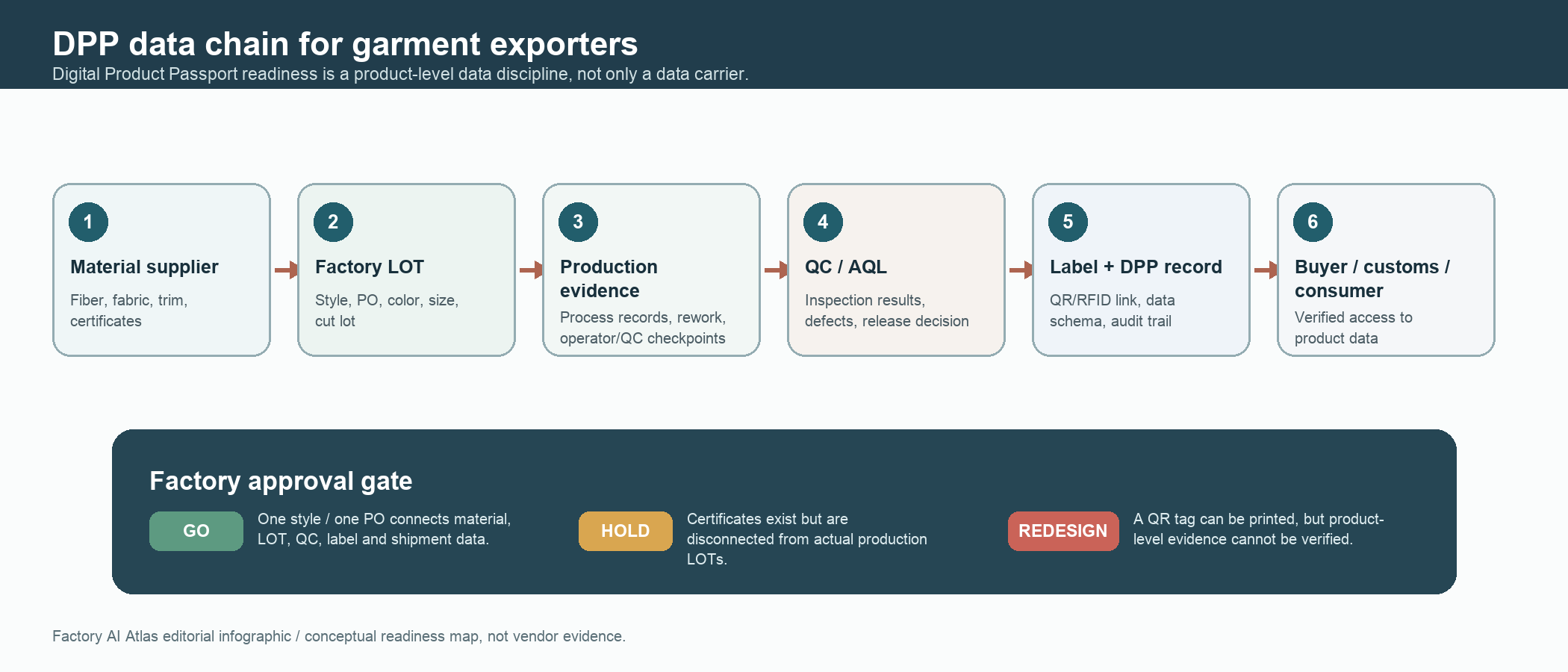
Most apparel factories do not start from zero. They already have a lot of data. The material team has supplier files and certificates. The production team has line and lot records. The QC team has inspection reports. The merchandising team has buyer approvals. The shipping team has packing lists and export documents. The compliance team has audits and certificates.
The weak point is that those data sets often do not share the same product key. That creates three operational problems.
First, the factory cannot quickly prove which certificate belongs to which lot. Second, the factory cannot easily show whether a specific production lot used the approved material. Third, the factory cannot reliably automate checks because the evidence lives in different formats and different owners’ folders.
This is why DPP readiness is not only an IT issue. It is a data ownership issue.
Every key field needs an owner. Every correction needs a record. Every supplier claim needs a way to connect to the finished product.
A practical DPP pilot for garment exporters
The best pilot is small enough to finish and strict enough to expose the weak points. A useful first pilot could be:
- one buyer
- one style
- one purchase order
- one main fabric group
- one trim group
- one production lot
- one final inspection release
- one shipment
- one sample DPP record
The pilot should not begin with a perfect dashboard. It should begin with a field map.
For each required data point, the factory should record:
- source system or source owner
- evidence format
- field name
- update frequency
- responsible person or department
- approval requirement
- correction method
- export/API method
The goal is to find the gaps before a buyer does. If the fabric certificate is only a PDF in a merchandiser’s email, that is a gap.
If the fabric lot is not tied to the cut lot, that is a gap. If the care label approval is not tied to the actual composition used, that is a gap. If the QR code can be generated but cannot point to audited product data, that is a gap.
Vendor proof requests
Factories should be careful when evaluating DPP platforms. The demo may look clean because the sample data is clean. Before buying, ask for proof of how the system handles messy factory reality.
Practical proof requests:
- sample DPP record for an apparel product
- data schema for material, product, lot, QC, label, and shipment fields
- import templates and API/export options
- supplier onboarding workflow
- audit trail and version control
- correction and approval workflow
- QR/RFID/NFC data carrier linkage method
- certificate expiry and mismatch alerts
- multi-supplier data collection method
- evidence access rules for buyer, auditor, authority, and consumer views
The last point is important. Not every user should see the same information. A consumer may need care, composition, repair, and recycling information. A buyer may need more supply chain evidence. An auditor or authority may need compliance proof.
A serious DPP system should support different access layers without breaking the product record.
Why DPP can become a Factory AI layer
DPP is usually filed under sustainability. But for factories, it may become part of the AI readiness layer. AI systems cannot reliably audit supply chains if the source data is inconsistent. A model or agent can check mismatches only when certificates, material records, production lots, QC releases, and shipments are connected.
Once the data layer exists, AI can help with practical checks:
- expired certificate detection
- material composition mismatch alerts
- missing QC record flags
- label and BOM inconsistency checks
- supplier data completeness scoring
- duplicate document detection
- shipment evidence package review
- buyer-specific compliance checklist generation
This is the Factory AI angle. DPP is not only about sustainability reporting. It is about building the product-level data structure that makes automated supply chain checking possible.
A factory that prepares for DPP carefully is also preparing for better buyer reporting, faster compliance review, cleaner ESG evidence, and more reliable AI-assisted operations.
Final factory approval check
Digital Product Passport should not be treated as a future European paperwork problem. For garment factories, it is a present-day readiness question: can the factory prove what a product is, where its key materials came from, how it was produced, how it was checked, how it was labeled, and which shipment it belongs to?
If yes, DPP becomes a structured extension of good factory control. If no, DPP exposes the hidden cost of scattered data.
The factory that wins will not be the one that prints the nicest QR code. It will be the one that can make the data behind the QR code trustworthy.
Sources checked and claim boundary
This article uses DPP as a practical factory-readiness lens, not as legal advice. Exact obligations will depend on EU product-group rules, delegated acts, buyer requirements, and implementation timelines.
Checked source anchors:
- European Commission — Ecodesign for Sustainable Products Regulation: https://environment.ec.europa.eu/strategy/circular-economy/ecodesign-sustainable-products-regulation_en
- European Commission — EU Strategy for Sustainable and Circular Textiles: https://environment.ec.europa.eu/strategy/textiles-strategy_en
- CIRPASS — Digital Product Passport project: https://cirpassproject.eu/
- CIRPASS-2 — Digital Product Passport deployment support: https://cirpass2.eu/
- Apparel News Korea — fashion industry DPP interest and domestic context: https://www.apparelnews.co.kr/news/news_view/?idx=219654&cat=CAT100
- Korea Textile News — DPP and sustainability data context for fashion: https://www.ktnews.com/news/articleView.html?idxno=140600