
Nearshore-sourcing evidence note
Latin America apparel sourcing should not be evaluated only as a nearshoring story. For factories, the practical question is whether speed, compliance, skills, trade readiness, and buyer evidence can be proven before a buyer shifts real volume.
Location advantage is sold before proof files are ready
The common mistake is to sell location advantage while leaving audit readiness, capacity discipline, costing assumptions, and documentation weak. Geography may open the conversation, but operating proof keeps the order.
Checks before shifting Latin America apparel volume
- Can the factory prove labor, OSH, chemical, quality, and shipment-control evidence quickly?
- Are skill availability, training, absenteeism, and line flexibility realistic for the product mix?
- Can trade, customs, lead-time, and supplier-risk assumptions survive buyer due diligence?
Proof requests for nearshore sourcing partners
- Provide audit-ready document samples, not only certification names.
- Show line-capacity evidence by product type, not only monthly factory capacity.
- Explain how buyer reporting data is collected and corrected.
Audit-ready sourcing gate
GO if the sourcing case is supported by operating evidence. HOLD if the location story is strong but proof files are scattered. REDESIGN if the factory cannot show buyer-ready evidence before trial orders.
Introduction: nearshoring is not just a geography strategy
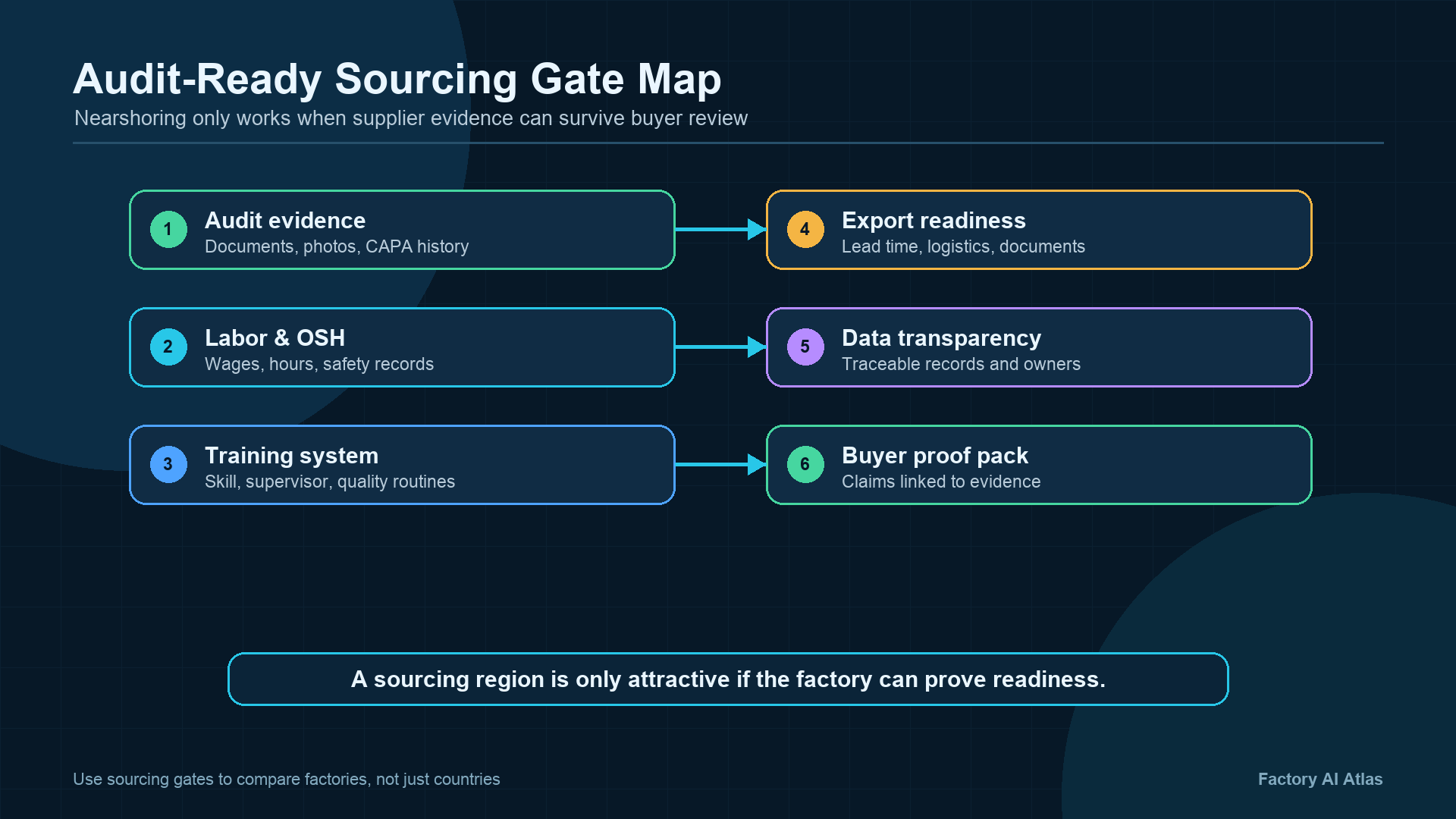
Latin America apparel sourcing review should score each supplier across audit evidence, labour and OSH compliance, training infrastructure, export readiness, data transparency, and corrective action discipline. This changes sourcing from a geography guess into an evidence-based supplier decision.
The practical release question is whether the supplier can provide buyer-ready evidence at the speed nearshoring promises: audit files, OSH proof, training records, export documents, capacity assumptions, and corrective-action ownership before the trial order grows.
Latin America apparel sourcing is becoming more attractive as brands look for shorter lead times, regional diversification, and nearshore options. But the real question is not only which country is closer. The stronger question is which factories are audit-ready, evidence-ready, and operationally stable.
But there is a mistake many companies make when they talk about nearshoring. They treat it as a map problem: which country is closer, which factory can ship faster, and which location has lower logistics risk?
Those questions matter, but they are not enough. For serious apparel sourcing, the better question is: which factory is audit-ready, evidence-ready, and operationally stable? Nearshoring does not remove factory risk. It only changes where the risk appears.
Why Latin America apparel sourcing needs a different sourcing lens
In Asia, many apparel buyers have long-established vendor bases, compliance teams, third-party auditors, testing labs, and production routines. In Latin America, the sourcing landscape can be more fragmented depending on the country and product category.
Some countries offer strong industrial clusters. Some have free-zone manufacturing models. Some have training institutions. Some have domestic industry associations. Some have labour and occupational safety frameworks that require careful review.
That means buyers need a structured evaluation model. The question is not simply whether a factory can make the garment. The better question is whether the factory can prove that it can make the garment responsibly, safely, and consistently.
Brazil as a useful case
Brazil is one of the strongest countries to study because it has several useful source layers: industry profile data from ABIT, supply-chain audit context through ABVTEX, occupational safety regulations through MTE, workplace safety research through Fundacentro, technical education through SENAI CETIQT, and trade data through official channels.
For Factory AI Atlas, Brazil is not only a country profile. It is a good example of how supplier readiness can be evaluated across multiple evidence layers.
A factory may have production capacity, but capacity alone is not enough. A buyer also needs to know whether the supplier is auditable, whether labour and safety requirements are controlled, whether machine safety and ergonomics are managed, and whether the supplier can provide export and product data.
Gate 1: supply-chain audit readiness
The first gate is audit readiness. A factory should be able to show legal entity information, factory address, production scope, subcontractor list, worker count, working hour control, wage and benefit records, health and safety documents, audit history, and corrective action records.
In Brazil, ABVTEX is an important reference point because it connects apparel retail supply chains with social responsibility and supplier audit expectations. The lesson is broader than Brazil: nearshore suppliers must be prepared to prove how the work is done, not only where the work is done.
For AI-enabled sourcing, supplier data must be structured. A PDF audit report alone is not enough. A supplier readiness system should turn audit evidence into searchable fields.
Gate 2: labour and OSH compliance
Latin America sourcing should always include labour and occupational safety review. In Brazil, the Normas Regulamentadoras provide an important OSH framework. For apparel manufacturing, the relevant themes include PPE, machine safety, ergonomics, workplace facilities, chemical handling, repetitive work, and manual material handling.
For a sewing factory, this becomes practical: are machine guards installed, are cutting machines controlled, are operators trained, are chairs and pedals adjusted, are steam and finishing areas safe, are spot-cleaning chemicals stored correctly, and are facilities acceptable?
This is not abstract compliance. It directly affects productivity, worker stability, quality, and buyer risk.
Gate 3: skill and training infrastructure
A factory is only as strong as its people system. Training institutions such as SENAI CETIQT in Brazil or INFOTEP in the Dominican Republic can be useful signals of workforce development capacity.
A buyer should ask whether there is a local training pipeline for sewing, pattern, textile, or quality skills; whether supervisors can be trained; whether technical schools or industry training centers exist; and whether the factory has a skill matrix.
Nearshoring often promises faster reaction, but fast reaction requires trained teams. Without skill infrastructure, a factory may accept orders but struggle with quality consistency, line balancing, style changeover, supervisor control, and technical problem solving.
Gate 4: trade and export readiness
Nearshoring is valuable only if the factory can support trade execution. This may include export documentation, free-zone or maquila programme understanding, HS code handling, country of origin rules, customs records, shipment coordination, and product declarations.
Paraguay, Dominican Republic, and other markets may offer interesting export or free-zone models, but buyers should not evaluate them only by headline incentives. They should ask whether the factory can provide accurate export documents and manage buyer-required origin and compliance records.
A nearshore factory that ships quickly but produces weak documents can still create major buyer risk.
Gate 5: data transparency for buyer reporting
Modern buyers increasingly need supplier data for compliance reporting, sustainability reporting, material traceability, audit follow-up, corrective action tracking, production visibility, and risk scoring.
This is where Factory AI becomes relevant. AI can help compare suppliers, detect missing evidence, summarize audit risks, and build readiness scores. But AI cannot work well if the supplier evidence is messy.
Factories should begin with a simple supplier evidence folder: company profile, factory capacity, audit documents, OSH documents, worker and training records, machine and safety records, product capability, export documentation, and corrective action history.
Latin America apparel sourcing should be scored, not guessed
A practical Latin America sourcing review can use a simple scorecard: production capability, audit readiness, labour and OSH compliance, training infrastructure, export readiness, data transparency, and corrective action discipline.
This changes the sourcing conversation. Instead of asking whether Brazil is good for apparel sourcing, ask which Brazilian suppliers are evidence-ready for this product, this buyer, and this compliance level. Instead of asking whether Paraguay is low cost, ask which suppliers can support documentation and stable production.
Before any large pilot, sourcing teams can use small validation exercises similar to Factory AI smoke tests: check the evidence, test the reporting path, and confirm whether the factory can respond under real buyer pressure.
Final nearshore-sourcing takeaway
Latin America has real sourcing potential. But the future of apparel sourcing will not reward factories only because they are closer to the market. It will reward factories that can prove their readiness.
That means production capability, labour discipline, OSH control, training systems, export documentation, audit evidence, and structured data. Brazil gives us a useful model because its source ecosystem includes industry data, audit context, safety regulation, OSH research, training infrastructure, and trade data.
For Factory AI Atlas, the key lesson is clear: nearshoring is not just a country strategy. It is a supplier evidence strategy. Factories that organize their evidence will become easier to trust, easier to audit, and easier to integrate into AI-driven sourcing systems.
Source notes for Latin America sourcing decisions
This article is based on public source lanes reviewed for Factory AI Atlas, including ABIT textile and apparel sector profile, ABVTEX programme, Brazil MTE Normas Regulamentadoras, Fundacentro workplace safety and health. Legal, standard, audit, and certification materials should be treated as reference-only and converted into factory question gates, not copied as operating rules.
Factory AI Atlas sourcing takeaway
Before choosing a nearshore supplier, build a Supplier Readiness Scorecard. Do not compare only cost and lead time. Compare audit evidence, OSH control, training capacity, export readiness, and data transparency. For a practical validation mindset, see Factory AI Smoke Tests and the Factory AI Readiness Checklist.
External validation anchors for apparel sourcing readiness
- ILO textiles, apparel, leather and footwear sector resources — use as a labor and sector-risk baseline.
- Better Work reports and publications — useful for buyer-facing compliance and improvement evidence.