
Factory-data privacy decision note
Private factory data should be classified before anyone uses a public AI tool. The factory needs a practical rule: if the file can reveal buyer identity, product design, cost, margin, worker information, supplier strategy, quality failure, or shipment risk, it should not be pasted into an uncontrolled public model.
Useful AI prompts can leak buyer evidence
The common mistake is to judge privacy by file format instead of business impact. A simple defect photo, delay note, costing line, or CAPA summary can expose more sensitive information than a formal report if it includes buyer, product, factory, or supplier context.
Checks before allowing public-AI use
- Does the factory have a red/amber/green data classification rule that non-IT teams can actually use?
- Are buyer manuals, product photos, costing, CAPA, worker, and supplier files excluded from public AI by default?
- Is there an approved workflow for anonymization, redaction, private model use, and audit logging?
Proof requests for private-data controls
- Explain where prompts, files, embeddings, logs, and outputs are stored and who can access them.
- Show retention, deletion, permission, and audit-log controls in writing.
- Demonstrate how confidential buyer and worker information is blocked or redacted before model use.
Prompt-redaction gate
GO if the AI workflow protects sensitive data while still helping teams work faster. HOLD if use cases are valid but data classification is incomplete. REDESIGN if public AI access depends only on employee judgment.
Public AI tools are useful. They can summarize documents, draft emails, explain technical terms, translate instructions, and help managers think faster.
But for apparel factories, the question is not simply whether AI is useful. The real question is whether the data being sent into an AI tool should leave the factory environment at all.
A factory does not only produce garments. It produces sensitive operational evidence every day: buyer manuals, costing files, defect photos, production reports, shipment-risk notes, audit findings, worker records, and CAPA histories. This information can reveal customers, weaknesses, suppliers, margins, delays, and internal control problems.
That is why the rise of local AI for factories matters. If some AI workloads can run inside a controlled environment, factories may not need to paste every sensitive question into a public AI tool. The future is not “never use public AI.” The future is knowing which data belongs in public tools, which data belongs in private systems, and which data should stay close to the factory floor.
This article is a practical starting point for factory leaders, QA managers, merchandisers, IE teams, and operations teams.
It is not legal advice. It is an operational risk guide.
This also matters for Physical AI in smart manufacturing, because cameras, sensors, quality evidence, WIP data, and operator records can become sensitive factory data once AI systems connect them to real decisions.
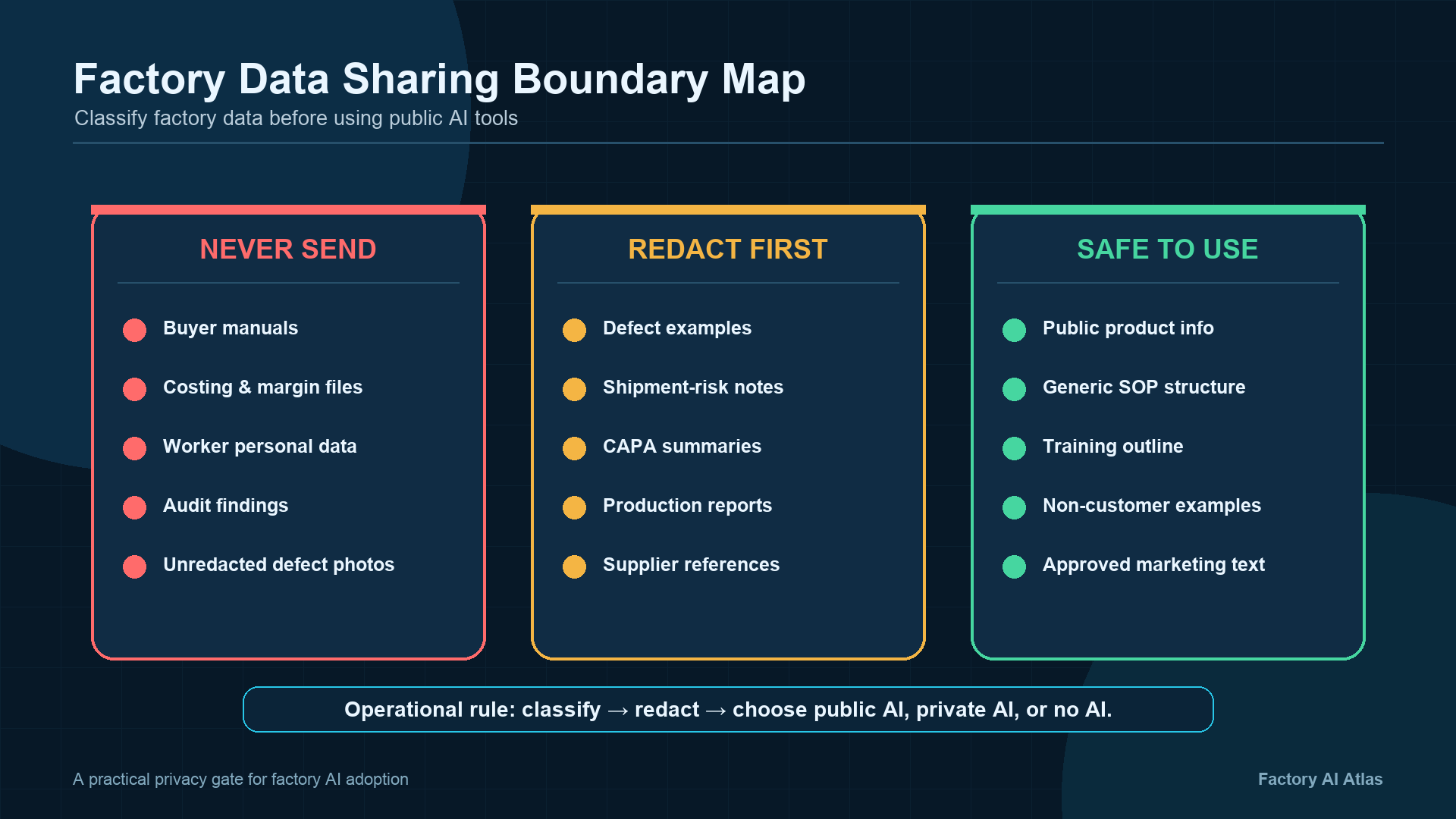
The basic rule: classify before you prompt
Many AI mistakes begin with a simple habit: someone copies a file, pastes it into a chatbot, and asks for a summary.
That may feel harmless. But in a factory context, a file is rarely just a file.
A buyer manual may contain confidential standards. A defect photo may reveal a product style. A production report may show capacity and efficiency. A shipment note may expose delay risk before the buyer has been informed. A costing sheet may reveal supplier strategy and margin pressure.
Before any factory uses public AI tools, it needs a simple data classification rule.
A practical factory policy can use four levels:
- Public — information already approved for public release.
- Internal — factory process knowledge that is not customer-specific.
- Confidential — buyer, order, supplier, cost, audit, or worker-related information.
- Restricted — data that should only be handled by approved people in approved systems.
Public AI tools may be acceptable for public and low-risk internal information. Confidential and restricted factory data need stronger controls, redaction, private AI systems, or local AI workflows.
1. Buyer manuals and quality standards
Buyer manuals are one of the most valuable knowledge sources in an apparel factory. They explain measurement rules, defect classification, packing requirements, labeling instructions, compliance expectations, testing protocols, approval gates, and escalation processes.
They are also often confidential.
A public AI tool can help summarize general quality concepts, but a full buyer manual should not be casually uploaded unless the factory has explicit permission and a clear data policy.
A safer approach is to create a controlled buyer-manual knowledge base. If the factory uses AI, it should define where the manual is stored, who can query it, what outputs can be shared, and whether the model runs in a private or local environment.
For many apparel factories, buyer manuals may be the first strong use case for local AI for factories — but only after access rules are defined.
2. Defect photos with identifiable product details
Defect photos can be powerful training data. They can help teams identify repeated issues such as broken stitch, puckering, open seam, skipped stitch, oil stain, shade mismatch, poor pressing, measurement deviation, label error, or packing defect.
But a defect photo may also show:
- buyer branding,
- product style,
- fabric type,
- factory environment,
- operator station,
- shipment or order tags,
- internal quality weakness.
Before uploading defect photos into any public AI tool, factories should ask: could this image identify the buyer, the product, the order, or the factory’s quality problem?
If yes, the image should be redacted, anonymized, or processed inside a controlled system.
The goal is not to stop AI-supported quality learning. The goal is to prevent quality evidence from becoming uncontrolled external data.
3. Costing sheets and margin-related files
Costing files are among the most sensitive documents in a garment business.
They may include fabric costs, trim costs, CM, FOB price, supplier quotations, subcontractor pricing, logistics assumptions, payment terms, yield assumptions, wastage assumptions, and margin pressure.
Pasting a costing sheet into a public AI tool for “quick analysis” can expose commercial strategy.
A safer method is to remove buyer names, supplier names, style references, exact prices, and margin details before using any external tool. Better still, factories should build internal cost-review workflows where AI can support explanation without exposing raw commercial data.
4. Production output and efficiency reports
Daily production reports may look operational, but they can reveal factory capacity and performance.
They may show:
- line output,
- manpower allocation,
- efficiency,
- WIP,
- bottlenecks,
- absenteeism,
- rework rate,
- shipment pressure,
- order priority.
If competitors, buyers, or unauthorized parties saw this data, they could understand how the factory operates under pressure.
Public AI tools can help explain generic production concepts. But raw line-level reports should be treated as confidential unless anonymized.
A better prompt would use a synthetic or redacted version:
“A sewing line planned 1,000 pieces but produced 780. Operation 5 has high WIP and operation 6 has low output. What questions should the production manager ask?”
This gives AI enough structure to help without exposing a real buyer, style, line, or shipment.
5. Shipment-risk notes and delay explanations
Shipment delay information is sensitive because timing matters.
A note that says “Order X may miss shipment because Line 3 is behind and fabric lot B has shade issues” is not just an operational update. It may become a buyer communication issue, a penalty risk, or a reputation risk.
Factories should not paste live shipment-risk notes into public AI tools unless the content has been cleared and anonymized.
AI can still help. It can draft a neutral internal escalation memo, create a root-cause checklist, or suggest questions for a production meeting. But the prompt should avoid identifiable buyer, PO, style, and shipment information.
6. CAPA records and audit findings
Corrective and Preventive Action records are important evidence. They show what went wrong, what the factory did, who was responsible, and how the factory will prevent recurrence.
Audit findings may include compliance gaps, safety issues, quality-system weaknesses, documentation failures, or buyer-specific requirements.
This is exactly the type of data that should be controlled.
If a factory wants AI support for CAPA, it should use redacted examples or private systems. The AI can help structure the logic:
- problem statement,
- root cause,
- containment action,
- corrective action,
- preventive action,
- owner,
- deadline,
- evidence required.
But real audit findings should not be treated as casual prompt material.
7. Worker and operator information
Worker-related data needs special care.
Factories may hold information about attendance, skill level, efficiency, disciplinary issues, medical status, wages, productivity, training history, and operator performance.
Even if the goal is operational improvement, worker data can create privacy and fairness risks.
A factory should not paste named worker records into public AI tools. If analysis is needed, use aggregated or anonymized information.
For example, instead of uploading a named skill matrix, the factory can ask:
“A sewing line has three operators qualified for collar attachment, but only one is currently assigned. What staffing risks should the line leader check?”
This protects individuals while still allowing useful operational analysis.
8. Supplier names, subcontractor details, and sourcing strategy
Supplier information can reveal how a factory competes.
Fabric mills, trim suppliers, subcontractors, washing units, embroidery units, printing partners, and logistics providers are part of the factory’s commercial network.
If a prompt includes supplier names, prices, delays, quality issues, or negotiation details, the factory may be exposing sourcing strategy.
Public AI tools can support generic supplier-risk thinking. They should not become a place where real supplier disputes or quotations are pasted without controls.
9. Machine maintenance and downtime logs
Maintenance logs may seem technical, but they can reveal capacity risk.
A factory’s downtime history can show weak machine types, recurring bottlenecks, lack of spare parts, mechanic shortages, preventive maintenance gaps, and line reliability issues.
This information can be useful for AI-supported maintenance planning, but it should be handled carefully.
Factories can safely ask general questions such as:
“What should a maintenance manager check when a sewing line has repeated needle breakage and thread trimming issues?”
But they should avoid uploading detailed machine logs that expose factory weakness unless the system is approved for confidential data.
10. Internal strategy, customer pipeline, and M&A discussions
Some data should be treated as restricted from the beginning.
This includes expansion plans, buyer pipeline, pricing strategy, acquisition targets, factory sale discussions, customer complaints, legal disputes, and senior-management decisions.
Public AI tools are not the right place for this information unless the company has formally approved that use case.
For sensitive strategy work, use internal review, private AI environments, or local systems with clear access control.
A practical redaction checklist before using public AI
Before anyone in the factory pastes information into a public AI tool, they should remove or replace:
- buyer name,
- supplier name,
- factory name,
- PO number,
- style number,
- customer code,
- worker name,
- exact price,
- margin,
- shipment date,
- audit score,
- confidential attachment,
- product photo with branding,
- any detail that identifies the order or customer.
A safe prompt should preserve the operational pattern while removing the identity of the case.
Bad prompt:
“Analyze this real buyer manual and defect report for Buyer X, Style 12345, shipping next Friday.”
Better prompt:
“A garment factory has repeated measurement defects on a knit top before final inspection. What root-cause questions should QA and production review before shipment?”
The second prompt is still useful, but much safer.
Where public AI is still useful
This article is not arguing that factories should avoid public AI tools completely.
Public AI tools can be useful for:
- rewriting non-confidential training text,
- explaining generic quality concepts,
- translating public instructions,
- drafting neutral meeting agendas,
- creating checklist templates,
- summarizing public standards,
- brainstorming training scenarios,
- creating synthetic examples,
- improving writing clarity.
The key is to separate general knowledge work from confidential factory evidence.
Why local AI matters
Local AI does not automatically solve every risk. A local system still needs access control, logging, data governance, model evaluation, cybersecurity, and management discipline.
But local AI changes the architecture. It can allow sensitive factory documents to be queried inside a controlled environment instead of being copied into public tools.
That matters for apparel factories because much of the useful AI work is connected to sensitive documents:
- buyer manuals,
- QC evidence,
- line reports,
- SOPs,
- CAPA records,
- training records,
- shipment-risk notes.
Local AI for factories should not be treated as a gadget trend. It should be evaluated as part of a broader data-control strategy.
The factory policy every team needs
A simple AI data policy should answer five questions:
- What data can be used in public AI tools?
- What data must be anonymized first?
- What data is restricted from public AI tools?
- Who approves AI use for confidential documents?
- Where should private or local AI be used instead?
Without these rules, AI adoption becomes a behavior problem. Different teams will make different choices, and the factory will not know what information has been shared outside the organization.
External validation anchors for private factory data use
- NIST Privacy Framework — useful for classifying sensitive information, managing privacy risk, and designing repeatable controls.
- NIST AI Risk Management Framework — relevant when AI use requires data governance, accountability, and risk controls before deployment.
Final factory takeaway
AI is becoming part of factory work. That is not the risk by itself.
The bigger risk is using AI before the factory knows which data should stay private.
Private factory data is not just an IT issue. It is a production issue, a quality issue, a buyer trust issue, and a management-control issue.
The factories that benefit most from AI will not be the ones that paste the most data into the newest tool. They will be the ones that know what to share, what to redact, what to keep private, and when local AI is the safer architecture.## Related reading
- Local AI for Factories: Hardware and Operations
- Factory AI Readiness Checklist
- Factory AI Smoke Tests
Source notes for private factory data controls
- NIST AI Risk Management Framework
- NIST Privacy Framework
- OWASP Top 10 for Large Language Model Applications
Editorial note
This article provides operational guidance for factory AI data handling. It is not legal, cybersecurity, or privacy-compliance advice. Factories should review their contracts, buyer requirements, local laws, and internal IT/security policies before using AI tools with confidential data.