Factory decision note
For a real factory, AGV, AMR, cleaning robot, automated forklift, and patrol robot decisions should start with the route, the safety exposure, the lost time, and the owner of daily exceptions. The robot category matters only after the factory proves the process is stable enough to measure.
The mistake factories usually make
Teams compare robot specifications before proving the route. If aisles are blocked, WIP locations move without control, pallet standards vary, operators cut across travel paths, or maintenance ownership is vague, the robot choice is premature. A mobile robot will not repair weak material-flow discipline by itself.
What I would check before approving budget
- The exact movement problem: cleaning discipline, material delivery, pallet transfer, patrol inspection, or repeated safety observation.
- The baseline evidence: walking time, missed replenishment, blocked aisle frequency, forklift exposure, cleaning cycle misses, or inspection gaps.
- The route condition during normal shift pressure, not only during a vendor demo.
- The daily owner for map changes, exception recovery, charging, maintenance, safety review, and operator escalation.
Vendor proof requests
- Demonstrate the route under real aisle congestion, mixed people-and-cart traffic, and normal shift interruptions.
- Show stop distance, obstacle handling, exception recovery, charging uptime, map-change control, and supervisor dashboards.
- Provide a 30- to 90-day pilot plan with acceptance criteria before claiming productivity or safety ROI.
Pilot gate
GO when the robot improves a controlled route with measurable safety, uptime, and productivity evidence. HOLD when the use case is valid but route discipline, ownership, or exception logs are not ready. REDESIGN when the robot purchase is being used to hide weak material-flow management.
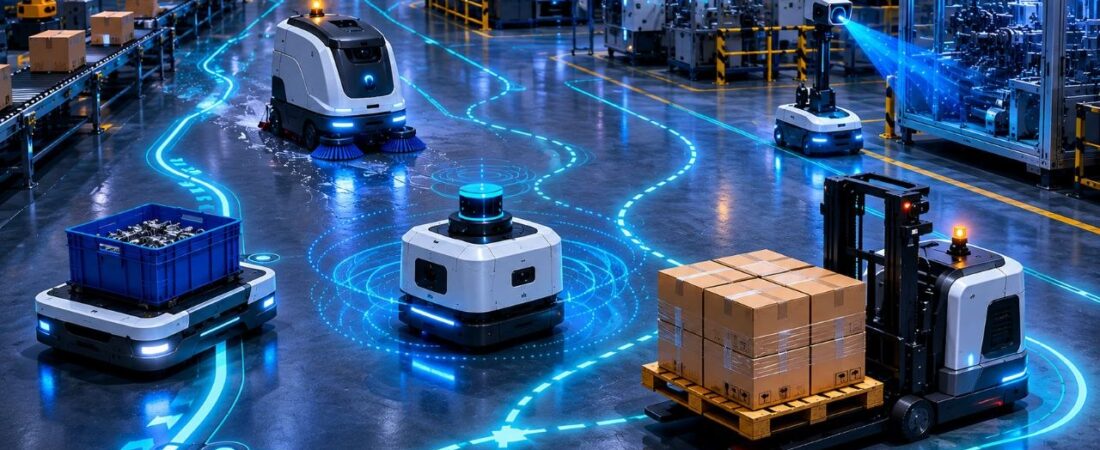
Factory mobile robots are often discussed as if they belong to one category. In practice, they solve different factory problems. An AGV may be the right answer for a fixed material route. An AMR may fit a changing layout. A cleaning robot may be the safest first automation project. An automated forklift may unlock warehouse productivity, but with a higher safety bar. An inspection robot may not move material at all; it may collect data.
That is why the first question should not be, “Which robot is the most advanced?” A better question is, “Which factory problem is stable, repetitive, measurable, and ready for a robot?”
For many factories, the first useful robot does not need to weld, sew, pick random objects, or replace a skilled operator. It may only need to move a cart, deliver material, clean an aisle, move pallets, or check the same safety point every day. Those are not small problems. They are often the places where wasted walking time, unsafe floor conditions, missed inspections, and poor material flow quietly reduce productivity.
This article compares AGVs, AMRs, cleaning robots, automated forklifts, and inspection robots from a practical factory-readiness point of view. The goal is to help factories choose factory mobile robots by task readiness, not by hype.
Factory mobile robots: 7 checks before choosing the first pilot
Among factory mobile robots, an AGV, or automated guided vehicle, is a driverless vehicle that moves materials along a controlled route. Traditional AGVs may use magnetic tape, optical guides, wires, reflectors, QR markers, or other route-guidance infrastructure. The main idea is simple: the vehicle follows a planned path and repeats the same transport task reliably.
This makes AGVs useful when the factory layout is stable. If material always moves from point A to point B, the pickup and drop-off points rarely change, and the route can be kept clear, an AGV can be a practical and lower-risk solution.
AGVs are often used for parts delivery, line-side replenishment, WIP movement, and finished-goods transfer. In a garment or apparel factory, an AGV could move fabric rolls, cut panels, accessories, WIP carts, or packed cartons along a fixed route between cutting, sewing preparation, finishing, and warehouse staging.
The mistake is to call AGVs outdated simply because AMRs are more flexible. A fixed route is not always a weakness. If the process is stable, a controlled route can be easier to supervise, easier to train around, and easier to protect with clear traffic rules.
Factory approval check: Choose an AGV only when the route is stable, the load is repetitive, the pickup and drop-off points are controlled, and predictable flow is more valuable than flexible rerouting.
AMR: flexible factory mobile robots for changing layouts
An AMR, or autonomous mobile robot, is usually more flexible than a traditional AGV. Instead of depending only on a fixed guide path, an AMR uses onboard sensors and software to understand its surroundings. Depending on the system, this may include LiDAR, cameras, depth sensors, safety scanners, maps, localization software, and fleet-management tools.
The practical benefit is rerouting. If a worker, cart, forklift, or temporary obstacle blocks the path, an AMR can often slow down, stop, or calculate another route. That makes AMRs attractive in factories and warehouses where routes change, work areas are shared, and production schedules shift frequently.
AMRs are commonly used for tote movement, shelf movement, cart towing, material replenishment, and flexible internal logistics. Some platforms are designed for lighter payloads, while others move pallets or connect to top modules and carts. The visible robot is only part of the system. Mission planning, traffic control, charging, exception handling, and operator training matter just as much.
That is the hidden challenge. An AMR can be more flexible than an AGV, but a flexible robot still needs a disciplined operating process. Someone must define the pickup points, allowed routes, blocked zones, priority rules, charging routines, and what happens when the robot cannot complete a mission.
Factory approval check: Choose an AMR when the layout changes, people and carts share the same space, and the factory can still define blocked zones, priority rules, exception handling, and operator response.
Cleaning robots: low-risk factory mobile robots for facility readiness
Cleaning robots are different from AGVs and AMRs because their first job is not material flow. Their job is facility readiness. They clean the floor, improve housekeeping discipline, reduce debris, and make aisles safer and easier to maintain.
In many factories, that makes them a strong first robot project. A cleaning robot does not touch the product. It does not need to handle fabric, parts, tools, or finished goods. It works on a repeated area, follows a route, and produces a visible result. The factory can see whether the route is clear, whether workers respect robot zones, whether charging is handled, and whether daily ownership is assigned.
For textile and garment factories, this is especially relevant. Lint, thread waste, fabric dust, packaging debris, and slippery walkways can create safety and quality problems. A cleaning robot will not solve sewing automation, but it can reduce a real operational burden while teaching the organization how to supervise autonomous equipment.
This is why the already published Atlas article on cleaning robots in factories treats them as a readiness test, not just a housekeeping tool.
Factory approval check: Choose a cleaning robot when floor condition affects safety, cleaning misses are measurable, routes are repeatable, and the factory wants a lower-risk way to learn robot supervision.
Automated forklifts: high-value pallet movement with a higher safety bar
Automated forklifts and autonomous pallet trucks bring mobile automation into heavier material handling. Instead of moving small totes or light carts, they lift and move palletized goods, fabric rolls, cartons, or warehouse loads. The value can be significant when pallet movement is repetitive and labor-intensive.
But automated forklifts should not be treated as simply “larger AMRs.” Payload changes the risk. A vehicle carrying a heavy pallet needs more controlled traffic rules, better staging discipline, reliable pallet quality, clear pedestrian separation, and stronger safety procedures. It may also need integration with a WMS, ERP, or warehouse operation process so missions can be requested, tracked, and confirmed.
For a factory, the right starting point may be a limited zone: a finished-goods warehouse, a staging area, or a night-shift movement route where pedestrian traffic is lower. The project should begin with the route, load, pallet condition, aisle width, safety rules, and exception process before choosing the vehicle.
Factory approval check: Choose automated forklifts or pallet trucks when pallet movement is repetitive and valuable, but only if the site can prove traffic control, staging discipline, training, and safe fallback rules.
Inspection and patrol robots: mobile sensing, not material flow
Inspection and patrol robots solve a different problem. They may not move material or clean the floor. Instead, they carry sensors through the facility. Those sensors may include cameras, thermal cameras, microphones, gas sensors, LiDAR, or other inspection payloads.
The value is repeatable observation. A robot can check the same route, capture the same type of evidence, and report abnormal conditions. This can matter in utilities, chemicals, mining, oil and gas, large campuses, and other sites where missed inspections or dangerous access can create serious risk.
For a typical garment factory, an inspection robot is usually not the first automation project. It may make sense for large campuses, warehouses, electrical rooms, boilers, compressors, fire-risk zones, or perimeter security. But it should be evaluated as a mobile sensing project, not as a material-handling project.
Factory approval check: Choose inspection or patrol robots when repeated observation is the problem: missed inspections, risky access, safety monitoring, or maintenance data collection that needs a repeatable evidence trail.
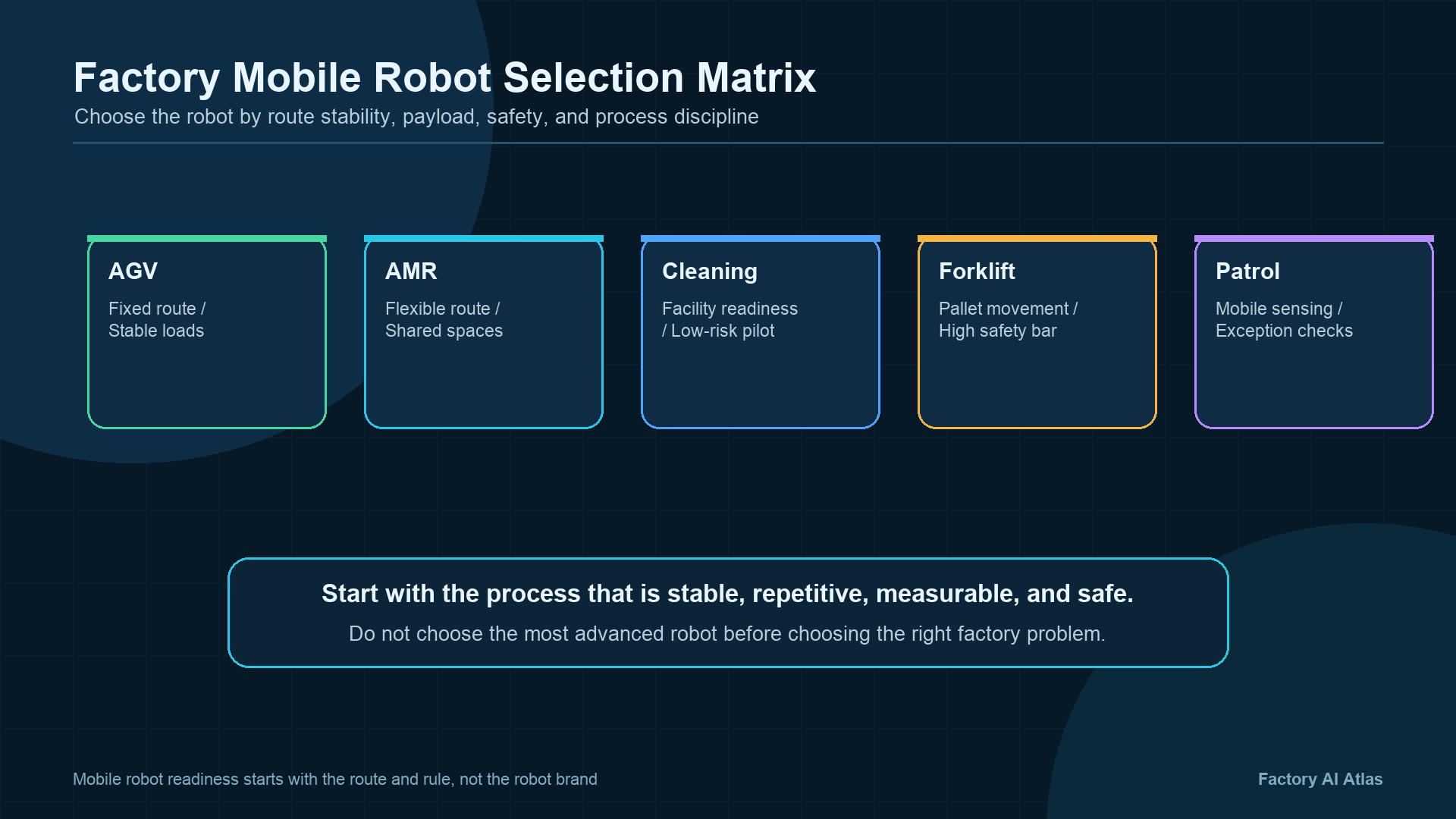
Decision map: which factory mobile robots should come first?
The best first robot is not always the most advanced robot. It is the robot that matches the most stable, repeated, measurable problem in the factory.
- If the route is fixed and repetitive: consider an AGV.
- If the route changes and people share the space: consider an AMR.
- If the floor condition affects safety or cleanliness: consider a cleaning robot.
- If pallet movement is repetitive and controlled: consider an automated forklift or pallet truck.
- If inspections are missed or risky: consider an inspection or patrol robot.
This decision is also connected to the broader Factory AI Readiness question. Mobile robots need route readiness, data readiness, safety readiness, and operational ownership. A robot that looks simple on a brochure can still fail if nobody owns the daily process.
Garment factory operating context
In garment factories, the first useful mobile robot may not be a sewing robot. It may be a cleaning robot that controls lint and floor debris, an AMR that moves WIP carts, an AGV that delivers fixed-route materials, or an automated pallet vehicle in the finished-goods warehouse.
That matters because sewing automation is hard. Fabric is flexible, styles change, quality standards vary, and line balance depends on many small human decisions. The Atlas article on why garment factory automation is difficult explains why direct sewing automation should not be treated as the only path forward.
A mobile robot project can be more realistic because the task is separate from stitching quality. Moving carts, cleaning aisles, transporting pallets, or checking a safety point is easier to define than replacing a sewing operator. These projects also reveal whether the factory can manage routes, exceptions, charging, worker behavior, and daily KPI tracking.
In simple terms: the first mobile robot may not solve sewing. It may solve walking, waiting, cleaning, or checking. That can still be valuable.
Checklist before buying factory mobile robots
Before comparing vendor models, the factory should answer these questions:
- What task is being automated: material movement, cleaning, pallet movement, inspection, or something else?
- Is the route stable or changing?
- Are people, carts, forklifts, and manual work happening in the same aisle?
- What happens when the route is blocked?
- Who requests the robot mission?
- Who confirms that the mission was completed?
- Where will the robot charge, refill, empty, or wait?
- What safety rules, signs, training, and emergency procedures are needed?
- Does the robot need to connect with WMS, MES, ERP, CMMS, or another system?
- Which KPI proves success: fewer walking hours, faster replenishment, cleaner floors, safer pallet movement, or fewer missed inspections?
The Robot Automation ROI Checklist is a useful next step because the business case should be built around the actual task, not around the robot category name.
How this connects to Physical AI
Mobile robots are a practical example of Physical AI in smart manufacturing. They sense the environment, move through physical space, respond to obstacles, and interact with human workflows. But the intelligence is not only inside the robot. It also lives in the factory process around the robot.
A good deployment requires clear routes, clean data, trained people, safety boundaries, and a process for exceptions. Without those basics, even an advanced robot becomes an expensive machine waiting in the wrong place while supervisors still solve the real workflow problem manually.
Final factory approval check: choose the process before the robot
AGVs, AMRs, cleaning robots, automated forklifts, and inspection robots all belong to the broader factory mobile robot family. But they do not solve the same problem.
An AGV is strong when the route is fixed. An AMR is useful when movement needs flexibility. A cleaning robot is a low-risk way to improve facility readiness. An automated forklift can improve pallet movement, but it requires stronger safety discipline. An inspection robot is valuable when the factory needs repeatable observation and safety data.
The best first robot is not the one with the most impressive demo. It is the one that fits a real, repeated, measurable factory problem and leaves an evidence trail the factory can review after every shift. Start there, and the factory will learn faster without turning a robot pilot into a hidden material-flow problem.
Further reading and references
- OSHA — Powered Industrial Trucks
- OSHA — Walking-Working Surfaces
- Mobile Industrial Robots — AMR examples
- Brain Corp — autonomous floor-care platform example
- Seegrid — autonomous mobile robot examples
- ANYbotics — autonomous inspection robot example
External validation anchors for factory mobile robot pilots
- OSHA robotics guidance — useful for safety, interaction, and risk control in robot deployments.
- International Federation of Robotics industrial robot resources — relevant for staged industrial robot adoption and realistic deployment expectations.
Related Factory AI Atlas reading
- Factory AI Readiness Hub
- Factory AI Readiness Scorecard
- Cleaning Robots in Factories
- Robot Automation ROI Checklist
Source anchors for mobile-robot pilot decisions
Author and mobile-robot pilot perspective
Factory AI Atlas is written from a manufacturing operations perspective shaped by hands-on apparel and textile production experience, including overseas factory management, woven and knit operations, production control, quality systems, and operational restructuring.
The site focuses on vendor-neutral, evidence-aware, and ROI-realistic guidance for AI, robotics, automation, internal logistics, and factory readiness. See the Editorial Policy & Disclaimer for sourcing standards and AI-use disclosure.