Vendor-question decision note
Vendor questions should end with a factory decision, not a longer meeting. Before buying apparel automation, the team should decide whether the proposal proves a real process constraint, fits the factory’s operating conditions, and creates measurable evidence within a small safe pilot.
The buyer-side discipline is to convert every vendor answer into a gate: continue, redesign, hold, or reject. That keeps the discussion tied to fabric behavior, changeover, downtime ownership, quality drift, WIP location, operator adoption, and maintenance reality.
Question lists are used without pass/fail rules
The common mistake is to ask many questions but not define the pass/fail rule. A vendor can answer every question politely while still avoiding the hard issues: fabric behavior, style changeover, downtime ownership, operator adoption, quality drift, WIP location, and maintenance reality.
Checks before approving an apparel automation vendor
- Which current loss is large enough to justify automation: labor touch, waiting, rework, changeover, quality escape, or planning delay?
- What baseline will be measured before the vendor arrives?
- What would make the factory stop the pilot, redesign it, or reject the purchase?
Proof requests for apparel automation vendors
- Provide a pilot plan using the factory’s actual style mix, fabric difficulty, operators, mechanics, and floor constraints.
- Show total-cost evidence including setup, changeover, spare parts, training, maintenance, downtime, and integration work.
- Share reference cases with comparable product complexity, not only best-case production videos.
Automation-purchase pilot gate
GO if vendor proof matches the factory’s real constraint and baseline. HOLD if the business case is attractive but field evidence is incomplete. REDESIGN if the proposal is driven by equipment appeal rather than operational loss.
Apparel automation vendor questions should start on the factory floor, not in a sales demo.
A vendor can show a clean video of a machine repeating one motion. A garment factory lives in a different world. Fabric lots change. Operators balance speed and quality. Bundles wait in the wrong place. A style that looked simple in the sample room becomes difficult when size ratios, shade lots, trims, and urgent delivery pressure enter the line.
That is why the most useful automation discussion is not “Can this machine work?” The better question is: “Can this machine work inside our production system, with our fabric, our operators, our changeovers, our QC standard, and our real order mix?”
Use these apparel automation vendor questions before the demo, during the pilot, and again before final sign-off. The goal is not to reject automation; it is to test whether the system can survive real factory conditions. For the broader reason this is hard, see our field note on why garment factory automation is difficult.
This article is written from the field side of apparel manufacturing. It is not a buyer’s checklist made from a brochure. It is a practical set of questions a factory team can use before a vendor meeting, especially when the project involves sewing support, inspection, material movement, cleaning robots, AI vision, or other early factory automation steps.
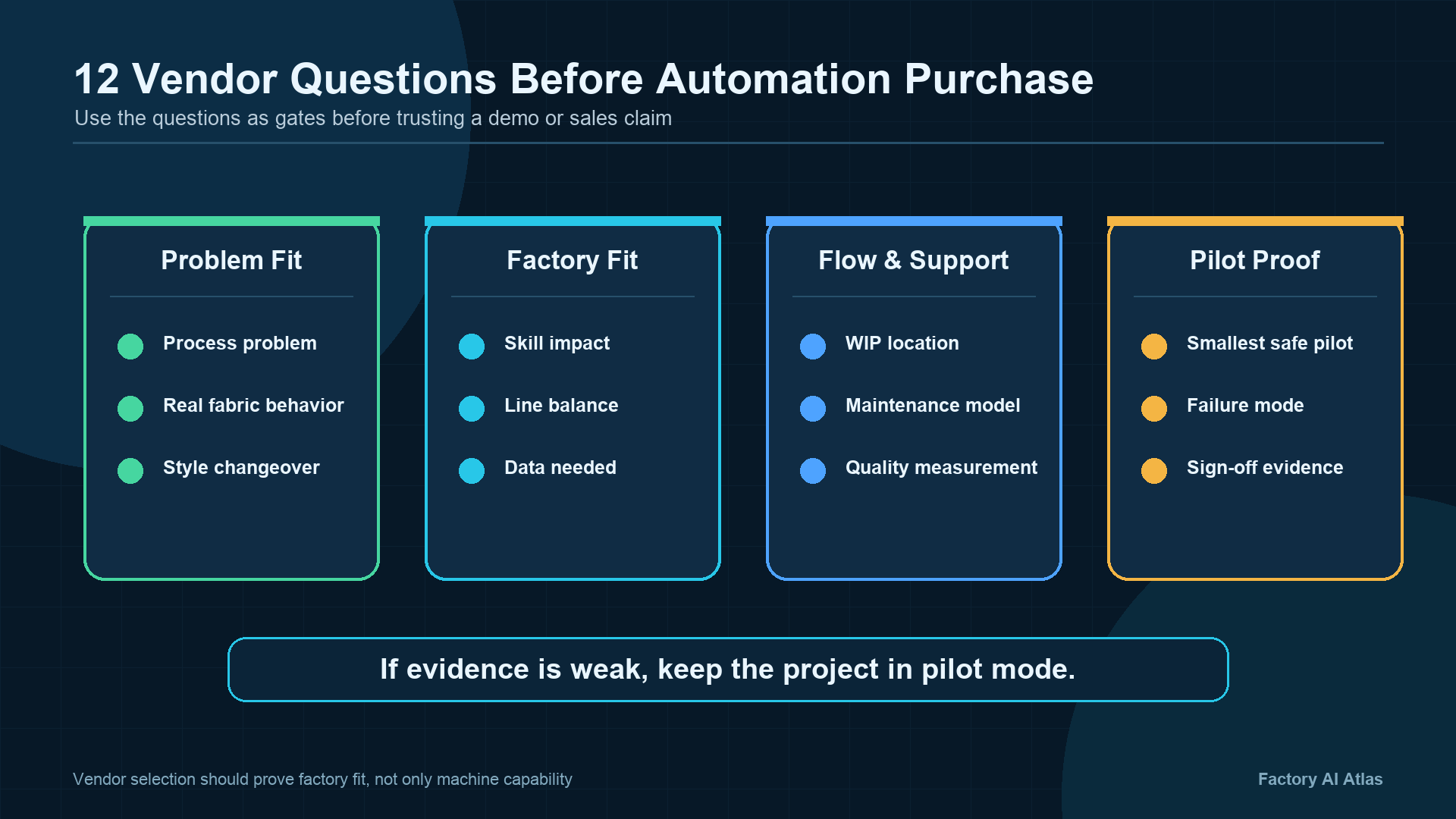
1. Which exact process problem are we trying to remove?
Before discussing the machine, define the problem in factory language. Is the issue output per hour, defect rate, rework, WIP buildup, operator shortage, safety, cleaning consistency, or delivery reliability?
A weak project says, “We need automation.” A stronger project says, “We lose time because semi-finished pieces wait between operation 7 and 8,” or “QC keeps finding shade/fabric handling defects after sewing, when correction is expensive.”
If the problem cannot be described at the operation level, the vendor will naturally define the project around the machine. That is risky for an apparel factory.
2. Has the vendor seen our real fabric behavior?
Garment work is difficult because fabric is not a rigid part. Cotton jersey, woven shirting, denim, stretch fabric, slippery lining, and lightweight synthetic material all behave differently. A machine that looks stable on one panel may struggle when edges curl, layers shift, or tension changes.
Before buying, ask whether the vendor can test your actual fabric, panel shape, seam type, lot variation, and tolerance. Do not accept a demo that only uses the vendor’s prepared sample material.
The ILO’s apparel and footwear automation research also notes that pliable material handling remains one of the reasons apparel automation is not as straightforward as automation in rigid-part industries.
3. What happens during style changeover?
Many apparel factories do not run the same product for months. They change style, color, size ratio, fabric, trims, labels, packaging method, and buyer requirements. A machine may perform well in a long, stable run but become a problem when the line changes quickly.
Ask the vendor to explain changeover time in detail. Which parts need adjustment? Who can do it? Does the factory need an engineer, a mechanic, or a trained line leader? How many minutes are lost before the first acceptable piece?
In a garment factory, changeover cost is often hidden. It appears later as waiting time, rework, supervisor attention, or a line that cannot reach its planned efficiency.
4. What skill is being automated, and what skill remains?
Automation rarely removes all human skill. It usually changes where skill is needed. A vision system may reduce manual checking, but someone still needs to define defect criteria. A guided sewing workstation may stabilize one seam, but someone still needs to prepare panels correctly. An AMR may move goods, but the line still needs clear WIP locations and dispatch rules.
Ask what skill remains after installation. Then check whether the factory has that skill internally. If the answer is always “the vendor will support,” the project may be too dependent for daily production.
5. How will this affect line balance?
A single automated station can look productive but still damage total line performance if it creates a new bottleneck or feeds the next process unevenly. Apparel output depends on line balance, not only one machine’s speed.
Before buying, compare the proposed automation with SMV, target output, operator allocation, WIP flow, and the slowest operations on the line. If the automated step saves 20 seconds but the next two operations still wait for parts, the savings may not become shipped output.
This is why robot automation ROI should include process flow, quality, downtime, and supervision time, not only machine cycle time.
6. What data does the system need from us?
AI and automation systems often need clean input data: style information, operation sequence, defect codes, size/color mapping, machine status, production counts, and maintenance records. Many factories have this information, but it may be spread across Excel files, paper tickets, line boards, and people’s memory.
Ask the vendor what data is required before go-live. If the vendor assumes perfect data and the factory operates with mixed manual records, the first project will be slower than expected.
This is also where many pilots fail because of weak master data, inconsistent operation definitions, or missing WIP visibility. See also: factory data problems that break AI projects.
7. Where will WIP physically wait?
Factory automation fails when people only design the machine position and forget the space around it. In apparel production, WIP needs carts, racks, bundle areas, inspection points, rework paths, and safe walking lanes.
Before purchasing, draw the physical flow. Where does input wait? Where does output go? Where are rejects placed? Who clears the station? How is priority decided when urgent orders enter the line?
This is especially important for cleaning robots, AMRs, and inspection stations because their benefit depends on route discipline and floor organization.
8. What is the realistic maintenance model?
A factory should not buy a system that only works when the vendor engineer is present. Ask what daily cleaning, calibration, spare parts, software checks, camera cleaning, sensor alignment, and preventive maintenance are required.
For apparel factories, maintenance must fit production rhythm. If a system needs frequent specialist attention during peak season, the machine may be parked when the factory needs it most.
9. How will quality be measured before and after?
Quality improvement should not be described vaguely. Define the before-and-after measurement: defect rate, rework minutes, inspection pass rate, shade mix-up, seam consistency, missing component errors, or customer claim reduction.
For AI vision or inspection projects, agree on defect definitions before the pilot. The same defect may be judged differently by sewing QC, finishing QC, buyer QA, and third-party inspection. If standards are not aligned, the system will be blamed for a process disagreement.
10. What is the smallest safe pilot?
Do not start with the most difficult process unless the factory has already stabilized the basics. A good first pilot is narrow enough to learn from but important enough to matter.
Examples include one cleaning route, one material movement lane, one inspection point, one recurring fabric handling problem, or one sewing aid for a stable style. The goal is not to prove that automation is exciting. The goal is to learn whether the factory can operate, maintain, measure, and improve the system.
11. What happens if the order mix changes?
Apparel factories often face seasonal and buyer-driven changes. A machine justified by one product family may not pay back if that product disappears or volume drops. Ask the vendor what other products, operations, or departments can use the system if the original style changes.
Flexible use is more valuable than a perfect demo for one narrow operation.
12. Who owns the result after go-live?
A practical automation project needs an internal owner. Not only engineering. Not only production. Not only IT. The owner must connect IE, production, maintenance, QC, warehouse, and vendor support.
If ownership is unclear, the project becomes nobody’s daily job after installation. That is when small problems accumulate and the machine becomes a display item rather than a production tool.
Apparel automation vendor questions: the factory-side buying rule
The most important apparel automation vendor questions are not technical tricks. They are operating questions:
- Can the system handle our real fabric and style variation?
- Can our people change over, maintain, and troubleshoot it?
- Does it improve the full production flow, not just one machine cycle?
- Can we measure the result in quality, output, WIP, or delivery reliability?
- Can we run a small pilot without disturbing daily production?
If the answer is unclear, the factory should slow down. A delayed purchase is cheaper than a machine that never becomes part of the operating system.
Before a vendor demo becomes a buying decision, factories can also test whether small operating apps for WIP, QC, PPC, SMV, 5S, and cutting-room records reveal the real process baseline.
Final automation-vendor takeaway
Factory AI and robotics are becoming more relevant to apparel manufacturing, but garment factories should not buy automation like a catalog item. Start with the process problem, test real fabric behavior, check line balance, define data needs, and run a narrow pilot. The best automation decision is the one that fits the factory’s actual work, not the vendor’s best demo day.
The best apparel automation vendor questions force the discussion back to process, data, people, maintenance, and measurable factory results.
About the Editorial Perspective
Factory AI Atlas is written from a manufacturing operations perspective shaped by hands-on apparel and textile production experience, including overseas factory management, woven and knit operations, production control, quality systems, and operational restructuring.
The site focuses on vendor-neutral, evidence-aware, and ROI-realistic guidance for AI, robotics, automation, and factory readiness. See the Editorial Policy & Disclaimer for sourcing standards and AI-use disclosure.
Automation-vendor source anchors
- NIST manufacturing resources — useful for grounding automation evaluation in measurement, systems, and operational evidence.
- International Federation of Robotics industrial robot resources — relevant for realistic industrial automation adoption and vendor-proof expectations.