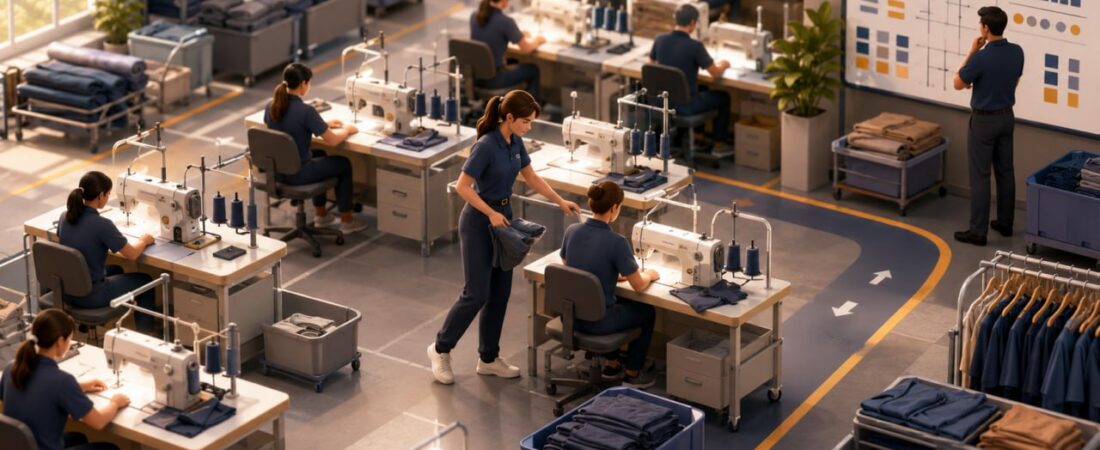
Jumper-pool approval note
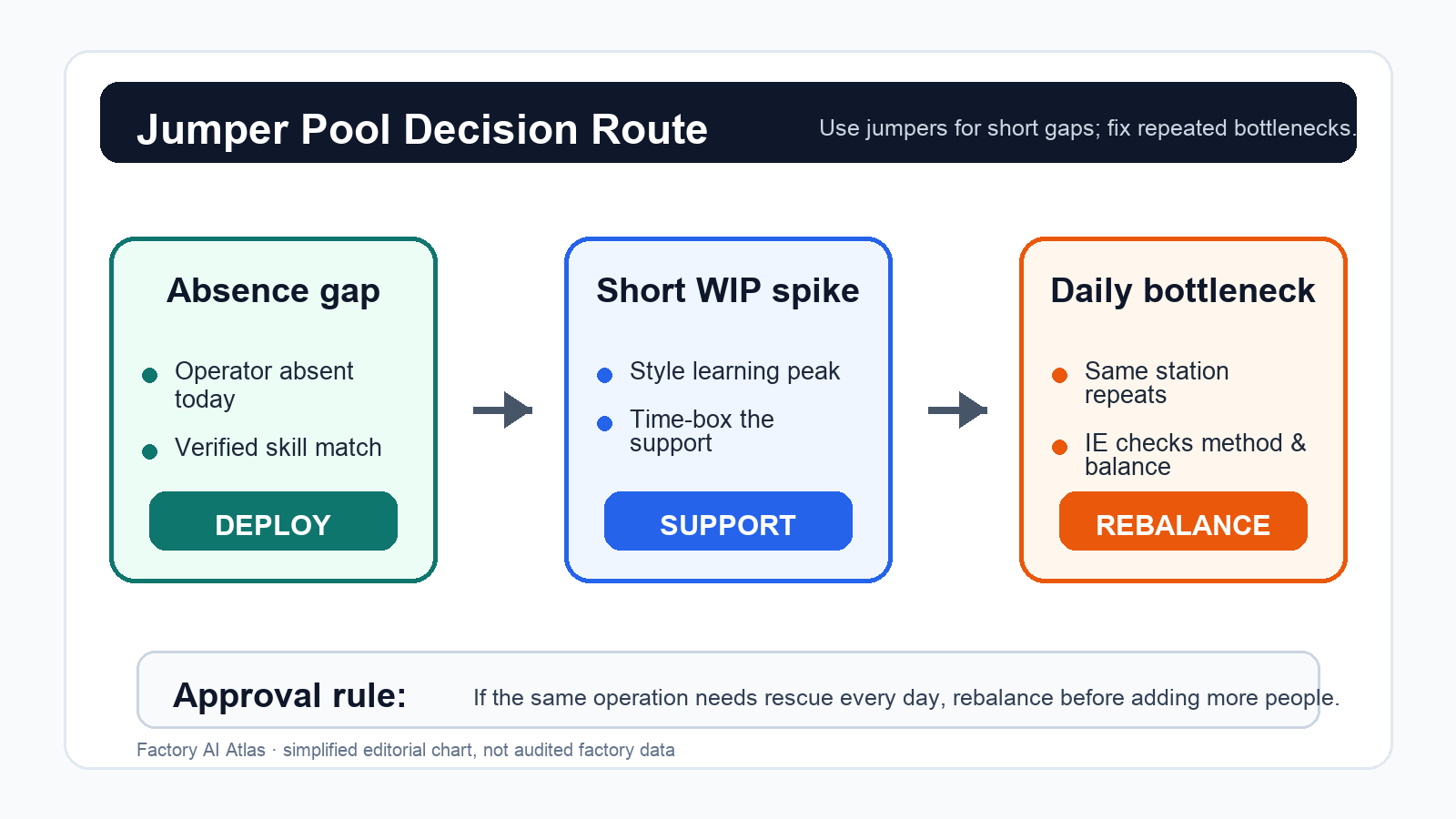
A jumper pool is useful only when the factory can separate three different problems: a temporary absence, a short WIP spike, and a repeated bottleneck. If those are mixed together, the pool becomes a polite name for daily firefighting. The practical question is not “how many jumpers do we need?” It is: which operation needs rescue, why does it keep happening, and what evidence proves the support recovered output without increasing defects?
The line-balance trap
The easiest mistake is to let the loudest line own the best flexible operators. A strong jumper may save the hour, but the factory learns nothing if no one records the reason, the operation, the before/after output, and the quality result. When the same station needs help every day, that is usually an IE, method, SMV, machine setup, helper-allocation, or layout question before it is a manpower question.
Evidence I would check before budget
- Absence pattern by line for 60–90 days, including Mondays, post-holiday days, and peak-season style changes.
- Bottleneck frequency by operation: which station repeatedly builds WIP before lunch or in the final production hour.
- Jumper deployment before/after evidence: hourly output recovery, DHU movement, waiting time, overtime, and whether the bottleneck simply moved downstream.
- Skill-matrix depth by operation, machine, fabric type, quality risk, and last verified deployment date.
- Repeated rescue on the same operation. If it keeps happening, the safer answer may be method improvement or line rebalance, not a larger jumper pool.
Proof I would ask from a workforce system
- Recommend jumpers using attendance, WIP, skills, SMV/SAM, quality, and current output together—not attendance alone.
- Keep a log of requested, approved, rejected, and revised deployments with supervisor, IE, and production-manager visibility.
- Flag overuse of the same high-skill operators and under-covered critical operations.
- Show whether deployment reduced lost output, defect risk, or overtime on real pilot lines, not only in a demo dashboard.
Approval gate: cover the gap or rebalance the line
GO when jumper deployment repeatedly recovers output at known short-term gaps without raising defect risk. HOLD when the skill matrix exists but deployment evidence is still manual, political, or incomplete. REDESIGN when the same station needs rescue every day; that is a line-balance or method problem before it is a jumper-pool staffing problem.
What Is a Jumper Pool System in a Garment Factory?
Jumper Pool systems help garment factories respond to absenteeism, bottlenecks, and urgent line support without turning every disruption into supervisor firefighting.
Jumper-pool implementation map
- What is a Jumper Pool system in a garment factory?
- Terminology: Jumper, floater, utility worker, swing operator
- Why traditional sewing lines break under absenteeism
- Prerequisites before building a Jumper Pool
- 5 practical benefits of a Jumper Pool
- Risks that must be managed
- 10-week implementation roadmap
- Simple KPI set for a Jumper Pool
- How this connects to Factory AI readiness
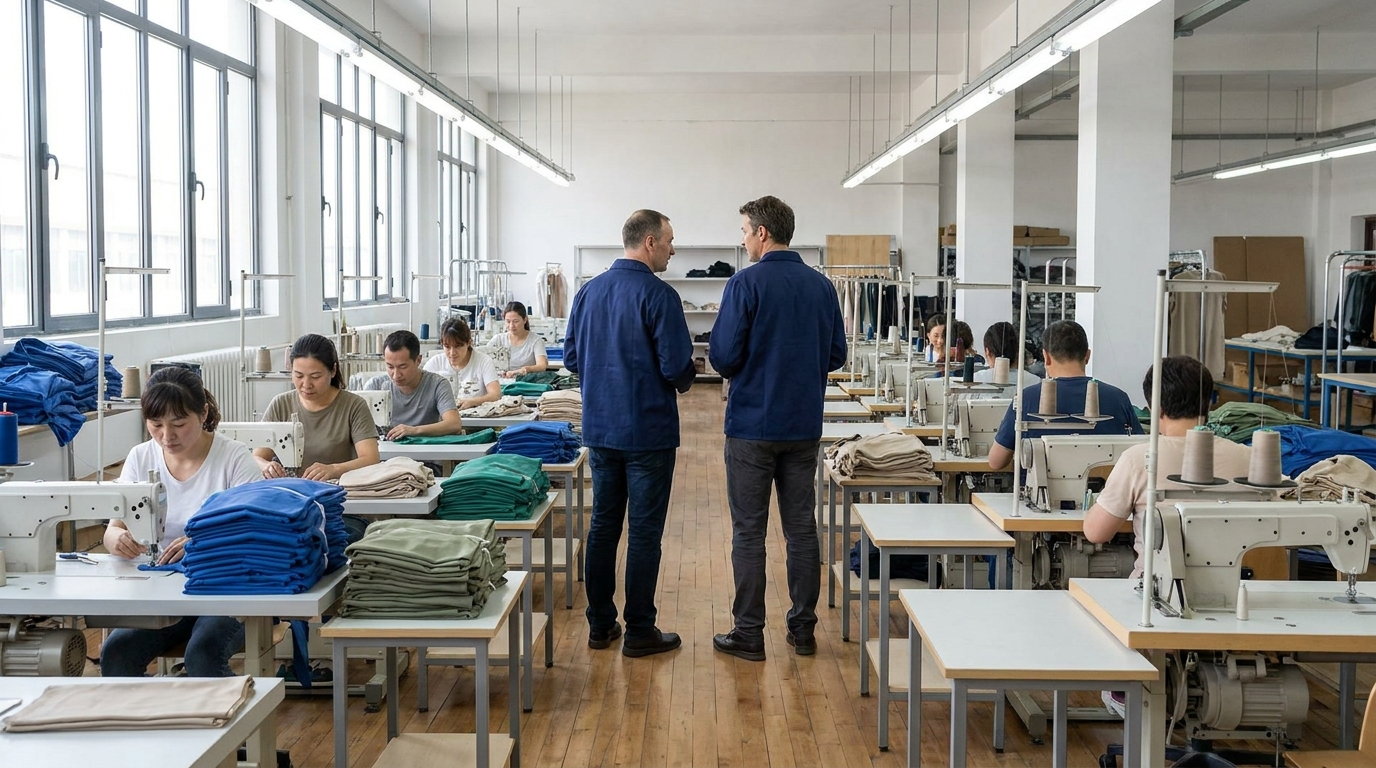
Walk through a high-volume garment sewing floor on a difficult Monday morning and the same pattern often appears: several operators are absent without much warning, one critical seam operation becomes a bottleneck before lunch, and the line supervisor starts moving the best workers from nearby stations to protect the daily output target. The first gap may be solved, but two new gaps appear somewhere else.
This is not only a supervision problem. It is a structural weakness in the traditional sewing line model. In many factories, each operator is trained deeply on one or two operations. That specialization can support strong efficiency when attendance is stable and the style is familiar. But when absenteeism, style complexity, or urgent rework appears, the line becomes fragile because too many stations depend on exactly the right person being present at exactly the right time.
A Jumper Pool system is one practical response to that weakness. In a garment factory, a Jumper Pool is a dedicated group of multi-skilled operators who are kept outside the normal line headcount and deployed to cover absences, bottlenecks, critical quality operations, samples, or special work. The best versions of the system are not informal “borrow one good operator from another line” arrangements. They are managed with a skills matrix, attendance data, deployment rules, ME/IE oversight, and a compensation structure that recognizes the higher flexibility expected from these operators.
For Factory AI Atlas, the topic matters because a Jumper Pool is also a factory AI readiness layer. Before a factory can use AI-assisted labor planning, it needs reliable operator skills data, daily attendance visibility, standard operation definitions, and a disciplined way to decide where flexible labor should go. The Jumper Pool system is a bridge between today’s manual sewing-floor problem solving and tomorrow’s data-assisted workforce planning.
This article explains what the model is, why it works, where it can fail, and how a garment factory can implement it without turning its best operators into an uncontrolled emergency resource. The main point is practical: a jumper pool should expose line-balance and skill-coverage problems, not hide them behind heroic daily firefighting.
Terminology: Jumper, Floater, Utility Worker, Swing Operator
Factories use different names for this role depending on country, management tradition, and IE background. The label is less important than the system design.
Common terms include:
- Jumper / Jumper Pool: Common in parts of Southeast Asia and Korea-managed factory environments. Usually implies a more structured pool model with ME/IE visibility, graded skill levels, and planned deployment.
- Floater / Floater Operator: Common in South Asia and apparel IE discussions. Often describes an operator who can cover different stations, but not always a formally managed pool.
- Joker: Used in some South Asian factory contexts for a worker who can be inserted at different points in the line when needed.
- Utility Worker / Utility Operator: Common in US and broader manufacturing language. Often refers to a multi-purpose operator with a recognized pay classification.
- Swing Operator: Informal factory-floor language in some apparel operations. It usually means an operator who can “swing” between stations.
- Flex Pool / Reserve Operator / Buffer Operator: More common in workforce planning, lean manufacturing, and scheduling discussions.
- Multi-Skilled Operative: A more formal term used in some manufacturing and HR systems.
The key difference is structural. A simple floater is often an individual solution. A Jumper Pool is an operating system: defined headcount, skill qualification, deployment SOP, ownership, utilization tracking, and premium compensation.
The Core Problem: Why Traditional Sewing Lines Break Under Absenteeism
The progressive bundle system remains common in export-oriented garment factories because it can deliver strong output when conditions are stable. Operators repeat specialized tasks, bundles move through a defined sequence, and line balance is calculated around standard times.
The weakness is that specialization creates single points of failure. If a high-skill or high-SAM operation is left uncovered, the whole line can slow down even if most operators are present. If a supervisor solves the gap by pulling a strong operator from another station, the original bottleneck may move rather than disappear.
Absenteeism makes this harder. Research and industry reports on manufacturing absenteeism show that replacement coverage often performs below normal productivity, especially when a co-worker or supervisor temporarily covers a station without the right preparation. In garment sewing, where output depends on rhythm, handling skill, machine setup, and operation familiarity, that productivity loss can compound across the shift.
Bottlenecks create a similar effect even when everyone is present. A difficult operation, a new style, a quality-sensitive seam, or an unstable machine can create work-in-process buildup. Without a trained flexible operator, the line has limited choices: wait, redistribute work informally, use overtime, or accept lower output.
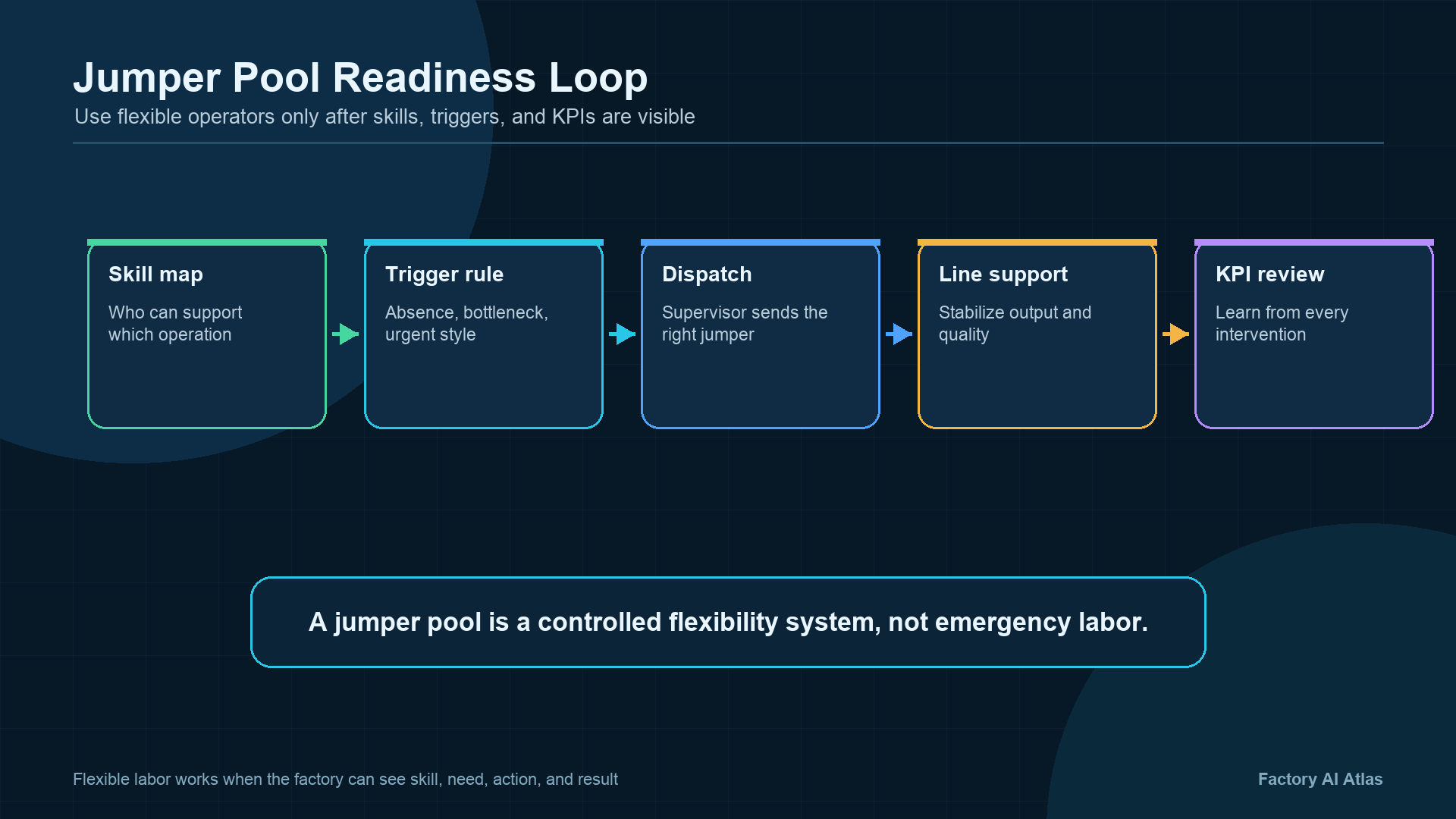
A Jumper Pool addresses these two problems with the same mechanism: pre-qualified operators who can be deployed quickly to the highest-impact gap.
Prerequisites Before Building a Jumper Pool
A Jumper Pool should not start as a motivational slogan. It needs operating discipline. The most common failure is launching the pool before the factory has enough data and control to deploy it properly.
1. A current skills matrix
A Jumper Pool cannot work if the factory does not know which operators can perform which operations at which level. The skills matrix should show:
- operation name and machine type,
- verified efficiency level,
- quality performance,
- last date of deployment or assessment,
- training status,
- whether the operator is approved for independent deployment.
Without this, the pool becomes guesswork. With it, ME/IE can decide which operator is suitable for a specific bottleneck or absence gap.
2. Reliable daily attendance data
Jumper Pool sizing should be based on real absence patterns, not instinct. The factory should analyze at least 60–90 days of attendance by line, day of week, department, and operation category. Monday absenteeism, post-holiday absenteeism, peak-season fatigue, and local events can all change the required pool size.
A factory does not need a complex AI system to begin. A clean daily attendance record and a simple dashboard may be enough. But the data must be timely and trusted.
The same logic applies to sewing line layout: flexible operators work best when flow direction, WIP movement, bottleneck visibility, and supervisor control are already clear.
3. Clear deployment triggers
If every line supervisor can freely request the best Jumper at any time, the pool will quickly become political and inefficient. The deployment SOP should define:
- which absences qualify for immediate coverage,
- which bottleneck conditions trigger support,
- who approves deployment,
- how long the Jumper stays at the station,
- how response time is recorded,
- when a Jumper should return to the pool.
For most factories, ME/IE or production management should control deployment priority, while line supervisors provide real-time signals.
4. Cross-training infrastructure
A Jumper Pool needs more than skilled people. It needs a training system that can keep skills current. That includes operation breakdowns, standard work instructions, training machines, quality checkpoints, and periodic reassessment.
One practical rule is to avoid overtraining too broadly at the beginning. A Jumper does not need to cover every operation in the factory. The first phase should focus on high-impact operations: critical bottlenecks, high-absence coverage points, and quality-sensitive operations.
5. Compensation and grade design
Factories often make the mistake of selecting their best operators for flexible deployment while paying them exactly like standard line operators. That creates resentment and turnover risk.
A Jumper role usually requires broader skill, higher adaptability, and more pressure. The compensation structure should reflect that. It can be a grade premium, skill allowance, attendance-linked premium, or performance-linked incentive. The design must be clear before recruitment begins.
The Case For: What a Jumper Pool Can Improve
1. Production stability during absence shocks
The most direct benefit is stability. When several operators are absent, the factory does not need to improvise from zero. A prepared Jumper Pool can cover the most critical gaps first.
The goal is not to make every operator fully interchangeable. In practice, the best return often comes from covering a limited number of high-impact operations: the stations that stop the line, create quality risk, or block downstream flow.
In factories with reliable skills data and disciplined deployment, a Jumper Pool may help protect a meaningful share of planned output on difficult attendance days. The result will vary by style, line balance, absenteeism pattern, and skill depth, so it should be measured locally rather than treated as a universal benchmark.
2. Faster bottleneck response
A bottleneck is expensive because it affects more than one station. When work piles up before a critical operation, downstream operators may wait, supervisors may reshuffle labor, and WIP becomes harder to control.
A trained Jumper can temporarily double a bottleneck operation, support a quality-sensitive step, or stabilize the station while IE checks the method. This improves the performance side of OEE by reducing speed loss and waiting time.
In practice, I would separate three cases before approving jumper support: a short absence gap, a temporary WIP spike during style learning, and a repeated bottleneck on the same operation. The first two can justify flexible support. The third usually requires IE to check SMV, method, attachment setup, helper allocation, or line layout before the factory simply adds more jumpers.
3. Better use of the skills matrix
Many factories build a skills matrix but do not use it as a daily management tool. A Jumper Pool gives the matrix a practical purpose. The matrix becomes the basis for:
- who can be deployed,
- who needs refresher training,
- which operations are under-covered,
- which lines are too dependent on a few key people,
- where future training should focus.
This is exactly the kind of operational data discipline that supports future AI-assisted planning.
4. Reduced disruption from samples, rework, and special work
Samples, buyer comments, urgent rework, small lots, and pilot runs often interrupt bulk production. If the factory has no flexible capacity, these jobs are handled by pulling strong people from lines at the worst possible time.
A Jumper Pool can reserve part of its capacity for controlled non-volume work. That does not mean Jumpers become a sample room. It means the factory has a defined resource to absorb urgent tasks without damaging line balance every time.
5. Stronger quality protection at critical operations
Some operations carry higher quality risk: collar setting, sleeve setting, topstitching, waistband, placket, pocket placement, bonding, seam sealing, and visible outerwear details. If a poorly trained replacement covers these operations, the line may keep moving but defects can rise.
A properly qualified Jumper can protect Right First Time performance better than an improvised replacement. This is especially important on styles with strict buyer standards or complex workmanship.
The Case Against: Risks That Must Be Managed
A Jumper Pool is not a silver bullet. It can fail if the factory treats it as free emergency labor.
1. Skill dilution
Multi-skilling can create a “jack of all trades, master of none” problem. If an operator is trained on too many operations but rarely practices them, the skill becomes shallow. When deployed under pressure, the operator may be slower than expected or may create quality risk.
To prevent this, the factory should define a skill maintenance rule. For example, each Jumper should regularly practice or be assessed on core operations, and the skills matrix should show whether the skill is current.
2. Removing the best operators from the line
The first Jumper candidates are usually the best operators. If management pulls too many strong people from one line, that line may lose its natural stability. The pool then creates the problem it was meant to solve.
The safer approach is phased selection. Do not remove multiple top performers from the same line at once. Replace skill capacity gradually and use training to backfill the line.
3. Premium cost without enough utilization
A Jumper Pool has a cost. If absenteeism is low and bottlenecks are rare, the premium may not be justified. If the pool is too large, underutilization becomes visible quickly.
This is why sizing should begin small. Start with a pilot, measure utilization, and expand only when the data supports it.
4. Supervisor conflict
Line supervisors may compete for the best Jumpers. Some may try to keep a Jumper longer than needed. Others may use the pool to hide line management problems.
The deployment SOP must prevent this. Jumper Pool performance should be reviewed by ME/IE and production leadership, not only by individual line supervisors.
5. Morale and identity issues
Jumpers move between teams. They may not feel the same line identity as standard operators. Other workers may see them as privileged if the premium is not explained well.
Factories should make the role transparent: what skills are required, how selection works, how pay is structured, and how standard operators can qualify in the future.
A Phased Implementation Roadmap
This roadmap is designed for a controlled pilot. Pool size should be calculated from verified absence patterns, critical-operation coverage, skill depth, and expected utilization—not copied from another factory.
Phase 1: Build the data foundation
- Update the sewing skills matrix.
- Review 60–90 days of attendance data.
- Identify critical operations by style family and line type.
- List bottleneck operations from recent line balancing records.
- Screen a candidate group larger than the initial pool so selection does not depend on a single line or a few top performers.
- Define the Jumper grade or allowance structure with HR.
Phase 2: Select and validate candidates
- Confirm candidate attendance reliability.
- Check quality history and defect patterns.
- Test candidates on priority operations.
- Confirm attitude, adaptability, and willingness to move between lines.
- Avoid selecting too many top operators from the same line.
Phase 3: Train and certify
- Train candidates on the initial priority operation set.
- Use operation breakdown sheets and standard method videos where available.
- Set minimum deployment standards for efficiency and quality.
- Mark skills as “training,” “approved,” or “needs refresh” in the matrix.
- Prepare a simple deployment log.
Phase 4: Pilot on selected lines
- Start with a limited group of comparable pilot lines, not the whole factory.
- Track absence coverage, bottleneck support, response time, utilization, and quality results.
- Record who requested deployment and who approved it.
- Review cases where the Jumper did not improve the situation.
Phase 5: Review and standardize
- Compare pilot lines against similar lines without Jumper support.
- Review utilization versus wage premium.
- Adjust pool size, training scope, and deployment triggers.
- Confirm monthly review ownership under ME/IE and production management.
- Decide whether to expand, pause, or redesign.
What a Short Factory Observation Changed in This Framework
A short, anonymized observation from one apparel factory added an important lesson to this framework. The early improvement did not begin with a larger labor pool or a more complex workforce system. It began with better timing.
Line leaders shared expected absences before the next shift. Management then matched available multi-skilled operators to the affected lines and operations before production started. The assigned operators could report directly to the designated workstations instead of waiting for supervisors to identify gaps after the line was already running.
This matters because the first production hour often reveals whether a flexible-labor system is working. If the factory waits until WIP has already accumulated, a Jumper may recover part of the loss but still spend the rest of the shift chasing a bottleneck that could have been anticipated.
The observation showed a positive early signal in first-hour output and daily operating stability. It does not prove that the Jumper Pool alone caused the improvement. The review period was short, and the available summary did not isolate daily absence severity, actual Jumper deployment, skill-match accuracy, quality effects, overtime, or unused Jumper time.
The practical lesson is narrower: advance absence information, pre-shift skill matching, and a deployment record are more important than simply deciding how many Jumpers a factory should have.
Field evidence boundary: This operating pattern is based on a short, anonymized observation from one apparel factory. Company, location, people, dates, line counts, staffing levels, compensation, and raw production records are withheld. The observation is a practical operating signal, not a universal benchmark or causal proof.
Simple KPI Set for a Jumper Pool
A Jumper Pool should be measured like an operating system, not only as a headcount group.
Recommended KPIs:
- Utilization rate: percentage of available Jumper hours used for approved deployment.
- Response time: time from approved trigger to station coverage.
- Skill-match accuracy: percentage of deployments where the Jumper’s verified skills match the assigned operation, machine, and quality risk.
- Bottleneck recovery: change in output or WIP at the supported operation.
- RFT impact: defect rate at operations covered by Jumpers.
- Absence coverage value: output protected during absence events.
- Skill freshness: percentage of approved skills practiced or reassessed within the defined period.
- Advance absence notice rate: percentage of next-shift absence forecasts submitted before the factory’s fixed daily cutoff.
- Pre-shift placement rate: percentage of required Jumper assignments confirmed before production starts.
- First-hour recovery: change in first-hour output loss after an approved Jumper deployment.
- Repeat-rescue rate: percentage of support requests coming from the same operation; repeated rescue should trigger an IE, method, SMV, setup, or line-balance review.
- Unused Jumper time: unassigned hours and how that time was used for training, method improvement, or skill refresh.
- Supervisor compliance: percentage of deployments following SOP.
These KPIs make the pool visible. They also prepare the factory for more advanced workforce analytics later.
How This Connects to Factory AI Readiness
AI does not fix missing operating discipline. If a factory wants AI-assisted planning in labor allocation, line balancing, or absenteeism response, it first needs clean basic data.
A Jumper Pool creates demand for exactly that data:
- operator skill levels,
- operation difficulty,
- standard time,
- attendance patterns,
- bottleneck frequency,
- quality risk by operation,
- deployment outcomes.
This is why the Jumper Pool should not be seen only as a labor buffer. It is also a practical data system. It teaches the factory which skills matter, where flexibility is missing, and which operations create the most disruption.
For factories still early in digital transformation, this is a realistic step between manual firefighting and AI-assisted production management.
Final jumper-pool operating takeaway
A Jumper Pool system is a structured buffer against two everyday realities of garment manufacturing: workforce absence and bottleneck volatility. It works best when the factory measures before it builds, trains before it deploys, and gives ME/IE clear ownership of deployment rules.
The model should not be sold as a universal cure. Its value depends on local attendance patterns, style complexity, skill depth, compensation design, and management discipline. When those prerequisites are visible, a Jumper Pool becomes more than backup labor: it becomes a controlled way to see which factory problems are temporary gaps and which ones need IE correction before more people are added.
Next in this series: Skills Matrix 2.0 — How AI-Assisted Operator Profiling Is Changing Cross-Training Decisions in Apparel Factories.
Sources and Further Reading
This article uses public industry references for context. Benchmarks should be validated against each factory’s own attendance, skill and line-balance data before implementation.
- CBI — Tips to increase efficiency in an apparel factory
- TeamSense — Absenteeism and manufacturing productivity
- Lean Production — Understanding OEE
- Textile Study Center — Modular Production System / Toyota Sewing System
- NCBI / PMC — Compensation systems in apparel manufacturing
- NCBI / PMC — Assembly operation productivity in garment manufacturing
- IJERT — Productivity improvement through lean manufacturing tools
Jumper-pool decision source anchors
- ILO textiles and apparel resources — useful for grounding labor deployment and skills discussion in apparel-sector realities.
- Better Work reports and publications — helpful context for factory improvement, workforce systems, and production discipline.