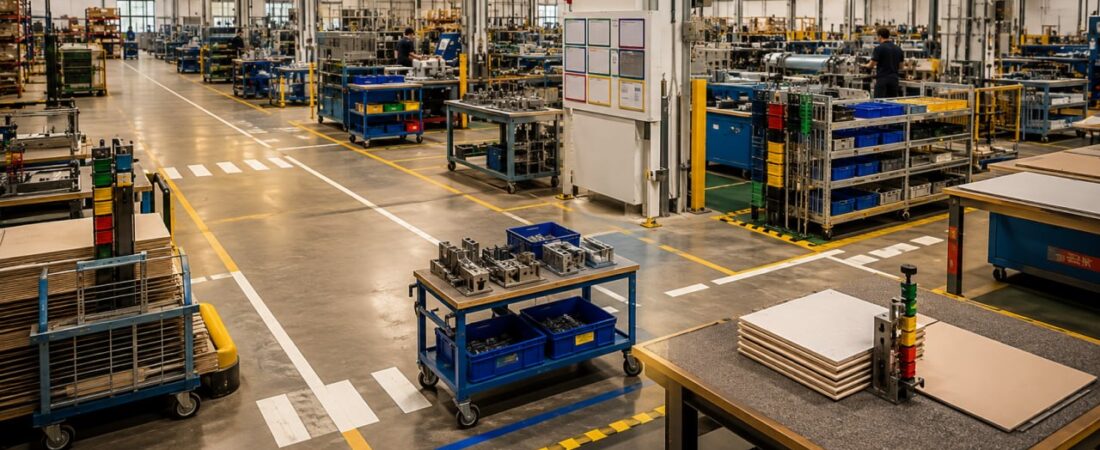
Visible-process-limit action note
Visible process limits are useful only when they trigger a same-shift action. A floor line, height gauge, shadow board, color mark, or digital threshold should tell the operator and supervisor what is acceptable, what is drifting, and who must act before the problem becomes late output or quality loss.
Visual standards become decoration
The common mistake is to install visual standards as decoration. If the factory does not define the owner, reaction rule, escalation path, and audit rhythm, the limit becomes background scenery and the AI layer later learns inconsistent behavior.
Checks before funding visible process limits
- Which decision does the visual limit control: stop, replenish, adjust, inspect, escalate, or release?
- Can operators explain the standard without reading a policy document?
- Does the supervisor record exceptions often enough for AI or dashboard logic to learn from them?
Proof requests for visual-control vendors
- Show how physical limits, sensor thresholds, dashboard alerts, and supervisor actions are connected.
- Provide before/after evidence for waiting, rework, over-height stacking, blocked aisles, or missed replenishment.
- Demonstrate how the system handles a visible-standard breach: who sees it, who owns it, and what closes the loop.
Work-point action gate
GO if the visible limit changes behavior at the work point. HOLD if the standard is clear but exception logging is weak. REDESIGN if the factory is adding AI alerts before basic physical limits are trusted.
Visible process limits are one of the simplest factory readiness layers that AI projects often skip.
The release test is not whether the line or gauge is visible; it is whether the operator, supervisor, and auditor all know the reaction rule when the limit is crossed.
Factories usually discuss AI in terms of dashboards, cameras, sensors, predictive models, robotics, or automated decision-making. But before AI can improve a factory decision, the factory must answer a more basic question: can people see the physical standard at the exact point where the work happens?
A standard that stays inside a manual, drawing, audit file, buyer requirement, or supervisor’s memory is weak at the moment of work. It may be technically correct, but it is not operationally visible. Workers still need to judge distance, height, alignment, stacking, clearance, loading, orientation, or quality limits in real time.
That is why visual standards matter. A parking line, a floor marking, a height gauge, a jig, a fixture, a color zone, or a go/no-go gauge can move the standard into the worker’s field of view. This is not a small cosmetic issue. It is part of factory operating discipline.
The lesson for Factory AI is simple: AI cannot optimize a process that the factory itself has not made visible, measurable, and enforceable.
A Simple Reference Line Can Change Behavior
A useful way to understand this is through a familiar example: a parking reference line. If the useful reference point is only on the ground, the driver may not see it well from inside the vehicle. When the same reference is moved vertically into the driver’s field of view, the driver can align more easily.
The important idea is not the line itself. The important idea is that a hidden or poorly positioned standard becomes a visible decision aid.
Factories have the same problem every day. A rule may exist, but it may not be visible at the point of work. A clearance limit may be written in a safety document. A stacking height may be known by an experienced supervisor. A fixture position may be explained during training. A buyer cutting rule may sit inside a manual. But during real production, workers need the standard in front of them.
This is where visible process limits become important.
What Visible Process Limits Mean in a Factory
Visible process limits are physical standards placed where work decisions happen. They help workers judge whether the current condition is acceptable, close to risk, or outside the allowed range.
They can appear in many forms:
- Floor lane markings and pedestrian crossings
- Forklift clearance zones and loading boundaries
- Stacking height guides for pallets, cartons, or material carts
- Color-coded height gauges
- Go/no-go gauges for size, clearance, or fit
- Fixture alignment marks and jig position references
- Material staging zones and buffer limits
- Pre-process quality gates before cutting, assembly, packing, or loading
These tools may look simple, but they create a common language between workers, supervisors, quality teams, safety teams, and future digital systems. The visible standard says: this is the limit, this is the warning zone, and this condition requires action.
This is close to the practical discipline behind factory workflow design. A dashboard is not enough if the worker still cannot see what action is expected on the floor.
Why Factory AI Needs Physical Standards First
AI needs signals. But many factories want AI before they have clear operating signals.
If a factory cannot define the limit, show where the limit is, record when the limit is exceeded, and connect the exception to a quality, safety, cost, or delay outcome, AI has very little practical context. It may detect noise, but it will not understand the operating reason behind the problem.
This is why factory AI readiness measurements should include visible physical control points, not only digital data fields. The factory should know which physical limits matter before trying to automate decision support.
For example, a computer vision system may eventually detect a blocked aisle, an overloaded cart, a misaligned part, or an over-height stack. But before that system can be useful, the factory must define what “blocked,” “overloaded,” “misaligned,” or “over-height” actually means at that process.
Physical standards make those definitions visible.
Example: Fabric Height Control on a Cutting Table
A garment cutting room gives a concrete example, even though the principle applies across manufacturing.
In apparel production, a fabric height identification device can be placed directly on the cutting table beside the fabric lay. The operator compares the current fabric stack against a color-coded inch scale before cutting starts. The device may show green, yellow, and red zones to separate normal, warning, and high-risk height ranges.
This is not an AI tool by itself. It is a buyer-regulation and quality-control support device. It helps the cutting team confirm whether the current lay height matches the approved standard for the fabric type, buyer requirement, marker plan, and cutting method.
The reason is practical. Thin woven fabric, thick fleece, denim, stretch fabric, slippery satin, padded fabric, mesh, and coated materials do not behave the same way during spreading and cutting. Some compress. Some shift. Some recover after cutting. Some distort when the ply height is too high. Some buyers also define specific cutting limits to prevent defects.
A table-level height gauge makes that rule visible before the blade touches the fabric. It turns a buyer standard and QC judgment into a shop-floor signal.
Actual field example: cutting-table height gauge
This is the kind of low-cost visual control the article is describing. The photo shows a garment cutting table with red fabric lay and color-coded inch gauges placed where the cutting-room team can compare the real stack height against an agreed limit before cutting starts.
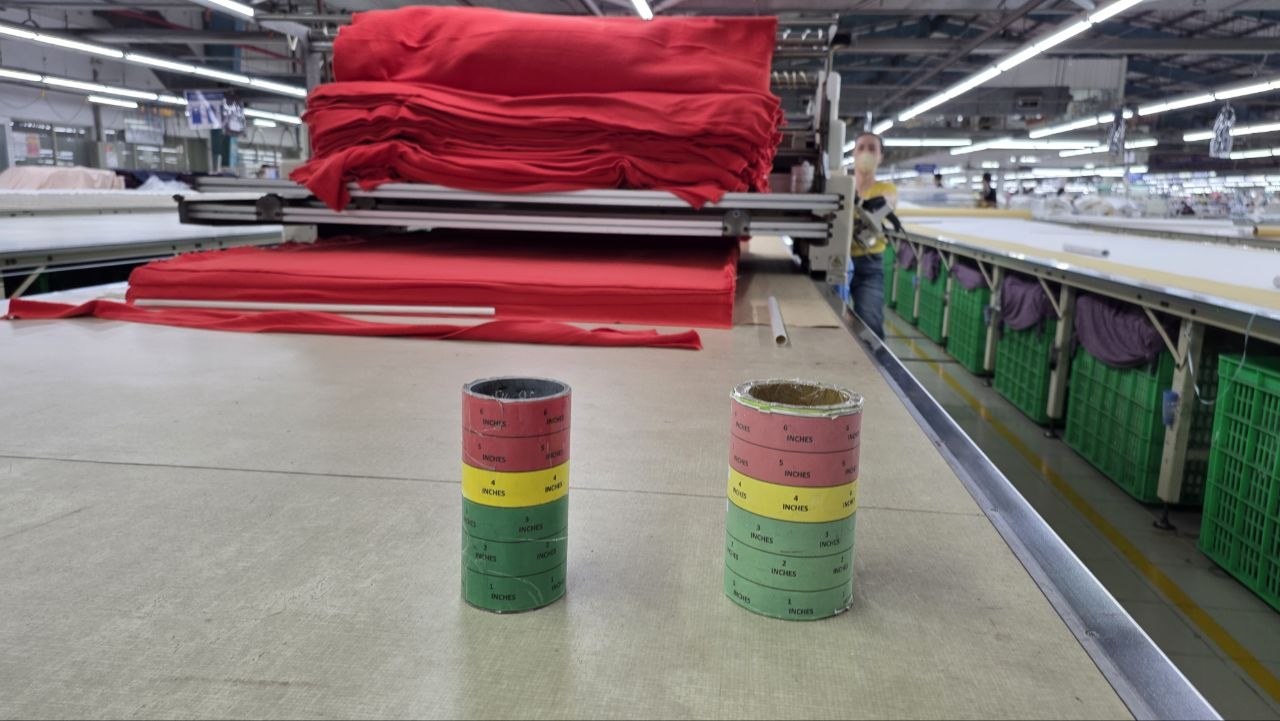
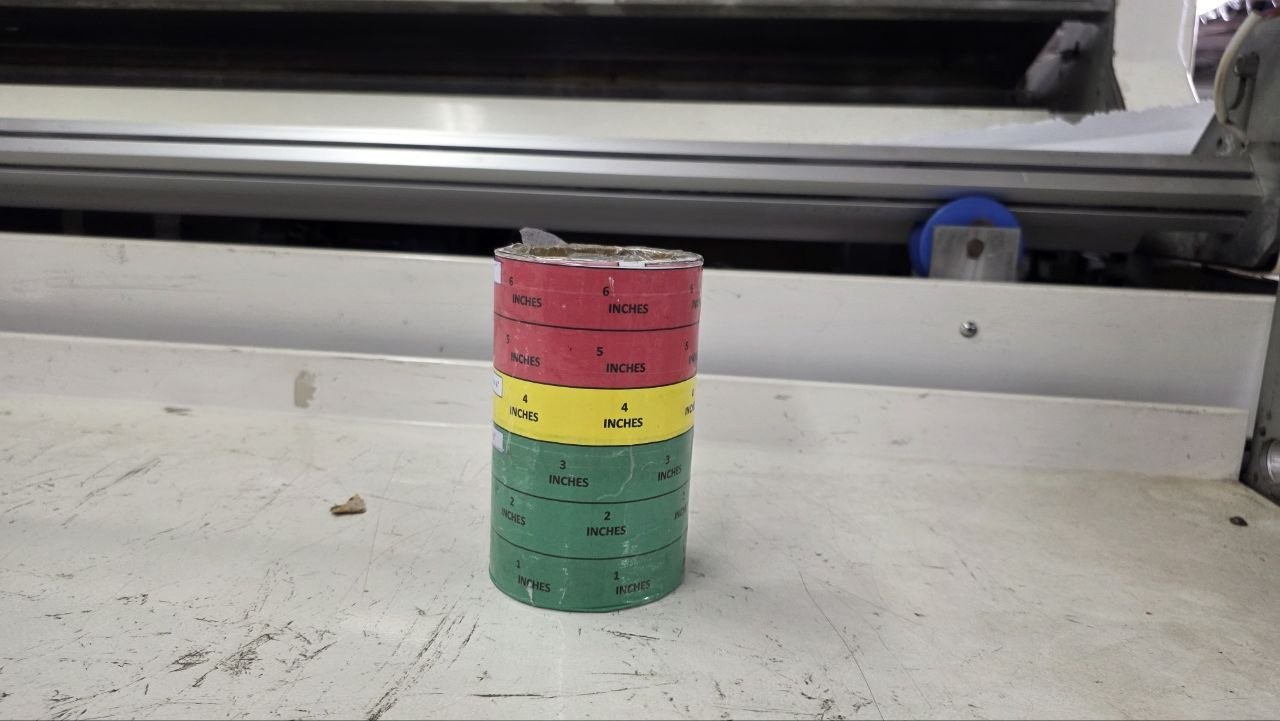
Factory use: treat the gauge as a control point, not decoration. The team should record the fabric type, approved lay height, actual stack height, cutter method, and defect feedback when height limits are exceeded.
The Same Principle Applies Beyond Apparel
The apparel example is useful because it is concrete. But visible process limits are not garment-specific.
- In a warehouse, pallet stacking height and forklift clearance zones define safe movement limits.
- In automotive or metal parts, fixture alignment marks and go/no-go gauges prevent incorrect assembly.
- In electronics assembly, component orientation guides and ESD zones reduce handling risk.
- In food or packaging, fill-height checks and carton stacking limits support quality and safety.
- In general assembly, material staging lines and tool placement outlines reduce searching, waiting, and movement waste.
The U.S. Occupational Safety and Health Administration’s walking-working surface rules emphasize that workplaces should be kept clean, orderly, and sanitary, including safe access and passage conditions. That is not an AI rule, but it shows the same operational reality: physical conditions on the floor matter before digital systems can help. The standard must be visible enough for people to act on it. See OSHA 1910.22.
AI risk and governance frameworks also remind factories that automated systems need context, accountability, and reliable operating conditions. The NIST AI Risk Management Framework is not a shop-floor checklist, but it reinforces the broader point: AI decisions should be connected to real-world conditions and risk management, not treated as isolated model outputs.
From Visual Standard to AI-Ready Signal
A visible process limit becomes more valuable when the factory records what happens around it.
The sequence can be simple:
- Define the physical limit.
- Make the limit visible at the point of work.
- Train workers to judge pass, warning, or hold.
- Record exceptions when the limit is exceeded.
- Connect exceptions to defects, delays, safety events, cost loss, or rework.
- Use the pattern later for dashboards, sensors, or AI support.
This is how a low-tech visual standard becomes a high-value factory signal.
For a broader readiness view, this connects directly with factory AI readiness. A factory that cannot see its physical limits will struggle to use AI responsibly. A factory that can see, record, and review those limits has a much stronger foundation.
7 Factory Checks Before AI Decisions
Before investing in factory AI, teams can ask these seven questions:
- What physical limit must the worker follow at this process?
- Is that limit visible at the exact point of work?
- Can the worker judge pass, warning, or hold without waiting for a supervisor?
- Is the limit connected to a quality, safety, cost, or compliance risk?
- Are exceptions recorded when the process exceeds the limit?
- Can defects or delays be traced back to the limit condition?
- Could this visual standard later become a sensor, dashboard, or AI signal?
If the answer is no to most of these questions, the first improvement may not be AI. It may be a better physical control point.
Final visible-process-limit takeaway
Factories do not become AI-ready only by adding cameras, dashboards, or predictive models. They become AI-ready when people and systems can see the same operating reality.
Visible process limits help create that shared reality. They turn hidden rules into physical signals. They make exceptions easier to detect. They help supervisors and QC teams act before problems spread. And they give future AI systems a cleaner operating context.
A parking line, a height gauge, a jig, a fixture, a clearance marker, or a go/no-go gauge may look simple. But each one teaches the same lesson: make the standard visible where the work happens.
External validation anchors for visible process limits
- NIST manufacturing resources — useful for grounding visible limits in repeatable measurement and process-control discipline.
- OSHA safety and health management guidance — relevant for linking visible standards, worker action, and operational control.