Factory data-layer release note
A factory AI data layer should be treated as the translation layer between machine events and management decisions. PLC, MES, ERP, maintenance, quality, and safety data are useful only when the factory knows which event changes which decision and who owns that decision.
Connected systems still miss operating events
The common mistake is to connect systems before defining operating events. A live integration can still be low value if it only moves reports faster while downtime, quality holds, maintenance signals, and work-instruction exceptions remain undefined.
Checks before funding PLC-to-ERP AI data work
- Which shop-floor events need real-time action, and which only need daily review?
- Can every key event be linked to time, asset, product, order, operator or team, reason code, and closeout action?
- Does the data layer preserve context when information moves from PLC or device level into MES, ERP, or AI tools?
Proof requests for factory data-layer vendors
- Show a real event flow from sensor or PLC signal to supervisor action and ERP/MES record update.
- Demonstrate handling of missing signals, duplicate events, delayed data, manual override, and master-data mismatch.
- Provide a governance view showing event definitions, owners, retention, access control, and audit history.
Data-layer decision gate
GO if the layer turns events into timely operating decisions. HOLD if connections work but event definitions are incomplete. REDESIGN if the project is only an integration exercise with no decision owner.
Factory AI data layer readiness is the first question manufacturers should ask before choosing models, dashboards, or automation tools.
The practical release question is whether PLC, MES, ERP, quality, maintenance, and safety signals can be traced back to a real operating event, not only whether the systems can technically exchange data.
Factory AI is becoming easier to imagine.
Manufacturers now hear about AI for visual inspection, predictive maintenance, safety documentation, work instructions, production planning, robotics, and supplier coordination. The promise is attractive: faster decisions, fewer defects, better visibility, and less manual follow-up.
But many factories are not blocked by the absence of AI.
They are blocked by the absence of a connected data layer. In practical terms, the factory AI data layer is missing or too fragmented to trust.
Before asking whether a factory is ready for AI, a better question is:
Can the factory capture the right event, connect it to the right system, and trust it when a decision is needed?
That question brings us back to an older but still useful idea: the automation pyramid.
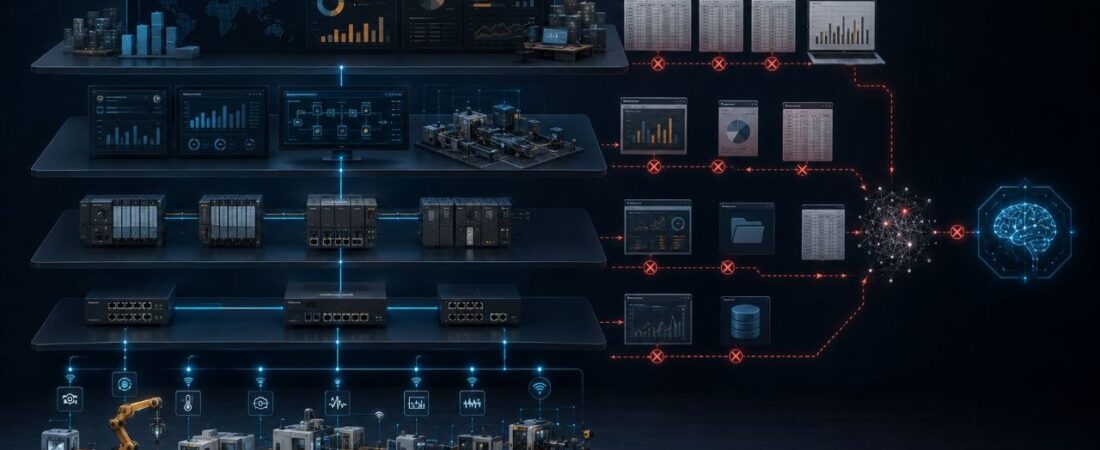
The automation pyramid is often used to describe how industrial data moves from machines and sensors at the bottom, through control and supervisory systems, into manufacturing execution and business systems. In many factories, this structure still explains why data is delayed, duplicated, or lost before it reaches decision makers.
AI does not remove this problem. AI makes the problem more visible.
Article map for factory readers
- The automation pyramid and factory AI data layer
- Why AI needs events, not only reports
- Seven checks before factory AI
- How to start with one decision flow
1. The Automation Pyramid Is Still Relevant
A typical factory data structure includes several layers.
At the lowest level are machines, sensors, actuators, and devices. These capture physical events: temperature, speed, pressure, machine state, output count, downtime, or alarm signals.
Above that are PLCs and control systems. They help execute machine logic and control physical processes.
Above that are systems such as SCADA or HMI, where operators and engineers monitor equipment status, alarms, and process conditions.
Above that are MES or MOM systems, where production orders, work-in-progress, labor, quality, downtime, and material flow are managed.
At the top are ERP and business systems, where orders, inventory, costing, purchasing, finance, and customer commitments are managed.
In theory, data should move upward from the shop floor to business decisions, while plans, orders, and instructions move downward from business systems to operations.
In reality, many factories still depend on manual updates, Excel files, chat messages, handwritten logs, delayed reports, and supervisor memory.
That is where AI readiness usually breaks.
2. AI Needs Factory Events, Not Just Factory Reports
Many factories already have reports: daily output reports, quality summaries, downtime summaries, shipment updates, and production meetings.
But AI needs more than finished reports. AI needs structured, timely, and reliable events.
- A visual inspection model needs defect images, labels, inspection conditions, and review decisions.
- A maintenance model needs machine condition signals, downtime records, alarm history, and repair actions.
- A planning model needs live WIP, material status, capacity, changeover constraints, and delivery priorities.
- A safety assistant needs verified procedures, machine manuals, hazard controls, and human approval.
- A costing or margin model needs actual labor, rework, material loss, output rate, and order history.
If the factory only has weekly summaries or manually edited reports, AI may produce polished answers without operational truth. That is a risk.
Factory AI should not be built on presentation data. It should be built on operational evidence. A factory AI data layer is the operating evidence that allows AI to support real decisions.
3. Seven Data Layer Checks Before Factory AI

Before investing in a factory AI project, manufacturers should check seven areas. These checks test whether the factory AI data layer is reliable enough for one decision flow at a time.
Check 1: Can Shop-Floor Events Be Captured?
The first question is simple: can the factory capture what actually happened?
- machine running or stopped
- output quantity
- downtime reason
- defect occurrence
- rework event
- material shortage
- operator intervention
- maintenance action
- line changeover
- QC approval or rejection
In highly automated factories, this may come from sensors, PLCs, machine logs, or SCADA systems.
In labor-intensive factories, the first data layer may look different. It may start with barcode scans, bundle tickets, QC photos, digital checklists, supervisor exception logs, or line output boards.
The point is not to automate everything at once. The point is to capture key events in a repeatable way. If the event is not captured, AI cannot use it.
Check 2: Is the Data Connected to the Right System?
Capturing data is only the first step. The next question is: where does the data go?
A machine alarm that stays inside one machine screen may help an operator, but it may not help maintenance planning. A QC defect photo that stays in a phone gallery may help one inspector, but it may not help root cause analysis. A material shortage written in a notebook may help today’s supervisor, but it may not help tomorrow’s production plan.
- machine data to maintenance and engineering
- quality data to production, supplier, and corrective action
- WIP data to planning and delivery control
- material data to purchasing and inventory
- labor and output data to costing and capacity planning
The main challenge is often not the lack of data. It is that data is stuck in separate systems, separate files, or separate teams.
Check 3: Is There a MES or Operations Layer?
Many factories try to connect shop-floor activity directly to ERP. That is often difficult.
ERP is usually designed for business transactions: purchase orders, inventory, invoices, costing, sales orders, and finance. It is not always designed to manage second-by-second or minute-by-minute production reality.
This is where MES or MOM becomes important. A manufacturing execution layer can connect production orders, WIP, quality, labor, downtime, material use, and operational performance.
- Excel production trackers
- manual WIP sheets
- separate QC logs
- supervisor chat groups
- unofficial planning files
- duplicated reports for different departments
These work for a while. But they make AI difficult because the factory has no single operational layer to trust.
Where does production reality live?
If the answer is “in many files and people’s heads,” the first AI project should probably be a data discipline project.
Check 4: Can Quality Evidence Be Linked to Production?
AI inspection is one of the most attractive use cases in manufacturing. But visual AI does not begin with the model. It begins with quality evidence.
- What defect occurred?
- Where was it found?
- Which line, machine, operator, material lot, supplier, or process was involved?
- What image or measurement proves the defect?
- Who reviewed it?
- What corrective action followed?
- Did the issue repeat?
If quality evidence is disconnected from production data, AI inspection becomes limited. The model may detect defects, but the factory may still struggle to answer the business question: why did this happen, and what should we change?
For factory AI, defect detection is only one part of the value. The larger value comes when quality evidence connects to root cause analysis, supplier performance, process control, training, and prevention.
Check 5: Can Maintenance Signals Become Decisions?
Predictive maintenance is another common AI use case. But maintenance AI needs more than a sensor.
It needs a reliable link between machine condition, downtime, maintenance history, spare parts, production impact, and repair decisions.
A useful signal could come from vibration, temperature, current, sound, pressure, cycle time, or alarm history. In some factories, even a simple repeated abnormal sound or downtime pattern can become an early warning signal if it is captured and validated.
- Do we record downtime reasons consistently?
- Do we know which failures repeat?
- Do we link repair actions to machine history?
- Do we know the production cost of each stoppage?
- Do maintenance teams trust the data?
AI can help predict problems, but only if the factory has enough historical evidence to learn from and enough operational discipline to act on the result.
Check 6: Are Safety and Work Instructions Verified?
AI can help draft documents, summarize manuals, generate checklists, or support job safety analysis. This can save time.
But safety-critical outputs must be treated carefully.
A factory should not treat an AI-generated safety document as an authority. It should treat it as a draft that requires review against official procedures, machine manuals, regulatory guidance, and qualified human judgment.
The same applies to work instructions. AI can help organize steps, simplify language, translate instructions, or convert technical manuals into training content. But if the underlying procedure is outdated, incomplete, or not approved, AI may only make the wrong instruction easier to distribute.
- Which procedure is the approved version?
- Who is responsible for review?
- How are changes controlled?
- Are machine manuals and risk assessments available?
- Can workers access the latest instruction at the point of work?
- Is there a feedback loop when reality differs from the document?
In factory AI, document generation is not the hard part. Governance is the hard part.
Check 7: Can Data Support Real Decisions Across Teams?
The final check is coordination. Factories do not make decisions inside one system.
A delivery decision may require order status, material availability, line capacity, quality risk, labor availability, machine condition, and customer priority.
A sourcing decision may require supplier capability, cost, lead time, quality history, compliance evidence, and production flexibility.
A production planning decision may require WIP, bottlenecks, changeover time, inspection results, material status, and shipment deadlines.
AI can help coordinate these decisions, but only if the underlying data can cross departmental boundaries.
The next bottleneck in manufacturing AI is not only smarter models. It is the coordination layer that connects design intent, factory capacity, quality evidence, material status, and delivery decisions.
AI Does Not Fix a Disconnected Factory
AI tools are improving quickly. They can read documents, inspect images, summarize reports, generate work instructions, analyze patterns, and support planning.
But AI cannot magically repair a disconnected factory.
- If production events are not captured, AI lacks evidence.
- If systems do not connect, AI sees fragments.
- If quality data is not linked to production, AI cannot explain root causes.
- If maintenance history is incomplete, AI cannot predict reliably.
- If safety procedures are not verified, AI-generated documents may create risk.
- If teams use different versions of operational truth, AI may accelerate confusion.
This is why the automation pyramid still matters.
It is not just an old industrial diagram. It is a practical way to ask:
Where does the data get stuck before it reaches the decision?
A Practical Starting Point
Manufacturers do not need to digitize everything at once. A practical starting point is to choose one high-value flow and map it from the shop floor to the business decision.
- defect occurrence to corrective action
- machine downtime to maintenance planning
- line output to delivery commitment
- material shortage to purchasing decision
- work instruction change to operator training
- rework event to costing and margin analysis
Then ask:
- Where is the event captured?
- Who records it?
- Which system receives it?
- Who checks it?
- How fast does it reach the next decision?
- What is still manual?
- What data is missing, duplicated, or not trusted?
This simple mapping often reveals more value than starting with an AI model. Without a reliable factory AI data layer, even advanced models may only summarize disconnected reports.
Factory AI should begin with operational truth. The more advanced the AI ambition, the more important the data foundation becomes.
Final factory takeaway
Factory AI is not just about adding intelligence on top of operations. It is about whether operations can produce trustworthy data for intelligence to use.
Before investing in AI, manufacturers should check their automation pyramid, data layer, MES gap, quality evidence, maintenance signals, safety governance, and coordination layer.
AI can improve manufacturing decisions. But first, the factory must be able to show what happened, where it happened, why it happened, and what decision needs to happen next.
That is the foundation of AI-ready manufacturing: a factory AI data layer that connects shop-floor events to trusted decisions.
Related Factory AI Atlas Reading
For a broader readiness view, see Factory AI Readiness Checklist. To connect machine and utility signals with cost decisions, use Factory Energy Data: The Hidden Cost Layer AI Should Understand. For a quick validation approach before buying tools, see Factory AI Smoke Tests. For the human action layer behind dashboards, see Factory Workflow Design: Why AI Needs Human Action Before More Dashboards.
Source references for data-layer decisions
- ISA — ISA-95 Enterprise-Control System Integration
- NIST — Smart Manufacturing
- NIST — Interoperability in Manufacturing
- NIST — AI Risk Management Framework
- MESA International — MESA Model
- OSHA — Job Hazard Analysis
External validation anchors for factory AI data layers
- NIST manufacturing resources — useful for process measurement, data reliability, and manufacturing-system improvement.
- NIST AI Risk Management Framework — relevant when factory data feeds monitored AI decisions.