
Factory decision note
Broken needle traceability should be judged as a factory control gate, not as a form-filling exercise. A factory leader should approve the process only when the team can prove five things without searching separate notebooks: who issued the needle, which machine and operator used it, when breakage occurred, how every fragment was recovered, and what evidence released the garment or bundle back to production.
The mistake factories usually make
The common mistake is to digitize the log before tightening the recovery rule. A dashboard may show that a needle was replaced, but that is not the same as proving that production stopped, affected garments were isolated, broken parts were recovered, and a supervisor closed the event. If those steps remain informal, the factory has a nicer record, not stronger control.
What I would check before approving budget
- Can the system connect needle issue, replacement, breakage, fragment recovery, machine, operator, style, line, and bundle or lot?
- Does the workflow stop risky output until recovery is verified, instead of letting production continue while records are completed later?
- Can QA, production, and compliance teams retrieve the same event history during an audit without reconciling separate notebooks?
- Does management review repeated breakage by machine, operation, needle type, fabric, or operator training pattern?
- Can the evidence be exported in a buyer-audit format without exposing confidential buyer, style, or cost information publicly?
Vendor proof requests
- Show a live broken-needle event from issue to recovery closeout, including missing-fragment exception handling.
- Demonstrate how the system prevents duplicate issue, unapproved replacement, incomplete fragment records, and after-the-fact editing.
- Provide a sample audit trail that includes timestamp, line, machine, operator role, recovery proof, release approval, and corrective action.
- Explain what happens when Wi-Fi, tablet, scanner, or trolley usage fails during production pressure.
Pilot gate
GO if the system reduces search time, closes recovery discipline, and produces buyer-ready evidence. HOLD if records are digital but operators still follow the old informal routine. REDESIGN if the tool creates reports without controlling the sewing-room risk.
Broken needle traceability may look like a small factory-control topic, but it shows what apparel Factory AI readiness really means: turning daily risk points into reliable data.
Factory AI is often discussed through robots, computer vision, digital twins and predictive analytics. Those topics matter. But in apparel manufacturing, AI readiness often begins much closer to the production floor.
One practical example is needle management. In a sewing factory, a broken needle is not just a machine problem. It can become a product-safety issue, a quality-control issue, an audit issue and a traceability issue. If the factory records needle exchange, breakage and recovery only on paper, the data may exist, but it is difficult to search, compare, verify or use for broader factory learning.
That is why broken needle traceability deserves attention inside Factory AI Atlas. It is a small control point, but it reveals a larger principle: before a factory asks AI to optimize production, it must first make critical control points visible, structured and trustworthy.
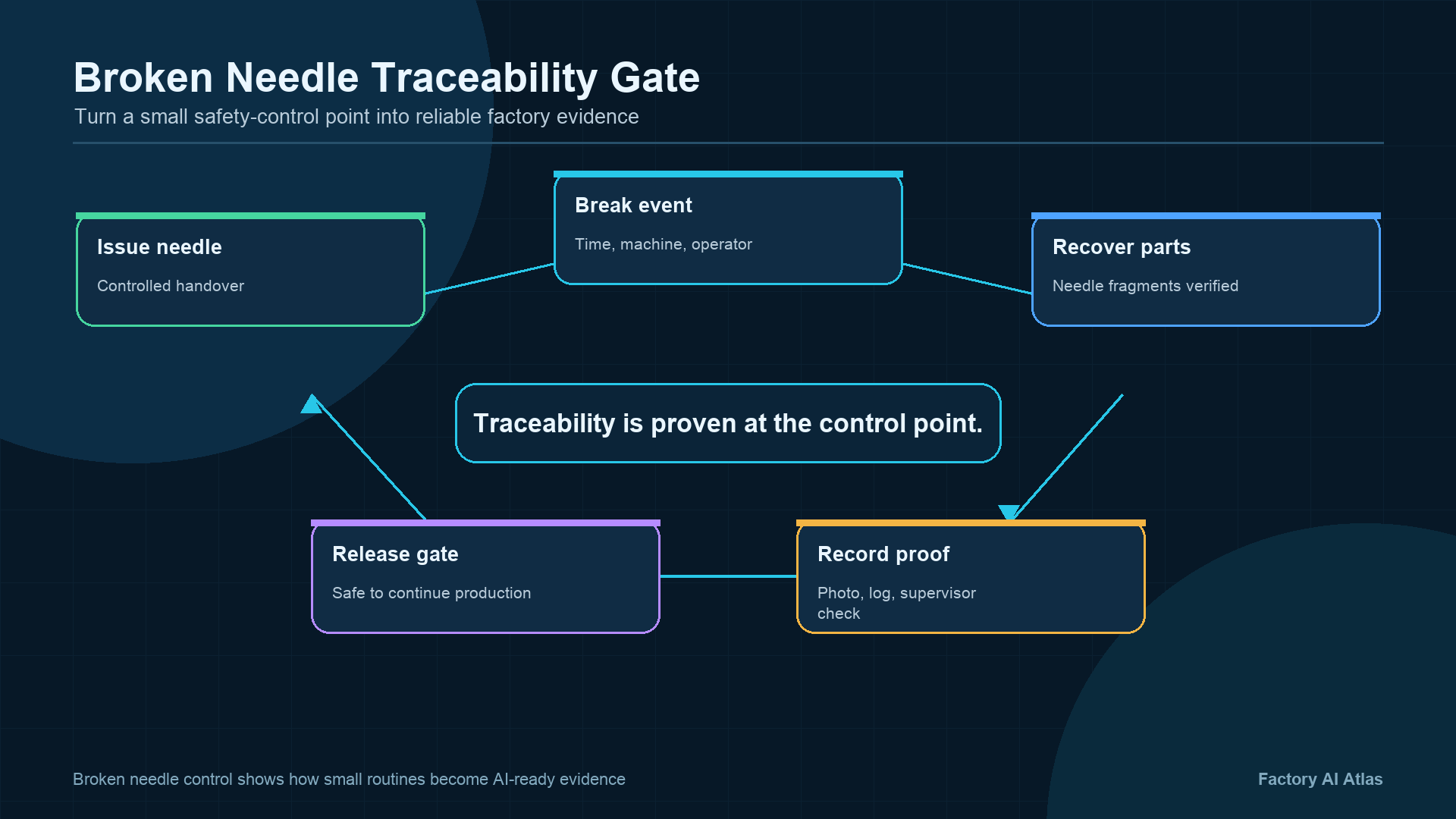
Needle management is a factory control point, not just a sewing-room routine
Needles are ordinary production consumables, but they are also a controlled risk item. A garment factory needs to know which needle was issued, when it was changed, whether it broke, whether all broken parts were recovered, who confirmed the recovery and what action was taken before production continued.
Traditional needle-management procedures usually include restricted needle storage, authorized needle issue and replacement, broken-needle collection, production stoppage after breakage, full fragment recovery and documentation. These steps are practical because the risk is practical: a broken needle fragment left inside a garment can become a serious safety and compliance problem.
From an AI-readiness perspective, the important point is not only the needle itself. The important point is whether the factory can prove which control event occurred, how it was contained, and which evidence allowed production to restart.
From paper logs to broken needle traceability
Many factories have historically used handwritten broken-needle logs. A paper log can satisfy a basic recordkeeping requirement, but it has limitations.
- Records may be hard to search across lines, dates or operators.
- Handwriting can be inconsistent or incomplete.
- Audit preparation may depend on manual file checking.
- Trend analysis is difficult when records sit in folders.
- Management cannot easily connect needle events with machine, style, operation or line conditions.
A paperless needle-management system changes the nature of the record. Instead of treating needle exchange as a form to be filed, the factory can treat it as structured traceability data: machine, line, needle type, replacement event, breakage event, image or confirmation record, recovery status, responsible person and timestamp.
Some public industry examples describe digital documentation for needle changes and broken or damaged needle collection. INH / Ideal Needle Handling is a useful public example because it combines shopfloor hardware, return discipline and management software. The public lesson is the same: the control point becomes data-ready when the record is digital, searchable and connected to the production context.
INH Quality Management: the needle dispensing trolley
One useful way to understand broken needle traceability is to look at the INH / Ideal Needle Handling trolley concept. The trolley is not only a storage unit for new needles. It turns needle issue, return and replacement into a controlled workflow that can move closer to the sewing line instead of forcing every exchange through a fixed station.
In a typical trolley-based needle-management process, operators use a dedicated return box or identification card, return broken or damaged needles in a controlled kit, and receive a replacement needle only after the event is registered. The hardware may include drawers for new needle storage, broken-needle collection, tools, metal-detection or inspection items, and supporting documents. The software layer then records the event history so supervisors and quality teams can review needle status through a management program rather than relying only on handwritten logs.
The value is not just mobility. A mobile needle dispensing trolley can reduce walking and waiting time around a central station, while also improving control over who exchanged a needle, where it happened, and whether the broken parts were properly returned. For garment factories, that combination of shopfloor convenience and digital traceability is exactly the kind of small automation that supports Factory AI readiness.
This is why INH should not be framed only as a product feature. The broader lesson is that a critical sewing-floor routine can become structured factory data. When needle events are captured by operator, machine, line, time and recovery status, the factory gains a cleaner audit trail and a better foundation for future quality analytics.
In this sense, broken needle traceability becomes more than a compliance record; it becomes a practical signal of whether the factory can turn critical shopfloor events into trusted data.
Why this matters for Factory AI readiness
Broken needle traceability is not glamorous. It will not appear in most AI headlines. But it is exactly the kind of factory discipline that separates a serious AI-readiness program from a technology demo.
AI needs clean and meaningful signals. If a factory cannot reliably capture what happens at a known control point, it will struggle to build trustworthy AI systems for more complex decisions. Needle management is a useful test because the process is narrow, concrete and auditable.
- Was the event captured at the time it happened?
- Can the factory retrieve the record quickly?
- Can the record be linked to line, machine and operation context?
- Can management see patterns across time?
- Can quality and compliance teams use the same version of the record?
If the answer is yes, the factory is not only improving needle control. It is practicing the same data habits needed for more advanced Factory AI: event capture, timestamping, standard workflows, exception review and feedback loops.
Small automation can create real factory data
In apparel manufacturing, automation is often imagined as a robot sewing a full garment. That may be part of the future, but it is not the only path. A more realistic path begins with smaller control-point systems that reduce ambiguity in daily work.
A digital needle-management system can help a factory standardize how needle events are recorded. A color kitchen can turn printing paste recipes into repeatable dispensing data. A line-status board can turn manual follow-up into shared WIP visibility. A QC checkpoint can turn inspection findings into searchable defect history.
These are not always called AI projects. But they create the data foundation that AI projects need.
Field Lens: AI readiness starts with traceable control points
For an apparel factory, a practical AI-readiness question is not “Do we have an AI platform?” The better question is: “Which critical control points are still trapped in paper, memory or disconnected spreadsheets?”
- Needle issue, replacement and broken-part recovery
- Machine maintenance and recurring stoppage reasons
- Inline defect findings and repair loops
- WIP movement and bottleneck locations
- Printing-paste or color-recipe control
- Style changeover and learning-curve events
- Actual output versus standard-time assumptions
Each control point may look small on its own. Together, they form the operating memory of the factory. When that memory is structured, AI has something useful to read. When it is fragmented, AI only sees gaps.
What factories should avoid
Digitizing needle management should not become another disconnected compliance screen. If the system is used only to replace a paper form without improving visibility, it may create administrative work without much learning value.
- Do not digitize a weak process without first defining the control rule.
- Do not collect records that nobody reviews.
- Do not isolate the data from quality, production and maintenance teams.
- Do not treat vendor dashboards as proof of ROI without factory-specific evidence.
- Do not expose buyer-specific audit criteria or internal factory details in public case studies.
The goal is not to make the factory look digital. The goal is to make risk, action and follow-up easier to verify.
A practical checklist for broken needle traceability
- Can the factory identify which machine and line had the needle event?
- Can the record show the time, responsible person and recovery status?
- Can broken parts be photographed or otherwise documented?
- Can quality, production and compliance teams retrieve the same record?
- Can recurring breakage patterns be reviewed by machine, operation or product type?
- Can the system support audit response without manual file searching?
- Can the record connect to wider factory data later?
If a factory can answer these questions, it is not only managing needles better. It is building one piece of the data discipline required for Factory AI.
Factory approval takeaway
Broken needle traceability is a practical approval test for apparel Factory AI readiness. If a factory cannot close a narrow needle event with reliable evidence, it should not expect AI to solve wider quality, WIP, maintenance, or compliance problems.
The stronger path is simple: define the control rule, capture the event at the moment it happens, make recovery evidence searchable, review repeated patterns, and use the lesson before scaling larger automation projects.
That is why this topic matters for buyers and factory leaders. It converts a routine sewing-floor risk into a decision-support asset: evidence of whether the factory can manage critical exceptions under real production pressure.
Related Factory AI Atlas reading
- Factory AI Readiness hub
- Garment factory data problems that break AI projects
- Factory AI readiness validation gates
- GSD SAM SMV: 7 Reasons They Are Apparel Factory AI’s Data Layer
References and source anchors
- Needle management procedures in the garments industry
- Textile Network — best practice for needle management and digital documentation
- Groz-Beckert — INH Ideal Needle Handling PDF
- Apparel Resources — INH Quality Management by Groz-Beckert
Evan Lee factory field note
Broken-needle control is a small system with big evidence lessons
Needle control looks narrow, but it teaches a factory how evidence should work: incident time, machine, operator, garment or bundle, search result, replacement record, supervisor confirmation, and buyer-audit proof. That evidence chain is the same discipline needed for larger Factory AI traceability systems.
About the Editorial Perspective
Factory AI Atlas is written from a manufacturing operations perspective shaped by hands-on apparel and textile production experience, including overseas factory management, woven and knit operations, production control, quality systems, and operational restructuring.
The site focuses on vendor-neutral, evidence-aware, and ROI-realistic guidance for AI, robotics, automation, and factory readiness. See the Editorial Policy & Disclaimer for sourcing standards and AI-use disclosure.
External validation anchors for broken needle traceability
- Better Work reports and publications — useful context for factory management systems, compliance evidence, and practical production discipline.
- ILO textiles, apparel, leather and footwear resources — relevant for apparel-sector production and workplace control points.