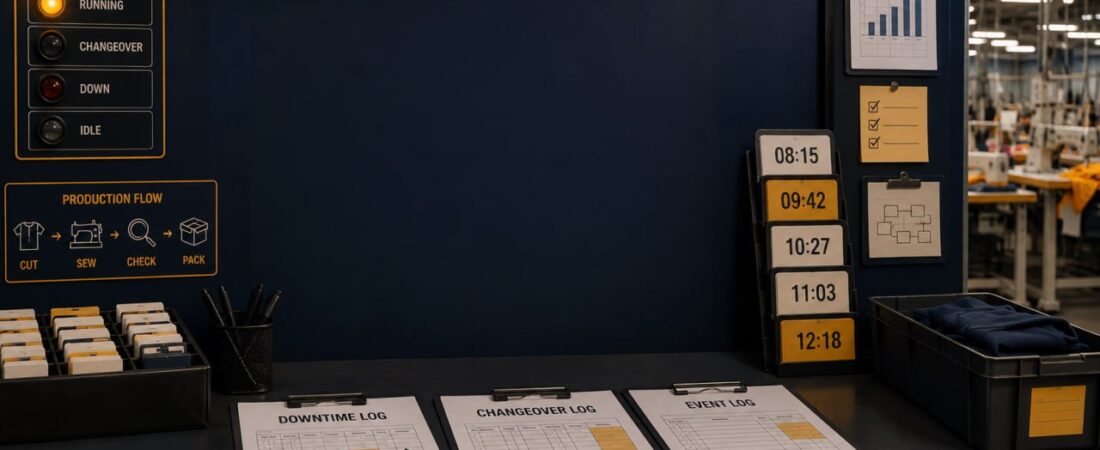
Turn each stop into a closed event record
A downtime total says how much time disappeared. It does not show what happened or whether the loss can be prevented. A useful record follows the event from the first stop to the checked result.
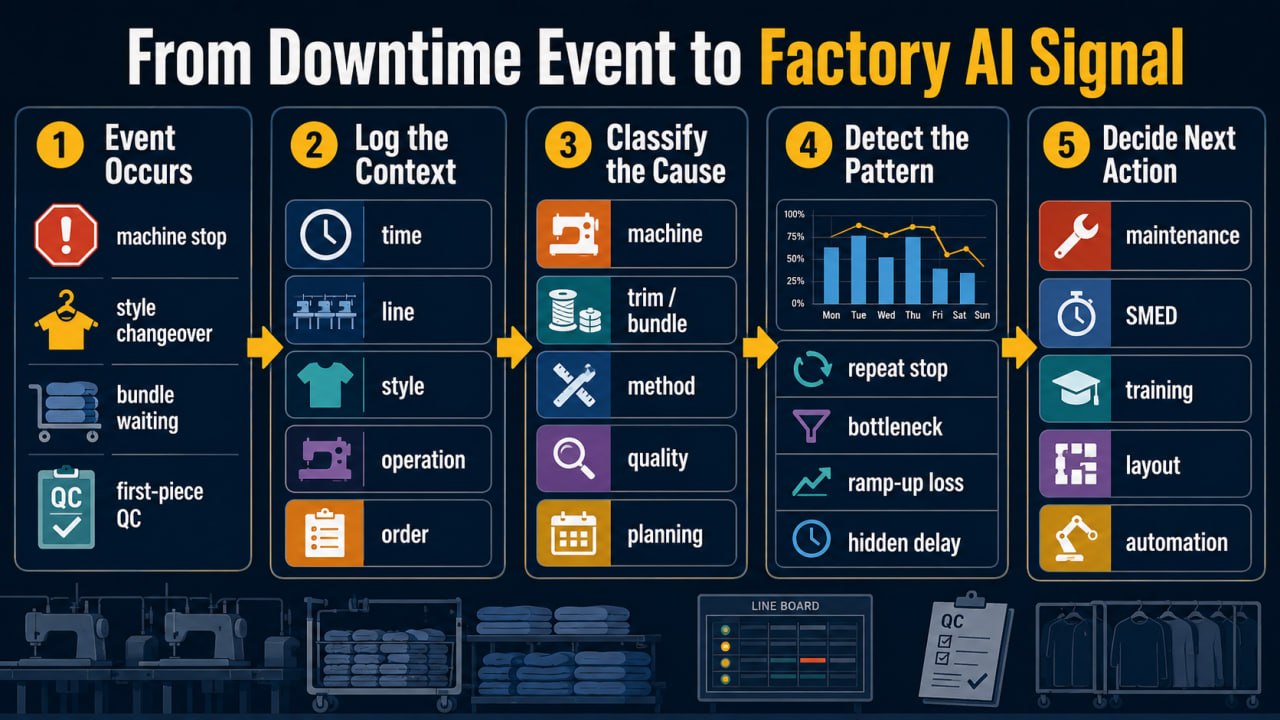
- Open the event: capture the actual start time, affected line or asset, style context, and what the operator or supervisor observed.
- Classify the cause: separate machine fault, planned changeover, material waiting, quality hold, method issue, approval delay, and ramp-up loss. Keep “other” visible for later review.
- Name the owner: assign the next action to production, maintenance, Industrial Engineering (IE), quality, planning, warehouse, or another responsible function.
- Close the event: record what was done, when the line recovered, and whether output and quality returned to the expected range.
- Check recurrence: compare the same cause across shifts, styles, lines, and changeovers before calling the pattern predictive.
Reconstruction test: someone who was not present should be able to explain the event, action, and result from the record alone. If they cannot, the data may support a meeting summary, but it is not yet a reliable baseline for predictive AI or an automation return-on-investment claim.
Factory operating context
Ask a factory for its robot automation ROI number and the answer may arrive quickly: a spreadsheet, a payback period, a vendor demo comparison, or a management target. Ask the same factory for last week’s changeover log by line, style, reason, and minutes lost, and the answer is often slower: a supervisor’s memory, a handwritten note, or a daily efficiency number that hides the real cause.
That gap matters. A sewing line may lose time to thread color change, missing trims, guide adjustment, first-piece approval, bundle waiting, quality hold, or technician support. If those events are only discussed in meetings and not logged consistently, AI has no reliable operating signal to learn from.
Downtime and changeover logs are not just maintenance paperwork. They are one of the first layers of factory memory — and one of the minimum evidence layers needed before predictive AI, factory dashboards, or automation ROI claims can be trusted.
Factory situation
This is not a response to a single news item. It is a gap visible across Factory AI Atlas’s own published frameworks. The Robot Automation ROI Checklist asks factories to check hidden costs, uptime assumptions, maintenance burden, and changeover reality before trusting a robot ROI number. The Factory AI Readiness Scorecard asks whether a factory has reliable operational data before piloting AI tools.
Both frameworks point toward the same missing layer: event-level operating evidence. A factory cannot test whether automation reduced downtime if it never defined downtime consistently. It cannot test whether a new tool improved changeover if the old changeover baseline came from memory. It cannot train useful predictive systems if every stop is recorded as a vague “machine issue” or absorbed into the day’s efficiency loss.
This article treats downtime and changeover logs as a practical data layer: not a full MES replacement, not a predictive AI system, and not an ROI guarantee — just the minimum event record a factory needs before higher-level tools can make trustworthy claims.
Why Downtime and Changeover Logs Matter for Factory AI
Any AI or automation claim that touches throughput, utilization, maintenance, line balance, or ROI is quietly making an assumption about downtime and changeover time.
A vendor may say a system reduces changeover time. A dashboard may say a line has low utilization. A predictive maintenance model may claim it can prevent stops. A robot automation proposal may promise faster output. All of those claims depend on a baseline: what was stopping the line before, how often, for how long, and why?
Without a log, the baseline is a guess. With a weak log, the baseline is a cleaner-looking guess. With a consistent downtime and changeover log, the factory at least has a starting point for asking better questions:
- Was the loss mechanical, material, quality, planning, approval, skill, or layout-related?
- Was the event planned or unplanned?
- Did the line stop completely, slow down, or suffer ramp-up loss after restart?
- Did the same problem repeat across styles, lines, operators, buyers, or seasons?
- Did the proposed automation target the real bottleneck or only the easiest visible symptom?
This is the same readiness-before-tool logic Atlas applies in the Factory AI data layer checklist and the Factory AI readiness measurements: AI quality depends on the operating evidence underneath it.
What the log changes across factory functions
- On-site intelligence: downtime and changeover data is generated every day on every line, whether or not anyone captures it.
- Production visibility: without event logs, planning works from theoretical capacity, nominal SMV, and end-of-day efficiency instead of real interruption patterns.
- Quality control: rushed changeovers and unclear first-piece approval can create early-run defects, but the root cause may disappear if the delay is recorded only as low efficiency.
- Planning: PPC schedules that ignore changeover buffers, trim readiness, first-piece approval, and ramp-up loss routinely slip — but the delay remains hard to explain without structured records.
- Worker support: operators, line leaders, technicians, and QC staff usually know the real cause first. A log turns that knowledge into usable evidence instead of losing it at shift end.
- Supervisor decision-making: a supervisor who can see today’s stop pattern can react faster; one working from memory may only discover the pattern after output is already missed.
- Data capture: this is a case where a simple, disciplined manual log or shared sheet can outperform an expensive system that nobody feeds correctly.
- Secure local AI: downtime and changeover data exposes real line performance, bottlenecks, and operating weakness. Any digital logging tool should make clear where that data is stored and whether it leaves the factory.
A changeover that one total cannot explain
A sewing line switches from Style A to Style B mid-shift. The previous style’s last good pieces have cleared the line, but the next style is not ready to run at normal speed yet.
The line leader waits for the correct bundle sequence. The mechanic changes a guide and checks the attachment. Thread color is changed. A trim card is checked again because the label and zipper version look similar. The first piece comes out, but QC asks for a small seam allowance correction. The operator who handled a key operation on Style A is moved, and the replacement needs a few cycles before reaching rhythm.
If that whole period is not timed and classified, the day’s efficiency number quietly absorbs the loss. It may look like a weak line, a slow operator, or a general machine issue. In reality, part of the loss may be changeover preparation, part may be first-piece approval, part may be material readiness, and part may be ramp-up.
That distinction matters. A robot, AI dashboard, or predictive maintenance tool cannot fix a trim-preparation delay. A new machine may not solve first-piece approval waiting. A line-balancing tool may not solve missing attachments. Before the factory buys a tool to reduce downtime, it needs to know what kind of downtime it actually has.
Define Changeover Before Measuring It
Factories often say “changeover time” as if everyone means the same thing. They usually do not.
For a practical apparel-factory baseline, define changeover time as:
From the previous style’s last good piece to the next style’s first approved good piece.
That definition is not perfect for every factory, but it is clear enough to compare lines and styles. It also prevents the factory from counting only the visible machine-adjustment time while ignoring bundle preparation, thread / trim checks, first-piece approval, and re-setting work.
Factories should also separate ramp-up loss from changeover time:
- Changeover time: the transition window before the next style’s first approved good piece.
- Ramp-up loss: the output or efficiency loss after the first approved piece while operators, balance, quality, and flow stabilize.
This distinction is important in garment manufacturing. A line may complete the technical changeover in 30 minutes but lose two more hours because the new style has a difficult operation, a new operator assignment, or an early quality issue. If the factory records only the 30 minutes, the AI baseline is still incomplete.
What to Log First
Start with a simple log — paper, a shared sheet, or a basic local app — before buying a full MES module. The first version should be easy enough for a line leader or supervisor to use under production pressure.
Minimum fields:
- Date and shift
- Line number or production zone
- Style / order / PO reference
- Process, station, or machine involved
- Event type: downtime, changeover, waiting, quality hold, ramp-up loss, or planned stop
- Start time and stop time
- Total minutes lost
- Cause code
- Short description
- Immediate action taken
- Responsible function: production, maintenance, IE, QC, planning, warehouse, technician, or management
- Recorder and reviewer
- Repeat flag: first time, repeated this week, repeated this season
Do not start with too many fields. A log that operators abandon is worse than a simple log that is actually used.
The purpose of downtime and changeover logs is not to create more paperwork. The purpose is to create a shared operating record that production, IE, QC, maintenance, and planning can review together.
Apparel-Specific Cause Codes
Generic reason codes such as “machine,” “material,” and “operator” are often too broad for apparel factories. They hide the difference between a real mechanical breakdown and a planning or preparation issue.
A practical first code set can look like this:
- Machine / attachment: machine fault, needle issue, presser foot, guide, folder, attachment, or setting problem.
- Thread / trim: wrong thread color, zipper, label, tape, button, hangtag, or trim not ready.
- Bundle / WIP: bundle waiting, size or color mix-up, numbering issue, missing cut panel, or WIP flow gap.
- Technical / method: unclear operation breakdown, sewing method change, pattern/spec question, SPI or seam allowance issue.
- Quality / first piece: first-piece rejection, measurement issue, appearance defect, rework hold, or QC approval delay.
- Manpower / skill: absent operator, new operator, low skill match, reassignment, or training delay.
- Layout / line balance: bottleneck process, line rearrangement, machine location, helper shortage, or unbalanced flow.
- Approval waiting: QC, IE, mechanic, technician, sample room, production manager, or buyer-related approval waiting.
- Planning / preparation: previous style overrun, next style not kitted, missing work instruction, wrong priority, or late style handoff.
The goal is not to blame the person closest to the stop. The goal is to separate the kind of problem so the right function can fix it.
How to Set a Recording Threshold
A single rule such as “record every stop over five minutes” is a good starting point, but it should not be the only view.
Use three levels:
- Micro stops: 1–5 minutes. Do not overload the line with full write-ups, but sample or count repeated patterns such as thread breaks, small machine adjustments, missing pieces, or frequent waiting.
- Minor downtime: 5–15 minutes. Record start/stop time, cause code, and immediate action.
- Major downtime: 15 minutes or more. Record the full event and review it with the responsible function.
For changeovers, record the whole transition window even if it is planned. Planned loss is still real capacity loss, and it still affects ROI assumptions.
For changeover improvement, many factories use SMED-style thinking — reducing internal setup time, preparing materials before the stop, and separating planned changeover work from avoidable waiting. The Lean Enterprise Institute’s SMED overview is a useful neutral reference for the concept.
How Downtime and Changeover Logs Connect to Automation ROI
A downtime/changeover log is not the full ROI model. It does not replace labor cost, maintenance cost, quality loss, training time, line-balance impact, floor-space constraint, spare-parts risk, or buyer requirement analysis.
But without the log, many ROI models are built on untested assumptions.
For example:
- If a machine claims to reduce changeover by 30 minutes, does it reduce only machine setup, or also first-piece approval and ramp-up loss?
- If AI predicts machine failure, is the line’s main loss really machine failure, or is it trim waiting and approval delay?
- If a robot increases operation speed, does the bottleneck move to QC, bundle feeding, or downstream packing?
- If a dashboard shows low utilization, can the factory explain the root cause by event type?
The safer statement is this:
Downtime and changeover logs do not prove automation ROI. They help test whether the ROI baseline is real.
That is why a factory should collect at least one full season of logs before trusting a major automation ROI claim that depends on downtime reduction. Even then, the log must be interpreted by style complexity, fabric type, order quantity, buyer requirement, operator skill mix, and line setup.
Start with the operating rule, not the software
Copy the operating discipline, not the software.
- Start with one pilot line, not the entire factory.
- Define changeover start and stop points before collecting data.
- Use the same cause-code list across lines.
- Train line leaders on why the log exists: process improvement and planning visibility, not individual blame.
- Review top recurring causes weekly with production, maintenance, IE, QC, and planning together.
- Separate changeover time from ramp-up loss.
- Compare actual changeover time against planning assumptions, not only against yesterday’s output.
- Keep sensitive line-performance data on-site unless the factory has a clear reason and policy for external sharing.
Signals that the log is not trustworthy
- Vendors quoting downtime-reduction percentages without asking for the factory’s own baseline first.
- Logs that ask operators for extra data entry but never return useful information to the line.
- Cause codes that are too vague: “machine issue,” “operator issue,” or “other” used for everything.
- Downtime data used to blame individual operators instead of fixing process, preparation, layout, material, approval, or maintenance gaps.
- Treating a few weeks of data as a stable baseline when style mix, fabric type, order size, and buyer requirements change by season.
- Counting changeover time but ignoring ramp-up loss after the first approved piece.
- Routing sensitive line-performance data to an external cloud tool by default without a clear data policy.
Can another team reconstruct the event?
- Do we define exactly when changeover starts and ends?
- Do we separate changeover time from ramp-up loss?
- Do we log downtime and changeover time by line, style, and reason code?
- Are our cause codes specific enough for apparel operations, or are we hiding everything under “machine” and “operator”?
- Who records the event, who reviews it, and how often?
- Do production, maintenance, IE, QC, and planning review the same log together?
- Have we compared actual changeover time against SMV, line-balance, and planning assumptions?
- If a vendor claims downtime or changeover improvement, do we have a baseline to test it against?
The useful output is a closed event record
Factory AI does not begin with a model. It begins with factory memory.
Downtime and changeover logs are one of the simplest ways to turn daily operating friction into evidence. They do not prove that a robot, AI dashboard, or predictive maintenance tool will pay back. But they show whether the factory knows what it is trying to improve.
Before evaluating predictive AI, automation ROI, or a new factory dashboard, check whether the factory can explain its downtime and changeover loss with consistent event logs. A good next step is to compare this log discipline against the Factory AI Readiness Scorecard and the hidden-cost questions in the Robot Automation ROI Checklist.
Used well, downtime and changeover logs become a practical bridge between daily factory reality and higher-level Factory AI decisions.
What these sources support—and what the log must prove locally
- NIST manufacturing resources provide public context for measurement and manufacturing improvement. They do not define one apparel factory’s changeover boundary or validate its cause codes.
- NIST AI Risk Management Framework helps teams ask whether data and monitored assumptions are fit for an AI use case. It is not evidence that a predictive model will prevent a stop or that an automation project will pay back.
The local proof remains the event trail: consistent definitions, attributable timestamps, action ownership, recovery evidence, recurrence checks, and enough coverage across the factory’s real style and operating variation.