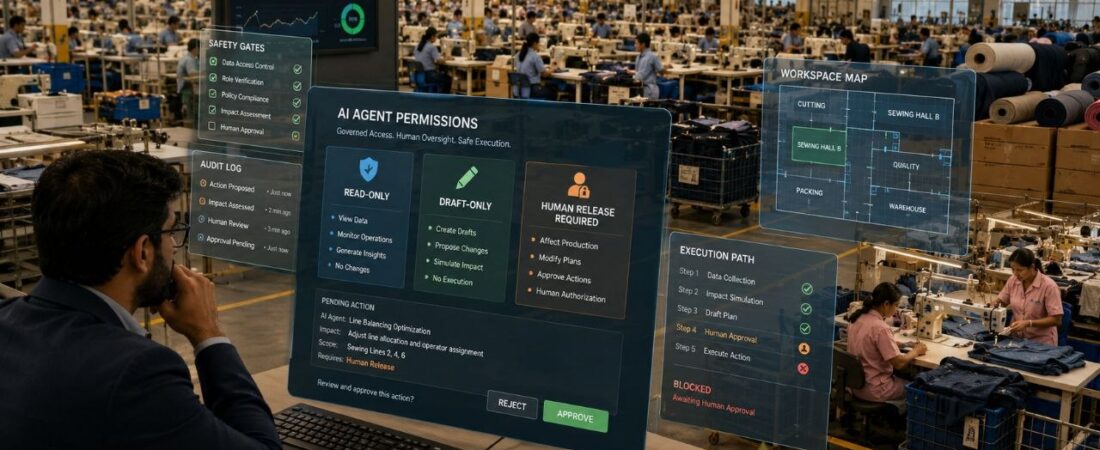
Agent execution-rights safety note
AI agents should receive execution rights only after the factory has a safety case for each action class. Read-only insight, draft-only workflow support, human-release actions, and autonomous execution are different risk levels and need different evidence gates.
Helpful demos are mistaken for safe execution
The common mistake is to move from a helpful agent demo to workflow execution too quickly. A wrong purchase-order draft, maintenance instruction, quality hold, machine command, robot route, or supplier message can create real cost even if the agent sounded confident.
Checks before granting agent execution rights
- Which actions can the agent observe, draft, recommend, queue, release, or execute?
- What is the worst credible damage from a wrong action, and who can stop it before release?
- Does every action have evidence, permission, rollback, audit replay, and escalation rules?
Proof requests for agent action safety cases
- Demonstrate the same workflow at read-only, draft-only, human-release, and blocked-action levels.
- Show a failed safety-case scenario and prove that the agent cannot execute outside the boundary.
- Provide logs that connect source evidence, tool call, approval, action, result, and rollback.
Execution-rights release gate
GO if the agent action is bounded, auditable, and reversible. HOLD if draft support works but release rules are weak. REDESIGN if the agent can execute before the safety case is proven.
Factory AI agent safety case design should come before any factory AI agent receives execution rights. AI agents are moving from answering questions to taking actions.
The release path should separate read-only analysis, draft-only support, human-approved workflow actions, and autonomous execution because each step creates a different factory risk profile.
That shift is important for every industry. In factories, it is also dangerous if it is handled too casually.
An office AI agent may summarize emails, prepare a document, or organize a file. A factory AI agent may read production output, review WIP status, prepare a CAPA response, recommend a line-plan change, update a material shortage escalation, or eventually connect with robots, machines, and operating systems.
The question is no longer only whether the AI can do the task.
The more important factory question is whether the AI should be allowed to execute the task.
This is where many Factory AI projects will face their next bottleneck. The limit will not always be model intelligence. It will be permission design, safety validation, auditability, and human release control.
A factory does not need an AI agent with unlimited access. It needs an AI agent with clearly defined boundaries.
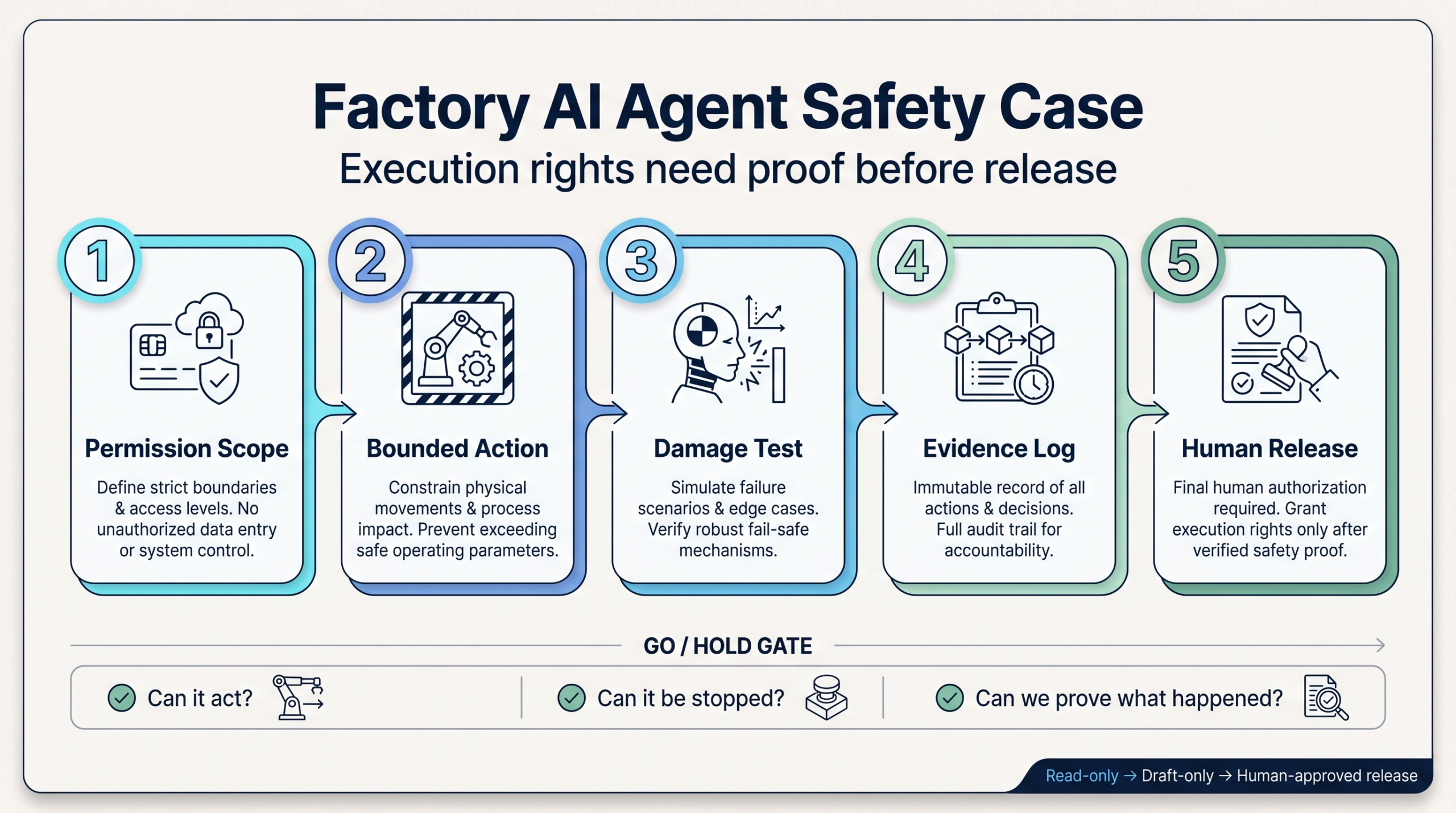
Factory AI Agent Safety Case Gate 1: Permission Comes First
AI models are becoming more capable. Agent frameworks are improving. Robotics and Physical AI systems are starting to interpret more complex environments. Industry sources are also moving in this direction. NVIDIA has discussed autonomous agent governance in enterprise AI factories, while robotics safety work such as NVIDIA Halos points toward functional safety as a core requirement for Physical AI systems.
These are useful signals, but Factory AI Atlas should read them carefully. They are not proof that any specific factory should immediately connect agents to production systems. They are better understood as a pattern: as AI moves closer to action, permission and safety become more important.
A wrong answer in a chatbot can be corrected. A wrong action in a factory can create production delays, quality escapes, shipment risks, safety hazards, or commercial damage.
For example:
- A production schedule change can disrupt line loading.
- A wrong material recommendation can create shortage or overstock.
- A quality decision can affect shipment release.
- A warehouse movement instruction can block a critical path.
- A robot action can create physical safety risk.
- An automatic buyer message can create commercial or compliance exposure.
This is why Factory AI should not start with broad execution rights.
It should start with a permission layer.
The permission layer defines what the AI can read, what it can suggest, what it can draft, what it can execute, and what must remain blocked until a human releases it.
Read-Only, Draft-Only, and Human Release
A practical Factory AI permission model can begin with three levels: read-only, draft-only, and human release required.
1. Read-Only
At this level, the AI can access data but cannot change anything. This is the safest starting point for most factories.
Examples include:
- Reading production output data
- Reviewing defect trends
- Checking WIP status
- Summarizing shipment risks
- Comparing plan versus actual
- Identifying unusual downtime patterns
Read-only AI is useful because it helps teams see problems faster without creating new operational risk. For many factories, this is the right first step.
The goal is not to let AI run the factory. The goal is to help managers, IE teams, QA teams, merchandisers, and supervisors understand the factory more clearly.
This connects directly with the broader Factory AI readiness question: before buying more tools, the factory should know which data can be safely used and which actions must stay protected.
In simple terms, a factory AI agent safety case is the evidence package that explains why a proposed AI action is bounded, reviewable, and safe enough to consider under factory conditions.
2. Draft-Only
At this level, the AI can prepare recommendations or documents, but it cannot execute them directly.
Examples include:
- Drafting a CAPA report
- Preparing a buyer update
- Suggesting a revised line plan
- Creating a defect analysis summary
- Drafting a material shortage escalation
- Preparing a maintenance follow-up note
- Generating a proposed action list after a production meeting
Draft-only is a powerful middle stage for Factory AI.
It saves time, improves structure, and helps teams move faster. But it keeps the final decision with people.
This matters because many factory decisions require context that is not always visible in the data. A line supervisor may know that a key operator is absent. A merchandiser may know the buyer’s hidden priority. A QA manager may know that a defect trend is linked to a temporary fabric issue. An IE manager may know that a bottleneck is caused by training, not machine capacity.
AI can draft. People must release.
3. Human Release Required
At this level, the AI may prepare an action, but the action cannot happen until an authorized person approves it.
This level should apply to high-impact factory actions.
Examples include:
- Changing production schedules
- Releasing shipment decisions
- Changing quality status
- Sending buyer-facing messages
- Modifying purchase or material orders
- Triggering machine or robot actions
- Changing system master data
- Approving CAPA closure
- Moving inventory or WIP between areas
The principle is simple: high-impact factory actions should be blocked by default.
The AI can recommend. The AI can explain. The AI can prepare evidence. But the final release should remain with a responsible human role.
Factory AI Agent Safety Case Gate 2: Prove the Action Is Bounded
Before an AI agent receives execution rights, the factory should prepare a safety case. A factory AI agent safety case should prove that the action is bounded, reviewable, logged, and safe enough to test under defined factory conditions.
A safety case is not just a technical document. It is a structured explanation of why a specific AI action is safe enough to allow under defined conditions.
For Factory AI, a safety case should answer practical questions:
- What data can the AI access?
- Which systems can it connect to?
- What actions can it perform?
- Which actions are prohibited?
- What is the maximum possible damage from a wrong action?
- Who can approve or reject the action?
- What evidence must be reviewed before release?
- Is there an audit log?
- Is there a stop, hold, or rollback procedure?
- Has the action been tested in a low-risk environment?
- What happens when the AI is uncertain?
This is especially important when AI agents move from analysis into execution.
A factory should not grant execution rights because a model appears confident. Execution rights should be granted only when the permission layer, safety case, evidence log, and human release process are ready.
Damage-Aware Smoke Tests
A factory AI agent safety case is incomplete if it only checks whether the agent can complete the task. It also needs a damage-aware smoke test.
Many software teams use smoke tests to check whether a system basically works. Factories need a stronger version: damage-aware smoke tests.
A damage-aware smoke test does not only ask whether the AI action works. It also asks what can be damaged if the AI action is wrong.
That distinction matters. Robotics safety research such as the arXiv preprint OopsieVerse points to a similar issue: task success alone is not enough if the surrounding environment, objects, or system are damaged in the process. This should be treated as a research signal, not as manufacturing proof. But the operating lesson is useful.
Factory AI tests should include wrong-action risk.
For example:
- If the AI changes a line plan incorrectly, what production delay could occur?
- If it recommends the wrong fabric allocation, which orders are affected?
- If it misclassifies a defect, could a shipment risk increase?
- If it sends a buyer update too early, what commercial issue could follow?
- If it triggers a robot or material movement, what physical safety risk exists?
- If it closes a CAPA too soon, what audit or compliance risk remains?
This kind of testing is essential because factories are connected environments. One wrong action can move across planning, production, quality, warehouse, shipment, and buyer communication.
Factory AI should therefore be tested not only for task success, but also for damage awareness. This extends the idea behind Factory AI smoke tests: the test should confirm not only that the tool runs, but that it does not create unacceptable operating risk.
Physical AI Needs Workspace Maps Before Robots
The same logic applies to Physical AI and robotics.
In manufacturing discussions, robots often receive the most attention. But in many factories, especially labor-intensive environments such as apparel, the bigger challenge is not only the robot. It is the workspace.
A robot or physical AI system needs to understand:
- Where materials are stored
- Where WIP is waiting
- Which paths are safe
- Which zones are temporary
- Where workers move
- Where inspection happens
- Where cartons, rolls, trims, samples, and tools are placed
- Which areas change during the day
Garment factories are especially dynamic. Tables move. WIP carts shift. Fabric rolls are staged temporarily. Cartons appear near packing areas. Samples move between teams. Operators adjust their workspaces.
This means Physical AI does not start with humanoids. It starts with a reliable workspace map.
BEV and spatial perception discussions in Physical AI are useful as technical signals, but factories should translate them into a practical question: can the system understand the actual workspace state before it acts?
This is close to the idea of Factory AI semantic maps, but with a stronger execution-risk layer. The map is not only for visibility. It becomes part of the permission and safety system.
Before factories ask whether a robot can act, they should ask whether the system understands the space in which it will act.
The Evidence Log Matters
Every AI-supported action should leave a trail.
The factory should be able to answer:
- What did the AI recommend?
- What data did it use?
- What alternatives did it consider?
- Who reviewed the recommendation?
- Who approved it?
- What was changed before approval?
- What happened after execution?
- Was the result successful or problematic?
This evidence log is not only useful for technical teams. It is also valuable for factory managers, QA teams, compliance teams, buyers, and auditors.
In the future, the credibility of Factory AI may depend less on impressive demos and more on whether the factory can explain how AI-supported decisions were made.
Factory AI Agent Safety Case Checklist Before Execution Rights
Before giving a Factory AI agent execution rights, manufacturers should use a factory AI agent safety case checklist to confirm the following:
- Can the AI clearly explain what action it is recommending?
- Is the AI limited to approved data sources?
- Are prohibited actions clearly defined?
- Is the action read-only, draft-only, or execution-level?
- Does high-impact execution require human release?
- Is there an audit log?
- Is there a stop, hold, or rollback procedure?
- Has the action been tested in a low-risk environment?
- Has the factory checked what could be damaged if the action is wrong?
- Is there a responsible owner for approval?
- Are buyer-facing or external messages blocked by default?
- Are quality, shipment, safety, and commercial risks reviewed before execution?
This checklist may become one of the most important parts of Factory AI readiness because the factory AI agent safety case turns AI governance into operating evidence.
Final factory takeaway
The next stage of Factory AI will not be defined only by smarter models, stronger agents, or more advanced robots.
It will be defined by safer execution systems.
Factories that succeed with AI will not simply be the ones that adopt the newest tools first. They will be the ones that design clear permission layers, safety cases, evidence logs, damage-aware tests, and human release gates.
In factory operations, the question is not only whether AI can act.
The real question is whether the factory can prove that the AI is allowed to act safely.
Source note: This article uses NVIDIA, Hugging Face/Amazon, Google DeepMind, and arXiv sources as industry and research signals. Vendor and preprint sources should not be treated as manufacturing proof or product recommendations. Factory examples are generalized for public discussion.
References
- NVIDIA: How to Govern Autonomous Agents in Enterprise AI Factories
- NVIDIA: Inside NVIDIA Halos for Robotics
- arXiv: OopsieVerse — A Safety Benchmark with Damage-Aware Simulation for Robot Manipulation
- NVIDIA: Accelerating BEV Pooling for Physical AI Applications
- Hugging Face / Amazon: From the Hub to robot hardware with Strands Agents and LeRobot
- Google DeepMind: Investing in multi-agent AI safety research
External validation anchors for AI agent safety cases
- NIST AI Risk Management Framework — useful for mapping, measuring, managing, and governing AI action risk.
- OSHA robotics guidance — relevant when AI actions can affect physical workspaces, equipment, or worker safety.