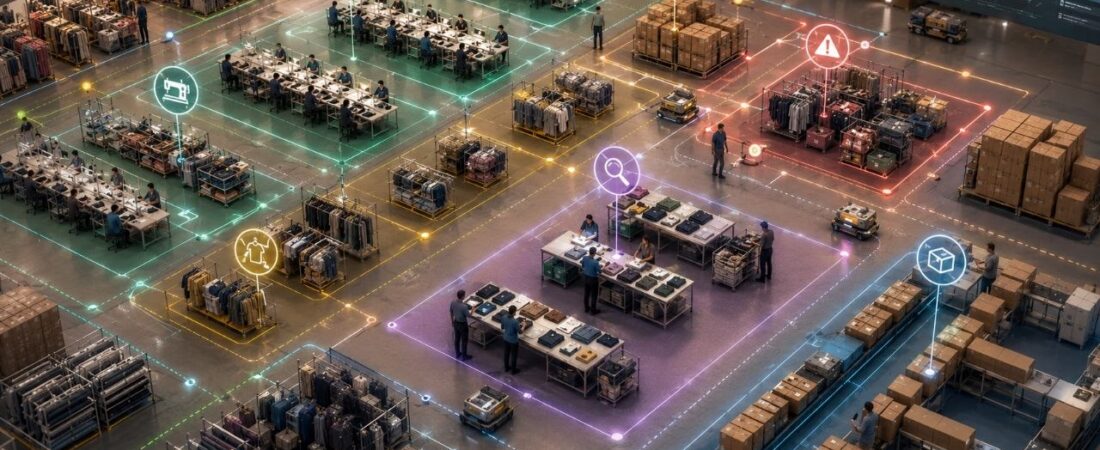
Semantic-map operations note
A semantic map is worth funding only if it connects physical locations, process ownership, material movement, quality evidence, and decision rules. For a garment factory, the question is not whether a robot can understand a map; it is whether supervisors, IE, maintenance, QA, and planning can share the same operating picture.
Floor maps miss production meaning
The common mistake is to map floor geometry while leaving process meaning outside the system. A digital floorplan that does not know WIP zones, bottleneck points, inspection gates, fabric risk areas, rework loops, and responsibility boundaries will not support useful Factory AI.
Checks before funding semantic factory maps
- Does the map identify production meaning, not only coordinates and aisles?
- Can the factory update the map when layout, style mix, WIP route, or quality-control points change?
- Will the map improve daily decisions: line balance, robot routing, safety control, WIP search, or exception recovery?
Proof requests for semantic-map vendors
- Show one style moving through the semantic map from cutting output to sewing, QA, finishing, and exception handling.
- Demonstrate how blocked aisles, temporary WIP zones, layout changes, and restricted areas are updated and approved.
- Export an evidence view that a production manager can use without needing a robotics engineer beside them.
Shared-map operating gate
GO if the semantic map improves shared factory decisions. HOLD if it is accurate but not maintained by operations. REDESIGN if it is only a robot-navigation asset with no production-management value.
Factory robots are often discussed as a movement problem.
A semantic map should be approved only when it helps operations share meaning: where WIP sits, why it is waiting, who owns the next action, and which quality or material rule controls movement.
Can the robot move from point A to point B? Can it avoid people? Can it carry a box, inspect a part, or navigate a warehouse aisle?
Those questions matter. But they are not enough. In a real factory, the hardest problem is not only movement. It is meaning.
A robot does not only need to know where a cart is. It needs to know what that cart means. Is it work in progress? Is it waiting for inspection? Is it on hold? Is it rework? Is it packing ready? Is it blocked until buyer approval?
Those are not small differences. They change the next action, the risk level, and the person who must approve movement. That is why Factory AI semantic maps matter. The next layer of Factory AI is not just more robots. It is semantic maps.
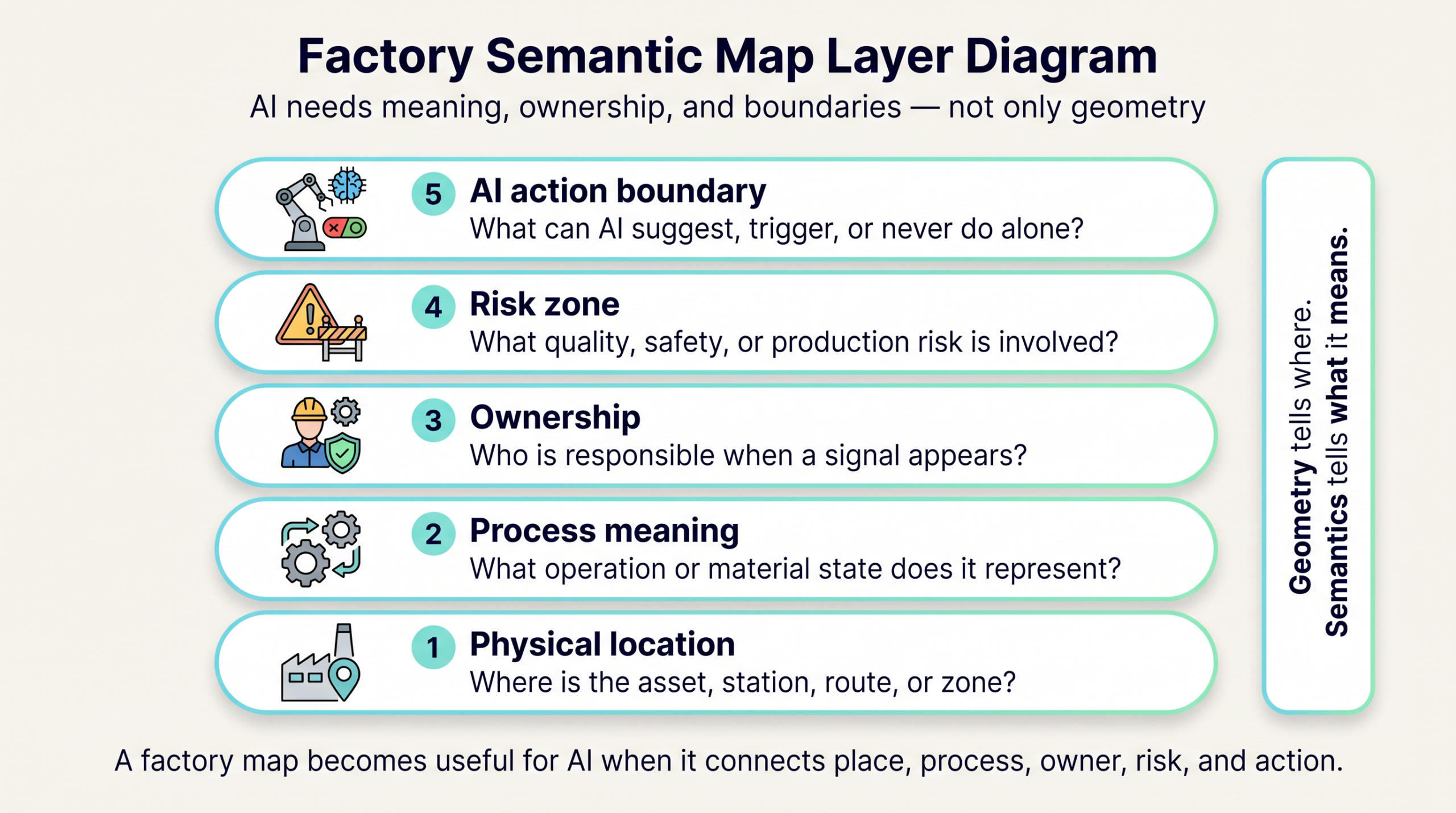
A factory map is not just geometry
Traditional robot navigation focuses on physical space. A robot needs to know where the aisle is, where the rack is, where people may walk, where obstacles are located, and where it can and cannot move.
This is the geometric map. But a factory floor is not only a geometric space. It is an operating system made of status, responsibility, priority, and risk.
The same physical location can mean different things at different times. A table near the sewing line may be a normal WIP area in the morning. By the afternoon, it may become a temporary rework area. During final inspection, it may become a hold area. Before shipment, it may become a packing release checkpoint.
To a camera or robot, those may look similar. To a factory manager, they are completely different.
This is where Factory AI semantic maps become practical: they translate floor movement into status, responsibility, and risk.
What is a semantic map in a factory?
A semantic map is a map that includes meaning, not just location. In a factory context, that means the system understands not only where something is, but also what it represents.
- WIP rack: work is still moving through production.
- Hold area: goods cannot move forward without review.
- Rework cart: something has failed a check and needs correction.
- Packing-ready zone: goods may be close to shipment but still need document or buyer release.
- Inspection table: decisions must be recorded with evidence.
- Line-side buffer: a temporary waiting area that may affect output rhythm.
- Rejected goods area: a high-risk zone that needs traceability.
A robot that only sees a cart or a box will miss the point. A Factory AI system needs to understand the operational meaning of that object. In this sense, Factory AI semantic maps are the bridge between physical movement and safe factory decisions.
This is not only theory. Recent robotics research is moving in the same direction. A 2026 arXiv paper on contextual semantic mapping in intralogistics argues that mobile robots need more than geometric navigation; they need context about objects and spaces. NVIDIA has also framed Physical AI deployment around broader system-level safety in its Halos robotics safety discussion. For factories, the practical lesson is simple: movement without meaning is risky.
Why this matters for garment factories
This is especially important in garment manufacturing. A garment factory is full of objects that look simple but carry operational meaning.
A carton is not just a carton. It may represent finished goods, mixed-size packing, a partial shipment, buyer hold, rework after final inspection, carton marking review, country-of-origin verification, or goods that are packed but not released.
A rack is not just a rack. It may hold sewing WIP, shade band separation, defect repair, size-set samples, audit samples, urgent shipment priority, pieces waiting for measurement, or pieces waiting for buyer comment.
A table is not just a table. It may be inline inspection, endline inspection, measurement check, trim-card verification, packing instruction review, claim sorting, or CAPA review.
If Factory AI cannot understand these meanings, it may automate movement while increasing operational risk. The robot may move the wrong cart. The AI may summarize the wrong status. The system may release a lot that should remain on hold. The dashboard may show output progress while hiding a quality bottleneck.
This is why Factory AI semantic maps are not a luxury feature. They are part of factory readiness.
The danger of robot-first automation
Many factory automation discussions start with the robot. What robot should we buy? Can it carry materials? Can it inspect defects? Can it replace labor? Can it run at night?
But a robot-first approach can miss the basic operating questions. Factory AI semantic maps force the team to answer these questions before automation moves materials at scale.
- Does the system know whether this carton is released or on hold?
- Does it know which buyer, PO, style, color, and size it belongs to?
- Does it know whether inspection has passed?
- Does it know whether rework is complete?
- Does it know whether packing instructions changed?
- Does it know who must approve the next step?
- Does it know what evidence must be stored before movement?
If the answer is no, the factory does not only have a robot problem. It has a meaning problem. And meaning problems are usually data, process, and governance problems.
Semantic maps connect AI with factory operations
A strong factory semantic map should connect physical space with operational data. It should link location, object type, production status, quality status, buyer or order context, risk level, responsible department, next allowed action, required evidence, and escalation rule.
For example, a cart in a garment factory could be understood like this:
- Object: cart
- Location: finishing area
- Status: rework
- Related order: buyer, style, and PO context
- Risk: shipment delay risk
- Next action: repair and re-inspection
- Approval: QA supervisor
- Evidence required: defect photo, rework record, measurement confirmation
- Movement allowed: not allowed to packing until released
This kind of information turns a factory map into an operating map. Without it, AI only sees objects. With it, AI begins to understand work. A practical Factory AI semantic maps project starts with this operating map, not with a robot purchase order.
For a broader deployment view, compare this approach with the Factory AI readiness scorecard and the article on Physical AI vs Generative AI for factory leaders. Factory AI semantic maps are the practical middle layer between data readiness, dashboards, and physical automation.
This is not only for robots
Semantic maps are useful even before a factory deploys physical robots. They can improve WIP tracking, QC photo review, packing release control, warehouse visibility, line balancing, claim investigation, production delay analysis, AI assistant workflows, manager dashboards, and digital twin readiness.
In many factories, the first practical use of semantic mapping may not be a robot at all. It may be an AI assistant that answers questions like these:
- Which lots are on hold?
- Which WIP is waiting for QA?
- Which packing lines are blocked?
- Which rework items are close to shipment risk?
- Which areas have abnormal waiting time?
- Which orders are physically ready but not document-ready?
That is a more realistic starting point for Factory AI. Before the robot moves, the factory should understand what is already happening. Factory AI semantic maps can also support an AI garment factory dashboard by giving managers cleaner status, risk, and responsibility signals.
The semantic gap between ERP and the factory floor
Many factories already have ERP, MES, WMS, or production tracking systems. But these systems often do not fully capture floor-level meaning.
ERP may know the order. MES may know the operation. WMS may know the location. QC records may know the defect. Supervisors may know the real issue. But the AI system needs these meanings to connect.
The real factory problem is often not that there is no data. It is that the meaning is fragmented.
A hold status may live in a spreadsheet. A rework reason may live in a QA notebook. A buyer instruction may live in an email. A packing exception may live in a messenger chat. A shipment risk may live only in the production manager’s head.
Factory AI needs a semantic layer that connects these fragments into operational meaning. This is also consistent with the direction of practical AI risk management: the NIST AI Risk Management Framework emphasizes mapping context, measuring risk, and managing AI systems over time. In factories, that starts with understanding what floor-level data actually means. For data preparation, see the related Factory AI Atlas guide on AI data foundations in garment factories.
What a factory should map first
A factory does not need to build a perfect digital twin from day one. A practical semantic mapping project can start small.
Start with the highest-risk operating zones:
- Hold area: where goods cannot move without approval.
- Rework area: where quality problems are corrected and rechecked.
- Packing-ready area: where goods look complete but still need final release.
- Inspection tables: where evidence, decisions, and responsibility matter.
- Line-side WIP buffers: where bottlenecks, shortages, and production rhythm become visible.
- Warehouse staging zones: where wrong movement can create shipment or traceability problems.
For each zone, define what objects can be there, what statuses are allowed, what actions are allowed, what actions are blocked, who approves movement, what evidence is required, and what exception should trigger escalation.
Factory AI readiness checklist
- Do we have a clear definition of WIP, hold, rework, and release status?
- Are these statuses visible in a system, or only known by people?
- Can the same physical object have different operational meanings?
- Do we know which zones require human approval before movement?
- Are quality decisions connected to physical locations?
- Are buyer-specific instructions linked to factory floor actions?
- Can AI distinguish between normal waiting and risk waiting?
- Are rework and hold records connected to photos or evidence?
- Can managers trace why a lot moved or did not move?
- If a robot or AI assistant acts on this data, what is the safe fallback?
If these questions are unclear, the factory is not ready for high-autonomy robotics. It may still be ready for AI. But the first AI project should be semantic mapping, not full automation. Use Factory AI semantic maps as a readiness gate before spending on autonomous movement.
The real future of Factory AI
The future factory will not be run by robots alone. It will be run by systems that understand the relationship between people, materials, spaces, instructions, quality decisions, and risk.
Robots will matter. Vision AI will matter. Agents will matter. But they will only work well when the factory has a layer of meaning underneath them.
A factory that only maps coordinates can automate movement. A factory that maps meaning can improve decisions.
That is the real starting point for Factory AI. Not just robots. Factory AI semantic maps first.
Related Factory AI Atlas reading
- Operator Skill Matrix: The Human Data Layer Apparel Factories Need Before AI — use this to connect semantic maps with human capability and line-flexibility data.
- AI Visual Inspection in Garment Factories: 7 Readiness Checks Before You Buy — use this when the semantic map must include defect, rework, and quality decision points.
- Factory AI Readiness Hub — start here when comparing data, process, ROI, and ownership gates before an AI pilot.
External validation anchors for semantic factory maps
- NIST manufacturing resources — useful context for connecting operational data, measurement, and process improvement.
- OSHA robotics guidance — relevant where semantic maps affect robot movement, human interaction, and safety zones.