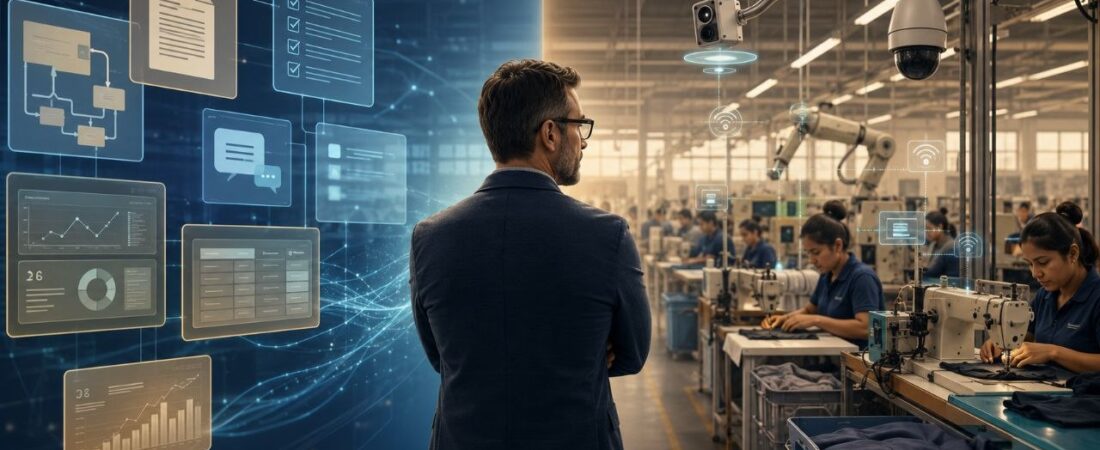
Factory decision note
Do not decide between Physical AI and Generative AI by asking which technology sounds more advanced. Decide by naming the factory decision that must improve. If the work is reports, SOPs, training, buyer communication, or meeting follow-up, generative AI may be the lower-risk first step. If the work touches machines, cameras, operators, safety, defects, WIP movement, or robot motion, the project has entered the Physical AI layer and needs stronger floor evidence before budget approval.
The mistake factories usually make
The common mistake is to let a good chatbot demo create confidence for a physical automation project. A language model can summarize a defect report, but it cannot prove lighting stability, fabric handling, operator response, false-reject cost, machine stop logic, or robot safety. Those belong to the production floor, not the slide deck.
What I would check before approving budget
- Which layer is being improved: knowledge work, management decision, or physical floor action?
- What daily KPI should move: report time, training speed, defect escape, downtime, waiting time, output recovery, or safety response?
- Who owns the result after AI gives a recommendation: planning, QA, IE, maintenance, production, or safety?
- What stop condition prevents AI advice from becoming unsafe or expensive action?
Vendor proof requests
- Separate document-generation ROI from physical-world ROI in the proposal.
- Show how the system handles uncertain images, weak sensor signals, blocked routes, style changeover, and conflicting operator feedback.
- Demonstrate the boundary between advice, recommendation, workflow trigger, and physical execution.
Pilot gate
GO when the AI type matches the factory decision and the evidence boundary is visible. HOLD when the value is plausible but the data owner or floor response routine is weak. REDESIGN when a generative AI demo is being used to justify cameras, robots, or machine action without floor proof.
Factory leaders are hearing two AI terms more often: Generative AI and Physical AI.
Both matter.
But they are not the same thing.
Generative AI helps factories think, write, summarize, search, explain, plan, and analyze. It works mainly through language, documents, images, code, and digital workflows.
Physical AI connects intelligence to the real production environment. It works through cameras, sensors, machines, operators, robots, quality checkpoints, safety systems, and factory-floor data.
The difference matters because a factory can waste money by applying the wrong AI to the wrong problem.
A chatbot cannot fix unstable material flow.
A robot cannot solve unclear production planning.
A camera system cannot improve quality if defect definitions are inconsistent.
And a dashboard cannot create ROI if no one on the floor changes the decision.
For factory leaders, the key question is not whether Generative AI or Physical AI is better.
The better question is:
Which layer of factory work are we trying to improve: information work, decision work, or physical work?
This article explains the practical difference between Physical AI and Generative AI, where each one creates value, and how manufacturers should combine both in a realistic Factory AI roadmap.
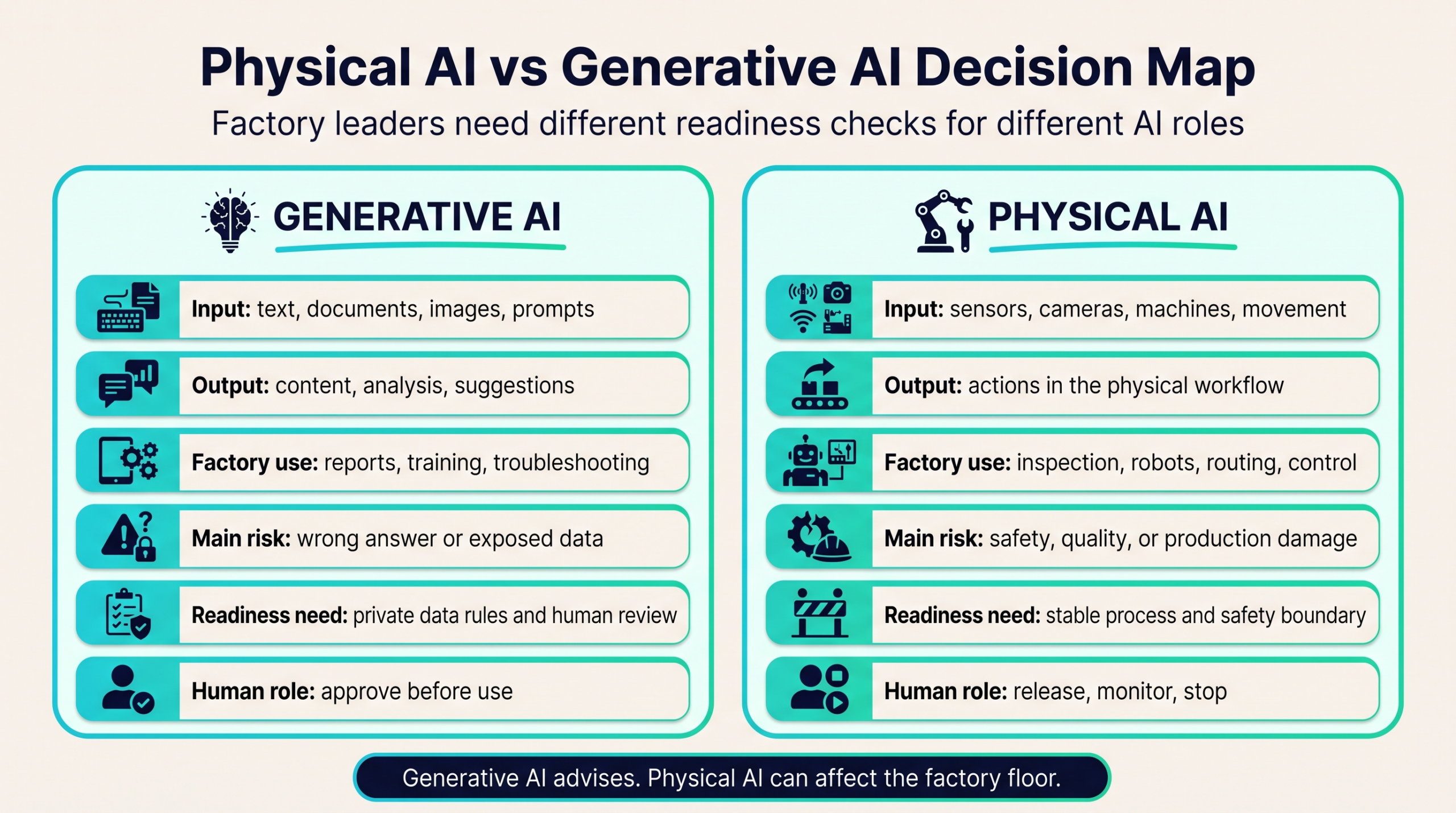
Factory answer: Physical AI vs Generative AI
Generative AI creates or transforms digital outputs such as text, reports, summaries, images, code, instructions, training material, and analysis.
Physical AI senses, interprets, guides, or acts inside the physical factory environment using cameras, sensors, machines, robots, operators, and production data.
In simple terms:
- Generative AI improves factory knowledge work.
- Physical AI improves factory-floor understanding and action.
- Factory AI needs both, but they should not be confused.
A factory may use Generative AI to summarize a quality report, draft a corrective action, translate work instructions, or analyze production meeting notes.
The same factory may use Physical AI to detect a defect, monitor machine condition, identify a bottleneck, guide an operator, or score whether a process is ready for robot automation.
Both can support manufacturing. But they operate at different layers of the factory system.
Physical AI vs Generative AI is not just a technology comparison. For factory leaders, it is a practical decision about where intelligence should operate: in digital workflows, physical production systems, or both.
Why Factory Leaders Confuse the Two
Factory leaders often see AI through vendor demos.
One vendor shows a chatbot that answers production questions.
Another vendor shows a camera detecting defects.
Another shows a robot arm handling parts.
Another shows a dashboard predicting downtime.
All are called AI.
That creates confusion.
The real distinction is not whether the technology is called AI. The distinction is what part of the factory it touches.
Generative AI usually touches:
- documents
- planning notes
- emails
- SOPs
- training material
- reports
- spreadsheets
- meeting summaries
- knowledge bases
- software workflows
Physical AI usually touches:
- machines
- sensors
- cameras
- operators
- tools
- defects
- WIP
- layout
- motion
- safety zones
- maintenance signals
- robot or automation cells
When factory leaders confuse these layers, they may expect a language model to solve a physical execution problem, or expect a robot project to solve a management information problem.
That is where many AI projects become expensive but weak.
In manufacturing strategy, Physical AI vs Generative AI should be framed as a workflow question: what work is digital, what work is physical, and where should people stay in control?
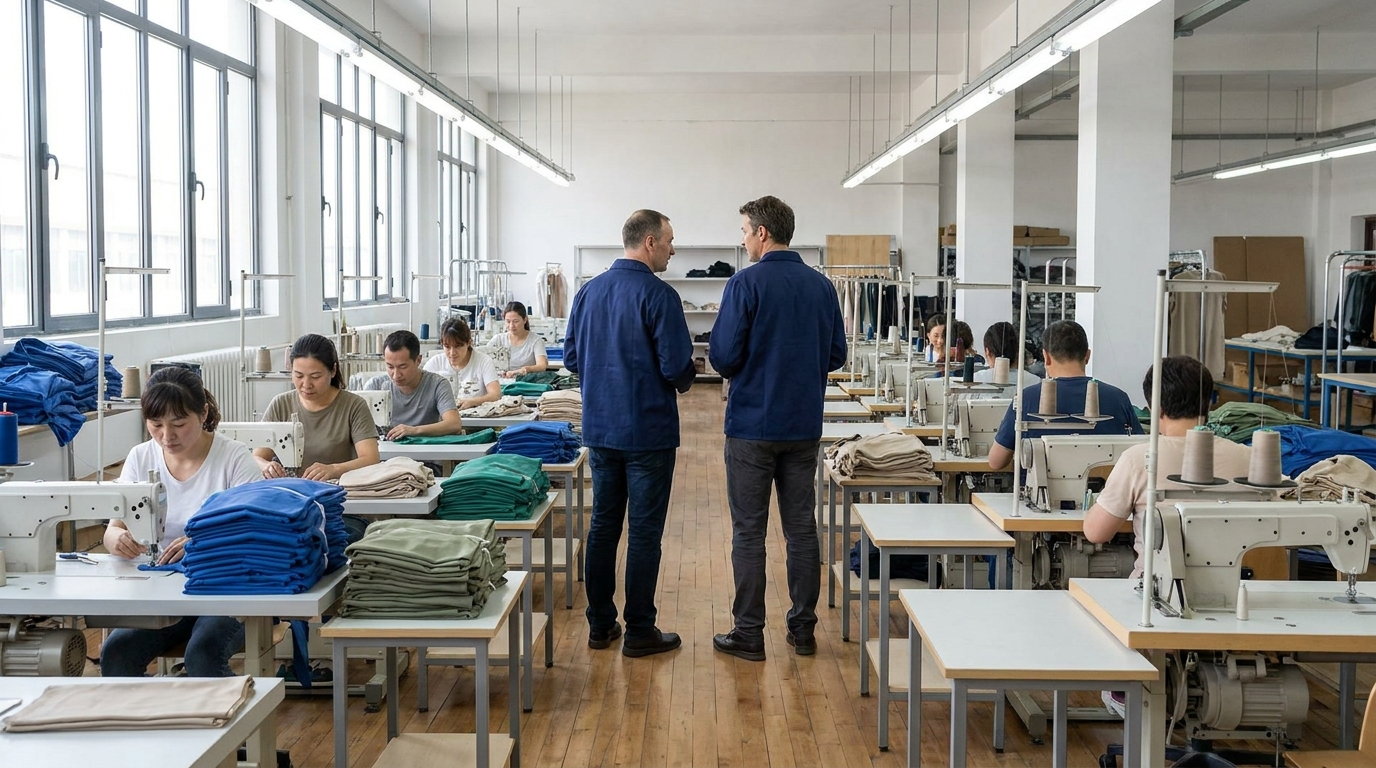
What Generative AI Does Well in Manufacturing
Generative AI is useful when the factory problem involves information, language, documentation, analysis, or communication.
It can help teams work faster with knowledge that already exists but is scattered across systems, files, meetings, and people.
1. SOP and Work Instruction Drafting
Factories often have inconsistent SOPs, outdated work instructions, and training material that depends too much on experienced supervisors.
Generative AI can help convert rough process notes into clearer SOPs, checklists, visual instruction scripts, training outlines, and multilingual explanations.
For apparel and garment factories, this can include:
- sewing operation explanation
- quality checkpoint summaries
- packing instructions
- measurement procedure drafts
- buyer audit preparation notes
- line leader training material
- translated operator guidance
The AI should not be the final authority. Factory teams still need to review the output against real methods, machines, tools, buyer requirements, and quality standards.
But as a drafting and standardization assistant, Generative AI can save time.
2. Production Report Summaries
Many factories already collect production data, but management teams do not always have time to read every report.
Generative AI can summarize:
- daily output reports
- downtime logs
- quality reports
- shipment risk notes
- planning changes
- meeting minutes
- buyer comments
- audit observations
The value is not just shorter text.
The value is faster understanding.
A good AI summary can highlight what changed, what is risky, what requires escalation, and what should be checked tomorrow.
3. Training and Knowledge Transfer
Manufacturing knowledge often lives in people’s heads.
Experienced supervisors, mechanics, QC managers, merchandisers, IE teams, and line leaders know what usually goes wrong. But that knowledge is not always captured.
Generative AI can help turn expert knowledge into reusable learning material.
Examples include:
- onboarding guides for new supervisors
- QC defect explanation sheets
- mechanic troubleshooting notes
- IE training modules
- buyer communication templates
- factory audit preparation guides
- multilingual training scripts
This is especially useful in garment factories where high operator turnover and style variation make consistent training difficult.
4. Scenario Analysis and Decision Support
Generative AI can help managers think through scenarios.
For example:
- What happens if absenteeism increases by 10%?
- Which orders are at risk if a fabric lot is delayed?
- What should the factory check before adding overtime?
- What questions should a manager ask before buying automation?
- What are the hidden risks in a robot ROI proposal?
The AI can organize questions and assumptions. But it still needs real data and human judgment.
Generative AI is strongest when it helps leaders think more clearly, not when it invents certainty.
What Physical AI Does Well in Manufacturing
Physical AI is useful when the factory problem involves real-world sensing, motion, inspection, condition monitoring, flow, safety, or automation.
It connects digital intelligence to the physical production system.
1. Visual Inspection and Defect Detection
Cameras and AI vision models can help detect defects, missing components, stains, wrong labels, surface issues, measurement deviations, or assembly errors.
In garment manufacturing, Physical AI may support:
- fabric defect detection
- seam issue detection
- skipped stitch detection
- label verification
- shade comparison
- packing label checks
- measurement flagging
This is not only a software task. Lighting, camera angle, defect definitions, inspection station layout, and human confirmation all matter.
That is why visual inspection belongs to the Physical AI layer.
2. Machine Condition and Predictive Maintenance
Physical AI can monitor machines and detect patterns that suggest future problems.
Depending on the factory, signals may include:
- vibration
- temperature
- sound
- motor load
- pressure
- error codes
- downtime history
- maintenance records
For garment factories, the starting point may be simpler: structured downtime logs and recurring machine problem patterns.
The goal is to reduce surprise breakdowns and identify which machine problems damage output or quality.
3. Bottleneck and Flow Detection
Production flow is physical.
WIP moves. Operators wait. Machines stop. Bundles accumulate. Material arrives late. Packing gets congested.
Physical AI can help detect where flow breaks.
It may combine:
- line output
- standard time
- WIP location
- operator performance
- downtime
- defect rework
- layout distance
- material feeding status
For apparel factories, this can help answer whether a bottleneck is caused by skill, method, machine, material, quality, or planning.
4. Operator Guidance and Human-in-the-Loop Support
Physical AI can also support operators directly.
This may include real-time guidance, machine setting recommendations, visual work instructions, quality reminders, or exception alerts.
In garment factories, this is often more realistic than full sewing robot automation.
Human operators still handle flexible fabric and style variation, while AI helps reduce mistakes and speed up learning.
5. Robot and Automation Readiness
Physical AI can help decide whether a process is ready for automation.
Before buying robots, a factory needs to understand:
- process stability
- variation level
- cycle time consistency
- material handling difficulty
- quality risk
- tooling requirements
- changeover frequency
- maintenance capability
- expected payback
This connects directly to practical Physical AI use cases in manufacturing.
Internal reference: practical Physical AI use cases in manufacturing
For factory leaders, Physical AI vs Generative AI should be evaluated by the layer of work being improved, not by vendor labels or demo language.
7 Key Differences Between Physical AI and Generative AI
1. Output Type
Generative AI produces digital outputs.
Examples include text, summaries, images, code, recommendations, checklists, translations, and reports.
Physical AI produces factory-floor understanding or action.
Examples include defect alerts, machine condition signals, safety warnings, robot motion, bottleneck detection, or operator guidance.
2. Data Source
Generative AI usually works with digital information.
It reads documents, tables, emails, SOPs, reports, transcripts, manuals, and structured datasets.
Physical AI works with real-world signals.
It uses cameras, sensors, machines, human activity, material movement, quality checkpoints, WIP flow, and production events.
3. Implementation Environment
Generative AI can often start in the office.
A team can pilot it with documents, reports, spreadsheets, and internal knowledge.
Physical AI must survive the factory floor.
It must handle lighting, dust, vibration, layout constraints, operator behavior, material variation, machine downtime, and safety requirements.
4. Risk Profile
Generative AI risk often involves misinformation, privacy, confidentiality, poor decisions, or weak governance.
Physical AI risk can include those issues plus safety, machine interaction, production disruption, false defect rejection, false pass, downtime, and operator trust.
A wrong report summary is a management problem.
A wrong safety alert or robot action can become an operational risk.
5. ROI Timing
Generative AI may produce faster low-cost productivity gains in office and management workflows.
Physical AI may require more setup but can create direct production impact through defect reduction, downtime reduction, output improvement, safer operations, and better automation investment decisions.
The right ROI question is different for each.
For Generative AI:
- How much time does it save?
- Which decisions become faster?
- Which knowledge becomes reusable?
- Which reports or workflows become clearer?
For Physical AI:
- How much defect, downtime, rework, waiting time, or automation risk does it reduce?
- Can the factory act on the signal?
- Does the system improve daily floor decisions?
6. Ownership
Generative AI often starts with management, planning, IT, HR, training, merchandising, or reporting teams.
Physical AI usually requires stronger floor ownership.
It may involve production, QC, maintenance, IE, safety, engineering, automation, and operators.
If Physical AI is owned only by IT, it may fail because the floor does not change behavior.
7. Readiness Requirements
Generative AI needs usable knowledge and governance.
Physical AI needs stable process signals.
Before using Physical AI, the factory should ask:
- Are defect definitions standardized?
- Is downtime captured consistently?
- Is standard time reliable?
- Is layout and WIP flow understood?
- Are operators trained to respond to alerts?
- Is there a clear owner for the decision after AI gives a signal?
Without these foundations, Physical AI becomes a technology demo rather than a factory improvement system.
For apparel factories, the Physical AI vs Generative AI choice often starts with simple use cases: better reports, better defect visibility, better line decisions, and better automation readiness.
Apparel Factory Example: Where Each AI Fits
Consider an apparel supplier producing multiple styles with frequent changeovers.
The factory faces late output, quality variation, line imbalance, and pressure to explore automation.
Generative AI can help by:
- summarizing daily production and quality reports
- drafting operator training guides
- translating buyer quality requirements
- creating supervisor checklists
- analyzing meeting notes
- preparing automation evaluation questions
- summarizing GSD, SAM, and SMV data for management review
Physical AI can help by:
- detecting visual defects
- monitoring machine downtime patterns
- identifying bottleneck operations
- guiding operators during style changeover
- flagging safety risks
- checking packing labels
- scoring operations for automation readiness
The best factory roadmap does not choose one and ignore the other.
It uses Generative AI to improve knowledge flow and decision preparation.
It uses Physical AI to improve real production visibility and execution.
Together, they create a stronger Factory AI layer.
Internal reference: standard time data for Factory AI
When Factory Leaders Should Start With Generative AI
A factory should start with Generative AI when the biggest problem is information friction.
This includes situations such as:
- managers spend too much time writing reports
- SOPs are inconsistent or outdated
- training material is weak
- buyer requirements are difficult to translate into floor instructions
- meeting notes are not converted into action plans
- production knowledge is trapped in experienced staff
- planning teams need faster scenario analysis
- quality teams need better corrective action drafts
Generative AI is often a good first step because it is easier to pilot without changing machines or layouts.
But leaders should still manage confidentiality, data quality, and human review.
AI-generated content should not become factory policy until the relevant expert checks it.
When Factory Leaders Should Start With Physical AI
A factory should start with Physical AI when the biggest problem is physical execution visibility.
This includes situations such as:
- quality defects are detected too late
- machine breakdowns are recurring
- bottlenecks are not clearly understood
- WIP is stuck but no one knows why
- operators need real-time guidance
- safety risks need faster detection
- automation investment decisions are unclear
- robot proposals look attractive but process readiness is weak
Physical AI is more demanding than a document-based AI pilot.
It requires floor validation, data capture, ownership, and clear response routines.
The question is not just whether the AI model detects something.
The question is whether the factory team can act on what it detects.
Internal reference: why garment factory automation is difficult
The practical answer to Physical AI vs Generative AI is not choosing one side. It is sequencing both correctly so digital knowledge work supports real factory-floor action.
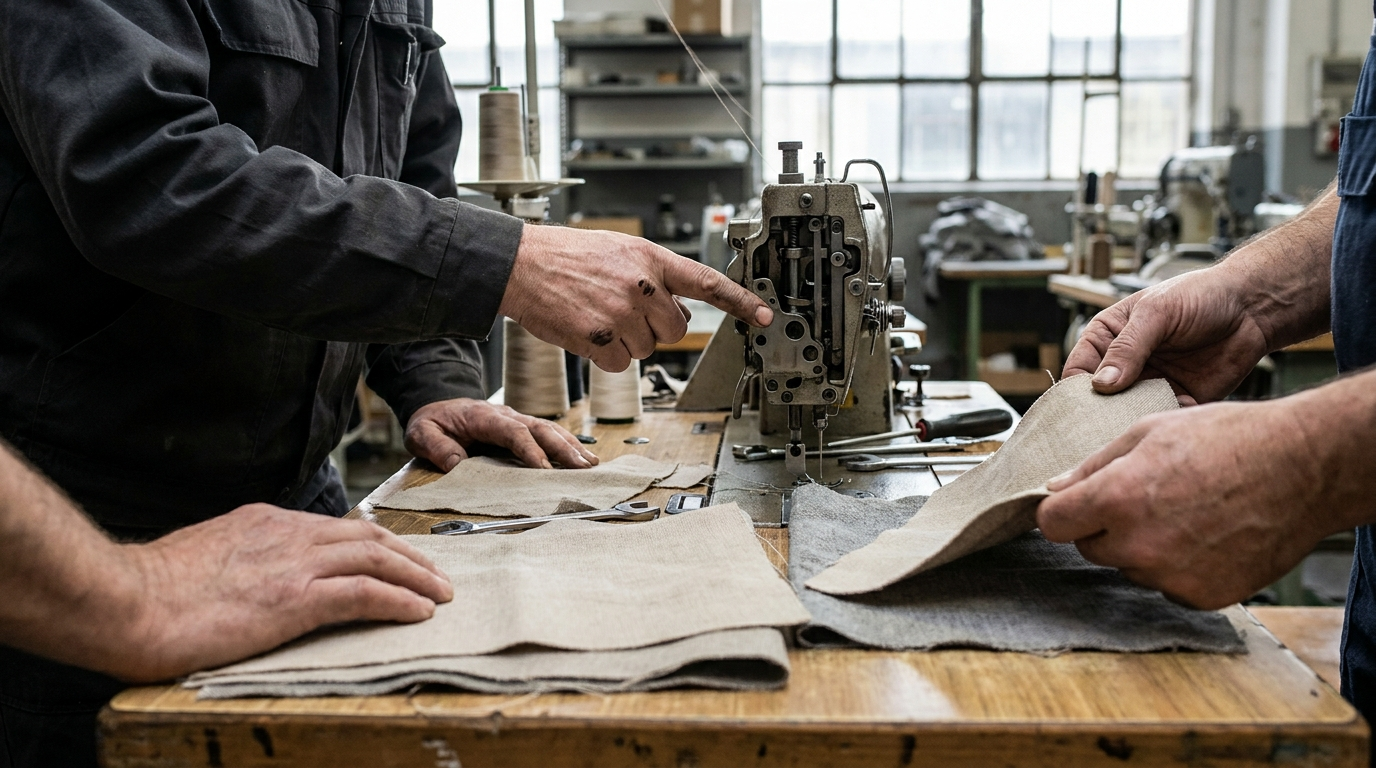
Why Factory AI Needs Both
Generative AI and Physical AI should not compete.
They should connect.
A factory may use Physical AI to detect a recurring defect pattern. Then Generative AI can help summarize the issue, draft a corrective action, create training material, and prepare a supervisor checklist.
A factory may use Generative AI to analyze maintenance reports. Then Physical AI can monitor machine signals and confirm whether the pattern appears on the floor.
A factory may use Physical AI to identify a bottleneck. Then Generative AI can help explain the options, prepare a line-balancing meeting summary, and document the improvement action.
The most useful Factory AI system connects three layers:
1. Knowledge layer — documents, SOPs, reports, training, policies. 2. Decision layer — planning, analysis, prioritization, escalation. 3. Physical layer — machines, operators, material, quality, flow, safety.
Generative AI is strongest in the knowledge and decision layers.
Physical AI is strongest in the physical layer.
Factory leaders need a roadmap that connects all three.
A realistic Physical AI vs Generative AI roadmap usually starts with clean information flows, then adds sensing, guidance, and physical-world feedback where ROI is visible.
Factory use-case route: choose the AI layer before the tool
A shorter route is enough for most factory leaders. First, name the business problem: reporting delay, training gap, late defect detection, unstable line balance, downtime, or robot readiness. Second, classify the work layer. If the work is mostly documents, reports, training, or management review, generative AI may be the first tool. If the work depends on cameras, sensors, machines, material movement, safety, or operator action, physical AI needs stronger evidence and control gates.
The practical rule is simple: use generative AI to improve knowledge work, use physical AI when the factory must sense or influence the real production floor, and connect both only after the data owner, approval rule, and stop condition are clear.
Decision Checklist for Factory Leaders
Before choosing between Physical AI and Generative AI, ask:
- Is the main problem digital, physical, or both?
- Does the problem involve documents, reports, SOPs, or communication?
- Does the problem involve machines, operators, defects, sensors, or motion?
- What decision should improve because of AI?
- Who owns the decision after AI gives an answer?
- What data is available today?
- Is the process stable enough for AI to learn from it?
- What can be tested in 30 to 90 days?
- What KPI should improve?
- What risk is created if the AI is wrong?
- Does the project prepare the factory for future automation?
If the answers are unclear, the factory should not buy technology yet.
It should first clarify the operating problem.
The best Physical AI vs Generative AI strategy does not separate office intelligence from floor intelligence; it connects both into one factory improvement loop.
Failure modes to avoid
- Treating every AI tool as the same: a chatbot, camera system, dashboard, and robot cell solve different factory problems.
- Starting with robots before information discipline: weak defect codes, downtime logic, standard time, or WIP visibility will make physical AI look worse than it is.
- Using generative AI without review: confident text still needs source control, expert review, and approval boundaries.
- Measuring model accuracy but not factory impact: the real test is quality, downtime, training, safety, or decision speed.
Governance references for AI risk boundaries
Factory leaders evaluating AI systems should also consider governance and risk management. The NIST AI Risk Management Framework provides a useful structure for thinking about AI risk, trustworthiness, measurement, and governance.
For manufacturing context, NIST also maintains a Smart Manufacturing resource page that can help leaders connect AI discussions to broader production-system modernization.
These references do not replace factory-floor validation. They help management ask better questions before deploying AI into production environments.
Final factory AI boundary
Use Generative AI first when the problem is knowledge work: reports, SOPs, training, summaries, scenarios, buyer communication, or management review.
Use Physical AI first when the problem is floor visibility or action: defects, machines, material flow, WIP, safety, maintenance, operator guidance, or automation readiness.
Connect both only after the factory names the owner, KPI, evidence source, human approval rule, and stop condition. The winning factory is not the one that buys the most advanced AI tool; it is the one that knows where each AI belongs and how it improves real factory performance.
Source anchors for factory AI type decisions
- NIST AI Risk Management Framework — useful for separating AI advice, evidence, monitoring, and action risk.
- OSHA robotics guidance — relevant when AI decisions interact with workers, machines, and physical automation boundaries.
Factory AI type FAQ
What is the main difference between Physical AI and Generative AI?
Generative AI creates or transforms digital content such as text, reports, summaries, images, code, and training material. Physical AI connects intelligence to real-world factory operations through cameras, sensors, machines, operators, robots, and production data.
Is Generative AI useful in manufacturing?
Yes. Generative AI can help with SOP drafting, report summaries, training material, translation, knowledge management, meeting notes, and scenario analysis. It is most useful when the problem involves information and decision support.
Is Physical AI the same as robotics?
No. Robotics is one possible expression of Physical AI, but Physical AI is broader. It can include visual inspection, machine monitoring, safety detection, bottleneck analysis, operator guidance, and automation readiness scoring even before robots are deployed.
Which should a factory adopt first?
It depends on the problem. If the issue is documentation, reporting, training, or analysis, Generative AI may be the best first step. If the issue is defects, downtime, bottlenecks, safety, or automation readiness, Physical AI may be more relevant.
Can garment factories use both?
Yes. Garment factories can use Generative AI for training, SOPs, production summaries, buyer communication, and planning support. They can use Physical AI for inspection, line balancing, downtime analysis, operator guidance, and automation readiness.
Why do AI projects fail in factories?
AI projects fail when factories start with technology instead of operational problems, lack reliable data, ignore floor ownership, skip human review, or measure model performance without measuring factory impact.