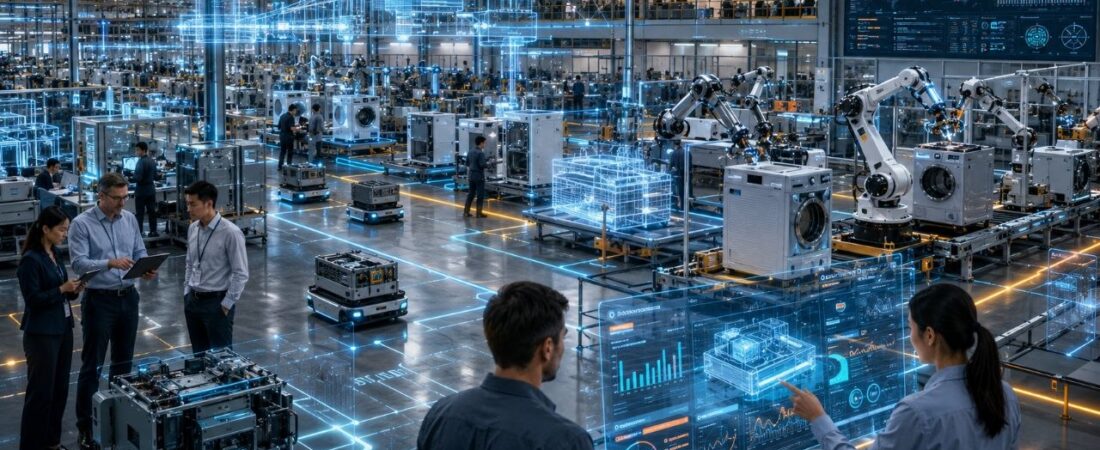
Factory-as-product decision note
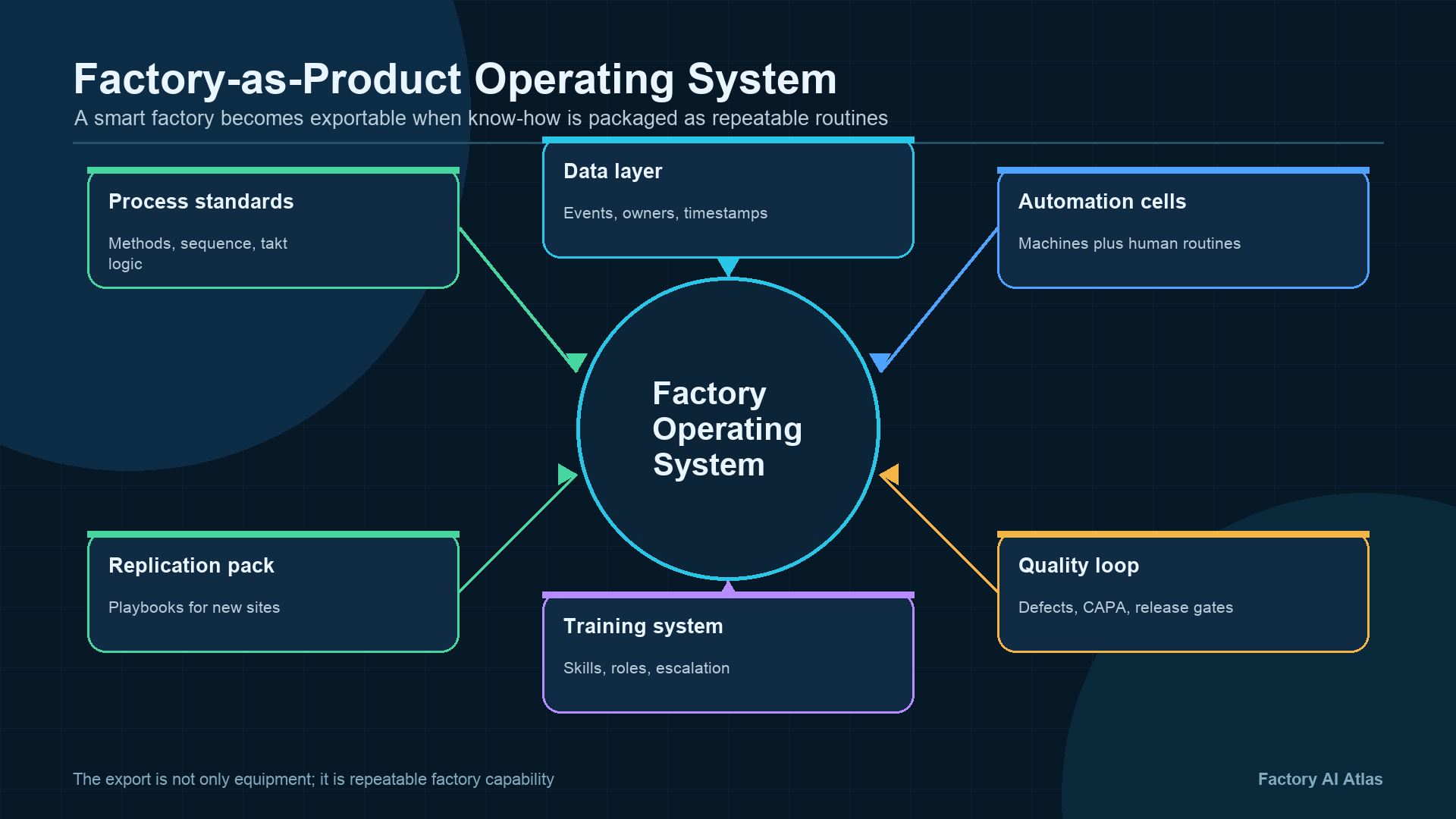
The LG smart factory example should be read as an operating-system lesson, not only a corporate technology story. The factory itself becomes exportable only when process visibility, standard work, data governance, automation maintenance, and decision rights are mature enough to transfer.
Copying the showcase misses the operating system
The common mistake is to copy the visible technology layer without copying the operating discipline behind it. Robots, sensors, dashboards, and AI models are easier to buy than the standards, feedback loops, training, and management routines that make them work.
Checks before funding a smart-factory transfer
- Which part of the smart-factory model is being adopted: equipment, data layer, operating routine, or management system?
- Can the factory prove that standards, exceptions, downtime, quality, and maintenance signals are already controlled?
- Is the implementation team able to transfer the model to another factory without relying on hero managers?
Proof requests for an exportable factory model
- Show a process map connecting equipment signals to operating decisions.
- Provide evidence from multiple lines or sites, not only one flagship showcase.
- Explain the training, maintenance, data ownership, and change-management model behind the technology.
Replication gate
GO if the smart-factory layer strengthens transferable operating control. HOLD if the technology is strong but factory routines are immature. REDESIGN if the project is a showcase purchase without an operating-system transfer plan.
LG smart factory strategy is not only about making appliances faster. It shows how a manufacturer can turn factory know-how into an exportable operating system.
It may be the factory that makes the washing machine.
A recent Hankyung Global Market video described LG Electronics’ Tennessee facility as something close to a “factory that makes factories.” The phrase is useful because it captures a shift that many manufacturers are still missing: an LG smart factory is no longer only an internal efficiency project. It is a repeatable operating model that can be sold, transferred, and adapted across industries.
For Factory AI Atlas, the lesson is not simply that LG has an advanced appliance plant in the United States. The bigger lesson is that manufacturing know-how is becoming a product. The companies that can design, operate, measure, and continuously adjust production systems may have a stronger advantage than companies that only compete on the final product.
Why the appliance pressure matters for factory strategy
The background matters. The U.S. appliance market is being squeezed from several directions at once. High interest rates have slowed housing transactions. When people buy fewer homes, remodel fewer kitchens, and move less often, they also delay purchases of refrigerators, washers, dryers, and other large appliances.
At the same time, manufacturers face higher labor costs, raw material pressure, tariff uncertainty, and stronger competition from lower-cost brands. Whirlpool’s Q1 2026 investor materials described recession-level weakness in U.S. and Canada appliance demand, pressure from consumer sentiment, tariff disruption, raw material inflation, and pricing pressure. The National Association of Realtors also reported that U.S. existing-home sales remained below the healthier 5-million-plus pace often associated with a stronger replacement cycle.
In this environment, appliance companies cannot rely only on price increases or brand reputation. They need a structural answer.
That answer is not just “make the product smarter.” It is “make the factory smarter.”
What the LG smart factory shows about operating systems
The LG smart factory in Clarksville, Tennessee is not just a factory built closer to U.S. customers. According to LG’s announcement via PR Newswire, the facility has annual production capacity of about 1.2 million washers and 600,000 dryers. It was selected by the World Economic Forum as a Global Lighthouse Factory, becoming the first U.S. home appliance plant in the industry to receive that recognition.
The World Economic Forum case page for LG Electronics — Clarksville describes the site as a manufacturing Lighthouse that used deep learning, automation, and digitalization to address human resource risks and production know-how gaps after establishing a U.S. plant.
LG’s announcement also points to a fully autonomous logistics system with 166 automated guided vehicles, AI-based quality optimization, digital production technologies, and a defect-rate reduction of more than 61 percent compared with earlier benchmarks cited in the WEF site visit report. The company also described plans for 5G connectivity and autonomous mobile robots to improve logistics accuracy and speed.
The specific technologies matter: digitalized production flow, autonomous logistics, AGVs and AMRs, AI-based quality optimization, IoT-connected factory data, robotics for heavy or dangerous work, and data-based monitoring of productivity risk.
But the most important point is not any single technology. The real point is integration.
The LG smart factory model is not simply about adding robots to a traditional factory. It is about connecting material flow, labor flow, machine flow, inspection flow, and quality data into something closer to a factory operating system.
Seven transfer lessons from the LG smart-factory model
This is where the story becomes more important for manufacturing AI.
LG has already moved beyond the idea that smart factories are only for internal use. In 2024, LG announced that it was expanding its smart factory solutions business by combining AI, digital transformation, and 66 years of manufacturing expertise.
The company said its Production engineering Research Institute would offer external clients services such as production consulting, equipment and operation system development, and technology personnel training. LG also said it had accumulated 770 terabytes of manufacturing and production data over the past decade and filed more than 1,000 patents related to smart factory solutions.
That is the real shift. The factory is no longer only a place where products are made. The factory itself becomes a product.
Not the building. Not the machines alone. The operating logic.
- How a line is designed
- How bottlenecks are detected
- How materials are delivered
- How robots are placed into real workflows
- How digital twins simulate production before problems happen
- How quality data is connected to process conditions
- How less-experienced workers can be supported by better systems
- How delays are detected before they become shipment risks
This is the difference between a smart factory as a technology project and a smart factory as a business capability.
Physical AI is not just about humanoid robots
Physical AI is often discussed through the image of humanoid robots, robotic arms, or autonomous machines. But in real factories, physical AI is usually less dramatic and more operational.
It shows up when a factory can answer questions like these:
- Where is the material right now?
- Which process is becoming a bottleneck?
- Which machine is drifting out of normal condition?
- Which quality issue is linked to which operation?
- Which line will miss its target before the supervisor notices?
- Which worker, material, or machine constraint will create a delivery risk?
This is why smart factories matter. The factory becomes visible. Then it becomes measurable. Then it becomes adjustable.
Without visibility, AI is just a dashboard. With visibility, AI can become an operating layer.
Why apparel factories should pay attention
Apparel factories should not copy LG’s Tennessee factory literally. A washing machine factory is a repeat assembly environment. Apparel manufacturing is much more variable. Styles change. Fabrics behave differently. Operators have different skill levels. Sewing operations are more labor-intensive, and small handling differences can affect quality and output.
So the lesson is not: “garment factories need the same robots.” The lesson is: “garment factories need the same operating logic.”
For apparel factories, the goal is not to copy LG’s robots. The goal is to copy the operating logic: make the factory visible, measurable, and adjustable before problems become shipment delays.
That means garment factories should focus on systems that connect line-level WIP, material availability, cutting output, sewing bottlenecks, finishing status, packing readiness, QC defect data, operator skill allocation, IE/GSD standard time, actual production time, and style-level performance variation.
In many garment factories, these signals still live in separate places. Some are in Excel. Some are in supervisor notebooks. Some are in ERP. Some are only inside the head of an experienced production manager.
That is the real problem. AI cannot manage a factory that the system cannot see.
What a garment factory operating system could look like
A garment factory version of this operating logic does not have to start with expensive robotics. It can start with disciplined visibility.
1. Real-time WIP visibility
Factories need to know where production is stuck by line, process, style, and order. A daily output report is not enough if the shipment risk was already visible three hours earlier.
2. Digital handoff between departments
Cutting, sewing, finishing, and packing should not operate as isolated islands. Each department should hand off digital status, not just physical bundles.
3. Defect data connected to process data
QC data becomes much more powerful when defects are linked to operation, machine, operator group, style, fabric type, and time window. This connects directly to the Factory AI Atlas view of AI visual inspection in garment factories: inspection only becomes valuable when it is connected to action.
4. IE/GSD standard time versus actual time
Factories already know the planned standard time. The next step is comparing that standard with live output and using the gap to identify training, balancing, material, or method problems.
5. AI-assisted line balancing
Line balancing should not depend only on the most experienced supervisor. AI can help simulate operator allocation, bottleneck risk, and target feasibility before the line falls behind.
6. Exception alerts for production managers
Managers do not need more dashboards. They need exception alerts: where to look, why it matters, and what action is likely to reduce risk.
This is the apparel version of factory intelligence. It is not about replacing the production manager. It is about giving the production manager a better operating system.
Strategic lesson: the factory becomes the product
The LG smart factory case is useful because it shows a broader manufacturing shift. The future of manufacturing AI is not only about smarter products. It is about factories that can sense, move, measure, and adjust production before cost, labor, quality, and delivery problems become business risks.
This matters especially in high-cost or unstable environments. When labor is expensive, the factory needs better labor leverage. When materials are costly, the factory needs less waste. When demand is uncertain, the factory needs faster adjustment. When quality risk is high, the factory needs earlier detection. When skilled workers leave, the factory needs more systemized know-how.
That is why factory know-how itself is becoming valuable intellectual property. A company that can repeatedly build better factories is not only a manufacturer. It is a manufacturing systems company.
For factories still at the beginning of this journey, the first step is not a robot purchase. It is a readiness check. Start by asking whether the factory has the data, process ownership, and operating discipline needed for AI to work. The Factory AI Readiness Checklist is a practical place to begin.
FAA takeaway: export the operating model, not only the equipment
The next stage of manufacturing AI will not be won by factories that only add isolated AI tools. It will be won by factories that turn their operations into connected, measurable, and adjustable systems.
The LG smart factory is one example from appliances. Apparel factories will need a different version. But the direction is the same.
The factory must become an operating system.
Not because every factory needs more technology. But because every factory needs better control before small problems become shipment delays, margin loss, or buyer complaints.
In the next manufacturing era, the product is not the only thing being exported.
The factory itself may be the product.
Source anchors for the LG smart-factory case
- Hankyung Global Market YouTube video on LG’s smart factory and “factory that makes factories” framing.
- LG Electronics / PR Newswire, “LG Home Appliance Factory in United States Latest to Receive Prestigious ‘Lighthouse’ Status.”
- World Economic Forum Global Lighthouse Network, “LG Electronics — Clarksville.”
- LG Electronics / PR Newswire, “LG Accelerates Smart Factory Solutions Business Integrating AI With 66-Year Manufacturing Expertise.”
- Whirlpool Corporation, Q1 2026 Earnings Presentation.
- National Association of Realtors, Existing-Home Sales.
- GE Appliances Pressroom, “GE Appliances Announces Historic $3 Billion Investment to Expand U.S. Manufacturing.”
External validation anchors for smart-factory transfer
- NIST manufacturing resources — useful for grounding smart-factory discussion in manufacturing systems and interoperability constraints.
- International Federation of Robotics industrial robot resources — helpful context for realistic industrial robot deployment rather than technology-showcase assumptions.