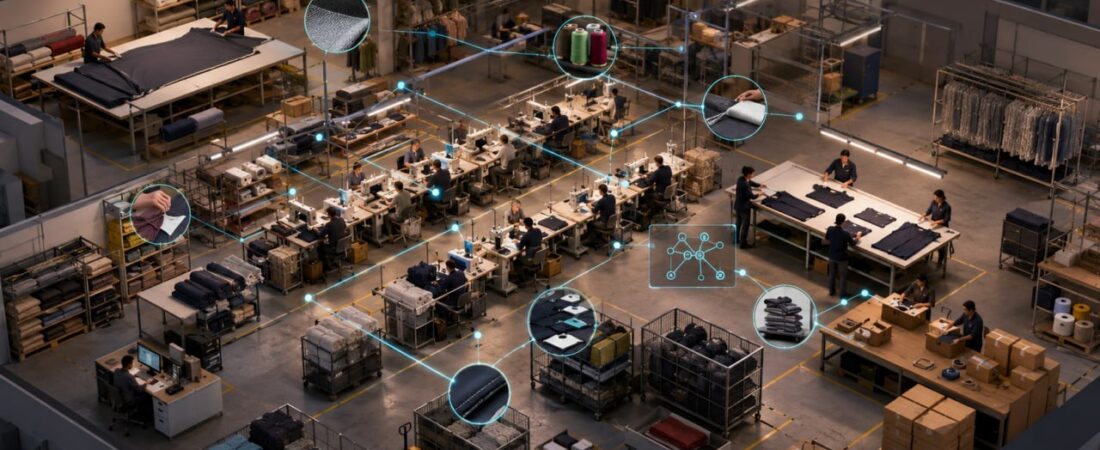
Garment Physical-AI data note
Physical AI in garment factories should begin with reliable process, skill, material, quality, WIP, and buyer-evidence data. Robots become useful later only when the factory can describe the physical work well enough for software to reason about it.
Robot plans fail when factory data is weak
The common mistake is to treat Physical AI as a robot purchase path. In garment production, the harder foundation is recording how fabric behaves, how operators adapt, where quality risk appears, how WIP moves, and which exceptions repeat by style or buyer.
Checks before planning garment Physical AI
- Can the factory explain the target process in data terms before introducing a physical AI system?
- Are skill variation, material behavior, workstation method, and quality outcomes connected to the same style or operation history?
- Which decision will improve first: training, work aid design, inspection focus, scheduling, maintenance, or automation readiness?
Proof requests for garment data readiness
- Map the proposed Physical AI use case to existing factory records and show which missing data must be created.
- Demonstrate how simulation or synthetic data will be checked against real production behavior.
- Provide a staged roadmap that separates data readiness, decision support, assisted operation, and robot deployment.
Data-before-robots gate
GO if the pilot strengthens the data foundation for a real physical decision. HOLD if the vision is strong but shop-floor evidence is thin. REDESIGN if the plan jumps to robots before describing the work.
Physical AI in garment factories will not begin with humanoid robots standing beside sewing operators.
That image is easy to imagine, but it can mislead factory leaders. For most apparel manufacturers, the first step toward Physical AI is not buying a robot, installing a fully automated line, or adding another screen to the production office.
The first step is more basic:
Can the factory turn physical work into structured data that AI can actually learn from?
A garment factory is full of physical intelligence already. Operators handle soft fabric. Line leaders balance work-in-progress. QC teams judge defects against buyer standards. Cutting teams manage shade, shrinkage, numbering, and bundling. Finishing teams connect sewing output to shipment readiness.
But much of this knowledge remains inside people, paper records, disconnected spreadsheets, and informal routines.
For Physical AI to become useful in apparel manufacturing, the factory must make this operating reality visible, measurable, and learnable.
For garment factories, Physical AI is not first a robotics question. It is a data-readiness question. This is why physical AI in garment factories must begin with the data layer, not with a robot purchase. For the broader definition, see what Physical AI means in smart manufacturing.
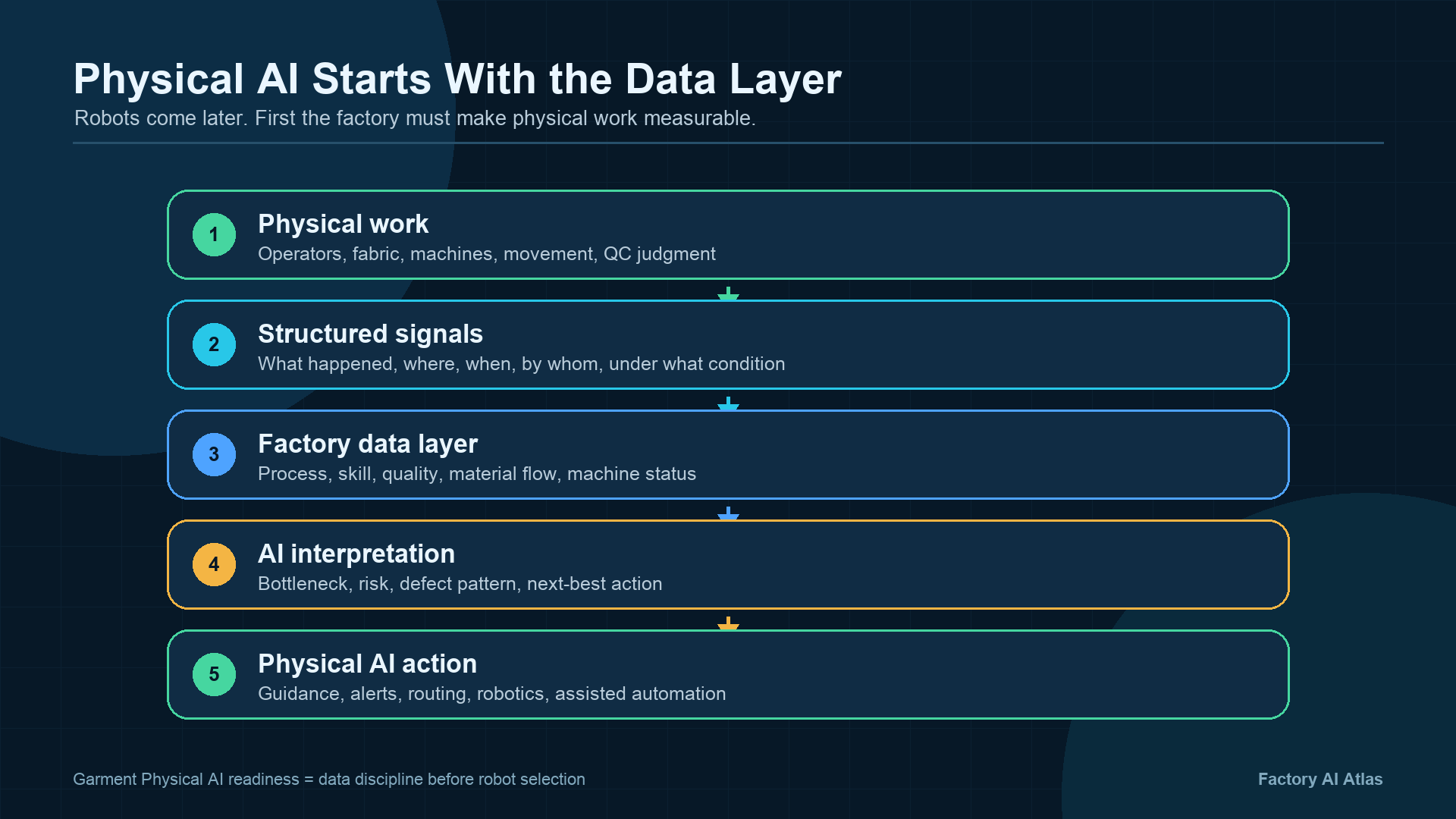
Physical AI Is Different From Generative AI
Generative AI works mainly with digital content: text, images, documents, code, and patterns in existing media.
Physical AI must work with the physical world.
That means it must understand:
- objects,
- motion,
- timing,
- sequence,
- location,
- material behavior,
- machine condition,
- human action,
- quality variation,
- and workflow constraints.
In a garment factory, these variables are difficult.
Fabric is not a rigid part. It can stretch, slip, shrink, twist, crease, shade differently, or behave differently after washing. A sewing operation that looks simple on an operation breakdown may become difficult depending on fabric type, seam construction, attachment readiness, operator skill, and buyer tolerance.
This is why apparel manufacturing is one of the harder environments for Physical AI.
The factory is not only moving products. It is managing soft materials, human skills, changing styles, quality judgment, and production flow at the same time.
Technology companies describe Physical AI as AI that can perceive, understand, and act in the real world. That definition is useful as background. But for apparel factories, the practical question is sharper:
What must the factory record so AI can understand how the factory actually works?
Why Garment Factories Cannot Start With Robots Alone
A robot does not automatically understand a garment factory.
It does not know why one fabric slips more than another. It does not know why one operator can handle a difficult operation while another operator struggles. It does not know whether a defect is acceptable, repairable, rejectable, or shipment-risk critical.
It also does not know whether a late output problem was caused by sewing, cutting, trims, approval delay, machine setting, skill shortage, rework flow, or poor line balance.
Those answers are not visible from order data alone.
ERP data may show the order. A dashboard may show output. A QC report may show defect counts. But Physical AI needs something deeper.
It needs the factory’s physical operating logic.
For physical AI in garment factories, that means the data must explain:
- what operation is being performed,
- what material is being handled,
- what skill is required,
- what defect risk exists,
- what machine or attachment is used,
- how WIP moves,
- where rework returns,
- who makes the decision,
- and what evidence closes the issue.
Without this data layer, robots and AI systems only see fragments of the factory. They may observe activity, but they cannot reliably understand the work.
The Real Starting Point: The Factory Data Layer
The most important preparation for physical AI in garment factories is a practical factory data layer.
This does not mean collecting every possible data point. More data is not automatically better data. A factory can drown in reports and still fail to explain what is happening on the floor.
A useful factory data layer structures the information that explains physical reality. This is the practical foundation for physical AI in garment factories.
For apparel manufacturing, that layer should include at least six areas.
1. Process Data
Physical AI needs to understand the work sequence.
For garment factories, this starts with operation-level clarity:
- operation breakdown,
- operation sequence,
- SMV, SAM, or GSD reference,
- machine type,
- attachment requirement,
- target output,
- actual output,
- bottleneck operation,
- changeover impact,
- and method improvement history.
A sewing line cannot be understood only through daily production totals.
If AI cannot see the operation, it cannot understand the production problem.
A line efficiency number may show that performance is low. But the useful question is more specific:
Which operation is blocking the line, why is it blocking the line, and what action should follow?
That is the difference between reporting and readiness.
This connects directly to factory workflow design. A signal is useful only when the factory knows what decision and action should follow.
2. Human Skill Data
Garment factories remain highly dependent on human skill.
Even when automation improves, operator skill still shapes output, quality, flexibility, and recovery speed.
Physical AI readiness therefore requires structured skill data:
- operator skill matrix,
- operation capability,
- actual cycle time by operation,
- learning curve,
- quality performance by operation,
- absenteeism impact,
- replacement operator readiness,
- and training priority.
This matters because AI cannot recommend realistic line balancing if it does not understand skill variation.
A plan that looks efficient on a screen can fail on the floor if the assigned operator cannot perform the operation at the required speed or quality level.
In apparel manufacturing, human skill is not a soft variable. It is production infrastructure.
3. Material Behavior Data
Physical AI in garment factories must also understand material behavior.
Fabric is not a stable block of metal or plastic. Different materials behave differently during cutting, sewing, pressing, washing, inspection, and packing.
A practical material data layer may include:
- fabric type,
- stretch,
- shrinkage,
- slippage,
- thickness,
- shade lot,
- wash behavior,
- defect tendency,
- sewing difficulty,
- needle and thread sensitivity,
- and pressing or finishing risk.
This is one of the biggest differences between apparel manufacturing and many other factory environments.
Two styles can have similar operation breakdowns but very different production difficulty because the fabric behaves differently.
If material data is not connected to process data, AI recommendations remain shallow.
4. Quality and Defect Data
Physical AI does not only need to detect defects.
It needs to understand what defects mean inside the factory and for the buyer.
In garment manufacturing, a defect is connected to:
- defect type,
- defect location,
- operation source,
- material condition,
- operator group,
- machine or attachment,
- repair possibility,
- buyer tolerance,
- shipment risk,
- and CAPA evidence.
AI inspection can help with consistency and visibility. But the factory still needs a clear defect taxonomy and decision rule.
A defect count alone is not enough.
The important questions are:
- Is the affected WIP isolated?
- Is the defect linked to the operation where it was created?
- Is photo evidence recorded?
- Is the repair decision clear?
- Is the CAPA closed?
- Can the factory explain the issue to a buyer if needed?
This is where quality data becomes buyer evidence.
The data is not only for internal control. It must also support trust. A factory that improves its defect taxonomy also improves its buyer evidence readiness.
5. Workflow and WIP Data
A garment factory is a flow system.
Cutting, bundling, sewing, inline QC, finishing, final inspection, packing, and shipment preparation are connected.
If one stage creates weak data, the next stage inherits the problem.
For example:
- weak shade control in cutting creates sewing and final inspection issues,
- inaccurate numbering creates bundle confusion,
- unclear rework flow hides true capacity loss,
- late trims appear later as sewing inefficiency,
- packing errors become shipment-risk issues,
- and approval delay may look like production delay.
Physical AI needs to understand these relationships.
That means the factory must define workflow data:
- WIP movement,
- bundle status,
- rework return path,
- cutting-to-sewing handover,
- finishing and packing status,
- shipment hold reason,
- escalation path,
- issue owner,
- action deadline,
- and evidence of closure.
A dashboard is only useful when the factory knows who should act on each signal.
6. Buyer Evidence Data
The final test of factory data is not whether it looks good on a screen.
The final test is whether it can explain factory performance, quality decisions, shipment risk, and corrective action.
For garment factories, buyer evidence may include:
- approval history,
- material readiness records,
- inline inspection records,
- defect photos,
- measurement reports,
- CAPA closure,
- packing evidence,
- carton-level verification,
- shipment risk communication,
- and traceability records.
Physical AI in garment factories and buyer evidence readiness are connected.
AI systems need structured data to learn. Buyers need structured evidence to trust.
The same discipline supports both.
Simulation and Synthetic Data Still Need Real Factory Logic
Physical AI discussions often include simulation and synthetic data. These tools can be useful for garment factories, but only when the real process is clearly defined.
A factory can simulate line balancing only if operations, skills, cycle times, and constraints are structured.
It can model changeover risk only if style, material, approval, and manpower data are connected.
It can generate useful defect training data only if the defect taxonomy is clean.
Simulation does not replace factory discipline. It depends on it.
Useful garment factory simulation may include:
- line balancing scenarios,
- style changeover scenarios,
- absenteeism recovery planning,
- bottleneck prediction,
- defect image augmentation,
- material difficulty prediction,
- cutting loss scenarios,
- rework flow impact,
- and shipment delay risk.
But if the factory cannot define the real process, simulation becomes another layer of guesswork.
Synthetic data is useful only when it is anchored to real operating knowledge. For physical AI in garment factories, simulation must start from real shop-floor logic.
Five Steps Before Planning Physical AI
Before planning robots, autonomous systems, or advanced Physical AI pilots, garment factories should begin with practical readiness work. For physical AI in garment factories, these steps are the foundation for any later automation project.
1. Standardize the Operation Breakdown
Define each operation clearly. Include sequence, machine, attachment, SMV or SAM, skill requirement, quality risk, and method notes.
If the operation is not defined, AI cannot understand the work.
2. Build a Defect Taxonomy
Create a consistent defect language. Connect defect type, location, likely source operation, photo standard, severity, repair rule, and buyer tolerance.
If defects are not classified consistently, AI inspection cannot become reliable factory intelligence.
3. Capture Actual Cycle Time
Standard time is important, but actual cycle time shows real factory behavior.
Collect actual performance by operation, style, material, operator skill level, and line condition.
This helps identify the difference between planning assumptions and shop-floor reality. It also strengthens basic factory AI readiness.
4. Connect Material, Style, and Production Difficulty
Do not treat all styles as equal.
Link fabric, trim, wash, construction, size mix, and buyer requirement to production difficulty.
Physical AI needs to understand why one order is harder than another.
5. Define Signal-to-Action Workflow
Every AI signal needs an owner.
Before adding advanced dashboards or AI alerts, define:
- who checks the signal,
- who decides,
- who acts,
- when escalation happens,
- what evidence is required,
- and how closure is verified.
Without this workflow, AI only makes factory confusion more visible. A simple factory AI smoke test can help teams check whether a pilot is ready before buying more tools.
Physical AI Readiness Is Factory Discipline
Physical AI may eventually change how apparel factories operate.
But the early work is not futuristic.
It starts with making the factory observable, measurable, and learnable.
That means better process definition. Better quality data. Better material records. Better skill visibility. Better workflow ownership. Better evidence discipline.
For garment factories, the first step toward Physical AI is not to ask:
When can we buy robots?
The better question is:
Can AI learn how our factory actually works?
If the answer is no, the factory is not ready for Physical AI.
If the answer is yes, then robots, automation, dashboards, and AI agents have a stronger foundation to build on.
Physical AI in garment factories starts with data, not robots.
Practical Next Step
Before planning robotics or Physical AI pilots, factories should audit whether their process, quality, material, skill, and workflow data can actually teach an AI system how the factory works.
Start with one line, one style, one defect family, or one bottleneck operation. Map the data. Define the owner. Record the action. Verify the result.
That is how Physical AI readiness begins: not with a robot purchase, but with a factory that can explain its own physical work.
External validation anchors for Physical AI readiness
- NIST manufacturing resources — useful for grounding physical-system improvement in process evidence and measurement.
- ILO textiles, apparel, leather and footwear resources — relevant for labor-intensive apparel production and shop-floor operating realities.