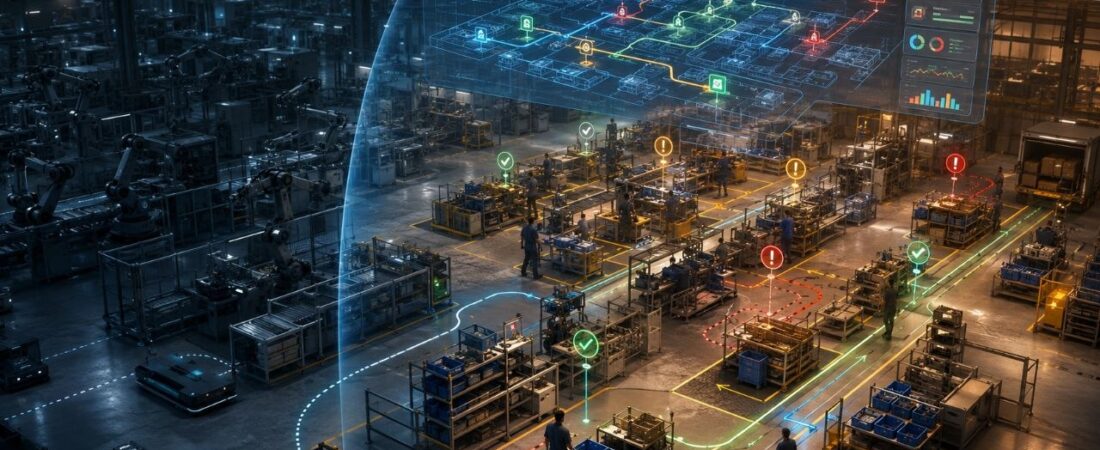
Visible-factory readiness note
A dark factory should not be the first target for most manufacturers. The better near-term goal is a visible factory: a plant where WIP, exceptions, downtime, quality loss, maintenance risk, and human overrides can be seen early enough to act.
The factory should prove visibility first: where the work is, why it stopped, who owns the recovery, and which human override prevented a larger loss. Only after those signals are reliable does deeper automation have a safe operating base.
Lights-out automation is discussed before lights-on control exists
The common mistake is to imagine lights-out automation before the factory has lights-on visibility. If managers cannot see today’s bottleneck, defect cause, material delay, or recovery plan, removing people from the process will not create control.
Checks before chasing dark-factory automation
- Can the factory see where work is, why it is stuck, and who owns the next decision?
- Are human interventions recorded as useful operating signals, not treated as noise?
- Can the factory run a semi-automated process safely before chasing unmanned operation?
Proof requests for visible-factory automation vendors
- Show exception visibility, stop reasons, operator override logs, and recovery workflow.
- Explain what remains human-controlled and why.
- Provide evidence that automation improves process control before reducing headcount assumptions.
Exception-visibility pilot gate
GO if automation increases visibility and recovery speed. HOLD if dashboards look good but exceptions remain manual. REDESIGN if the project’s main promise is “fewer workers” without a stronger operating-control layer.
Visible factory readiness is the practical step most manufacturers need before chasing dark factory automation.
The idea is easy to understand: robots move materials, machines run without interruption, digital systems monitor production, and human workers are no longer needed for repetitive tasks. In some stable production environments, parts of this vision are already real. Automated warehouses, robot-heavy production cells, and lights-out manufacturing areas show how far industrial automation has progressed.
But for most factories, especially labor-intensive factories, the more useful question is not whether a factory can remove people.
The better question is this: can the factory see what is actually happening?
A factory cannot become autonomous simply by adding more robots. It becomes automation-ready when its processes are visible, its exceptions are traceable, and its people know when and how to intervene. Before a factory can become lights-out, it must first become a visible factory.
This visible factory stage is not a branding exercise. It is a readiness layer: WIP must be located, exceptions must be recorded, quality signals must be trusted, and human override rules must be clear before automation scales.
What a Dark Factory Promises
A dark factory, or lights-out factory, is a manufacturing environment designed to operate with little or no human presence. In theory, the lights can be turned off because robots, sensors, software, and automated material-handling systems do most of the work.
- 24-hour production
- fewer manual interruptions
- lower dependency on repetitive labor
- higher consistency
- better use of robotics, sensors, and digital systems
In industries with stable product designs, predictable materials, and highly repeatable processes, this promise can be realistic. But automation discussions often show the robot, not the operating system behind the robot.
A robot can repeat a task. A conveyor can move a box. A scanner can capture a code. A digital twin can display a warehouse or production area. None of these automatically solve the deeper factory question: what happens when the process is no longer normal?
Automation Is Easy When the Process Is Stable
Automation works best when inputs are consistent, tasks are repeatable, and exceptions are rare. Moving a standardized box is easier than handling soft fabric. Scanning a fixed barcode is easier than judging a complex visual defect. Repeating one assembly motion is easier than switching between many styles, sizes, materials, and buyer requirements.
In real factories, the difficult part is often not the normal process. The difficult part is the exception.
- material arrives late
- a bundle goes to the wrong line
- a shade issue appears after cutting
- a defect repeats without a clear root cause
- rework moves outside the standard flow
- a dashboard shows “normal” while the floor is already blocked
These are not small details. They are the real factory operating system. If these exceptions are invisible, automation does not remove the problem. It can make the problem faster, more expensive, and harder to diagnose.
Automation is easy when the process is stable. Factory AI becomes valuable when the process is unstable, ambiguous, and full of exceptions.
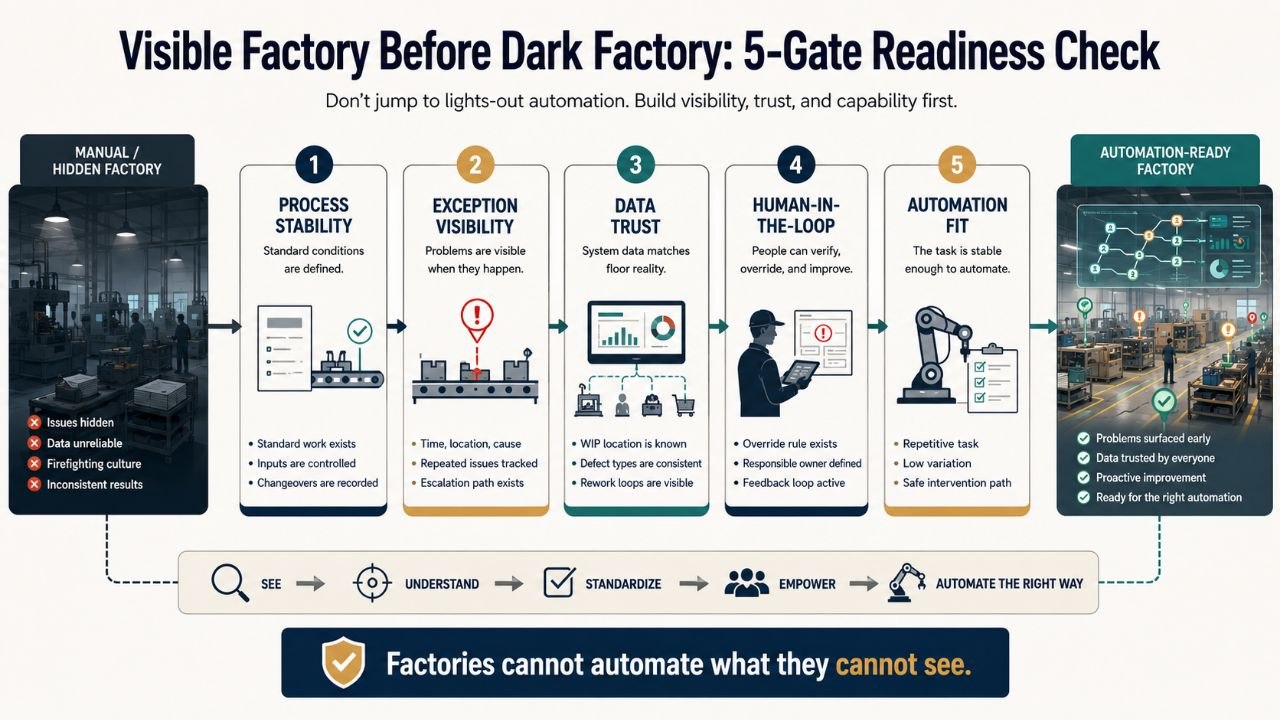
5 Visible Factory Checks Before Dark Factory Automation
A visible factory is not necessarily a fully automated factory. It is a factory where important operating conditions can be seen, measured, and acted on.
- where WIP is located
- which process is delayed
- where defects are recurring
- which materials are short
- where rework is accumulating
- which exceptions are repeating
- when human intervention is required
- whether system data matches floor reality
This is the foundation of Factory AI. Factory AI does not begin with a humanoid robot or a fully autonomous production line. It often begins with a scanner, a camera, a simple exception log, a reliable WIP board, or a better way to connect quality signals to production decisions.
For related readiness layers, see Factory AI Atlas guides on factory AI readiness measurements, factory AI data layer checks, and the factory robotics readiness matrix. Each one supports the same visible factory principle: automate only after the operating signals are clear enough to trust.
The Real Lesson from Over-Automation
One useful lesson in modern manufacturing automation is that over-automation can create new bottlenecks when the underlying process is not mature enough. The lesson is not that automation is bad. The lesson is that automation without process maturity can multiply complexity.
When a factory automates too early, the bottleneck may not disappear. It may simply move into the automated system. Instead of a person waiting, a robot waits. Instead of a supervisor walking to check a problem, an engineer may be needed to debug a complex automated sequence. Instead of a visible production delay, the factory gets a hidden software, sensor, or material-flow problem.
In labor-intensive manufacturing, this risk is especially important. A garment factory may invest in automation, but if its cutting lot control is weak, defect taxonomy is inconsistent, WIP data is delayed, and material shortage signals are not connected to production planning, automation will not magically create stability. The factory may only automate confusion.
Human Workers Do Not Simply Disappear
The dark factory conversation often becomes a labor replacement conversation. But in many real factories, the future role of people is more likely to change than disappear completely.
As automation increases, workers and supervisors may shift from doing every physical task to managing exceptions, validating data, and improving the system.
- detecting exceptions
- confirming whether system data is correct
- deciding when to stop or override automation
- interpreting quality signals
- improving standard work
- feeding practical knowledge back into the system
This is the human-in-the-loop factory. People are not just labor cost. They are part of the factory’s sensing, judgment, and recovery system.
Collaborative Automation Is the More Realistic Middle Step
For many labor-intensive factories, the realistic path is not a sudden jump from manual work to a lights-out factory. A more practical middle step is collaboration between people, robots, cameras, scanners, carts, and simple digital systems.
In garment and other labor-intensive factories, full automation is difficult because materials are flexible, product variation is high, and changeovers are frequent. Sewing, fabric handling, inspection, bundling, and finishing still involve many conditions that are hard to standardize.
But that does not mean automation has no role. The first useful automation step may be moving fabric rolls, scanning inventory, capturing QC photos, monitoring WIP movement, detecting missing bundles, or supporting heavy and repetitive lifting tasks.
This kind of automation does not begin by removing the worker. It begins by reducing the worker’s friction: less waiting, less searching, less rework, and fewer invisible problems.
Digital Twin Is an Operating Map, Not a 3D Picture
Digital twins are often presented as futuristic 3D models of factories, warehouses, or production systems. For Factory AI, the value of a digital twin is not the visual design. The value is operational trust.
A useful digital twin is a live operating map of what the factory believes is happening. It should help answer what is where, what is moving, what is delayed, what is blocked, what has changed, and what needs attention.
For a garment factory, that may mean visibility across style, PO, color, size, cutting lot, bundle movement, sewing line status, inspection hold, rework loop, trim shortage, carton packing, and shipment risk. Without this operating map, AI recommendations are weak because the factory cannot know whether the input data reflects reality.
Apparel Factory Translation: Lights-On Before Lights-Out
For apparel factories, the dark factory conversation needs a practical translation. The first goal is not a fully autonomous sewing floor. The first goal is lights-on visibility.
- where WIP is waiting
- where bundles are delayed
- where rework is accumulating
- where shade or lot issues appear
- which defect types are recurring
- which trims are short
- which lines are blocked
- which orders carry shipment risk
A sewing robot may be attractive, but it will not solve weak WIP discipline. AI inspection may be useful, but it will not solve unclear defect definitions. A production dashboard may look modern, but it will not help if floor updates are late or incomplete.
For apparel factories, the first goal is not lights-out sewing. It is lights-on visibility: WIP, defects, rework, material shortages, and shipment risk.
The practical visible-factory readiness question
Before investing in advanced robotics, digital twins, or AI automation, factories should ask a simpler set of questions.
- Can we see the process?
- Can we see the exceptions?
- Can we trust the data?
- Can people intervene safely?
- Can automation improve the process instead of hiding the problem?
If the answer is no, the factory is not ready for lights-out manufacturing. It is ready for visibility work.
The most advanced factory is not always the one with the most robots. It is the one where people, machines, data, and decisions are connected well enough to respond when reality changes.
Dark factories may be the future for selected processes. But for most factories, the first step is not darkness. It is visible factory discipline.
Visible-factory source notes
- NIST — Smart Manufacturing Systems
- NIST — AI Risk Management Framework
- International Federation of Robotics — World Robotics 2023 Report
Visible-factory validation anchors
- International Federation of Robotics industrial robot resources — useful context for realistic industrial robot deployment patterns.
- OSHA robotics guidance — reinforces why automation still needs safety, human interaction, and risk controls.