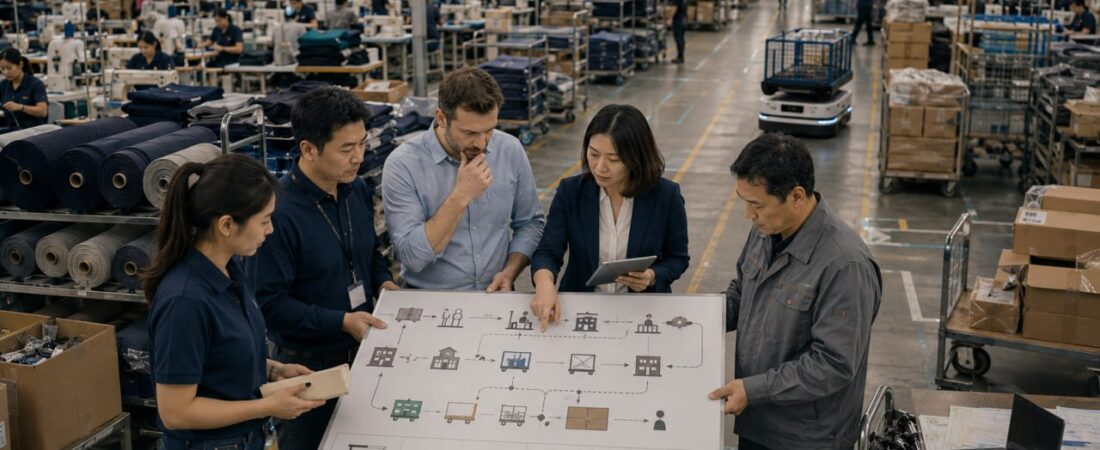
Prove one material move from request to receipt
A factory is not ready for mobile robots because an Automated Guided Vehicle (AGV) or Autonomous Mobile Robot (AMR) can complete a clean route. It is ready when one real movement can be identified, requested, executed, received, and reconciled without people repairing the record from memory.
Use a controlled item, lot, quantity, handling condition, and source location. Do not begin with labels that different teams interpret differently.
Record who requested the move, the destination, priority, time window, and the system that owns the request.
Include peak traffic, temporary staging, blocked aisles, manual carts, doors, turns, ramps, and operator crossings—not only an empty demonstration path.
Log missing loads, scan failures, route blocks, charging events, manual overrides, unsafe conditions, and failed handoffs with a named owner.
Confirm the correct load reached the correct place once, the receiver accepted it, and inventory, work-in-progress, and task status agree.
Check whether the same route and rules still work under another shift, product mix, congestion pattern, and supervisor handover.
What this matrix should decide
Use the ten readiness dimensions below to explain why a movement is stable or unstable. Do not average a weak safety, route, identity, or handoff condition into a high total score. A pilot can advance only when the factory can show both the physical result and the matching operating record.
Boundary: this is an editorial self-review lens. It is not a safety assessment, factory certification, vendor ranking, or return-on-investment guarantee.
Physical AI in factories will not always begin with humanoid robots, fully automated sewing cells, or lights-out production.
For many real factories, especially garment and labor-intensive manufacturing sites, the more realistic starting point is material flow.
Before a robot can move through a factory, the factory must answer basic operating questions:
- What item needs to move?
- Where is it now?
- Where should it go?
- Who requested the movement?
- Is the route safe and available?
- What happens if the item is missing, damaged, delayed, or placed in the wrong location?
These questions sound simple. But they are the foundation of factory robotics.
A factory that cannot trust its item data, location data, routes, requests, exceptions, and ownership will struggle to make AGVs, AMRs, ACRs, or AS/RS systems work beyond a demo.
This is why a factory robotics readiness matrix should come before vendor selection. A practical factory robotics readiness matrix turns the automation discussion from “which robot?” into “which factory flow is ready?”
Physical AI Starts With Material Flow
In apparel and other labor-intensive factories, the first automation opportunity is often not the main production operation itself.
It may be the movement of:
- fabric rolls from warehouse to cutting,
- trims and accessories from storage to preparation areas,
- WIP carts between sewing, finishing, inspection, and packing,
- samples between QA, technical, merchandising, and production teams,
- cartons and packing materials toward finished-goods areas,
- maintenance spare parts from stores to machine repair points.
These flows are less glamorous than robot sewing. But they are often more measurable, more repeatable, and more realistic as early robotics candidates.
They also reveal whether the factory has the operating discipline required for more advanced Physical AI later.
This connects directly to the broader Factory AI Atlas position that Physical AI in garment factories starts with data, not robots. Material movement is one of the places where that data becomes visible.
A robot exposes the flow rules people were repairing by memory
A robot does not automatically create factory discipline.
It exposes the discipline that already exists.
If the item master is weak, the robot may move the wrong item faster. If location records are unreliable, the robot may arrive at the wrong place more consistently. If routes are blocked, unclear, or constantly changing, the robot will not solve the traffic problem. If exception handling is informal, the robot may create new bottlenecks instead of removing old ones.
That is why robotics readiness is not only a hardware question. It is an operating-system question.
The first question should not be:
Which robot should we buy?
The better question is:
Is our material flow ready to be automated?
Greenfield vs. Brownfield: Why Existing Factories Face a Harder ROI Problem
New factories have one major advantage.
They can design for automation from the beginning.
A greenfield factory can plan warehouse layout, fabric-roll storage, cutting-room access, WIP movement lanes, trims flow, finished-goods routes, robot charging areas, barcode or RFID points, AMR or AGV traffic rules, safety zones, system integration, and data-capture points before production starts.
In that case, smart factory design and robotics planning can be part of the original factory setup.
But most factories are not greenfield factories.
Most factories are already operating. They already have fixed warehouse areas, existing cutting tables, sewing lines arranged around manpower flow, temporary WIP storage habits, manual carts, narrow aisles, shared pedestrian and material traffic, older building structures, and production pressure that makes layout changes difficult.
This creates a different robotics question.
A new factory may ask:
How do we design this factory for smart material flow?
An existing factory must ask:
Can we retrofit automation into this factory without disrupting production, overspending, or creating a weak ROI case?
That is a much harder question.
Why Robotics ROI Is Difficult in Existing Garment Factories
Many factories do not reject robotics because they dislike automation.
They hesitate because the investment case is difficult.
A factory may see the value of AGVs, AMRs, ACRs, or automated storage systems. But the real constraints may include:
- the fabric warehouse was not designed for automated roll movement,
- the path from warehouse to cutting is too narrow or irregular,
- cutting-room layouts change by order type,
- WIP carts move through congested sewing areas,
- trims are stored and issued through semi-manual practices,
- finished-goods movement depends on carton buildup and buyer shipment schedules,
- workers and carts share the same paths,
- floor conditions are uneven,
- ERP, WMS, MES, barcode, or RFID data is not reliable enough,
- production cannot stop long enough for major layout redesign,
- the expected labor saving may not justify the investment,
- maintenance capability or local technical support may not be ready.
This means robotics feasibility is not only technical. It is spatial, financial, operational, and organizational.
A robot may work well in a vendor demo. But inside an existing factory, the real question is:
Does the automation improve flow enough to justify the cost, disruption, and operating discipline required?
For many factories, the honest answer may be: not yet.
That is not failure. It is readiness assessment.
Robotics terms translated into factory reality
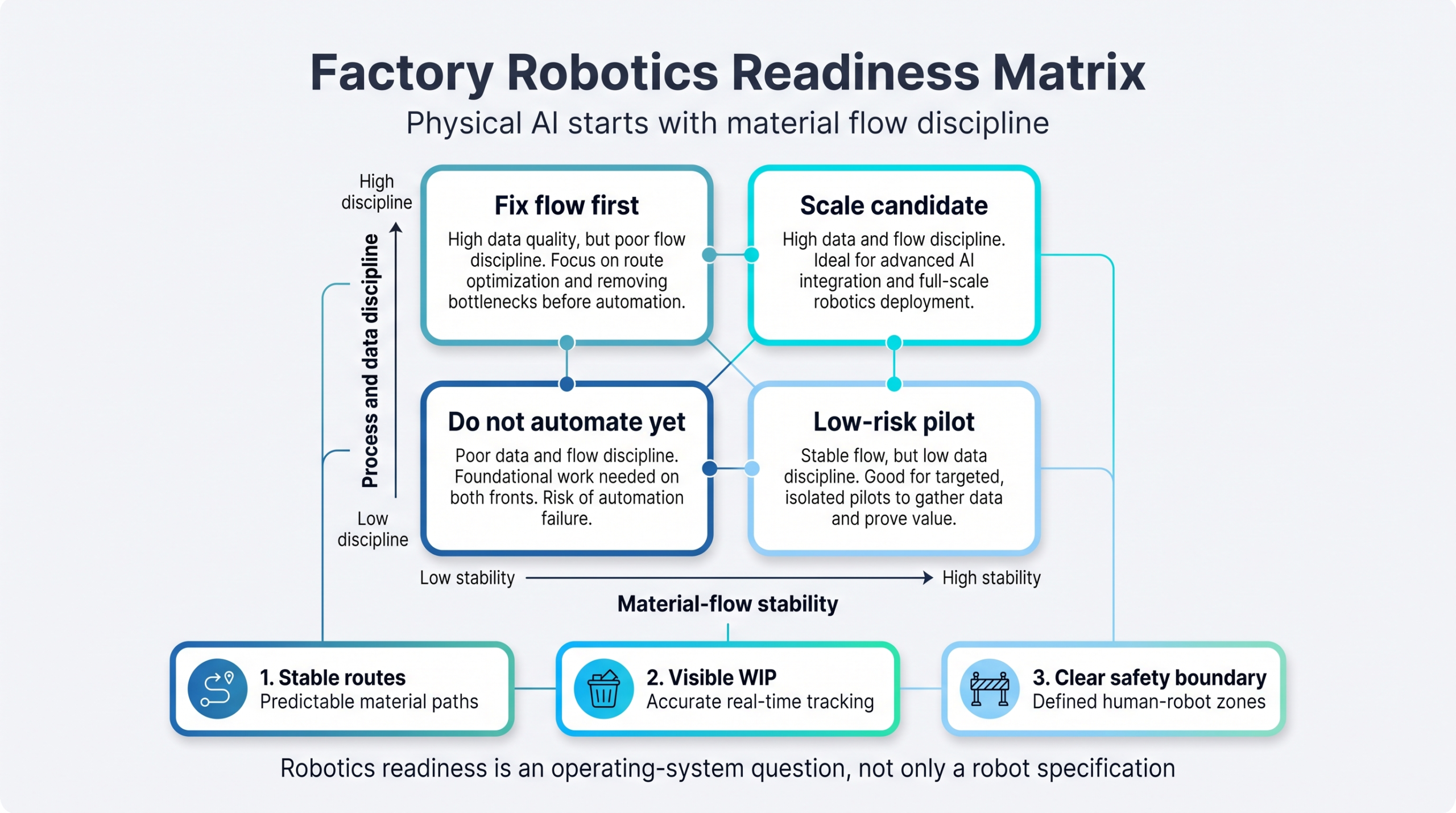
Before using the readiness matrix, the factory only needs a working vocabulary. AGV fits fixed, repeatable routes; AMR adds flexible navigation but still needs clear aisles, traffic rules, charging discipline, and exception ownership; ACR and AS/RS fit storage and case-handling environments where item, location, and scan discipline are already strong.
The practical point is simple: these systems do not replace material-flow discipline. They expose whether the factory has it. If labels, routes, staging areas, and handoff rules are unstable, robotics will amplify the instability instead of solving it.
Fast scoring rule for robotics readiness
Score each readiness dimension from 1 to 5: 1 means informal and memory-based, 3 means defined but exception-heavy, and 5 means stable, measured, integrated, and ready for a controlled automation pilot. Several level-1 or level-2 areas usually mean the next investment should be route discipline, layout cleanup, or data control before robot deployment.
The Factory Robotics Readiness Matrix
The factory robotics readiness matrix below is designed for practical review by operations, warehouse, IE, QA, maintenance, and management teams.
The following readiness matrix helps factories assess whether they are ready for robotics pilots such as AGV, AMR, ACR, or AS/RS.
This is not a vendor selection tool. It is a factory-readiness tool. The goal of the factory robotics readiness matrix is to check whether the operating environment can absorb automation.
1. Item Master Readiness
In the factory robotics readiness matrix, item master readiness is the first gate because robots cannot move what the factory cannot clearly identify.
Before automation, the factory must know what is being moved.
Check whether item codes are consistent, units of measure are standardized, duplicate names are controlled, rolls and trims are clearly identified, cartons have traceable references, and operators can scan or identify items reliably.
Low readiness: “Blue rib fabric” appears differently in warehouse, cutting, and merchandising records.
High readiness: Each roll, trim, or carton has a clear code, description, quantity, lot reference, and transaction history.
FAA point: Robotics cannot fix weak item identity.
2. Location Master Readiness
The second gate in the factory robotics readiness matrix is location trust.
Robots need reliable locations.
Check whether warehouse zones, racks, shelves, staging areas, cutting areas, sewing-line drop points, finishing, packing, and loading areas have clear location codes. Temporary locations should also be controlled.
Low readiness: Materials are moved to “near cutting” or “beside line 3” without system updates.
High readiness: Each storage, staging, and drop-off point has a defined location code and is updated when movement happens.
FAA point: If the factory cannot tell where an item is, a robot cannot reliably move it.
3. Route and Path Readiness
The factory robotics readiness matrix treats routes as operating behavior, not only floor markings.
AGVs and AMRs need physical movement space.
Check aisle width, floor condition, ramps, doors, turns, pedestrian traffic, cart traffic, blocked paths, temporary staging habits, and whether movement lanes are stable across shifts.
Low readiness: Every shift creates a different route because materials are staged wherever space is available.
High readiness: Main movement paths are marked, controlled, and rarely blocked.
FAA point: A robot route is not only a map. It is a factory behavior pattern.
4. Request and Dispatch Readiness
Robots need to know when and why to move.
Check who can request movement, whether the request is digital or informal, how priority is defined, how urgent requests are controlled, and whether the system can distinguish normal replenishment from emergency movement.
Low readiness: A supervisor calls someone and says, “Bring the trims quickly.”
High readiness: A movement request includes item, quantity, source, destination, priority, requester, and timestamp.
FAA point: Robotics needs structured demand signals, not only physical movement capability.
5. Exception Handling Readiness
Factories are not clean simulations.
Items go missing. Labels are wrong. Routes are blocked. Urgent changes happen. Materials are damaged. Workers override the process.
Check what happens if the item is not at the expected location, the path is blocked, the robot reaches the destination but no one receives the item, the wrong item was requested, or a manual override is needed.
Low readiness: People solve the issue manually, but the system is never updated.
High readiness: Exceptions are logged, assigned, resolved, and reviewed for root cause.
FAA point: Exception discipline is one of the strongest indicators of robotics readiness.
6. System Integration Readiness
Robots do not operate alone.
They may need to connect with WMS, ERP, MES, QMS, CMMS, barcode systems, RFID systems, production planning tools, maintenance systems, and fleet-management software.
Check which system owns item data, which system owns location data, which system triggers movement requests, and which system confirms movement completion.
Low readiness: The robot system, warehouse record, and production plan all show different information.
High readiness: Movement requests and completion confirmations are synchronized across relevant systems.
FAA point: Physical AI depends on data architecture, not only robot hardware.
7. Safety and Human-Workflow Readiness
Factory robotics must coexist with workers.
Check pedestrian routes, emergency stop rules, speed zones, loading and unloading points, manual cart movement, forklift coordination, night-shift conditions, training, and near-miss reporting.
Low readiness: Workers treat robots as moving obstacles and improvise around them.
High readiness: Human workflow, robot workflow, and safety rules are designed together.
FAA point: Robotics readiness is also human-workflow readiness.
8. Ownership and Maintenance Readiness
A robotics pilot fails when no one owns the operating model around it.
Check who owns robot uptime, route changes, master data, exception review, operator training, maintenance, spare parts, and the decision to expand or stop the pilot.
Low readiness: IT, production, warehouse, and maintenance each assume someone else owns the robot process.
High readiness: A cross-functional owner group reviews performance, exceptions, safety, and improvement actions.
FAA point: Robotics is not only an equipment project. It is an operating model.
9. Retrofit Feasibility Readiness
For brownfield sites, this may be the most important part of the factory robotics readiness matrix.
This dimension is especially important for existing factories.
Check whether the existing layout is suitable for automation, whether routes can be redesigned without major production disruption, whether there is enough space for robot staging and charging, and whether building constraints such as columns, narrow doors, ramps, uneven floors, or elevators create practical barriers.
Also check whether the factory can separate pedestrian, cart, forklift, and robot traffic, and whether teams are willing to change long-standing material-handling habits.
Low readiness: The factory wants AMRs, but the route from fabric warehouse to cutting passes through narrow, congested, manually staged areas.
High readiness: The factory has mapped current constraints, identified feasible robot paths, and redesigned selected material-flow lanes before vendor discussions.
FAA point: Existing factories need retrofit feasibility before robotics feasibility.
10. ROI and Investment Readiness
The final gate in the factory robotics readiness matrix is the investment case.
Robotics investment should be connected to a real factory pain point.
Check what exact cost or delay automation will reduce. Is the target movement frequent enough? Is current transport time, waiting time, manpower involvement, damage, downtime, missed material calls, or shipment delay measurable? What layout redesign, integration, training, maintenance, and support costs are required?
Also check whether the pilot can scale. A robot that works only in one narrow showcase area may not justify the full operating burden.
Low readiness: Management wants robots because competitors are discussing automation, but no one has measured the current movement cost or delay.
High readiness: The factory has measured current transport time, waiting time, manpower involvement, damage rate, missed material calls, downtime impact, and realistic payback assumptions.
FAA point: Robotics ROI must be calculated from factory reality, not vendor-demo potential.
Where to Start in a Garment Factory
For a garment factory, the first robotics-readiness pilot should usually avoid the most complex production operation.
Instead, start with a material-flow area that is repetitive, visible, measurable, physically safe, not too style-dependent, connected to a clear business pain, and easy to audit before and after the pilot.
Possible starting points include fabric roll movement, trims replenishment, WIP cart movement, sample movement, carton and packing material movement, or maintenance spare-parts delivery.
These are not glamorous robotics use cases. But they are often more realistic than trying to automate sewing first.
They also connect to factory workflow design: a signal is useful only when the factory knows what decision and action should follow.
Robotics Readiness Before Vendor Selection
Before meeting robotics vendors, factories should prepare evidence from their factory robotics readiness matrix.
Useful evidence includes a material-flow map, item master sample, location master sample, movement frequency data, route photos, path width measurements, current transport time, waiting time, exception examples, safety constraints, current labor involvement, system integration map, and pilot success criteria.
Without this evidence, a vendor demo may look impressive but still fail in factory reality. This is the same reason Factory AI Atlas often recommends factory AI smoke tests before buying tools.
A good vendor conversation should not begin with:
Show us your robot.
It should begin with:
Here is our material-flow problem. Here is the data. Here are the constraints. Which automation pattern fits, if any?
Use the matrix as a test plan, not a score alone
This factory robotics readiness matrix should be used with source-backed robotics and safety references, not only vendor demos. For general robotics adoption context, teams can review the International Federation of Robotics. For worker-safety planning around mobile equipment and industrial automation, the OSHA robotics guidance is also useful as a starting reference.
These sources do not replace a factory-specific pilot study. They help frame why a factory robotics readiness matrix must include layout, human workflow, safety, maintenance ownership, and measurable ROI before automation is scaled.
Advance one verified flow before scaling the fleet
Physical AI will become more important in manufacturing. But the factories that benefit most will not be the ones that chase the most advanced robot first.
They will be the factories that understand their own operating reality.
For new factories, robotics can be designed into the operating system. For existing factories, robotics must be earned through layout readiness, data discipline, retrofit feasibility, and ROI evidence.
That distinction matters.
AGVs, AMRs, ACRs, and AS/RS systems can support better factory flow. But they cannot replace the discipline required to run that flow.
For labor-intensive factories, the road to Physical AI may not begin with humanoids.
It may begin with a fabric roll, a trims box, a WIP cart, a carton, or a spare part moving through a factory that finally knows where things are, why they move, what they cost, and what happens when the process breaks.
Standards and research checked—and what they do not prove
- International Federation of Robotics industrial robot resources — provide broad adoption and deployment context.
- OSHA robotics guidance — provides a starting point for worker hazards and control planning around robotic systems.
- NIST mobility performance research — shows why localization, obstacles, ramps, load stability, dynamic environments, and repeatable test methods matter.
- ISO 12100 machinery risk-assessment principles — provides a general machinery risk-assessment and risk-reduction framework.
These references do not prove that one robot, route, integration, safety design, labor assumption, or payback case fits a specific factory. Qualified safety assessment, site-specific engineering, controlled trials, maintenance capability, and the factory’s own operating evidence remain necessary.