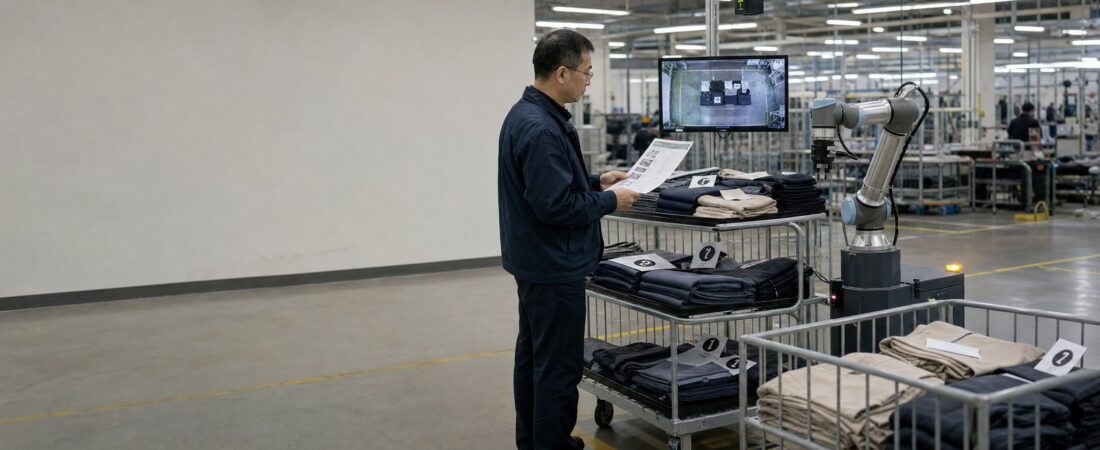
A robot fails to pick an object. The team changes something, tries again, and records a clean success. The second video looks like improvement. It does not yet show what improved.
The prompt may have become more specific. A memory file may contain the answer from the first attempt. A small adapter may steer the action differently. The robot skill, camera setup, tool interface, controller, or base model may have changed. A person may also have moved the object into an easier position.
This is the missing question behind many self-improvement claims: which component carried the change? A factory cannot approve “the robot got better” as one combined claim. It needs to isolate the change carrier, keep the rest of the system stable, and test whether that one change survives a fresh task.
This article sits beside three existing Factory AI Atlas controls, but it covers a different layer. Factory AI validation gates ask whether a pilot is ready to influence production. The action reliability layer checks the path between an AI output and an action. Action assurance before release checks whether the intended final state was actually reached. The narrower question here is what changed between the approved baseline and the claimed improvement, and how to validate that change without giving it credit for everything around it.
An improvement video hides the change carrier
A before-and-after clip compresses a system into one image: robot, object, motion, and result. The hidden system is much larger. It includes instructions, retrieved files, policy weights, tools, sensors, software, and physical setup. If several of these move at once, the test cannot tell the factory which change caused the result.
That matters for rollback. If the next shift produces a bad grasp, the team must know whether to restore a prompt, remove a memory artifact, disable an adapter, return to an earlier skill, or roll back a driver. “Use yesterday’s version” is not a useful instruction when yesterday’s version contains seven changing parts.
Seven carriers that must not be grouped together
- Prompt: system rules, task instructions, forbidden actions, and the order of checks.
- Memory: retrieved examples, prior plans, failure notes, maps, or persistent state carried from an earlier run.
- Adapter: a lightweight learned module, such as a noise actor or Low-Rank Adaptation (LoRA) layer, that changes behavior while leaving the base model fixed.
- Skill: a reusable behavior, script, motion primitive, or behavior tree called by the agent.
- Base model: the main checkpoint that maps observations and instructions toward predictions or actions.
- Harness: the surrounding tool catalogue, routing logic, verifier, simulator interface, and evaluation code.
- Runtime: the robot controller, driver, device, inference engine, camera pipeline, timing, and resource limits used during execution.
A scene asset or fixture can also change the result, but it should be recorded as test-environment state rather than quietly credited to the robot. For each declared carrier, record a version, owner, reason, validity window, and rollback target.
Gemini 4 Argon shows why the control contract matters
Google’s Gemini 4 Argon for Robotics post presents a general-purpose model across robot control, Real-to-Simulation (Real2Sim) work, simulation steering, and hardware iteration. The important factory signal is not only the model name or the success footage. It is the control contract visible in the task instructions.
The example asks for a no-motion dry-run before hardware movement. It uses overhead and wrist-camera checks. It separates verification duties. In simulation, it asks for visual and physical matching while banning shortcuts such as object teleportation, external force injection, collision disabling, and copied contact-force readings. After failure, it calls for log and video review, another dry-run, and a bounded retry.
Those details show that a result can come from model + prompt contract + tool primitives + verifier + safety rules + evidence loop. They also prevent a polished simulation from receiving credit for physics it did not obey.
There is a clear limit. This is first-party vendor material. The reported Embodied Reasoning Question Answer (ERQA) benchmark is a 400-example multimodal multiple-choice benchmark, not a factory robot deployment test. The post is useful as a control-contract signal. It is not independent proof of functional safety, repeatable factory performance, or return on investment (ROI).
A frozen base model can still produce a new physical risk
The preprint Noise Space Learning for Vision-Language-Action Adaptation separates the base from the adaptation mechanism. It keeps the pretrained Vision-Language-Action (VLA) model fixed and learns a context-conditioned distribution over the noise that the model converts into actions.
The authors report tests on four real-robot tasks with 40 trials per task. Their reported average success rate rose from 37.5% initially to 71.3% for autonomous Noise Space Learning with Advantage-Weighted Regression (NSL-AWR) and 83.8% with human guidance. These are research results under the paper’s conditions, not expected factory outcomes.
The safety lesson is more important than the headline gain. In an earlier Noise Space Learning with Soft Actor-Critic (NSL-SAC) bead-placement run, the authors report unintended table contact and discuss noise drift and critic disagreement. The base weights were frozen, but the action distribution was not. A small changed component can still produce a large physical consequence.
For a factory trial, the base checkpoint hash and the adapter or noise-actor hash therefore belong in the same release record. So do the approved context, uncertainty or noise limits, contact abort rule, and canary scope. “The main model did not change” is not enough evidence to keep the old approval.
MC-EvoBench asks whether improvement survives a reset
The MC-EvoBench preprint studies experience-driven self-improvement in Minecraft agents. Its useful contribution for factories is the audit design, not direct evidence about robots.
The benchmark resets the target world and allows only a declared artifact to cross from the source task. It compares related, unrelated, and shuffled source conditions under matched budgets and multiple seeds. It also measures verified intermediate progress instead of relying only on one final success.
This design challenges a common claim: “The agent saved a memory, then succeeded, so it learned a reusable capability.” The success may come from a carried-over resource, extra interaction, an easier start, or one favorable run. A clean reset and artifact-only transfer make that claim testable.
The limitation must remain visible. MC-EvoBench is a Minecraft benchmark, not a production line, a robot cell, or a safety evaluation. Both MC-EvoBench and Noise Space Learning are preprints dated October 9, 2026. Factories can borrow their separation logic, but should not treat either paper as proof of garment handling, industrial uptime, functional safety, or financial return.
The Factory AI Adaptation Acceptance Contract
The following seven-step contract turns “it improved” into a reviewable change record. It is an editorial evaluation framework, not a safety standard, certification, or substitute for a factory’s risk assessment and qualified controls.

1. Lock the approved baseline
Record the base model, prompt, memory, skill set, harness, runtime, sensor and fixture setup, scene, task, material scope, and current permission level. A baseline is useful only when the team can reproduce it.
2. Declare one change carrier
Name the prompt, memory artifact, adapter, skill, model, harness, or runtime change. Give it a version, owner, reason, expiry or review date, and rollback target. If two carriers must change together, state that dependency rather than hiding it.
3. Write the pre-execution contract
Start read-only where possible. Define permitted tools, blocked actions, physical exclusion zones, fresh-observation requirements, camera agreement, force and speed limits, simulation shortcuts that are forbidden, and the person who can stop the test.
4. Run a contamination-resistant evaluation
Use a fresh target state. Allow only the declared artifact to cross the boundary. Keep interaction and compute budgets equal. Compare the changed system with the locked baseline on a held-out material, lot, scene, or task. Include an unrelated or shuffled control when it can expose false transfer credit.
5. Keep a human correction ledger
Record who corrected the system, the evidence available at that moment, the exact action or constraint changed, the expected result, the actual result, and whether the correction applies once or changes future policy. Human guidance is labeled input, not automatic ground truth.
6. Use a bounded canary
Move to a small lot, low speed, low force, a protected fixture, limited retries, and an independent emergency stop. Use deterministic local guards. Give the canary an expiry and automatic rollback condition.
7. Read the final state independently
Compare intended and actual object or process state. Keep synchronized camera, measurement, contact, and source timestamps. Record quality outcome, wrong action, false hold, operator effort, and repeatability. Then classify the change as release, hold, rework, retest, or rollback.
Garment mini-case: picking and routing fabric bundles
Consider a VLA-guided robot adapted to pick fabric bundles and place them on the correct trolley. The base VLA, camera positions, fixture, gripper, controller, and routing table are locked first. The team then tests a prompt change, a retrieved memory, and a noise actor as separate change carriers, not one combined “improved policy.”
In simulation, the bundle cannot be teleported into the gripper and force cannot be injected to rescue a weak grasp. Human corrections are structured as grasp point, approach angle, do-not-grip zone, and observed fold or deformation state. A fresh held-out set includes different shade groups, materials, thicknesses, fold states, and bundle orientations.
The canary runs slowly on a small, non-urgent batch. Overhead and wrist views are checked against gripper force or motor-current evidence. The final readback confirms bundle identity, trolley destination, visible damage, fold change, dropped pieces, and misrouting. If the adapter crosses its approved noise or uncertainty limit, or the camera views disagree, the result is hold even when the last pick looked successful.
This case does not claim that current research has solved deformable-material handling in mixed garment production. It shows what evidence would be needed to evaluate a narrow adaptation without confusing one clean pick with stable capability.
Promote authority in four steps, not one jump
Read-only
The changed system can inspect records, images, and robot logs. It cannot move hardware or write a production state. The team checks whether it selects the correct task, evidence, and version.
Dry-run
The system produces a plan, pose sequence, tool-call preview, or simulation trace without physical execution. The team checks forbidden shortcuts, constraints, expected contact, and rollback conditions.
Canary
The system receives bounded physical authority under low speed, low force, a small scope, independent stop control, and close evidence capture. One success does not expand the scope.
Limited execution
The system may act only inside the validated task, material, device, shift, and time window. Exceptions return to hold or human control. Any new carrier version restarts the relevant acceptance steps.
This ladder is not a claim of functional safety. Safety-rated guarding, interlocks, emergency stops, hazard analysis, qualified integration, and legal duties remain separate. It also does not promise better throughput, quality, uptime, or ROI. Those outcomes require repeated factory measurements against an agreed baseline, including the extra setup, review, maintenance, and operator effort created by the adaptation.
The final question is not whether the robot looks smarter
A useful improvement claim names the carrier, locks the baseline, survives reset, transfers only the declared artifact, passes held-out tests, records human correction, stays inside a bounded canary, and ends with an independent final-state readback.
If the team cannot identify what changed, the result should remain an observation. If the carrier is clear but the evidence does not survive reset, the change should remain on hold. Limited execution becomes reasonable only when the exact changed component passes its own acceptance path and the factory can restore the prior state.
The practical rule is simple: do not approve a better video. Approve a declared change, within a declared scope, using evidence that the changed system did not grade by itself.