
Action-reliability decision note
An action reliability layer should be treated as the operating brake between AI confidence and factory action. Before agents or robots are trusted, the factory has to prove that context, tool calls, schemas, world state, defect evidence, approval rules, and rollback paths are reliable enough for the action being proposed.
Model confidence is not action permission
The common mistake is to evaluate the model answer but not the action chain. A correct-looking answer can still trigger the wrong tool, use stale context, misread the physical state, route work to the wrong owner, or create an action that no supervisor can trace after the fact.
Checks before agents or robots act
- Which actions are allowed, blocked, downgraded, or held for human approval when context is incomplete?
- Can the system validate schemas, permissions, tool outputs, physical-world state, and action logs before release?
- Does the factory know how to review false actions, near misses, overrides, and rollback cases by owner and severity?
Proof requests for action-chain reliability
- Demonstrate a wrong-context case, a tool-schema failure, a stale-world-state case, and a blocked action.
- Show the complete action trail from source evidence to agent reasoning, tool call, approval, release, result, and rollback.
- Provide separate reliability thresholds for advice, draft workflow, queued action, human-release action, and autonomous execution.
Action-release gate
GO if the reliability layer catches weak context and unsafe action paths before release. HOLD if the model works but action logs or rollback rules are incomplete. REDESIGN if agents or robots can act without proving action reliability first.
Factory AI is entering a phase where the main risk is no longer whether an agent or robot can produce an impressive answer. The harder question is whether the factory should let that answer become an action. Before agents touch workflows, before robots move in a cell, and before vision models trigger quality decisions, factories need an Action Reliability Layer that checks the evidence behind every action.
This matters because a factory is not a demo environment. A wrong answer in a chat window is a nuisance. A wrong action in production can create rework, missed shipment windows, safety exposure, buyer disputes, or false quality confidence. The next practical step for Factory AI is not simply a bigger model. It is a structured layer that asks: is the context reliable, is the action aligned with the physical world, is the defect evidence strong enough, and has a human approved the final decision?
That is the role of a Factory AI action reliability layer. It sits between AI recommendations and factory execution. It does not replace agents, robots, or inspection models. It makes them usable by forcing each proposed action through context QA, drift testing, evidence checks, and human approval before anything changes on the floor.
Recent research signals point in the same direction. Agent reliability work is shifting attention from model intelligence to context quality. Robotics papers are warning that world-action models can produce plausible future predictions while still selecting unsafe or incorrect actions. Industrial anomaly detection research is showing that defect evidence, boundary quality, and normal variation matter as much as model architecture. For manufacturing leaders, these signals translate into one operating rule: do not connect AI directly to action until the reliability layer is visible.
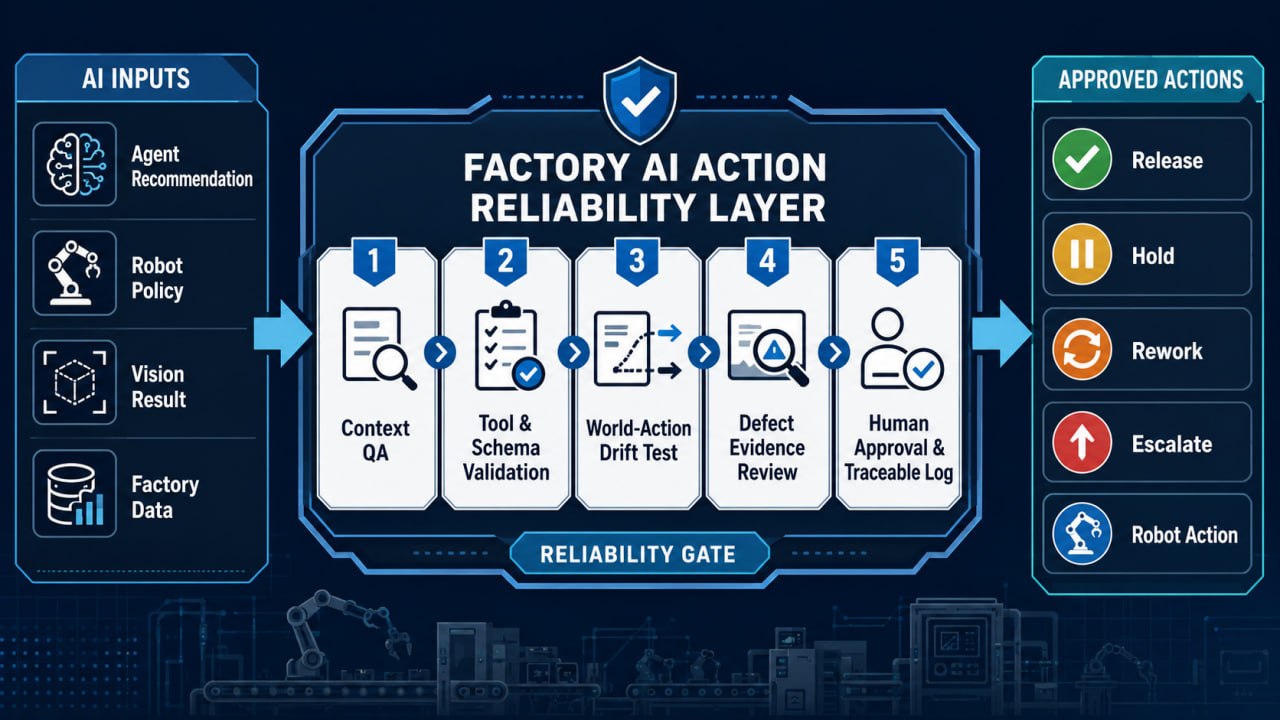
The Factory AI Action Reliability Layer Is a Missing Operating Layer
Most Factory AI discussions describe a stack: sensors, edge devices, cloud models, dashboards, agents, robots, and ERP or MES integration. That stack is useful, but it often skips a dangerous middle layer. Between “AI has produced a recommendation” and “the factory has acted on it,” there should be a reliability check that is explicit, logged, and owned by operations.
A Factory AI action reliability layer is not one product. It is a governance pattern. It defines what must be checked before an AI system can suggest a shipment release, stop a line, classify a defect, trigger a maintenance job, change a schedule, or guide a robot movement. In a mature factory, this layer may become software. In a smaller factory, it may begin as checklists, sample folders, approval rules, and simple audit logs.
The important point is that the layer must be separate from the model. If the same AI system that generates the action also decides that its own action is safe, the factory has not created reliability. It has only created confidence without separation of duties. Manufacturing already understands this principle through QC gates, shipment release rules, and supervisor approvals. Factory AI needs the same discipline.
Context Fails Before the Agent Fails
AI agents do not work from empty space. They work from instructions, tool schemas, retrieved documents, memory, policies, permissions, and user inputs. If that context is wrong, stale, contradictory, or vulnerable to untrusted input, even a strong model can produce a dangerous recommendation. The failure may look like an agent failure, but the root cause is often context failure.
In a factory, context failure is easy to imagine. An agent may read an outdated SOP, a buyer comment from the wrong season, a QC report with inconsistent defect terminology, or a WIP file that has not been reconciled with the latest line status. It may use a tool whose schema hides key constraints. It may retrieve a policy note without the approval history behind it. If that agent is allowed to recommend action, the factory is trusting a context bundle that no one has inspected.
This is why the first checkpoint in a Factory AI action reliability layer should be context QA. Before the AI output is evaluated, the input environment should be checked. Which documents were used? Are they current? Do the instructions conflict? Is the tool allowed for this decision? Is the source grounded in factory records or copied from a general answer? Has any untrusted content entered the workflow?
For apparel and broader manufacturing, context QA can start with a small set of records: SOP version, PO or order reference, buyer requirement, QC standard, line status, defect definition, shipment priority, and approval owner. If any of these are missing or inconsistent, the agent should not be allowed to move from advice to action.
Robots Can Dream Right and Act Wrong
Physical AI introduces a different reliability problem. A robot policy or world-action model may generate a plausible future scene and still choose an action that does not match the real world. In simple terms, the system can dream right and act wrong. That gap is especially serious in factories because the physical environment is full of small variations: lighting, dust, reflection, fabric deformation, hand tools, worker movement, carts, bins, and partial occlusion.
For a robot pilot, the question is not only whether the simulation looks convincing. The question is whether the proposed action remains safe and useful when the world changes slightly. A gripper path that works in a clean demo may fail when fabric folds differently. A sorting motion may work under one camera angle and drift under glare. A mobile robot may interpret a temporary obstruction differently from a permanent layout boundary.
The action reliability layer should therefore include a world-action drift test. This is a practical smoke test that compares the model’s predicted world state with the actual action candidate. The factory should ask: what small visual or layout changes would break this action? Does the robot still choose the same safe action under lighting variation? Does the system know when to stop, hold, or escalate?
This does not require a full digital twin on day one. A small pilot cell can begin with repeatable scenario cards: normal condition, lighting variation, material variation, operator interference, object misplacement, and emergency hold. The robot should pass these scenarios before its action is trusted in production.
Vision AI Needs Defect Evidence, Not Just More Labels
Quality inspection is another place where the action reliability problem becomes concrete. Many factories talk about AI visual inspection as if the main issue is collecting more images and training a larger model. In practice, the problem is more specific. The factory needs reliable defect evidence: images captured under controlled lighting, clear defect boundaries, consistent labels, known normal variation, and a business understanding of false positives and false negatives.
This is especially important for garment and textile environments. Fabric moves, wrinkles, stretches, reflects light, and changes appearance by style, color, wash, print, and process stage. A model trained on one clean condition may misread another normal condition as a defect. A single-class detector may work in a stable industrial surface dataset but struggle when the factory changes materials every week.
The Factory AI action reliability layer should treat inspection output as evidence, not as automatic truth. Before an AI inspection result can trigger rework, rejection, claim escalation, or shipment hold, the system should show the defect image, boundary, label confidence, lighting condition, reference standard, and human reviewer decision. The question is not “did the model detect something?” The question is “is the evidence strong enough for this factory action?”
A practical starting point is a defect evidence folder by style or process. Each case should include original image, cropped defect area, normal comparison, label, lighting note, reviewer, final action, and buyer or internal standard reference. This creates a training asset, but more importantly, it creates an operating record that teaches the factory when AI evidence is strong enough to act.
Five Checks Before AI Becomes Factory Action
The action reliability layer can be expressed as five checks. These checks are simple enough for a pilot and strong enough to shape a serious AI governance architecture.
1. Context QA
Verify the documents, data, tool permissions, and instructions used by the agent or model. If SOP, PO, QC, WIP, or buyer context is missing or stale, the action should be blocked or escalated.
2. Tool and Schema Validation
Check whether the tool being used is appropriate for the decision. A read-only analysis tool should not trigger a write action. A scheduling recommendation should not change an ERP record without a separate approval rule.
3. World-Action Drift Test
For robots, simulation, and physical workflows, test whether small changes in lighting, layout, material position, or worker interaction cause the proposed action to drift. If the action changes unpredictably, the pilot is not ready.
4. Defect Evidence Review
For vision AI and QC workflows, require the model to expose the image evidence behind its conclusion. Review defect boundary, normal comparison, label quality, confidence, and the cost of being wrong.
5. Human Approval and Traceable Logs
High-impact actions should end with a human release, hold, or escalation decision. The system should leave a traceable artifact chain: request, context, AI output, evidence, reviewer, final decision, and action result.
A Field Example: QC, WIP, CAPA, and Shipment Decisions
Consider a factory using an AI agent to summarize QC findings and recommend whether a shipment risk should be escalated. Without an action reliability layer, the agent may combine a QC note, a buyer comment, and an outdated WIP report into a confident summary. It may recommend release, rework, or escalation without showing where each claim came from.
With the reliability layer, the same workflow changes. The system first checks whether the QC report is current, whether the PO and buyer standard match the style, whether the WIP status is reconciled, and whether the defect evidence is attached. If the issue is visual, the image evidence is reviewed. If the action affects shipment, a human owner must approve release or hold. The AI still helps, but the factory does not blindly execute.
The same logic applies to CAPA. An agent can draft root cause candidates, but it should not close a corrective action without evidence. It should connect the defect record, process step, operator or machine condition, corrective action, verification result, and final approval. This is how Factory AI becomes an operating workbench rather than a chat answer.
How a Small Factory Can Start Without Overbuilding
The action reliability layer does not need to begin as a large IT project. A small factory can start with four lightweight assets.
- Context checklist: SOP version, order reference, buyer standard, QC record, WIP status, and approval owner.
- Defect evidence folder: original image, cropped defect, normal comparison, label, lighting note, reviewer, and final action.
- Robot or workflow smoke test: normal case, lighting change, material change, obstruction, operator interference, and stop condition.
- Action log: AI recommendation, evidence shown, human decision, timestamp, and result.
These assets are not glamorous, but they are the foundation of practical Factory AI. They give the factory a way to learn from every AI-assisted decision. They also protect the organization from turning AI confidence into operational risk.
How This Connects to the Factory AI Stack
Factory AI Atlas has previously argued that factories need evidence gates, deployment evaluation layers, edge decision rules, and data routing discipline. The action reliability layer connects those pieces into one operating map. It answers the question that comes after data collection and model selection: what must be true before the factory acts?
For infrastructure planning, this means the reliability layer should sit above raw data pipelines and below final execution. It should read from MES, ERP, QC systems, image folders, edge devices, and robot logs. It should write to approval records, action logs, and continuous improvement loops. In other words, it is both a governance layer and a learning layer.
For market mapping, this also creates a useful category distinction. Some vendors sell sensors, some sell models, some sell robots, and some sell dashboards. The missing category is the layer that validates action readiness across all of them. Buyers should ask every Factory AI vendor: how do you prove that the recommended action is reliable enough for my floor?
Final factory takeaway
Factory AI will not become trustworthy just because agents become more capable or robots become more fluid. Trust will come from a visible operating layer that checks context, validates tools, tests physical drift, reviews defect evidence, and records human approval before action.
The factories that win with AI will not be the ones that connect every model directly to production first. They will be the ones that build the discipline to ask one extra question before action: is the evidence reliable enough to let this AI touch the workflow?
Written and edited by: Evan Lee, Founder / Editor of Factory AI Atlas.
Factory AI Atlas reviews AI, robotics, and manufacturing signals through a practical factory-readiness lens. Research papers and vendor materials cited for this article should be read as signals and validation candidates, not as proof of universal factory deployment readiness.
Source-Backed Signals Behind This Article
- AI Agents Do Not Fail Alone: The Context Fails First — research signal on agent context quality and failure modes.
- BadWAM: When World-Action Models Dream Right but Act Wrong — research signal on world-action drift risk.
- RoboTTT: Context Scaling for Robot Policies — research signal on long-context robot policy direction.
- Rough Path Signature-Guided Geometry Augmentation for Few-Shot Industrial Surface Defect Detection — research signal on few-shot defect evidence and boundary structure.
- SwinAD: Multi-stage Feature Reconstruction for Unsupervised Industrial Anomaly Detection — research signal on anomaly evidence and normal variation.
- NVIDIA Technical Blog on lightweight USD runtimes and AI agents — vendor signal on scene representation and physical AI workflows.
Related Factory AI Atlas Reading
- Factory AI Needs an Edge Evidence Gate Before Agents Touch Workflows
- Factory AI Needs a Deployment Evaluation Layer Before It Trusts Robots
- Factory AI Stack Map: 5 Critical Layers from Chips to Factory Decisions
- Cloud vs Edge AI in Factories: A Practical Data Decision Matrix
- Downtime and Changeover Logs Before Predictive AI
External validation anchors for action reliability
- NIST AI Risk Management Framework — useful for mapping, measuring, managing, and governing AI action risk before deployment.
- OSHA robotics guidance — relevant when AI outputs can affect physical workspaces, equipment movement, or worker safety.