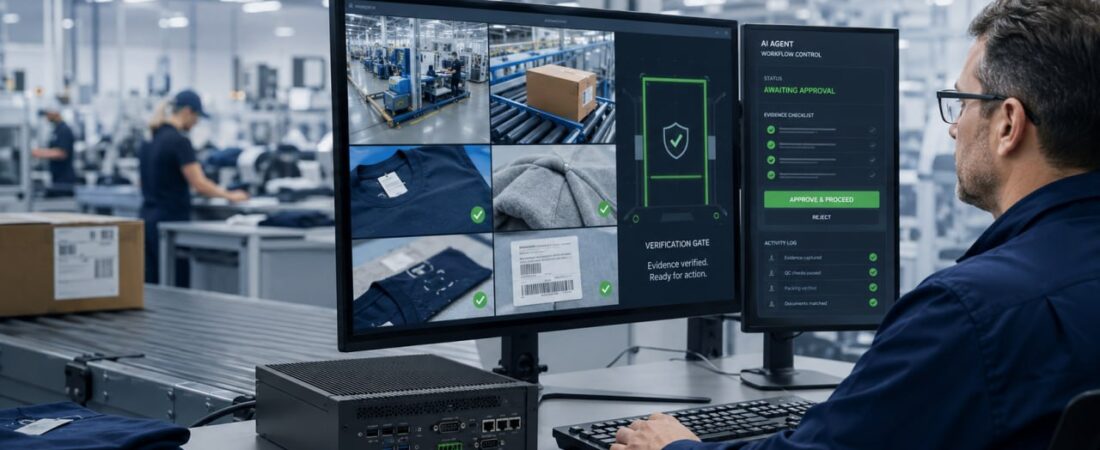
Edge-evidence decision note
An edge evidence gate should be funded only if it prevents weak AI signals from becoming factory actions. The gate must prove what was captured, how precise the evidence is, what policy boundary applies, and whether an agent or robot is allowed to draft, recommend, or execute.
Confident vision is not enough evidence
The common mistake is to trust a confident visual answer as if it were operating evidence. In a factory, one wrong interpretation of a blocked zone, missing guard, quality defect, or human position can turn an AI workflow into a safety, quality, or audit problem.
Checks before agents touch workflows
- Which edge signals are allowed to trigger action, and which require supervisor confirmation?
- Can the system store the evidence, timestamp, device, location, confidence, policy rule, and human override together?
- Does the gate block action when evidence is incomplete, stale, low-confidence, or outside the approved work boundary?
Vendor proof for edge evidence
- Demonstrate a failed evidence case and show how the system prevents action.
- Show audit replay for one visual event from capture to policy check to draft action and final approval.
- Provide separate thresholds for observation, recommendation, workflow trigger, and autonomous execution.
Agent-action evidence gate
GO if the gate reliably separates evidence from action. HOLD if evidence capture works but policy boundaries are vague. REDESIGN if agents can act before the factory can audit why they acted.
Factory AI is moving from dashboards into actions. Cameras can describe events. Vision models can read QC photos. Agents can call tools. Robots can follow policies. But the next bottleneck is not whether AI can produce an answer. The bottleneck is whether a factory can verify the evidence before that answer changes a workflow.
That is why factories need a factory AI edge evidence gate. This is a local verification layer, usually close to the camera, workstation, AI PC, or line device, that checks what the system saw before an agent, robot, or workflow tool is allowed to act.
The gate matters because factory action is different from digital response. A wrong chatbot answer can be corrected. A wrong production hold, supplier message, shipment release, CAPA ticket, or robot movement creates operational cost. In garment, electronics, packaging, automotive, and general manufacturing, the question is not only “Did the model answer?” It is “Can a supervisor see the frame, object, field, defect, document, or behavior pattern that justified the next step?”
This is also where the edge becomes more strategic. Edge AI is not just about lower latency or lower cloud cost. In factory settings, edge AI can become the place where visual evidence, extraction quality, policy boundaries, and human approval are checked before AI touches workflow rights.
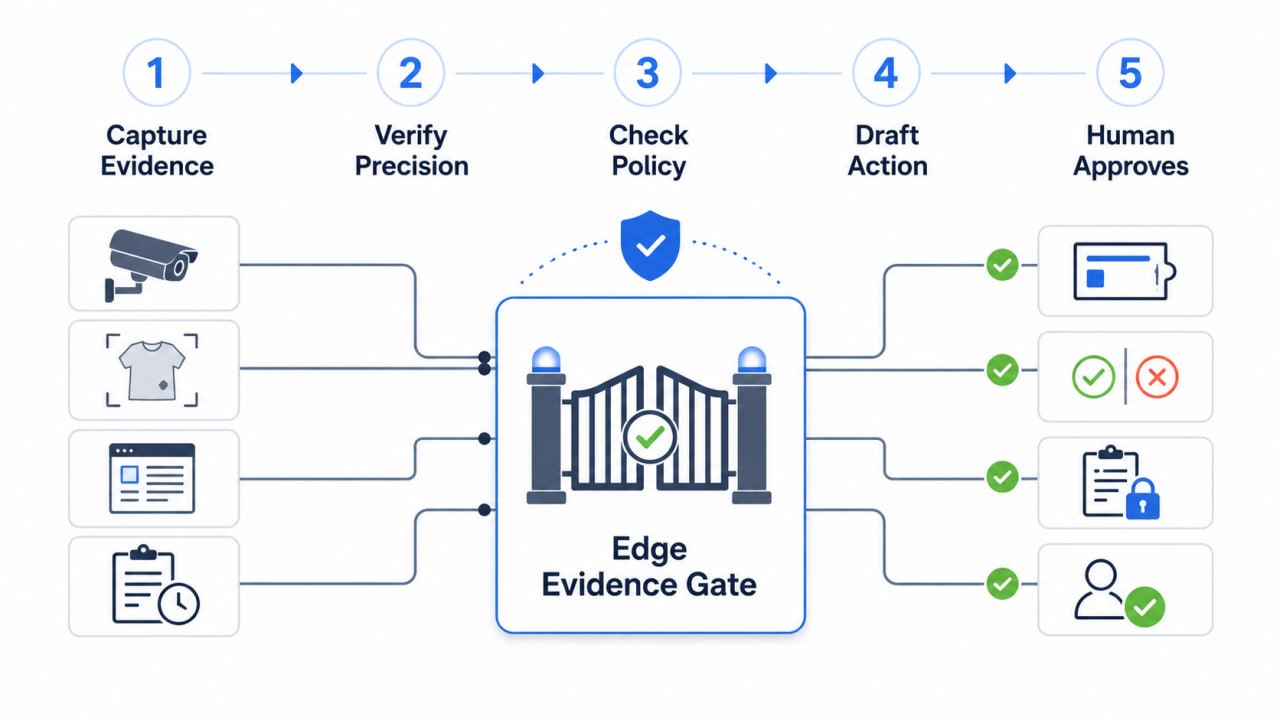
Factory AI Edge Evidence Gate: The Missing Step Between Sensing and Action
A factory AI edge evidence gate sits between sensing and execution. On one side are cameras, QC images, packing screenshots, ERP/MES screens, BOM files, trim cards, robot observations, and agent logs. On the other side are actions: create a ticket, draft a supplier message, hold a shipment, release a line, escalate a defect, update a dashboard, or trigger a robot policy.
The gate prevents a dangerous shortcut. Without it, a factory may jump from “AI detected something” to “the workflow changed.” With the gate, the system must first prove what was detected, where it was detected, how confident the extraction is, which policy applies, and whether a human approval path is required.
This connects directly with the broader cloud vs edge AI in factories decision. Some learning and reporting can happen in the cloud. But evidence capture, visual verification, and immediate action gating often belong closer to the line, device, or workstation because that is where the raw context is still available.
Video Answers Are Not the Same as Video Evidence
Recent research on evidence-backed video question answering points to an important gap: a video model may answer a question without making the real visual basis inspectable enough for operational use. In a factory, the answer “the operator missed the step” or “the carton count looks wrong” is not enough. The supervisor needs the frame, time segment, object, motion, and visible condition that support the claim.
For a sewing line, packing area, warehouse aisle, or inspection station, this distinction is practical. A camera might show a WIP delay, a shade-lot mismatch, a missing label, a broken-needle response, or a carton discrepancy. But before that observation becomes a hold, escalation, or buyer-facing explanation, the evidence must be reviewable.
A factory AI edge evidence gate should therefore store more than a label. It should preserve the short clip, selected frame, object crop, timestamp, camera ID, station ID, and reason code. If the model says a packing discrepancy exists, the evidence bundle should show the carton, label, quantity mark, or movement pattern that led to that conclusion.
This does not mean every factory needs a complex video intelligence platform on day one. It means the first useful design principle is simple: no video-based AI recommendation should become a workflow action unless a manager can inspect the evidence that produced it.
Visual Tool-Calling Agents Must Prove Precision Before They Act
The same problem appears with visual tool-calling agents. A factory agent might read a QC photo, packing screenshot, BOM table, trim card, supplier attachment, or inspection report and then decide which tool to call. The plan can look correct while the visual extraction is wrong.
This is dangerous because many factory documents contain small but critical fields: color code, PO number, style number, size ratio, carton quantity, lot reference, defect severity, tolerance, shipment date, or buyer-specific wording. If the agent misreads one field and then calls a tool, the mistake moves from perception into the operating system.
A practical edge evidence gate should separate visual extraction from workflow execution. Before an agent is allowed to create a ticket, update a field, or draft a supplier message, it should show the extracted fields and the source crop or screenshot region. The human reviewer should be able to confirm whether the agent saw the right item, not just whether the final sentence sounds reasonable.
For this reason, the first factory agents should start in read-only and draft-only modes. They can summarize a QC photo, propose a CAPA draft, or prepare a packing discrepancy note. But they should not send, update, release, block, or escalate until the visual precision gate is proven. This extends the logic in Edge AI for Factories: 7 Decisions That Should Stay Local: local decisions are useful only when the local evidence is trustworthy.
Robot Policy Evaluation Belongs Inside the Same Gate
Robots make the evidence problem more physical. A robot policy may work in a demo, but real deployment requires task-specific evaluation, environmental variation, safety boundaries, repeatability checks, and clear failure handling. NVIDIA’s recent discussion of evaluating general-purpose robot policies reinforces the same point: factory deployment needs more than impressive examples.
For most factories, especially labor-intensive or flexible-material environments, the immediate lesson is not “automate sewing tomorrow.” The better lesson is to create a release path for narrow tasks. Cleaning routes, material movement, simple sortation, inspection assistance, and guided handling may be evaluated before higher-risk production tasks.
The factory AI edge evidence gate should therefore include robot readiness checks. What task was attempted? What camera or sensor evidence was available? What failure modes are known? What human stop condition exists? What happens if lighting, placement, material shape, or operator movement changes?
This approach connects with the broader deployment evaluation layer. The edge gate is the local operating version of that idea. It is where proof is collected before the workflow or machine is trusted with a production-impacting action.
Agent Behavior Needs Continuous Signals, Not One-Time Approval
Another lesson comes from the rise of agentic behavior monitoring and contextual policies. A single action may look harmless, but a sequence of actions can create risk. In factory operations, an agent might read inventory, draft a supplier email, compare a shipment field, prepare a hold memo, and summarize a buyer issue. Each step looks small. The sequence may affect money, delivery, compliance, or buyer trust.
That is why the edge evidence gate should not be limited to one approval button. It should track behavior signals across a session: repeated access to sensitive fields, unusual volume of tool calls, changing intent, missing evidence, or repeated attempts to move from draft into execution.
For a small or mid-sized manufacturer, this can begin with a simple rule set. Read-only actions are allowed. Draft creation requires source evidence. Workflow updates require supervisor review. Shipment holds, buyer-facing messages, and production release decisions require explicit approval. Anything outside the normal operating path is blocked by default.
This is not bureaucracy. It is the operating logic needed when AI moves from recommendation to rights. If a factory would not let a junior employee release a shipment without evidence and approval, it should not let an agent do it because the text output looks confident.
For operators, the phrase factory AI edge evidence gate should mean one practical rule: no AI recommendation becomes a factory action until the local evidence is visible, the extraction is checked, and the approval path is clear.
Five Checks for a Practical Factory AI Edge Evidence Gate
A practical gate does not need to start as a large platform. It can start as five checks that every AI-assisted factory workflow must pass before action.
1. Evidence Capture
The system should preserve the source: video clip, frame, image crop, screenshot, document section, sensor timestamp, or robot observation. The evidence should be visible to the person who approves the action.
2. Visual Precision Check
The extracted fields or detected objects should be shown beside the evidence. This is especially important for QC photos, packing lists, BOMs, trim cards, labels, and ERP/MES screenshots.
3. Policy Boundary Check
The system should know whether the next step is read-only, draft-only, approval-required, limited execution, or blocked. This prevents silent escalation from observation into action.
4. Draft Action
Instead of executing immediately, the AI should prepare a recommended action: a CAPA note, ticket draft, hold recommendation, supplier message draft, or exception summary. The draft should include the evidence link and reason code.
5. Human Hold, Release, or Escalate
A manager should make the final call for production-impacting decisions. The decision should be logged so the factory can later audit whether the gate improved quality, reduced delays, or created false alarms.
Garment Example: From Shade-Lot Evidence to Workflow Approval
Consider a garment factory handling a suspected shade-lot mismatch. A camera, QC photo, or line report may suggest that a fabric roll or bundle does not match the approved standard. A weak AI workflow might immediately create a hold ticket or send a warning message. A stronger workflow would pass through the edge evidence gate.
First, the system captures the relevant image, roll label, standard reference, station, time, and operator note. Second, it highlights the area that triggered the mismatch. Third, it extracts the style, lot, color, and bundle data from the visible documents or labels. Fourth, it prepares a draft hold recommendation with confidence and evidence. Fifth, the responsible manager decides whether to hold, release, inspect more units, or escalate to merchandising and QA.
This makes the AI useful without pretending it has final authority. It speeds up evidence collection and draft preparation while keeping the factory’s real control point in human review.
What Factories Should Build First
The first build is not a full autonomous factory agent. The first build is an evidence checklist. Which workflows are allowed to use AI? Which ones require video, photo, screenshot, or document evidence? Which fields must be extracted correctly? Which actions are draft-only? Which actions require supervisor approval?
Next, factories should identify one or two low-risk workflows. Good starting points include QC photo summarization, packing discrepancy draft notes, line delay evidence capture, maintenance observation logs, or document comparison summaries. These workflows produce value without giving AI full operational rights.
Then the factory can connect the gate to the broader Factory AI stack map. Edge devices capture evidence. AI infrastructure stores and routes it. Agents prepare drafts. Human managers approve or reject actions. Over time, the factory can measure which checks are reliable enough to automate further.
Source Signals Behind the Factory AI Edge Evidence Gate
The factory AI edge evidence gate framework in this article is based on a mix of research and architecture signals. NVIDIA’s robot policy evaluation discussion is useful for thinking about deployment readiness before physical automation. The arXiv papers on Evidence-Backed Video Question Answering and MM-ToolSandBox point to the need for visual evidence and visual tool-calling precision. Cloudflare’s Precursor work and Databricks’ contextual policy discussion are used here as agent-behavior and policy analogies, not as direct factory ROI proof. Hugging Face LeRobot v0.6.0 also reinforces the need for evaluate-and-improve loops before robots are trusted in production workflows.
In other words, the factory AI edge evidence gate is a practical translation of these signals for factories: verify the evidence locally, confirm visual precision, check the policy boundary, draft the action, and keep a human approval point before execution.
Final edge-evidence takeaway
The next step in Factory AI is not giving every agent more tools. It is building the proof layer that decides when an AI output is allowed to become an action.
A factory AI edge evidence gate turns edge AI from a local inference box into an operating control point. It verifies video evidence, visual precision, policy boundaries, draft actions, and human approval before AI touches workflows. That is the practical path from AI observation to factory trust.
Source notes: This article uses recent signals from NVIDIA Robotics on robot policy evaluation, arXiv research on evidence-backed video question answering and visual tool-calling agent evaluation, Cloudflare’s agentic behavior signal work, Databricks’ contextual policy discussion, and Hugging Face LeRobot release notes. Vendor posts are treated as architecture signals, not proof of factory ROI. arXiv papers are treated as research signals, not production evidence.
Written and edited by: Evan Lee, Founder / Editor of Factory AI Atlas.
This article reflects Factory AI Atlas editorial analysis of public AI research, vendor technical posts, and manufacturing operating patterns. Vendor posts are treated as architecture signals, while arXiv papers are treated as research signals rather than production proof.
External validation anchors for edge evidence gates
- NIST AI Risk Management Framework — useful for accountable, monitored, and governed AI decision systems.
- NIST manufacturing resources — relevant for connecting edge evidence to measurable manufacturing decisions.
About the Editorial Perspective
Factory AI Atlas focuses on practical manufacturing AI readiness: evidence quality, operating discipline, edge/cloud routing, workflow safety, and human approval paths before automation is trusted on the shop floor.