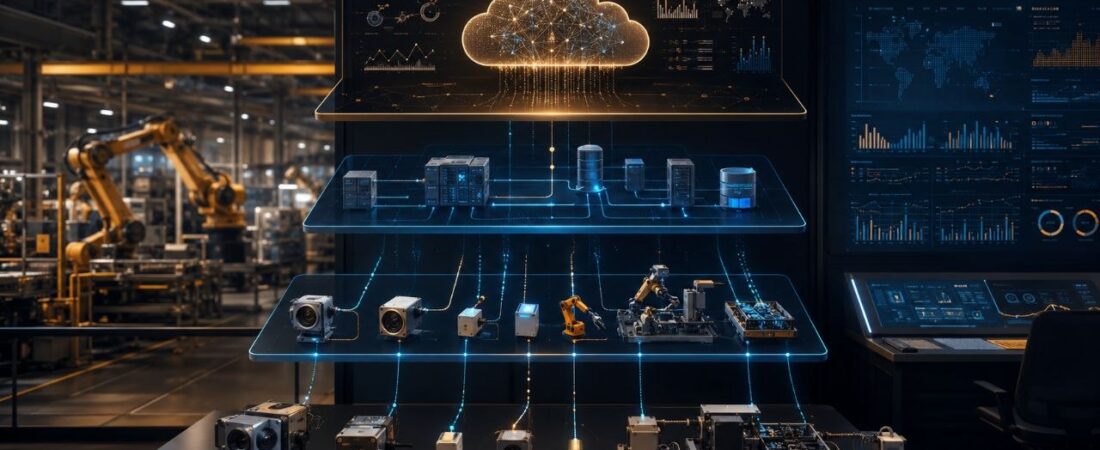
Cloud-edge routing decision note
Cloud vs edge AI in factories is not an IT fashion choice. It is a routing decision: which data must be acted on immediately near the machine, which can be analyzed later in the cloud, and which should never leave the factory without controls.
Architecture is chosen before data risk is classified
The common mistake is to pick cloud or edge as a platform preference before classifying latency, safety, privacy, bandwidth, downtime, and human-approval needs by process.
Checks before choosing cloud or edge AI
- Which decisions affect safety, quality, machine control, or line stoppage in seconds?
- Which data is strategic learning data that can safely move to cloud analytics?
- What happens when internet, local network, sensor, or cloud service availability fails?
Proof requests for cloud-edge routing controls
- Show the failover logic for network loss and delayed cloud response.
- Explain where raw images, defect data, production records, and model outputs are stored.
- Provide a data-routing map with latency, privacy, retention, and human-approval rules.
Data-routing architecture gate
GO if data classes and decision timing are clearly mapped. HOLD if the architecture works only in ideal connectivity. REDESIGN if sensitive or time-critical factory data is routed by convenience rather than risk.
Cloud vs edge AI in factories is often framed as a technology choice: should the factory buy more AI PCs, send more data to the cloud, or wait for a better platform? That framing is too narrow for real production environments.
The routing decision should start with the factory signal, not the platform: latency, safety consequence, buyer sensitivity, worker-identifiable data, downtime risk, and learning value decide where each AI task belongs.
On the shop floor, the practical question is not where the newest model runs. The better question is where each factory signal should be judged, stored, protected, and later learned from.
A camera image of a sewing defect, a machine alarm, a worker-identifiable video frame, a buyer inspection photo, and a monthly energy-cost pattern do not belong in the same data bucket. They move at different speeds, carry different risks, and support different decisions.
That is why a cloud vs edge AI discussion should start with a factory data decision matrix. Before choosing architecture, the factory should classify data by decision speed, sensitivity, evidence value, and learning purpose.
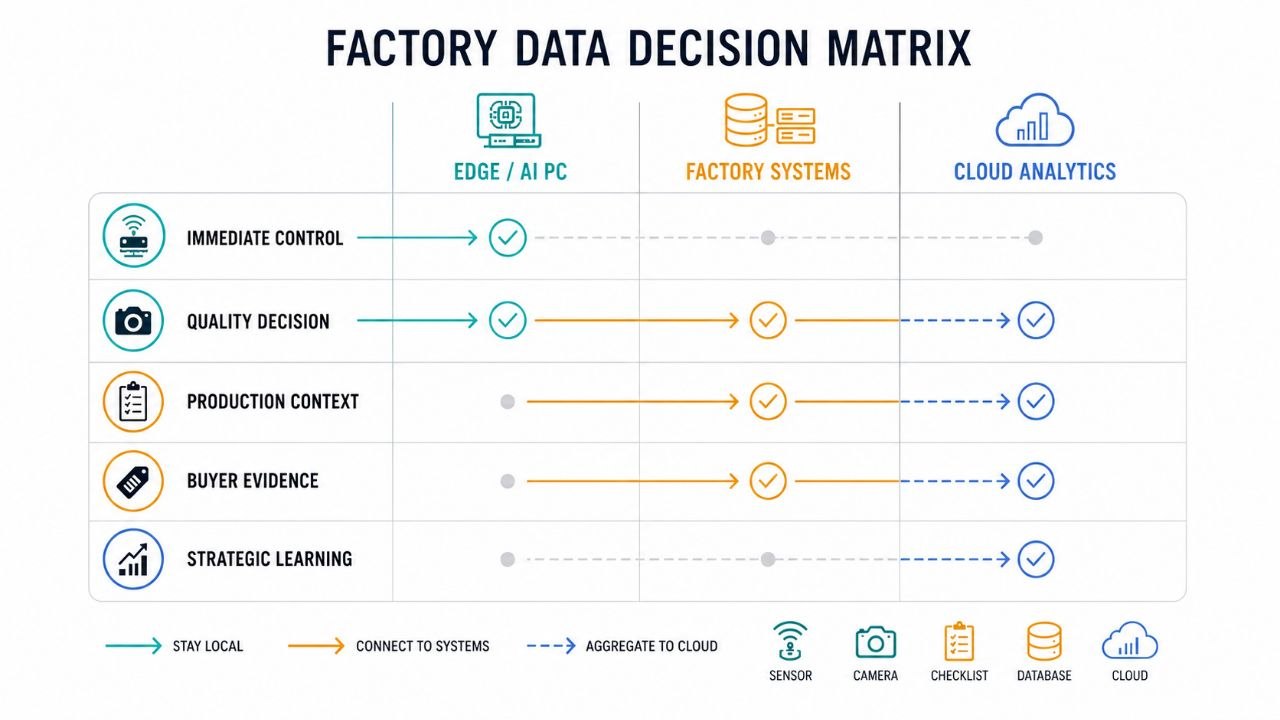
Cloud vs edge AI is a factory data-routing decision
Factories should not send every shop-floor signal to cloud AI. They should first classify factory data by four questions: how fast the decision must happen, how sensitive the data is, whether the record becomes operational evidence, and whether the value comes from immediate action or long-term learning.
For a factory, edge AI is useful when data needs local judgment: quality screening, abnormal signals, safety alerts, sensitive images, internet-failure fallback, or fast line-level exceptions. Cloud analytics is useful when data can be aggregated, cleaned, anonymized, and compared across longer periods.
For practical planning, cloud vs edge AI in factories should be treated as a routing discipline, not a vendor category. The strongest factory AI architecture is usually not cloud-only or edge-only. It is a hybrid system where the factory knows which layer should make which decision.
Why cloud-only AI fails on the factory floor
Cloud AI can be powerful for pattern analysis, benchmarking, model improvement, and cross-site learning. But the factory floor is not only an analytics environment. It is an operating environment where people, machines, materials, and buyer requirements collide in real time.
If every signal must leave the factory before a decision can happen, several risks appear. A quality issue may wait for a network round trip. A camera image may contain worker faces or buyer-sensitive product details. A machine alarm may become a dashboard event instead of an immediate shop-floor response. A buyer evidence record may be mixed with general analytics data instead of being preserved as a controlled proof record.
This is especially important in garment and other labor-intensive factories. A single image can include a style detail, label, operator, workstation, bundle card, defect, and production context. That image is not just “data for AI.” It may also be privacy data, quality evidence, buyer-sensitive product information, and training material.
That is why cloud vs edge AI in factories needs a decision-first data architecture. The architecture should decide what stays local, what connects to factory systems, and what can move to cloud analytics after aggregation or masking.
The five factory data classes
A practical factory data decision matrix can start with five classes of information.
1. Immediate control data
This includes machine alarms, safety signals, sensor thresholds, stop conditions, restricted-zone alerts, abnormal pressure, temperature, vibration, compressor events, or other signals that require fast local action. This data usually belongs closest to the operation.
If the decision must happen in seconds, the first judgment should not depend on a distant cloud workflow. Edge devices, local controllers, AI PCs, and factory-side systems are better suited for the first action layer.
2. Quality decision data
Quality images, defect predictions, re-inspection triggers, false accept risk, false reject risk, and exception routing belong in a mixed layer. The first judgment may happen locally, but the decision result should connect to QMS, MES, inspection logs, or other factory systems.
For example, an AI model may screen a defect image locally. But the factory still needs to record the style, operation, bundle, line, inspector, defect class, rework action, and final decision. Edge AI without factory-system context becomes a disconnected signal.
3. Production context data
Order, style, line, operation, shift, machine, workstation, bundle, operator assignment, and production schedule data provide context. This data does not always need edge inference, but it must be clean enough for factory systems to connect decisions to real production conditions.
If production context is weak, even a good AI result becomes hard to use. The factory may know that a defect was detected, but not whether it came from a specific style, operation, fabric, line condition, or batch.
4. Buyer evidence data
Buyer evidence includes inspection photos, CAPA records, carton checks, audit proof, label evidence, traceability snapshots, shipment documentation, and exception records. This data should not be treated as ordinary analytics exhaust.
Evidence records need controlled storage, clear timestamps, responsible owners, and retrieval paths. Some evidence can support analytics later, but the first requirement is proof discipline: can the factory show what happened, when it happened, and what action was taken?
5. Strategic learning data
Strategic learning data includes long-term trends, cost patterns, defect recurrence, downtime categories, model performance drift, energy usage, productivity patterns, and cross-line comparison. This is where cloud analytics can be valuable.
But even here, raw data should not move carelessly. The factory should aggregate, anonymize, or summarize where appropriate, especially when the source includes worker-identifiable data, buyer-sensitive product details, or private operational records.
A practical cloud vs edge AI decision matrix
The matrix in this article separates destination from value. “Edge / AI PC” does not mean the data is more important. “Cloud Analytics” does not mean the data is automatically safer or smarter. Each destination serves a different decision purpose.
- Edge / AI PC: best for fast local decisions, sensitive first-pass filtering, quality screening, safety alerts, and fallback when connectivity is weak.
- Factory Systems: best for MES, ERP, QMS, maintenance, traceability, evidence logs, and operational records that must stay connected to real production context.
- Cloud Analytics: best for aggregated learning, cross-period analysis, model improvement, benchmarking, and strategic planning after data has been cleaned and classified.
This decision logic also supports AI risk management. The NIST AI Risk Management Framework emphasizes the need to govern and manage AI risks, while the NIST Cybersecurity Framework reinforces the importance of identifying and protecting critical digital assets. In factories, those ideas become practical only when data routing is specific enough for real operations.
Garment factory example: defect image routing
Consider a garment factory using camera-based inspection for sewing defects. The image may show the garment panel, stitch line, label, bundle ticket, workstation, and sometimes an operator or inspector. A cloud-only approach may treat this as a normal image upload. A factory-ready approach separates the decision layers.
First, the defect image can be screened locally on an edge device or AI PC. The local system can flag suspected defects, mask sensitive areas where possible, and trigger re-inspection before the bundle moves too far downstream.
Second, the decision result should connect to factory systems. The defect class, style, line, operation, timestamp, bundle, inspector decision, rework action, and final disposition should be stored as operational context. Without this connection, the AI result becomes a floating prediction.
Third, only the right learning data should move to cloud analytics. The factory may send aggregated defect patterns, model-performance results, or anonymized image samples for improvement. It should not automatically send every raw image, buyer detail, or worker-identifiable frame to external tools.
How this connects to the existing Factory AI architecture
This article is a practical follow-up to Edge AI for Factories: 7 Decisions That Should Stay Local. That article explains which decisions should remain near the shop floor. This article turns the same idea into a routing matrix for factory data.
It also connects to the broader Factory AI Stack Map, where factory AI decisions sit above chips, models, infrastructure, data layers, and operational systems. Edge AI should not be seen as a separate gadget category. It is part of the decision layer that connects physical signals to useful factory actions.
The same logic supports factory data layer readiness. A factory may already have PLC, SCADA, MES, ERP, cameras, and spreadsheets, but still lack reliable event definitions, timestamps, quality labels, and evidence ownership. Cloud vs edge decisions are weak if the underlying data layer is not disciplined.
Readiness checklist: what to ask before choosing the layer
Before deciding whether data should stay at the edge, connect to factory systems, or move to cloud analytics, a factory can ask these questions:
- Does this data require action within seconds or minutes?
- Could this data expose worker identity, buyer-sensitive product details, or private factory process information?
- Is this data part of a quality, audit, CAPA, shipment, traceability, or buyer evidence record?
- Does the factory need the raw record, or is an aggregated summary enough?
- Which system owns the final decision: edge device, QMS, MES, ERP, maintenance system, or management analytics?
- Can the factory explain why this data was routed to this layer?
- Can the factory retrieve the record later if a buyer, auditor, engineer, or manager asks for proof?
Where public AI tools do not belong
A cloud analytics layer is not the same as an uncontrolled public AI tool. Factories should be careful not to paste raw production records, buyer documents, worker-identifiable images, inspection photos, or private operational data into tools that are not approved for that data class.
This is why cloud vs edge AI should be tied to data governance. The question is not only whether the cloud is technically capable. The question is whether the data is allowed to leave the factory, whether it has been masked or aggregated, and whether the factory can prove its handling process.
For a deeper privacy and governance angle, see Private Factory Data: What Should Never Be Sent to Public AI Tools. For evidence discipline, see Buyer Evidence Readiness.
Common mistake: treating edge AI as hardware purchasing
Many factories will hear “edge AI” and immediately think about device specifications: GPU, NPU, AI PC, industrial PC, camera model, or server size. Those details matter, but they should not be the first decision.
The first decision is operational: what problem must be judged locally, what evidence must be preserved, what context must be connected, and what learning can safely happen later?
If the factory cannot answer those questions, edge devices may become isolated boxes. Cloud dashboards may become attractive charts without reliable action. AI pilots may look modern but remain disconnected from quality, maintenance, traceability, and buyer proof.
Final cloud-edge routing takeaway
Cloud vs edge AI in factories is not a debate about where intelligence should live. It is a discipline for deciding where each factory signal should be judged, stored, protected, and learned from.
Immediate control data should stay close to the operation. Quality decisions should combine local judgment with factory-system context. Buyer evidence should be controlled and retrievable. Strategic learning can move to cloud analytics after aggregation and governance.
The factory that builds this routing discipline before buying more AI tools will be better prepared for inspection AI, predictive maintenance, energy optimization, traceability, robotics, and future Factory AI agents.
External validation anchors for cloud and edge AI decisions
- NIST Cloud Computing Program — use as a cloud-computing reference when classifying factory data and architecture.
- NIST manufacturing resources — useful context for manufacturing systems, interoperability, and operational constraints.