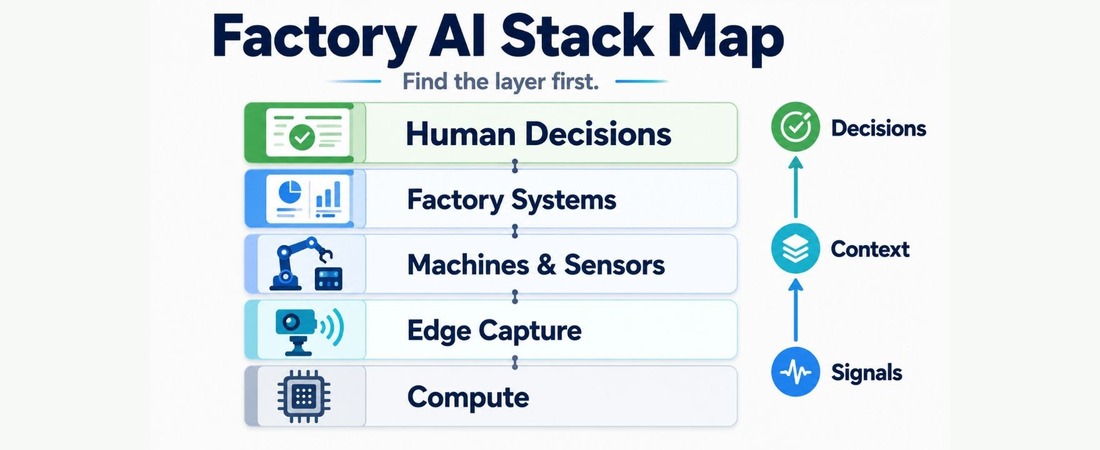
Factory AI stack-layer decision note
A factory AI stack map is useful only if it stops teams from buying the wrong layer first. The practical question is which layer currently blocks the factory decision: chips, edge inference, robots, systems integration, data quality, or operating rules.
Teams buy a layer before naming the bottleneck
The common mistake is to compare vendors from different layers as if they solve the same problem. A robot vendor, an edge gateway provider, an MES add-on, and a model platform may all say “AI,” but each removes a different bottleneck and creates a different dependency.
Checks before funding a factory AI stack layer
- Which decision is the project supposed to improve, and which stack layer is the current constraint?
- Does the proposed layer depend on data, integration, or operating discipline that the factory does not yet have?
- Can the pilot prove value without forcing the factory into a full-stack lock-in too early?
Proof requests for stack-layer vendors
- Place the solution on the stack map and name the layers it requires but does not provide.
- Show integration points, data ownership, failure modes, upgrade path, and exit risk.
- Explain what factory evidence must exist before the claimed AI benefit becomes credible.
Stack-to-decision gate
GO if the chosen layer removes the real decision bottleneck. HOLD if the layer is useful but upstream evidence is weak. REDESIGN if the proposal sells a stack story without showing where factory value is created.
Factory AI is often discussed as if one technology layer will transform the factory by itself.
The stack map should therefore work like a buying filter. It should show whether the factory is blocked by sensing, edge inference, robot action, system integration, data trust, or decision ownership before any vendor is treated as the solution.
Sometimes the conversation starts with chips. Sometimes it starts with edge AI boxes, computer vision models, robots, digital twins, MES platforms, or AI agents. Each layer matters. But none of them creates factory value alone.
A factory AI stack only becomes useful when technology layers connect to real factory decisions.
That is why manufacturers need a stack map before comparing vendors, buying hardware, or launching an AI pilot. The goal is not to chase the newest component. The goal is to understand which layer creates the signal, which layer interprets it, which layer acts on it, and which human or operating rule owns the final decision.
A factory AI stack map helps separate hype from readiness. Before a factory can use advanced automation well, it often needs visible factory readiness: clearer WIP, clearer exceptions, and clearer human intervention rules.
Why factories need a stack map before comparing AI vendors
Many factory AI projects start with the wrong question. The question is often: “What AI tool should we buy?” A better question is: “Which operating decision are we trying to improve, and which stack layers must be ready for that decision to improve?”
This distinction matters because factory AI is not a single product category. It is a connected operating stack. A visual inspection model may need local compute, camera placement, lighting control, defect definitions, operator review rules, quality hold logic, and integration with production records.
A mobile robot pilot may need material flow discipline, route stability, traffic rules, safety validation, WIP visibility, and clear handoff points. A production planning assistant may need trusted order data, real-time WIP, capacity assumptions, downtime signals, and human approval gates.
Without a stack map, factories often compare vendors at the wrong level. They compare robot brands before stabilizing material flow. They compare AI dashboards before fixing data trust. They compare edge devices before deciding what should stay local and what can safely move to the cloud.
A factory AI stack only becomes useful when technology layers connect to real factory decisions.
The 5-layer factory AI stack map
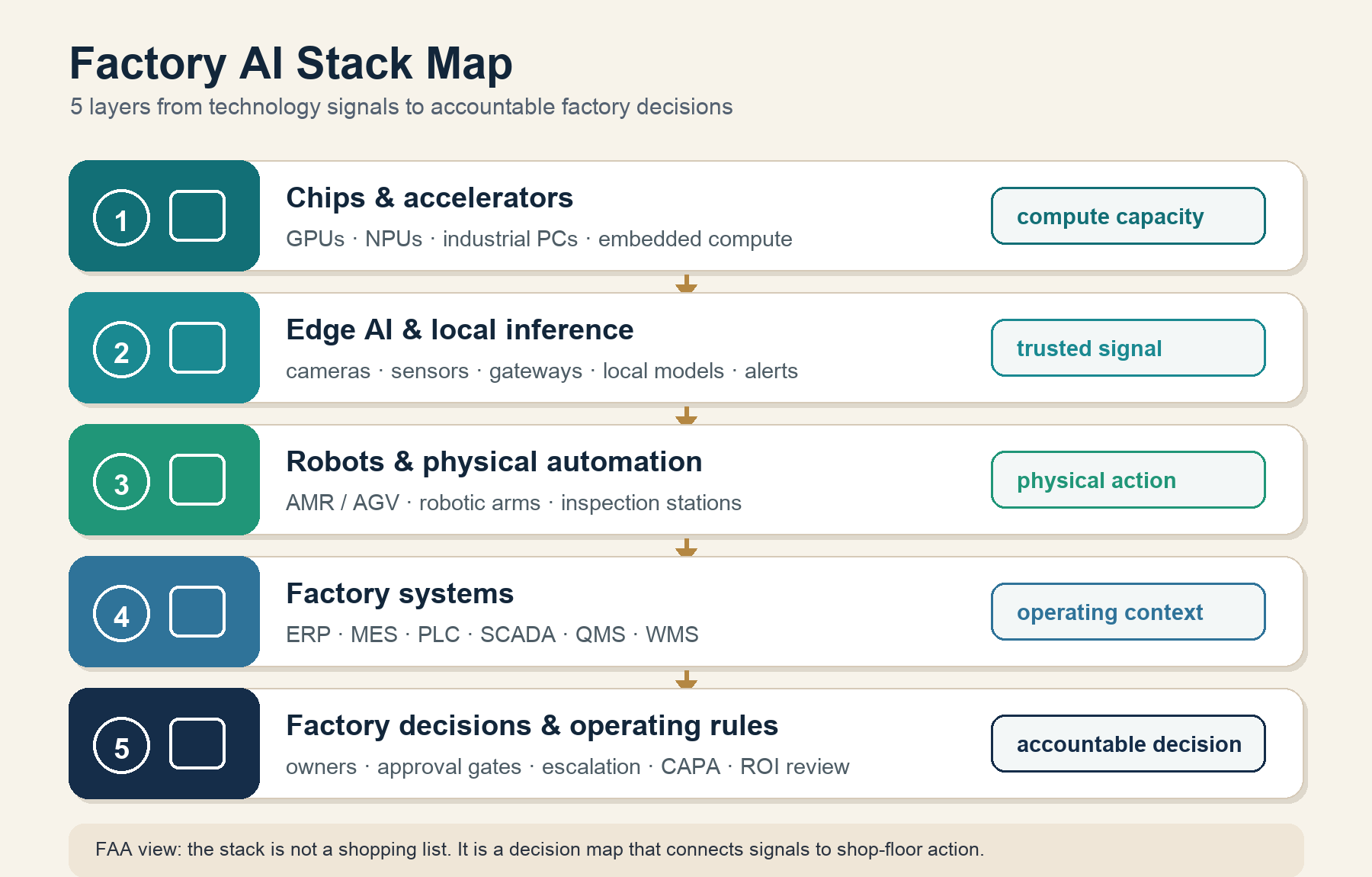
A practical factory AI stack can be viewed in five layers:
- Chips and accelerators
- Edge AI and local inference
- Robots and physical automation
- Factory systems
- Factory decisions and operating rules
These layers are not just technical categories. They are decision layers. The stack only works when each layer passes usable signals to the next layer and when the final decision is clear enough to act on.
Layer 1: Chips and accelerators
Chips and accelerators are the compute foundation of the factory AI stack. This layer includes GPUs, NPUs, industrial PCs, AI accelerators, embedded processors, and other hardware that makes AI workloads possible.
In manufacturing, this layer matters because factories often need AI to run close to the process rather than only in a remote cloud environment. This is the basic edge computing logic behind many shop-floor AI architectures. But chips alone do not create factory value. A faster processor does not automatically reduce defects. A more powerful AI accelerator does not automatically improve line balance.
The useful factory question is: “What decision or signal can this compute layer support that the factory could not handle before?”
- Faster inspection feedback
- Lower latency safety monitoring
- Local processing of sensitive factory data
- Real-time anomaly detection near a machine
- Offline or unstable-network factory operation
- Reduced dependence on external cloud services
Layer 2: Edge AI and local inference
Edge AI is where factory signals begin to become useful. This layer includes cameras, sensors, edge gateways, industrial PCs, local AI models, and inference systems running near the production process. This is where local AI for factories becomes more than a hardware trend: it becomes an operating and governance choice.
Edge AI can support visual inspection, worker safety monitoring, machine anomaly detection, energy monitoring, WIP tracking, tool condition monitoring, process parameter alerts, and local SOP assistance. For a broader technology definition, IBM describes edge AI as AI processing closer to where data is generated rather than only in a centralized cloud.
But edge AI also creates a discipline problem. If the factory does not define what should be detected, who reviews exceptions, what confidence level is acceptable, and how alerts enter daily work, the edge AI layer becomes another dashboard layer.
- If a defect is detected, who confirms it?
- If a machine anomaly is flagged, does maintenance receive a work order?
- If WIP is delayed, does production planning adjust the schedule?
- If a safety risk is detected, who has authority to stop the process?
- If factory data is sensitive, what must remain local?
The edge AI layer also helps decide which private factory data should remain local instead of being sent to public AI tools.
Layer 3: Robots and physical automation
Robots are the most visible layer of the factory AI stack. This layer includes AGVs, AMRs, robotic arms, automated inspection stations, cleaning robots, automated storage systems, robotic sewing concepts, machine tending systems, and other physical automation assets.
A robot does not fix an unstable process. It exposes it.
If material flow is unclear, a mobile robot will struggle. If workstations are not standardized, automation will require constant exceptions. If quality criteria are inconsistent, robotic inspection will generate disputes. If maintenance routines are weak, automated equipment may add downtime rather than reduce it.
Before adding mobile robots or robotic equipment, teams should use a factory robotics readiness matrix to test material flow, safety, and handoff stability.
- Material flow stability
- Layout discipline
- Handoff points
- WIP visibility
- Safety zones
- Exception routes
- Maintenance ownership
- Human override rules
- ROI baseline
- Integration with existing systems
Layer 4: Factory systems
Factory systems are the layer where AI signals must connect to production context. This layer includes ERP, MES, PLC, SCADA, WMS, QMS, maintenance systems, planning tools, spreadsheets, dashboards, and manual records. Siemens’ industrial edge framing is a useful reminder that factory AI often sits between machine-level signals and enterprise-level systems.
The factory systems layer depends on a trusted factory AI data layer that connects ERP, MES, PLC, quality, WIP, and maintenance signals.
- A defect detection model needs product style, defect category, quality rules, and disposition logic.
- A predictive maintenance model needs machine history, downtime logs, spare parts, and maintenance response data.
- A planning assistant needs capacity, WIP, order priority, material availability, and confirmed constraints.
- A mobile robot fleet needs route rules, pickup and drop-off logic, inventory status, and safety events.
The factory systems layer answers the question: “What does this signal mean inside the actual operating context?” This is where many AI pilots fail. They produce a useful signal, but the signal does not enter the factory’s normal decision system.
Layer 5: Factory decisions and operating rules
The final layer of the factory AI stack is not technology. It is decision ownership. This layer includes supervisors, operators, quality teams, maintenance teams, planners, engineers, managers, escalation rules, approval gates, exception handling, CAPA logic, and ROI review routines.
- Who reviews the AI output
- When the AI can act automatically
- When human approval is required
- How exceptions are escalated
- How false positives are handled
- How results are measured
- How accountability is assigned
- How the process improves after each cycle
This is why human-in-the-loop design is not a temporary weakness. In many factories, it is the correct operating model. The goal is not to remove people from every decision. The goal is to make factory decisions faster, clearer, more consistent, and better supported by trusted signals.
The final layer of the factory AI stack is not technology. It is decision ownership.
How to use the factory AI stack map before a pilot
A factory AI stack map is useful because it gives teams a practical way to evaluate pilots before money is spent.
1. Which factory decision are we trying to improve?
Do not begin with the tool. Begin with the decision: defect hold or release, line support priority, maintenance timing, order risk, material-flow delay, operator support, or energy waste correction.
2. Which stack layer is currently weakest?
A pilot may fail because of a weak layer outside the AI model: inadequate local compute, poor camera setup, unstable material flow, missing WIP visibility, inconsistent quality definitions, untrusted ERP or MES data, weak exception handling, no human approval rule, or no ROI baseline.
3. Which signals are trusted enough to act on?
Factories should separate available data from trusted data. Downtime logs may be incomplete. Quality records may be delayed. WIP may be updated manually after the fact. Production counts may not match actual line conditions.
4. What should stay local?
Factories should consider local processing for sensitive buyer data, product development information, worker-related data, quality images, process recipes, machine performance records, cost and capacity assumptions, and compliance-related evidence.
5. Who owns the final decision?
Every AI pilot needs a decision owner. If the system flags an issue, someone must know what happens next. If the AI recommendation is wrong, someone must know how to override it. If the recommendation is accepted, someone must track whether the outcome improved.
A practical example: visual inspection
Visual inspection touches every layer of the factory AI stack. The factory needs enough compute for image processing, cameras and lighting for local inference, possible connection to conveyors or alarms, product and defect context inside quality systems, and clear human confirmation rules.
If any layer is missing, the inspection pilot may still look impressive in a demo. But it may not create stable factory value. This is the purpose of the factory AI stack map: it shows the difference between a technical demonstration and an operating system improvement.
A practical example: mobile robots
Mobile robots also show why stack thinking matters. An AMR or AGV may look like a robotics investment, but the pilot depends on stable routes, clear pickup and drop-off rules, traffic zones, safety validation, material identification, WIP visibility, integration with inventory or production status, exception rules, human override procedures, maintenance ownership, and an ROI baseline.
If the factory lacks material flow discipline, the robot may spend more time managing exceptions than moving goods. The robot is visible. But the hidden stack determines whether the robot works.
The FAA view: AI value appears when layers connect to factory decisions
The factory AI stack is not a shopping list. It is a decision map.
Chips matter because they enable compute. Edge AI matters because it keeps intelligence close to the process. Robots matter because they act in the physical world. Factory systems matter because they connect signals to operating context. Human decision rules matter because they turn signals into accountable action.
The factory AI stack is not a shopping list. It is a decision map.
The practical path is not to chase the most advanced layer first. The practical path is to ask what decision is being improved, what signal that decision needs, which layer creates the signal, which layer interprets it, which layer acts on it, and which person or rule owns the outcome.
That is the real purpose of a factory AI stack map. It helps factories move from technology comparison to operating readiness. And for most manufacturers, that shift is where factory AI begins.
External validation anchors for factory AI stack mapping
- NIST manufacturing resources — useful for grounding AI stack choices in process measurement and factory improvement.
- NIST AI Risk Management Framework — relevant for mapping AI layers to governance, monitoring, and risk controls.