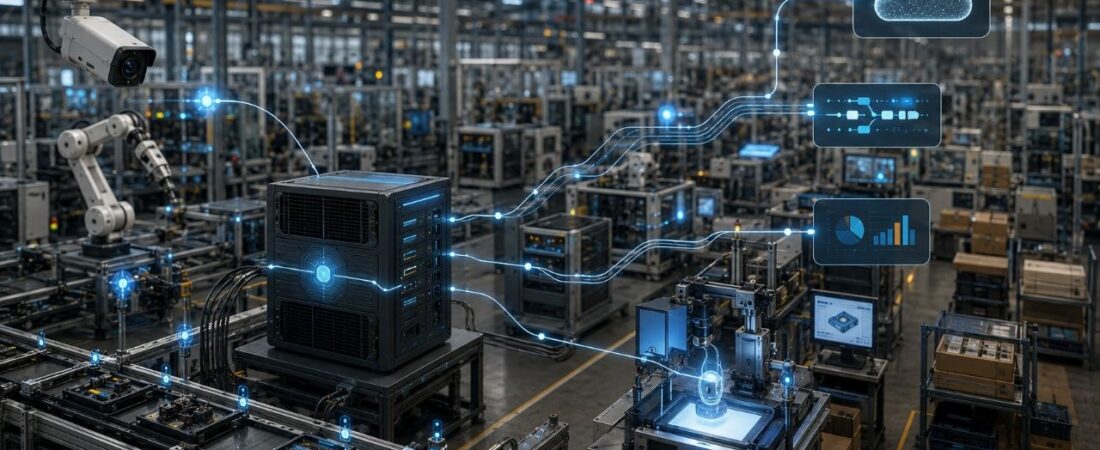
The practical boundary for a local AI decision
Edge processing is useful when a factory cannot wait for the cloud, cannot send the raw record outside, or must keep working during a network failure. The device is not the decision. The operating rule is.
Find the event near the machine, camera, or workstation.
Release, stop, hold, or escalate only within an approved limit.
Store the minimum record needed for quality, maintenance, or supervisor review.
Use a local-first design only when one of these conditions is real
- Time: cloud delay could increase defects, downtime, or safety exposure.
- Data: the raw image, video, style, label, or worker record should not leave the site.
- Continuity: the process must keep a safe fallback when the connection is slow or offline.
- Accountability: a named owner can review exceptions, device health, model changes, and retained evidence.
Boundary: Local processing does not remove human approval, access control, record retention, or cloud analysis. It only changes where the first bounded decision happens.
Factories are starting to ask a practical question about AI: should every image, machine signal, production record, and exception log be sent to the cloud?
The answer is no.
Cloud AI is useful. It can support reporting, benchmarking, model improvement, document analysis, and multi-site visibility. But not every factory decision belongs in the cloud first. Some decisions are too fast, too sensitive, too operational, or too dependent on local context.
This is where Edge AI for factories becomes important.
Edge AI is not just about AI PCs, industrial computers, chips, smart cameras, or local servers. Those are only the hardware layer. The real factory question is operational: which decisions should happen locally before data leaves the shop floor?
For factories, especially labor-intensive manufacturing sites, the edge is not a technology trend. It is a control layer. It decides what should be processed locally, what should be masked, what should be summarized, and what can safely move to the cloud.
Edge AI Is Not Just a Hardware Trend
Many discussions about edge AI start with hardware. They focus on GPUs, NPUs, industrial PCs, smart cameras, embedded devices, and edge servers. These components matter, but they are not the starting point for factory leaders.
The better starting point is the factory decision.
- Does this decision need to happen in seconds?
- Does the data include buyer-sensitive information?
- Does the image or video identify workers?
- Would production stop if the internet connection failed?
- Does a supervisor need to approve the action immediately?
- Can the cloud receive only a summary instead of raw data?
- Does the result need to become an evidence record in MES, QMS, ERP, or a maintenance log?
If the answer is yes, the decision may need to stay local, at least in the first step. Edge AI becomes useful when it supports a specific factory operating rule. It is not valuable because it is closer to the machine. It is valuable because it helps the factory make faster, safer, and more controlled decisions at the point of work.
This also connects to the broader factory AI stack map. Edge AI is one layer between shop-floor signals, factory systems, and human decisions. It should not be treated as an isolated device purchase.
Why Some Factory Data Should Not Go Directly to the Cloud
Factory data is not generic data. A single production image may contain a buyer logo, style detail, label, packing information, workstation condition, defect evidence, operator movement, or process method. A video feed may show people, layout, workflow, material handling habits, and production bottlenecks. A machine signal may reveal capacity, downtime patterns, or process weaknesses.
This does not mean factories should avoid cloud AI. It means factories need a decision rule before sending data out. Some data can go to the cloud safely after it is cleaned, masked, summarized, or aggregated. Some data should remain local. Some data should move only after human review. Some should be converted into an event record instead of being stored as raw image or video.
The wrong question is: “Should we use cloud AI or edge AI?” The better question is: what should the factory decide locally before the cloud receives anything?
That is the practical FAA view of Edge AI for factories.
1. Real-Time Quality Image Screening
Quality inspection is one of the most common factory AI use cases. Cameras can capture product defects, sewing issues, stains, incorrect trims, damaged packaging, wrong labels, missing components, or visual abnormalities.
But raw quality images can be sensitive. They may show buyer designs, labels, style details, proprietary construction methods, or inspection conditions. Sending every image directly to the cloud may create unnecessary risk.
A better edge AI design starts with local pre-screening. The local system can first check whether the image is clear, whether the angle is usable, whether the defect candidate is visible, whether sensitive labels should be masked, and whether the image should be cropped before it becomes a record.
The cloud may still be useful later for trend analysis, model improvement, or management reporting. But the first decision should often happen locally. A garment factory, for example, may not need to upload every full inspection image. It may only need a cropped defect area, defect category, operation code, time, line, style group, and inspector confirmation.
The goal is not to hide quality problems. The goal is to create better evidence with less unnecessary exposure.
2. Worker-Identifiable Video Filtering
Video is powerful, but it is also sensitive. Factory video can identify workers. It can reveal faces, movement patterns, work speed, workstation habits, and supervisor behavior. If video AI is introduced without clear rules, it can quickly feel like surveillance rather than operational improvement.
Before video leaves the factory floor, the system should ask whether the factory needs the raw video at all. Often, the useful signal is not the person. The useful signal is the event.
- WIP congestion detected
- Restricted-zone entry detected
- Workstation idle event detected
- Bundle missing event detected
- Safety risk detected
- Abnormal movement near equipment detected
Edge AI can convert raw video into privacy-safer operational signals. Instead of sending full video to the cloud, the local system may send an event count, timestamp, zone, confidence score, and supervisor review status. A good rule is simple: do not send people when the factory only needs events.
3. Buyer-Sensitive Product Data Protection
Many factories work with buyer-sensitive information: product artwork, labels, brand marks, style names, PO details, packing instructions, carton marks, sample images, inspection photos, and process conditions. Even when the information is not legally classified as confidential, it can still be commercially sensitive.
Cloud AI workflows can create risk if factories upload this information casually. This is related to a broader question covered in private factory data and public AI tools: what should never leave the factory in raw form?
Edge AI helps by creating a first control layer. Before data is sent outside the factory, the local system can mask labels, crop sensitive areas, remove buyer identifiers, convert images into defect metadata, summarize production conditions, flag records for human approval, or block specific data types from leaving the site.
The edge layer should not only process data. It should enforce rules. Factory AI readiness includes knowing which data should not leave the factory in raw form.
4. Machine Stop and Abnormal Signal Alerts
Not every factory AI decision is about images. Some of the most important signals come from machines, utilities, alarms, sensors, and production equipment. A machine stop, abnormal pressure drop, repeated alarm, overheating event, vibration change, air supply issue, or power fluctuation may require immediate attention.
If the signal must travel to the cloud, wait for processing, return to the factory, and then trigger action, the response may be too slow. This is why abnormal signal capture is a natural edge AI use case.
The local system can detect repeated machine stops, abnormal cycle patterns, pressure drops, utility instability, unusual alarm combinations, downtime triggers, and recurring fault signals. Predictive maintenance may come later. But before a factory can predict failure, it must capture abnormal signals reliably.
A practical sequence is: capture local abnormal signals, classify downtime events, connect events to machine, line, process, and time, review repeat patterns, build maintenance data discipline, and only then consider predictive AI. Edge AI does not replace maintenance management. It creates faster and cleaner input for it.
5. Safety and Restricted-Zone Alerts
Safety-related AI decisions often need to happen locally. If a worker enters a restricted zone, stands too close to moving equipment, approaches a dangerous area, or if an abnormal motion pattern is detected near a machine, the alert must be fast.
A cloud-first design may not be reliable enough for this type of decision. Network delay, internet outages, cloud processing time, or integration lag can all reduce the usefulness of the alert. For safety and near-real-time risk detection, the factory should consider local processing.
This does not mean every safety system should be fully automated. Human review, proper safety engineering, and formal controls still matter. Edge AI should support the safety system, not replace it.
A good local safety AI design defines what event is detected, how quickly the alert must happen, who receives the alert, what action is expected, how false alarms are reviewed, what evidence is stored, and when the event is escalated.
6. Line-Level Exception Handling
Factories run on exceptions. A line may have missing bundles, excess WIP, wrong operation sequence, QC hold, rework backlog, material delay, operator imbalance, wrong trim supply, or unplanned waiting time. These exceptions often need immediate local response.
Cloud reporting is useful later, but the line supervisor needs visibility now. Edge AI can help detect line-level exceptions from cameras, scanners, sensors, production terminals, or local dashboards. But the goal should not be automatic control for its own sake. The goal is earlier exception visibility.
- WIP pile-up detected at one operation
- Bundle flow delay detected between two workstations
- Rework queue rising above a threshold
- Missing component detected before packing
- Line stop reason not recorded within a time limit
- Inspection hold waiting for supervisor approval
For labor-intensive factories, many problems are not purely machine problems. They are flow problems, handoff problems, instruction problems, or evidence problems. Edge AI can support the supervisor by turning messy signals into actionable exceptions.
The best question is not “Can AI control the line?” The better question is: can AI show the supervisor the right exception early enough to act?
7. Internet-Failure Fallback Decisions
Many AI workflows assume stable connectivity. Factories should not. Internet connections fail. Wi-Fi coverage may be uneven. Cloud services may be delayed. Local networks may be segmented. Some production areas may not have reliable connectivity during all shifts.
If an AI workflow stops working when the internet connection fails, it may not be factory-ready. Edge AI can provide local fallback. A factory may need to continue quality inspection, local logging, exception capture, barcode or QR scanning, machine signal recording, supervisor approval, safety alerting, or temporary data storage.
When the connection returns, the system can sync records to the cloud or central system. This is not only an IT issue. It is an operations continuity issue.
A good factory AI design defines what happens when the cloud is unavailable: which decisions continue locally, what data is stored temporarily, how synchronization works later, who approves exceptions during offline mode, and what evidence proves that the process continued correctly.
Edge Does Not Mean Isolated
A common mistake is to treat edge AI and cloud AI as opposites. They are not opposites. They are different layers.
A strong factory AI architecture may use both. The edge layer can handle fast, sensitive, local, and operational decisions. The cloud layer can support larger analysis, cross-site comparison, reporting, model improvement, and long-term learning. MES, QMS, ERP, maintenance systems, and production records can keep the official evidence trail. Human supervisors and managers remain responsible for approval and exception handling.
- Edge AI: first detection and local decision
- Factory systems: official record and workflow connection
- Human owner: approval, action, and escalation
- Cloud AI: aggregation, analysis, learning, and reporting
Local-first does not mean cloud-never. It means the factory decides what should be processed, masked, summarized, approved, or blocked before data leaves the floor. That decision must still connect to the factory AI data layer so local events become trusted records instead of isolated alerts.
Fast cloud-versus-edge decision matrix
Use edge AI when the factory decision is time-critical, safety-related, privacy-sensitive, buyer-sensitive, or needed during network failure. Mask before cloud when raw images contain faces, labels, PO details, proprietary methods, or style information. Send summaries when the cloud only needs trends such as defect rate, downtime category, WIP congestion, or abnormal-event frequency. Use cloud processing for aggregated, delayed, non-sensitive, or already approved management data.
The architecture should follow the operating decision. If the factory cannot say what must stay local, what can be masked, and what evidence must be retained, it is not ready to buy edge hardware.
Garment and Labor-Intensive Factory Examples
Garment factories provide a clear example of why edge AI matters. A sewing line, cutting room, finishing area, or packing section may generate many useful AI signals. But many of those signals are sensitive or operationally urgent.
- QC images that show buyer style details
- Labels and carton marks visible in packing photos
- Worker-identifiable video from sewing lines
- WIP congestion around bottleneck operations
- Rework queue growth near final inspection
- Spreading or cutting conditions captured by camera
- Iron, steam, compressor, or utility abnormal signals
- Missing bundle or wrong trim supply events
- Machine stop events that need immediate supervisor response
A cloud AI tool may be useful for summarizing these trends later. But the first layer should often happen locally. A camera near a QC station may not need to upload all images. The local AI can first identify whether the image is usable, whether the defect area is visible, whether sensitive labels should be masked, and whether the case needs supervisor review.
A camera watching WIP flow does not need to send worker video to the cloud. It may only need to create a flow exception event. A maintenance signal from a compressor or sewing machine should not wait for a cloud dashboard before alerting the floor. The local system should capture the event and notify the right person.
In labor-intensive factories, edge AI should reduce uncontrolled data exposure while improving local visibility. It can help make exceptions visible before factories attempt deeper automation, which is also why a visible factory before dark factory approach matters.
Questions before buying an AI PC or edge server
Do not start with the device. Start with the local decision: what signal is captured, how fast the response must be, whether the data identifies workers or buyers, what should be masked, what happens when the internet fails, who approves the action, where evidence is stored, and how false alarms are reviewed. These questions turn edge AI from a hardware purchase into an operating design.
Useful External References
The concept of processing data closer to where it is generated is often discussed in edge and fog computing research, including the NIST fog computing conceptual model. Factory teams should also connect edge AI decisions to cybersecurity and governance practices such as the NIST Cybersecurity Framework. These references do not replace factory operating rules, but they support the broader point: architecture, data control, and operational responsibility must be designed together.
FAA view: edge decisions need operating ownership
Edge AI for factories is not a replacement for cloud AI. It is the factory’s first control layer for sensitive, fast, and operational decisions.
The most important question is not whether a factory should be cloud-first or edge-first. The better question is: which factory decision needs to happen locally, and what evidence should remain after it happens?
A factory that cannot answer this question may buy edge hardware without improving operations. It may also send too much sensitive data to the cloud without clear rules. A factory that can answer this question is in a stronger position. It can separate raw data from useful signals, protect buyer-sensitive and worker-identifiable information, respond faster to safety, quality, maintenance, and line-flow exceptions, and use cloud AI where cloud AI is useful without making the cloud the default destination for every signal.
In factory AI, the best architecture is not cloud-first or edge-first.
It is decision-first.
Sources checked and claim boundary
- NIST AI Risk Management Framework — supports governed, monitored, and accountable AI use; it does not prove that a specific edge device or architecture is suitable for a factory.
- NIST SP 800-82 Rev. 3, Guide to Operational Technology (OT) Security — explains why performance, reliability, safety, segmentation, and recovery matter for systems that interact with physical processes.
- NIST manufacturing resources — provides general context on measurement, production monitoring, quality, resilience, and technology adoption.
This article is an editorial operating guide. It does not certify an edge product, define a complete cybersecurity design, or replace a factory-specific safety, privacy, legal, or Operational Technology (OT) review.